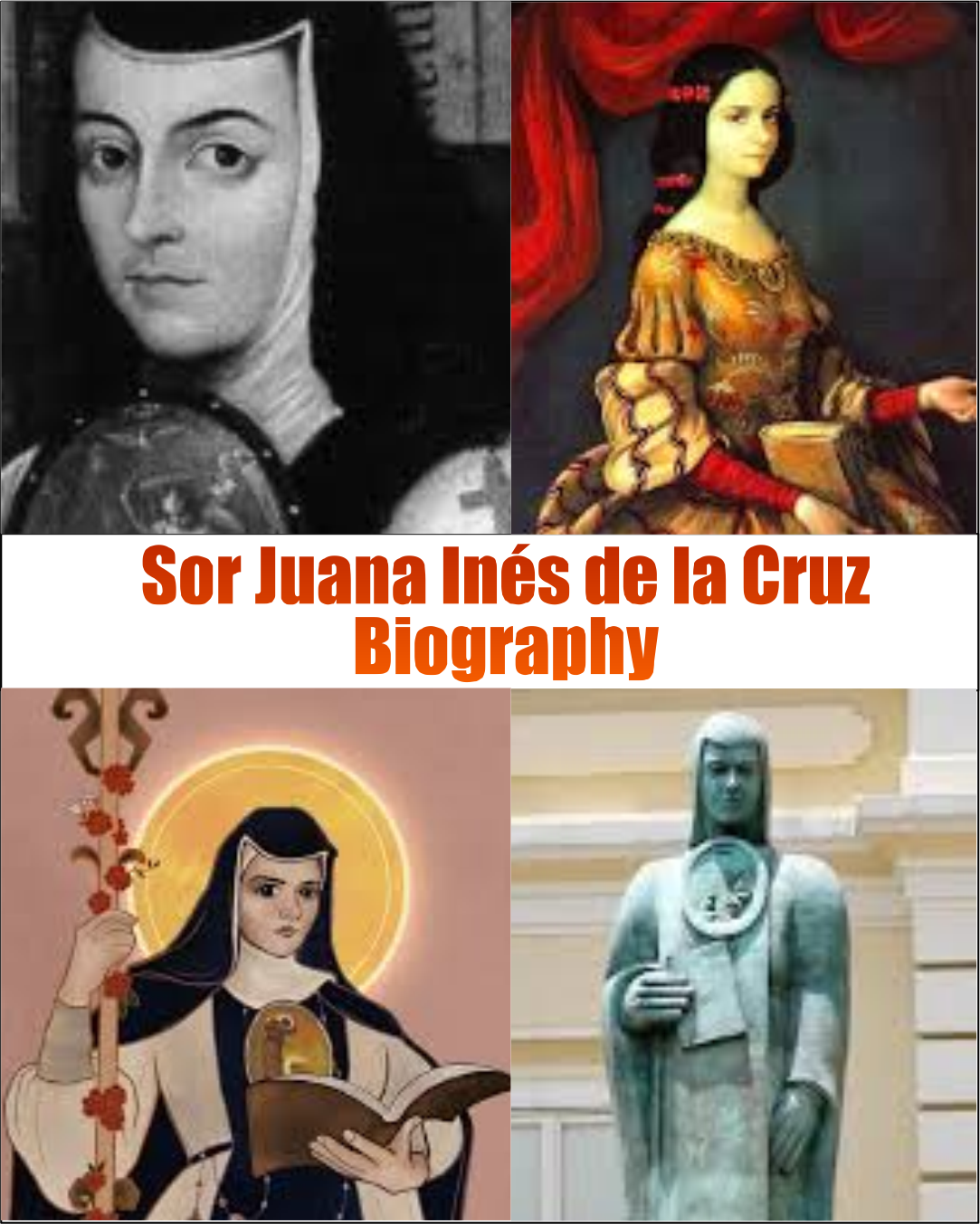
The Sor Juana Inés de la Cruz Biography: The Illegitimate Child Who Wrote the First Feminist Manifesto in the Americas.
Born illegitimate in colonial Mexico in 1651, Sor Juana Inés de la Cruz knew how to read at three, asked her mother to disguise her as a boy so she could attend university, assembled the largest private library in the New World inside a convent cell, and wrote a feminist argument so powerful that the Church took her library, her instruments, and her silence – but not her legacy.
She Asked Her Mother to Cut Her Hair and Disguise Her as a Boy. Her Mother Said No. She Became the First Feminist of the New World Anyway: The Story of Sor Juana Inés de la Cruz
The university was for boys. Everyone in colonial Mexico in the 1650s understood this. It was not a policy that required defence or elaboration. It was simply the order of things – the natural arrangement of a society that had inherited from Spain its conviction that knowledge belonged to men, that women who pursued it were a disruption to be managed, and that the proper ambitions of a girl child involved the altar or the kitchen or, if she were fortunate, a suitable marriage to a man whose education would supply whatever intellectual requirement the household required.
Sor Juana Inés de la Cruz Biography
Of course! Here is the table with the 8 most relevant details, followed by the top 5 FAQs for Sor Juana Inés de la Cruz:
| Category | Details |
|---|---|
| Full Name | Sor Juana Inés de la Cruz |
| Date of Birth | November 12, 1651 |
| Place of Birth | San Miguel Nepantla, New Spain (present-day Mexico) |
| Nationality | Mexican |
| Profession | Poet, Playwright, Philosopher, Nun |
| Field of Work | Literature, Philosophy, Theology, Science |
| Notable Achievement | First published feminist of the Americas and one of the greatest writers of the Spanish Golden Age |
| Legacy | Featured on the Mexican 200 peso banknote; celebrated as a symbol of women’s intellectual freedom across Latin America |
A six-year-old girl in San Miguel Nepantla did not find this convincing.
By the age of six, she had started asking permission to cut her hair short and disguise herself as a boy so she could attend university.
Her mother said no. The university would not admit her in any disguise. The order of things would not accommodate a girl child’s ambition regardless of the length of her hair.
So she went to her grandfather’s library instead. And what she built from the books she found there – in a cloister in Mexico City, over the next forty years, against the sustained opposition of an institution that controlled every aspect of her daily life – became the first feminist manifesto published in the Americas. It is still being read today, three hundred and thirty years later. The university that refused to admit her is now less significant than the woman it refused.
See also: Professor Bolanle Awe Biography – The Woman Who Write Nigeria Into History
Nepantla – Born on the Wrong Side of Everything
Juana Inés de la Cruz was born out of wedlock in San Miguel Nepantla, Tepetlixpa – now called Nepantla de Sor Juana Inés de la Cruz in her honour – near Mexico City, circa November 12, 1651, when Mexico was still a Spanish territory.
The illegitimacy was not a minor biographical detail. In seventeenth-century colonial Mexico, it was a structural condition – a fact that shaped your social position, your legal status, your prospects for marriage, and your relationship with institutions that organised the world according to bloodlines and certificates. Sor Juana grew up in a single household and her father never recognised her as his legitimate daughter, a circumstance that presented a detriment in colonial Mexican society. The nun was acutely aware of this and went on to eloquently address it in one of her poems.
An illegitimate child in a patriarchal colony, raised by a woman who ran a farm alone, whose father refused to acknowledge her existence. Sor Juana Inés de la Cruz arrived in the world with every structural disadvantage colonial society could arrange – and she spent the rest of her life treating those disadvantages as an argument she was going to win.
She began early. A child prodigy, Sor Juana demonstrated a thirst for knowledge from an early age and knew how to read by the age of three. The nun claims to have followed her older sister to a school for young girls called Amigas. She heard about this amazing thing called a university. She begged her mother to send her there so she could study full time. Her mother informed her daughter that the university was for boys, not little girls. Young Juana was not deterred and asked her mother to cut off her hair, disguise her as a boy and send her to this magnificent university already.
The request was refused. The library was not.
Juana had to quench her thirst for knowledge by reading through all of the books in her grandfather’s extensive library. Whatever her grandfather had accumulated – and in colonial Mexico, a private library of any size was a significant collection – she read it. All of it. She was eight years old when she started writing poetry. She was nine when she began learning Latin. She learned Nahuatl, one of the Aztec languages spoken in central Mexico. She taught herself Greek logic. She was, in the most precise sense, building the education that the university had refused to give her, one book at a time, in a room that nobody had formally designated as a classroom.
Did you know?
Sor Juana imposed punishments on herself for failing to learn quickly enough. When she was not able to memorise something after a set number of days, she would cut off the length of hair that she had determined should have been long enough to learn the subject, believing it “unseemly that a head should be adorned with hair while so naked of learning.” Self-imposed haircuts as academic discipline.
The girl who had been told to cut her hair to attend university turned the gesture into a private system of intellectual accountability – punishing herself not for vanity but for failing to meet the standard she had set for her own mind.
The Viceroy’s Court, the Forty Scholars, and the Test Nobody Expected Her to Pass
Her family sent her to stay with her aunt and uncle in Mexico City, where she continued to study Greek logic and Nahuatl. She also began teaching Latin to students.
The move to Mexico City placed her in a different intellectual environment – one with access to more books, more learned people, and eventually the most powerful social institution in colonial New Spain: the viceregal court.
Her work as a lady-in-waiting at the viceregal court brought her brilliance to the attention of Viceroy Marquis de Mancera. Word spread about the teenage prodigy at court. When the viceroy proposed a test of her knowledge and skill, forty scholars from various fields – theologians, philosophers, mathematicians, historians, poets – were assembled to examine her.
Forty scholars. Against a teenage girl from a farm in Nepantla who had no formal education, no university degree, and no institutional standing beyond the social connection her aunt and uncle’s position had provided.
According to the viceroy, she performed like a galleon fighting off the attacks of small canoes. She held her own and more against all comers.
A galleon against small canoes. The image is martial and maritime and entirely appropriate for a girl who had been denied access to every formal institution of knowledge and had built her education by private warfare against ignorance. The forty scholars sent to examine her discovered that she knew what they knew, and in some cases knew it better, and had arrived at that knowledge without a single one of them ever teaching her.
She was sixteen years old.
The Convent as the Only Viable Classroom
At the age of 17, Sor Juana had to make a life choice: to enter the convent or marry. These were the only socially acceptable ways for a woman in 17th-century Mexico to protect her social status, economic security, and respectability.
The courtly life had provided intellectual stimulation but also the specific pressures that came with being a young woman of conspicuous beauty and intelligence in a society that had very particular expectations of both. The courtly lifestyle disillusioned Juana. Within four years, she left to pursue the sisterhood to avoid marriage and to continue her studies.
In 1667, owing to her desire to have no fixed occupation which might curtail her freedom to study, Sor Juana began her life as a nun. She moved in 1669 to the Convent of San Jerónimo in Mexico City, where she remained cloistered for the rest of her life.
She entered the Convent of San Jerónimo at eighteen. Her living quarters brimmed with maps, books, mathematical and scientific instruments, gems, and rare art objects. The cell of a cloistered nun, transformed into the most intellectually equipped private space in colonial Mexico. Her personal library included more than 4,000 books and she was said to have amassed the largest personal library in the New World.
Four thousand books. In a convent cell. In a colony. The girl who had read every book in her grandfather’s library had spent the intervening years ensuring that the library she built around herself would never again run out.
The Phoenix of Mexico – Twenty Years of Writing Everything
What emerged from the Convent of San Jerónimo across the next two decades was a body of work so extraordinary in its range, its ambition, and its technical mastery that scholars three centuries later are still measuring it.
She wrote moral, satiric, and religious lyrics, along with many poems of praise to court figures. Her breadth of range – from the serious to the comical and the scholarly to the popular – is equally unusual for a nun. Sor Juana authored both allegorical religious dramas and entertaining cloak-and-dagger plays. Notable in the popular vein are the villancicos that she composed to be sung in the cathedrals of Mexico City, Puebla, and Oaxaca. Sor Juana was as prolific as she was encyclopedic. The authoritative modern edition of her complete works runs to four lengthy volumes.
The villancicos – carols, sung in cathedrals across multiple Mexican cities – represent one of the most remarkable dimensions of her output. She was not writing for a literary audience of educated elites. She was writing music for the ordinary people who filled the cathedrals, in a form they could receive and carry home. The same mind that wrote philosophical poetry of labyrinthine intellectual complexity also wrote songs for the masses. The range was not a contradiction. It was a statement about who deserved good writing.
Her most significant poem, Primero Sueño – First Dream – published in 1692, is at once personal and universal, recounting the soul’s quest for knowledge. Octavio Paz argues that Sor Juana’s works were the most important body of poetic work produced in the Americas until the arrival of 19th-century figures such as Emily Dickinson and Walt Whitman. Not in Latin America. In the Americas. The entire literary output of a hemisphere, from its colonial origins to the nineteenth century, with Sor Juana at its summit.
And then there was Hombres Necios – Foolish Men.
Her famous poem Hombres necios accuses men of behaving illogically by criticising women. The poem addressed men directly: Thick-headed men who, so unfair, bemoan the faults of women, not seeing as you do that they’re exactly what you’ve made them. Her satires took on the double standard of men who solicit sex outside marriage while insisting on marrying virgins. The satire was not gentle. It was precise, logical, and devastating – the work of someone who had spent years studying rhetoric and had decided to turn its tools against the very people who had claimed the exclusive right to use them.
The Bishop’s Trap, the False Name, and the Reply That Changed History
In November 1690, the Bishop of Puebla, Manuel Fernández de Santa Cruz, did something that he almost certainly did not anticipate would have the consequences it had.
A private letter Sor Juana had written to the bishop of Puebla, in which she criticised the sermon of a Jesuit priest, began to circulate. The bishop had solicited the letter and then distributed it to his peers under the gender-bending pen name Sor Filotea. In the process, the bishop also admonished her for a lack of religious content in her poems.
The trap was elegant in its design. The bishop had invited Sor Juana to write a private theological critique – she obliged, demonstrating once again her ability to engage at the highest level of scholarly debate. Then he published it without her consent, under a female pseudonym that simultaneously exposed her work and admonished her for producing it, suggesting that a woman of the cloth should restrict herself to religious matters and leave theological disputation to the men appointed to conduct it.
He had handed her the argument she had been building her entire intellectual life – and she replied with everything she had.
In March 1691, Sor Juana penned her Respuesta a Sor Filotea de la Cruz – Reply to Sister Filotea of the Cross – a passionate defence of women’s right to knowledge and education. She drew upon the example of learned women of biblical, Classical, and contemporary times to argue that women are entitled to private instruction.
In it, she defended, among other rights, a woman’s right to education. Her impassioned response became the subject of even further criticism. The document is not a polite disagreement. It is a systematic, exhaustive, historically grounded argument that the exclusion of women from education and intellectual life is not divinely sanctioned but humanly constructed – and that the construction is indefensible on its own theological terms. She cites learned women from the Bible. She cites classical scholars. She cites contemporary examples. She builds the case the way a lawyer builds a case, from evidence, and she makes the argument that God, having given women reason, could not logically desire them to remain ignorant.
The most famous line: “One can perfectly well philosophize while cooking supper.”
Silence, the Library Stripped, and the Plague That Took Her
The Church’s response to the Respuesta was to intensify the pressure it had been applying since the bishop’s intervention.
Church officials demanded that she forswear non-religious books and non-religious studies. The Church forced her to abjure objects and rituals that had become vital parts of her identity: her library, her scientific equipment, and her musical instruments.
Four thousand books. The largest private library in the New World. Taken.
The musical instruments she had used to compose the villancicos sung in the cathedrals of three Mexican cities. Taken.
The scientific equipment in the cell that had made it, in the words of every visitor who recorded their impressions, the most intellectually equipped private space in colonial Mexico. Taken.
By 1694, Sor Juana had succumbed in some measure to external or internal pressures. She curtailed her literary pursuits. Her library and collections were sold for alms. She returned to her previous confessor, renewed her religious vows, and signed various penitential documents.
What exactly happened in those final years – what combination of external coercion and internal spiritual reckoning produced the silencing – is one of the most debated questions in Latin American literary history. Octavio Paz, in his landmark 1982 biography, argued for the coercion as primary. Others have read in her final documents a genuine spiritual crisis. What is not debated is the outcome: the most prolific, most important, most intellectually courageous writer in the history of colonial Latin America stopped writing.
A plague swept through the convent in 1695, and on April 17, after taking care of her fellow sisters, she died at the age of 44.
She was forty-four years old. She died nursing the sick. The woman who had spent her life arguing that women deserved the same access to knowledge as men spent her last weeks in the practical, unglamorous, entirely ordinary act of caring for her community through an epidemic – the same act she had always performed alongside the poetry and the philosophy and the arguments the Church had found so threatening.
The 200-Peso Bill and the Question That Took Three Centuries to Reach Everyone
She now stands as a national icon of Mexico and Mexican identity. Her former cloister is a centre for higher education, and her image adorns Mexican currency.
The convent of San Jerónimo – where she was cloistered from 1669 until her death, where the library was stripped from her walls, where she nursed the sick and died of plague – is now the Universidad del Claustro de Sor Juana. A university. Named for her. On the site of the institution that silenced her. The irony is so complete it requires no additional commentary.
Her face is on the 200-peso bill. She is so important in Mexico that her face appears on the national currency. The illegitimate daughter from Nepantla, whose father refused to acknowledge her existence, whose request to attend university was refused because she was born in the wrong body – her face is the face that Mexico puts on its money.
In the early 20th century, because of her outspoken defence of the equality of the sexes in matters of intellect, Dorothy Schons labelled Juana the first feminist of America. The label arrived two centuries late, as labels for women who were ahead of their time always do. But it arrived. And with the rise of feminist scholarship in the late twentieth century, Sor Juana’s work was read again – by scholars who understood, finally, what she had been doing with such precision and such courage from inside a convent cell in colonial Mexico.
What She Was Actually Doing
Sor Juana Inés de la Cruz was not a proto-feminist in the sense of anticipating a movement that would come later. She was a thinker doing what thinkers do – following an argument wherever logic led it, regardless of whether the destination was institutionally comfortable.
The argument she was following was straightforward: if God gave women reason, and reason is the faculty through which human beings understand the divine, then the exclusion of women from the exercise of reason is not a religious act but an anti-religious one. It denies women the very faculty through which the Church claimed to reach God. It is, on its own theological terms, incoherent.
She made this argument from inside the institution whose authority over her was total. She made it in poetry and in plays and in theological correspondence and in the most carefully constructed prose argument that colonial Latin America had yet produced. She made it knowing the consequences – the library stripped, the instruments taken, the silence enforced.
She made it anyway.
Nearly three and a quarter centuries after her death, her work sounds remarkably contemporary.
She philosophised while cooking supper. She has not stopped since.
Frequently Asked Questions
1. Who is Sor Juana Inés de la Cruz?
Sor Juana Inés de la Cruz was a 17th century Mexican poet, playwright, philosopher, and Roman Catholic nun who is widely regarded as one of the most important literary figures in the history of the Spanish-speaking world. Born in 1651 in what is now Mexico, she displayed exceptional intellectual ability from early childhood and went on to produce a body of work that challenged the intellectual and social boundaries placed on women in colonial Latin America.
2. Why is Sor Juana Inés de la Cruz important?
She is significant for multiple reasons that extend well beyond her literary output. At a time when women were denied access to formal education and expected to remain entirely within domestic or religious roles, Sor Juana pursued philosophy, science, theology, and poetry with a depth and ambition that rivalled and often surpassed the male scholars of her era.
3. Why did Sor Juana Inés de la Cruz become a nun?
Her decision to enter a convent was less about religious calling in the conventional sense and more about intellectual survival. In 17th century colonial Mexico, the options available to an exceptionally intelligent woman were severely limited. Marriage would have consumed her time and energy in domestic responsibilities with no space for intellectual life.
4. What did Sor Juana write and what is she most famous for?
Sor Juana produced an extraordinary range of work across multiple genres. Her poetry — including the famous collection Inundación Castálida — is celebrated for its philosophical depth, emotional intelligence, and technical mastery. Her plays, including religious dramas and secular comedies, demonstrate a sophisticated understanding of human psychology and social dynamics.
5. How did Sor Juana Inés de la Cruz die and what is her lasting legacy?
Sor Juana died on April 17, 1695, at approximately 43 years of age, during an epidemic that swept through her convent in Mexico City. In the final years of her life she faced significant pressure from church authorities who disapproved of her intellectual activities, and she largely ceased writing before her death. Despite this difficult ending, her legacy has only grown with time.