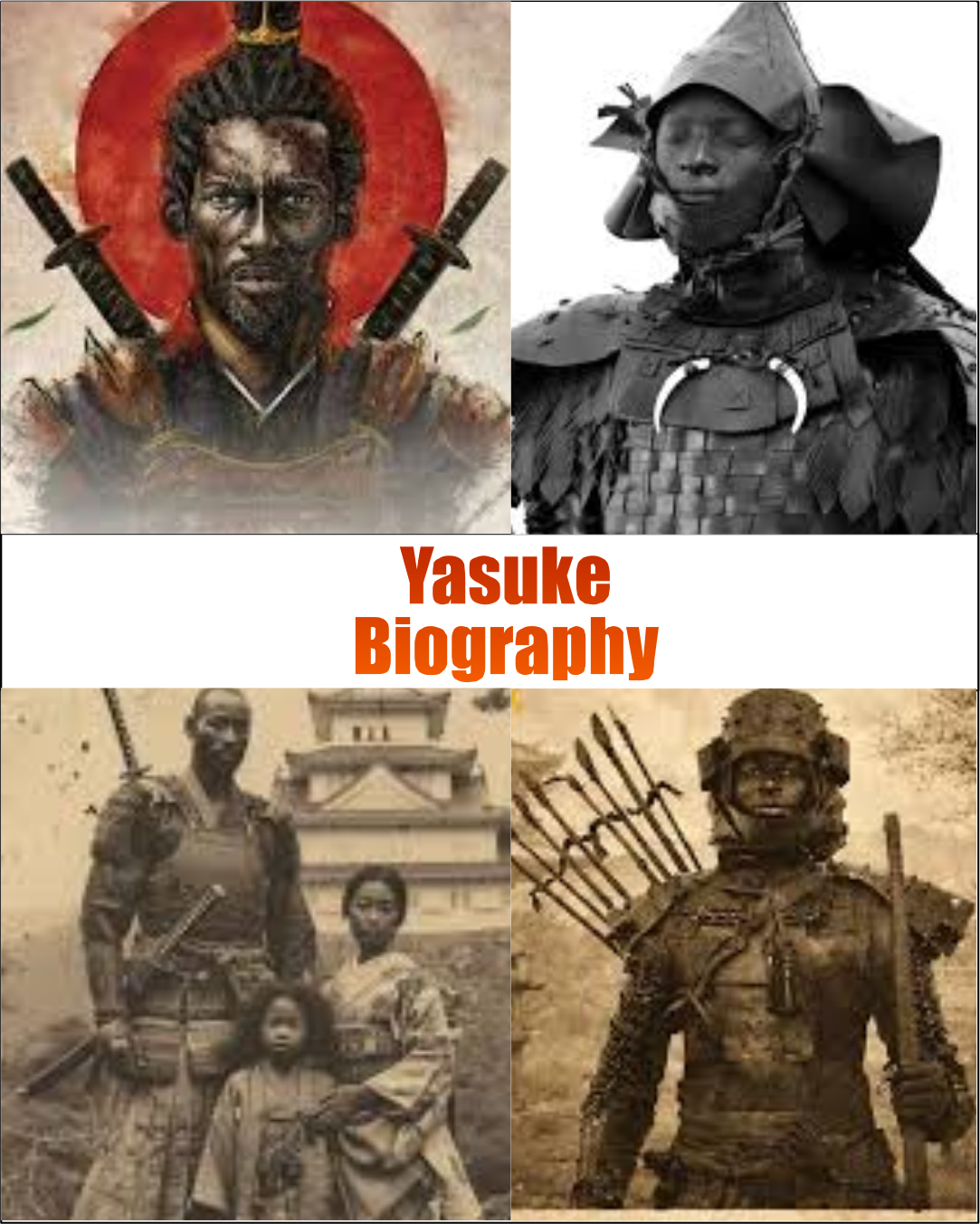
The Yasuke Biography: The African Man Who Walked Into Japan.
In 1579, an African man arrived in Japan with a Jesuit missionary. The crowd was so large to see him in Sakai that buildings were damaged. Oda Nobunaga scrubbed his skin trying to find the paint. Then he gave him a house, a sword, a stipend, and a name – and made him the first known African to hold warrior rank in Japan. What happened to him after 1582 is one of history’s most compelling unanswered questions.
The Man Whose Skin Nobunaga Tried to Scrub Clean – and Then Made His Samurai
The crowd in Sakai was so large that buildings were damaged.
Not a metaphor. Buildings – actual structures – were damaged by the press of people trying to catch a glimpse of a man they had never seen anything like before. A man whose height, whose physical presence, whose skin colour existed entirely outside the visual vocabulary of sixteenth-century Japan. People pushed against each other. They pushed against the buildings. The buildings gave way before the crowd did.
The man at the centre of all of this was an African in the retinue of an Italian Jesuit missionary, somewhere in his mid-twenties, navigating a country he had arrived in two years earlier with no Japanese, no context for what he was walking into, and no way of knowing that a few miles away, in a temple in Kyoto, the most powerful warlord in Japan was about to hear about the commotion and summon him for an audience.
His name – the name he was given in Japan, because the name he was born with has never been recovered from the historical record – was Yasuke. He served Oda Nobunaga from 1581 until Nobunaga’s death in 1582. He was given a house, a sword, a stipend, and the status of a warrior in the most militarised society in the world at that time. He fought in two battles on the day his lord was assassinated. He was captured, spared, and returned to the Jesuits.
And then the historical record goes silent. What happened to him after June 21, 1582 – where he went, how long he lived, whether he ever left Japan – is one of the most compelling unanswered questions in the history of the early modern world.
Yasuke Biography
| Category | Details |
|---|---|
| Full Name | Yasuke |
| Date of Birth | Approximately 1555 |
| Place of Birth | Possibly Mozambique or South Sudan, Africa |
| Nationality | African — exact origin debated by historians |
| Profession | Samurai, Retainer, Warrior |
| Field of Work | Military Service, Feudal Japanese Court |
| Notable Achievement | First known African samurai in Japanese history; served under the powerful warlord Oda Nobunaga |
| Legacy | Celebrated globally as a symbol of extraordinary cross-cultural history and recognised in books, films, and popular culture |
Before Japan – The Journey Nobody Fully Knows
The earliest record of Yasuke dates to 1581. He received his name from Oda Nobunaga. His birth name is unknown.
That sentence – his birth name is unknown – is the foundation on which everything about Yasuke’s story is built. He existed before Japan. He had a life before Alessandro Valignano found him, before the Jesuit mission took him aboard, before the ship arrived at the coast of Kyushu and he stepped onto Japanese soil for the first time. He had a childhood, a language, a community, a name. None of it survived the historical record in any form that modern scholarship can access.
Based on Shinchō Kōki, Yasuke was estimated to be in his mid-twenties in 1581. Accounts from his time suggest Yasuke accompanied Alessandro Valignano from “the Indies,” a term encompassing Portuguese overseas territories like Goa and Cochin as well as Portuguese Mozambique.
The debate about his origins – Mozambique, South Sudan, the Yao people, the Dinka – is not simply an academic puzzle. It is the last trace of the person he was before Japan defined who he became. A man born somewhere in eastern Africa, in the mid-1550s, into a world the historical record has not preserved for him, who arrived in Japan at roughly twenty-six years old carrying everything those years had given him and nothing the written record could name.
Thomas Lockley, co-author of African Samurai: The True Story of Yasuke, says it’s possible Yasuke was enslaved and trafficked as a child but believes he was a free man by the time he met Alessandro Valignano. He was employed as muscle because missionaries were not allowed to carry weapons. Japan at the time was in the middle of a brutal century of civil war, and therefore Valignano needed somebody to look after him.
See also: Professor Bolanle Awe Biography – The Woman Who Write Nigeria Into History
The Sengoku Period – Understanding the World He Walked Into
In 1581, Yasuke captured the interest of Oda Nobunaga, a powerful warlord striving to unify Japan as it emerged from the chaos of the Sengoku period. This era, also known as the Age of Warring States, was among the most turbulent in Japanese history, with constant military conflict as warlords battled for control over fractured territories.
The Sengoku period had been running for over a century by the time Yasuke arrived. The civil war began in 1467 with the collapse of the Ashikaga shogunate, which left rival feudal lords vying for control of Japan. A hundred years of war had produced a society in which military skill was the primary currency of power, in which loyalty and betrayal were the central political activities, and in which the capacity for violence was simultaneously a social obligation and a practical survival skill for anyone in or adjacent to the ruling class.
This was the man who heard about the commotion in Sakai and summoned the African.
The Audience, the Scrubbing, and the Name
Nobunaga learned of Yasuke around March 23, 1581, after he had generated significant interest in locals who had never seen someone his size or skin tone. In the book African Samurai, author Thomas Lockley stated that Nobunaga must have believed Yasuke was a guardian demon or a god of prosperity. In Japan, temples represented gods of prosperity with black statues.
Upon their meeting, Nobunaga famously scrutinised Yasuke’s skin, initially believing it to be painted black. Convinced this was the case, Nobunaga ordered him to bathe.
This detail has been repeated in every account of Yasuke’s story, and it deserves to be understood in its full complexity rather than simply as an illustration of Nobunaga’s ignorance. Nobunaga was not a stupid man. He was one of the most strategically sophisticated political and military thinkers of his era. But he had never seen a Black African in person. The visual knowledge available to him – the statues of Buddhist temple guardians, the depictions in Japanese art of frightening supernatural figures – had prepared him for the idea that a very dark-skinned human being might be something other than human, might be painted, might require explanation.
The scrubbing produced no paint. It produced a man with skin that was exactly what it appeared to be. Yasuke responded directly: “I was born with black skin.”
Did you know?
Yasuke’s striking presence, towering at over six feet, would have made him an impressive companion in a country where the average height was considerably lower. He was renowned for his strength. The Chronicle of Lord Nobunaga, a seventeenth-century Japanese text, described his power as formidable, surmising that it surpassed that of ten men.
The physical impression he made on sixteenth-century Japan – a man of exceptional height and build, in a country that had never seen a Black African – is one of the few things about him that the historical record has preserved with specificity.
The Samurai Question – What the Historical Record Actually Says
The most debated aspect of Yasuke’s story is also the most practically significant: was he actually a samurai?
Several academic historians in Japan have weighed in on this topic, many of whom have suggested that it is not unreasonable to call Yasuke a samurai, even by the loose definition of the time. Hirayama Yū notes that one copy of the near-contemporary primary source Chronicle of Lord Nobunaga refers to Yasuke being granted a sword and a stipend by Nobunaga. This suggests that Yasuke was in Nobunaga’s direct service and was treated better than a servant or low-ranking foot-soldier would have been.
During this period, the definition of samurai was ambiguous, but historians think that this would contemporaneously have been seen as the bestowing of warrior rank. This is where the claim that Yasuke was a samurai originates.
Mexia even reported rumours that Yasuke would be made tonō, or lord, which has been interpreted as meaning that he might have been in line for the bestowal of a fief.
The Celebrity and the Campaigns – Living Inside Nobunaga’s Circle
While serving Oda Nobunaga, Yasuke met some of the most influential men of the Sengoku period. He knew Tokugawa Ieyasu, who became the Tokugawa shogunate founder. He may have met Toyotomi Hideyoshi, who was another great unifier of Japan.
In the spring of 1582, he went to war. From April to May 1582, the Oda clan launched an expedition against Takeda Katsuyori in the Kōshū region. The Oda army was led by Nobunaga’s eldest son, Nobutada, and upon victory Nobunaga – with Yasuke at his side – toured the new territory under his control.
He stood on the territory that Nobunaga had just unified, in the company of the man who was unifying it, as a participant in the campaign rather than an observer of it. Whatever the precise designation of his status, what he was experiencing was the inner workings of one of the most consequential military and political campaigns in Japanese history – from the inside.
June 21, 1582 – The Morning Everything Ended
In 1582, one of Nobunaga’s vassals, Akechi Mitsuhide, launched a rebellion and surrounded Nobunaga at a temple in Kyoto.
The Honnōji Incident – the assassination of Oda Nobunaga by his own general – is one of the most dramatic moments in Japanese history. Nobunaga was at the temple with a small retinue, not expecting attack, when Mitsuhide surrounded it with 13,000 men. What followed was not a battle in any meaningful sense – it was an overwhelming force against a few dozen defenders.
Yasuke fought fiercely at his side, but the vastly larger enemy force soon overpowered them. Facing capture, Nobunaga enacted seppuku, a ritualised form of suicide.
Then Yasuke made a decision that reveals more about his character and his loyalty than any other documented moment in his story.
The Silence After 1582 – What the Mystery Actually Means
Some historians suggest he may have stayed in Japan, with records hinting at the presence of a tall African man in Japan during the 1590s. But whether this man was Yasuke remains a mystery.
The absence of records after 1582 is itself significant. In a society with meticulous chronicle traditions, the silence around Yasuke suggests several possibilities – that he left Japan entirely, returning to Goa or Mozambique or somewhere else in the Portuguese colonial network; that he remained in Japan in a private capacity that did not attract chronicle attention; or that he died sometime in the 1580s, unremarked in the records that have survived.
What the Pop Culture Got Right and Got Wrong
The Netflix anime series. The Chadwick Boseman film that was announced and cancelled after his death. The video game Nioh. The children’s books. The 2019 Thomas Lockley biography. Yasuke has attracted more creative attention in the twenty-first century than in the four centuries between his disappearance from the historical record and the present.
There is an important distinction between the historical Yasuke and the popular culture Yasuke. The historical figure is documented in fragmentary Jesuit letters and Japanese chronicles, fought for Nobunaga for approximately a year, and disappeared from the record after 1582. The popular culture figure has been expanded, embellished, and in some cases significantly fictionalised – most obviously in the Netflix anime, which uses the historical Yasuke as the launching point for a story involving giant robots and magical armies.
The popular culture interest is not itself a problem. Yasuke’s story is genuinely extraordinary. The specific contours of what actually happened – a man of African origin navigating one of the most militarised societies in history, earning the trust and genuine affection of its most powerful warlord, fighting two battles on the morning of his lord’s assassination – are dramatic enough to sustain any number of creative adaptations.
The Folding Screen in Osaka
There is a folding screen in the Sakai City Museum in Osaka. It was painted in the early seventeenth century, probably by an unknown artist, probably within a few decades of the events it depicts. It shows a Black man wrestling a Japanese man, surrounded by spectators. One of the spectators appears to be Oda Nobunaga, watching the match.
Artworks such as these show that Yasuke’s memory lived on in the Japanese popular consciousness for decades after the events for which he is remembered occurred.
He was remembered. Not in an official chronicle, not in a formal monument, not in a historical tradition that passed his name from generation to generation in the way that great warriors’ names were passed. He was remembered in a painting of a wrestling match, preserved on a folding screen, by an artist who had probably heard the story from someone who had heard it from someone who had been there.
Frequently Asked Questions
1. Who is Yasuke?
Yasuke was a 16th century African man who became the first known non-Japanese samurai in history. Arriving in Japan in 1579 as an attendant to the Italian Jesuit missionary Alessandro Valignano, he quickly attracted the attention of Oda Nobunaga — one of the most powerful and ambitious warlords in Japanese history who was in the process of unifying Japan under his rule.
2. How did Yasuke end up in Japan?
Yasuke arrived in Japan in 1579 as part of the entourage of Alessandro Valignano, an Italian Jesuit priest who was overseeing the Catholic missionary effort in Japan. Yasuke is believed to have come from East Africa — with historians debating whether his origins were in present-day Mozambique, South Sudan, or another part of the continent.
3. What was Yasuke’s relationship with Oda Nobunaga?
The relationship between Yasuke and Nobunaga appears to have been one of genuine mutual respect and personal connection that went well beyond the typical lord and retainer dynamic. Historical records suggest that Nobunaga initially suspected that Yasuke’s dark skin was ink and ordered it to be scrubbed — a moment that speaks to how completely outside Japanese experience Yasuke’s appearance was. Satisfied that the colour was natural, Nobunaga became deeply interested in the man himself.
4. What happened to Yasuke after Nobunaga’s death?
In June 1582, Nobunaga was betrayed and attacked by his own general Akechi Mitsuhide in an event known as the Honno-ji Incident. In a decision that reveals much about how Yasuke was perceived, Mitsuhide reportedly declined to execute him — stating that Yasuke was not Japanese and therefore could not be held to the same standards of loyalty and accountability as a Japanese samurai. He was handed over to the Jesuit missionaries.
5. What is Yasuke’s lasting legacy?
Yasuke’s legacy has grown considerably in recent decades as historians and popular culture have rediscovered his extraordinary story. He has been the subject of books, manga, documentary films, and most prominently the Netflix animated series Yasuke released in 2021, which brought his story to a global audience.