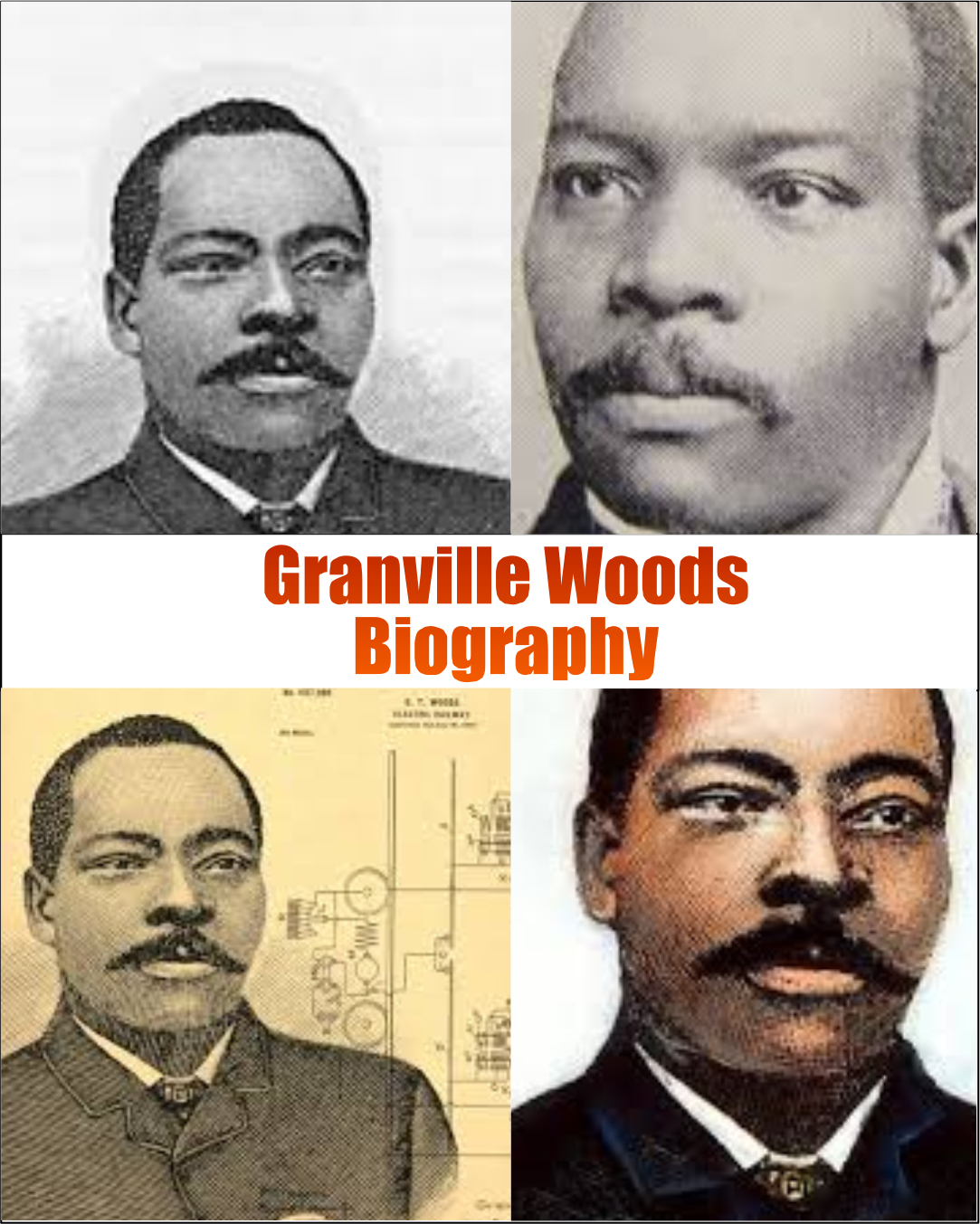
The Granville Woods Biography: The Man Who Beat Thomas Edison in Court Twice,
Granville Woods left school at ten, taught himself electrical engineering from library books his friends checked out because Black people were excluded, invented the system that made railway communication possible, defeated Thomas Edison’s patent lawsuit twice, turned down Edison’s job offer, and died penniless in Harlem with no headstone. His inventions run under every subway system in the world.
He Beat Thomas Edison in Court Twice. He Died in an Unmarked Grave. His Inventions Are Under Every Subway in the World: The Story of Granville Woods
The patent examiner at the United States Patent Office had seen a lot of applications cross his desk. In the 1880s, the age of invention was producing claims at a rate that the office struggled to process — telegraph improvements, electrical mechanisms, railway safety devices, the entire infrastructure of a modernising industrial economy being filed for protection one patent at a time.
The man who had filed the application was a self-taught Black electrician from Columbus, Ohio, who had left school at ten years old, had taught himself electrical engineering from library books that friends checked out on his behalf because Black people were excluded from many public libraries, and who had spent twenty years working in machine shops and steel mills and aboard a British steamship, accumulating the practical knowledge that no institution had been willing to formally teach him.
His name was Granville Tailer Woods. And Thomas Edison was about to argue, in a court of law, that the patent should belong to him instead.
He was wrong. The court said so. Twice.
Granville Woods Biography
| Category | Details |
|---|---|
| Full Name | Granville Tailer Woods |
| Date of Birth | April 23, 1856 |
| Place of Birth | Columbus, Ohio, USA |
| Nationality | American |
| Profession | Inventor, Electrical Engineer, Entrepreneur |
| Field of Work | Electrical Engineering, Telecommunications, Railway Technology |
| Notable Achievement | Invented the Multiplex Railway Telegraph and over 60 patented devices that revolutionised railway safety and electrical systems |
| Legacy | Known as the Black Edison — celebrated as one of the most prolific and significant inventors in American history |
Columbus, a Machine Shop, and the Education That Nobody Gave Him
Granville Tailer Woods was born on April 23, 1856, in Columbus, Ohio, to Martha J. Brown and Cyrus Woods. His mother was part Native American, and his father was African American.
Granville attended school in Columbus, Ohio, until age 10 but had to leave due to his family’s poverty, which meant he needed to work.
Left school at ten. In the Columbus of 1866, for a Black child from a poor family, that was not an unusual trajectory. The formal education system had not been designed with his presence in mind — not in terms of its racial policies, not in terms of its economic prerequisites, and not in terms of what it was preparing its students to do with their lives. What Granville Woods did next was not what the system expected of him. It was, in retrospect, something the system had made necessary by leaving him no other option.
He went to work in a machine shop. He became an apprentice machinist and blacksmith. He learned how things were made, how metal was shaped, how mechanical systems worked — not from textbooks but from the objects themselves, from the experienced hands of the men working around him, from the specific physical intelligence that comes from spending your days making things and fixing things and understanding, at the level of your hands and your eyes, exactly why they work.
At the age of 20, he enrolled in a technical college and trained for two years in electrical and mechanical engineering. The formal education that the system had denied him at ten, he provided for himself at twenty — supplementing what the machine shops and the library books had already given him with the structured technical training that would allow him to patent what he invented.
The Steamship, the Railroad, and a Man Building Toward Something
The years between leaving school and filing his first patent were not wasted years. They were, in retrospect, the most important years of his education.
In 1872, Granville T. Woods obtained a job as a fireman on the Danville and Southern Railroad in Missouri, eventually becoming an engineer. In 1878, he took a job aboard the steamer Ironsides and became chief engineer within two years.
Chief engineer of a British steamship. A Black man from Ohio, in 1880, in command of the mechanical systems of an ocean-going vessel. The job required exactly the combination of theoretical knowledge and practical experience that he had been building since he was ten years old in a Columbus machine shop. He understood how steam systems worked. He understood how mechanical power was generated and distributed. He understood, at the deepest level of practical knowledge, what the problems were and what solving them required.
Then he settled in Cincinnati. And everything accelerated.
In 1880, he returned to Ohio, settling in Cincinnati, and focused on developing inventions. After obtaining his first patent for a steam boiler furnace, in 1885 Woods began to work on his most notable invention, which he called telegraphony. Telegraphony — a combination of the telegraph and the telephone, allowing users to switch between Morse code and voice transmission on the same line. It was a genuinely novel idea, and it was purchased immediately by one of the most powerful communications companies in the world.
Did you know?
In 1887, the American Catholic Tribune declared that Woods was the greatest electrician in the world. Not the greatest Black electrician. The greatest electrician.
In a year when Thomas Edison was at the height of his fame, when George Westinghouse was building his alternating current empire, when Frank Sprague was pioneering electric railways — a Catholic newspaper looked at the field and named a self-taught Black man from Columbus the best in it.
The Multiplex Telegraph — The Invention That Changed Everything and Started the War
In 1887, Granville Woods invented the device that would define his legacy and trigger the most significant legal battle of his career.
Based on telegraphony, Woods invented the induction telegraph in 1887. Prior to its creation, moving trains were unable to communicate with each other or with rail stations, resulting in dangerous situations. The induction telegraph used static electricity from the existing telegraph lines running parallel to the train tracks, making messaging possible between moving trains and rail stations.
The safety implications were immediate and enormous. In the 1880s, American railways were among the most dangerous workplaces on earth. Trains operated on single tracks. Dispatchers had no reliable way of knowing where a moving train was. Head-on collisions occurred regularly — not through negligence but through the fundamental impossibility of communicating between a moving train and a fixed station. People died in these collisions. Many people. Regularly.
This device not only helped dispatchers locate trains, but also allowed moving trains to communicate to or from any direction via telegraph. Train operators and dispatchers could send Morse code, or with the addition of a telephone receiver, even have real-time conversations, and could show the location of a moving train on a dispatcher’s display board.
The Lawsuits — Two Defeats for the Most Famous Inventor in America
Thomas Edison attempted to take credit for the Synchronous Multiplex Railway Telegraph. Woods was determined to protect his invention, and though Edison twice took him to court, he won his case both times.
The sequence matters. Edison filed. Not Woods. The man with every institutional advantage — the famous inventor, the well-funded businessman, the man whose laboratory in Menlo Park had produced the phonograph and the incandescent light bulb, the man whose name was synonymous with American invention — took a self-taught Black inventor to court twice, claiming that the device the Black inventor had created was actually his.
Woods was twice successful in defending himself, proving that there were no other devices upon which he could have depended or relied upon to make his device.
After Edison’s second defeat, the Black press began calling Granville Woods the Black Edison. Thereafter, Woods was often known as Black Edison.
The Third Rail, the Air Brake, and the Roller Coaster That Runs Under New York
The multiplex telegraph was the most famous of his inventions. It was not the last consequential one.
Woods’s next most important invention was the power pick-up device in 1901, which is the basis of the so-called third rail currently used by electric-powered transit systems.
The third rail. The electrified rail that runs parallel to the two carrying rails on subway tracks worldwide — the one passengers are warned never to touch, the one that supplies continuous power to the trains running above it. The system that makes every underground electric railway in the world possible. It runs under the New York City subway. It runs under the London Underground. It runs under virtually every urban electric transit system on the planet.
Granville Woods designed the foundational technology for this system in 1901.
See also: Mary Seacole Biography – The Crying Woman of London Street
The Sales, the Struggle, and the Specific Cruelty of Being Paid Less Than Your Work Was Worth
Through all of this — the patents, the court victories, the sales to major corporations — Granville Woods never achieved the financial security his work warranted.
Some of the people who bought his inventions didn’t pay him fairly, simply because of the color of his skin.
This sentence contains a world of economic violence in seven words. The inventions were real. The patents were legally established. The court had twice confirmed his ownership. And the buyers — Westinghouse, General Electric, American Engineering, the companies that built their systems on his patents — paid him less than they would have paid a white inventor for equivalent work, because in post-Reconstruction America the marketplace was no more racially neutral than the library system or the school system or the patent system that Edison had tried to use against him.
January 30, 1910 — Harlem Hospital, an Unmarked Grave, and a Headstone That Took 65 Years
Woods died penniless, of a cerebral hemorrhage at Harlem Hospital in New York City on January 30, 1910, having sold a number of his devices to such companies as Westinghouse, General Electric, and American Engineering.
He was fifty-three years old. He had held over sixty patents. He had beaten Thomas Edison in court twice. He had sold inventions to the most powerful electrical companies in America. He had given railways the ability to communicate in motion, given urban transit systems the third rail, given the phonograph improvements that Alexander Graham Bell’s company had purchased, given American cities the overhead electric infrastructure for their elevated railways.
He died penniless.
The headstone is there now. It marks the grave of a man whose inventions run under every electric subway in the world, whose electromagnetic induction principles are ancestors of the wireless communication infrastructure of the digital age, who beat the most famous inventor in America in court twice and refused his job offer and died in Harlem with nothing left.
What the Libraries Kept From Him and What He Made Anyway
Granville Woods did not have a formal education past the age of ten. The libraries that contained the books he needed were closed to him because of his race. The companies that bought his inventions paid him less than they were worth because of his race. The courts that twice found in his favour could not prevent the economic extraction that followed those victories.
And yet. Sixty patents. The multiplex railway telegraph. The third rail. The overhead electric railway lines. The telegraphony device that Alexander Graham Bell’s company purchased. The air brake improvements. The electrical roller coaster system. The forerunner of wireless networking.
All of it built from library books that friends had to check out on his behalf, from machine shop apprenticeships, from two years at a technical college, from the specific, methodical intelligence of a man who had decided that the barriers in his way were problems to be solved rather than boundaries to be respected.
Black newspapers frequently expressed their pride in his achievements, saying he was the greatest of Negro inventors, and referring to him as professor despite his lack of such a college education.
Frequently Asked Questions
1. Who is Granville Woods?
Granville Woods was a self-taught African American inventor and electrical engineer who became one of the most prolific and consequential inventors of the 19th century. Born in Columbus, Ohio in 1856, he received very little formal education but possessed a natural mechanical genius and an insatiable curiosity about how things worked that drove him to educate himself through reading, practical experimentation, and hands-on work in machine shops and on railways.
2. What were Granville Woods’ most important inventions?
Woods’ most celebrated invention was the Multiplex Railway Telegraph, patented in 1887. This device allowed moving trains to communicate with railway stations and with each other using telegraph signals — a breakthrough that dramatically improved the safety of railway operations at a time when collisions between trains were a serious and frequently deadly problem. Before this invention, railway operators had no reliable way of knowing where trains were relative to each other on shared tracks.
3. Why was Granville Woods called the Black Edison?
The nickname the Black Edison was applied to Granville Woods during his lifetime in recognition of the sheer volume and significance of his inventions — a productivity and impact that invited direct comparison with Thomas Edison, the most celebrated inventor of the era.
4. What challenges did Granville Woods face as a Black inventor in the 19th century?
The obstacles Woods faced were formidable and relentless. Racial segregation and discrimination permeated every aspect of American professional life in the post-Civil War era, and the worlds of engineering and invention were no exception.
5. What is Granville Woods’ lasting legacy?
Granville Woods died on January 30, 1910, in New York City, in relative poverty — a painful irony given that his inventions had generated enormous wealth for the corporations that purchased his patents. His legacy however has grown considerably in the decades since his death as historians and educators have worked to recover and celebrate his contributions.