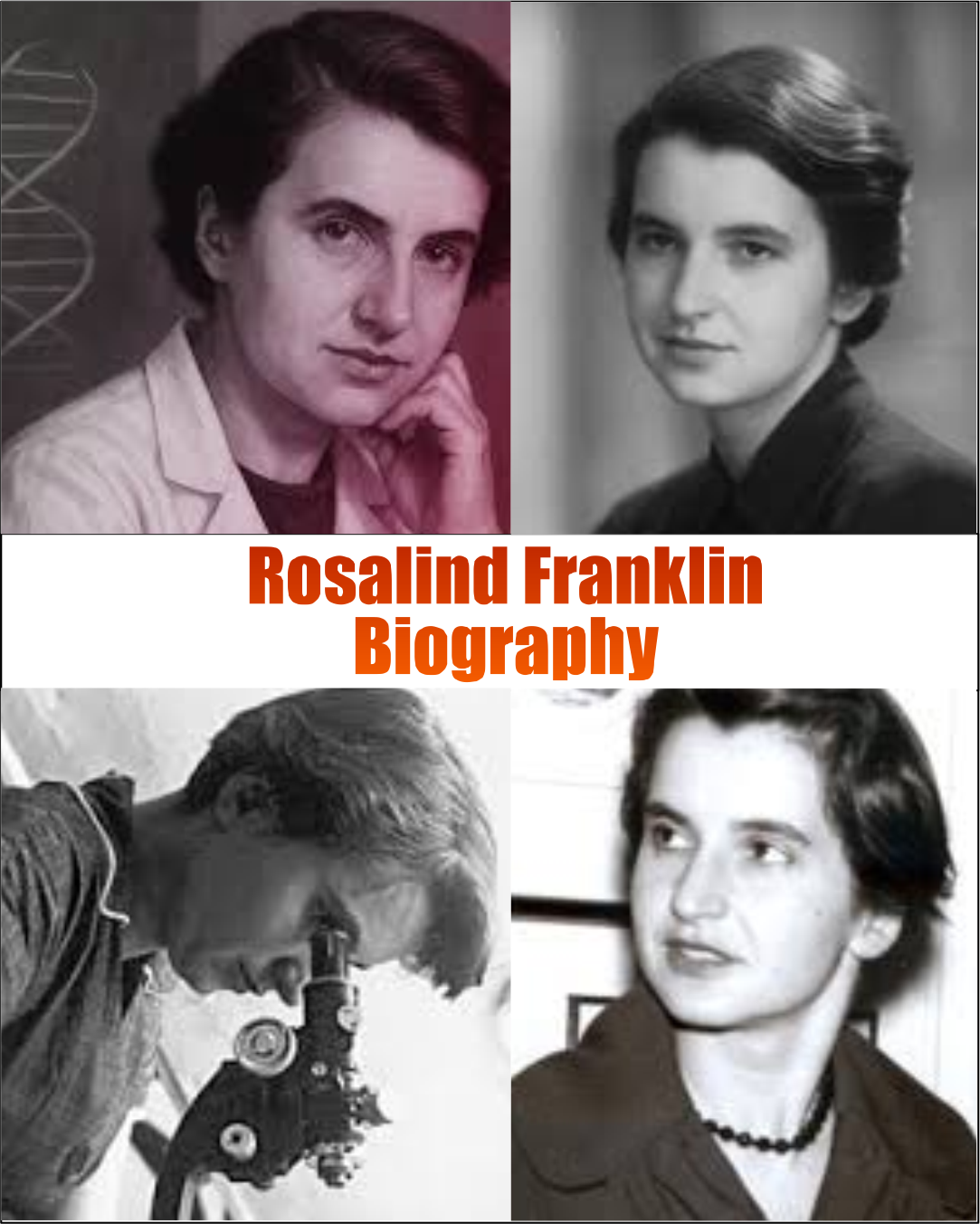
The Rosalind Franklin Biography: An Equal Who Never Got Deserved Equal Credit.
Rosalind Franklin took Photo 51 — the most important scientific photograph ever taken. She identified DNA’s two forms. She was the first to establish the phosphate backbone was on the outside. History called her a tragic victim. Recent scholarship says she was an equal co-discoverer. The Nobel Committee never asked because she died at 37 of ovarian cancer — four years before the prize was awarded.
She Was Not the Victim History Made Her. She Was the Equal It Refused to Acknowledge: The Story of Rosalind Franklin
For decades, the story of Rosalind Franklin was told as a tragedy.
A brilliant scientist, the story went, whose work was stolen by two men who then won the Nobel Prize for it. A woman who was shown in Watson’s memoir as a difficult, humourless obstacle to be got around. A dark lady in the shadows of the greatest scientific discovery of the twentieth century.
The tragedy is real. But recent scholarship has complicated the story in ways that make it simultaneously more honest and more powerful than the simple narrative of theft and victimhood allowed.
Historians Nathaniel Comfort and Matthew Cobb, after going through Franklin’s personal papers, letters and unpublished documents, argued in a 2023 commentary in Nature that Franklin should be recognised not as a martyr but as an equal contributor to solving the double helix structure of DNA.
Rosalind Franklin Biography
| Category | Details |
|---|---|
| Full Name | Rosalind Elsie Franklin |
| Date of Birth | July 25, 1920 |
| Place of Birth | Notting Hill, London, England |
| Nationality | British |
| Profession | Chemist, X-ray Crystallographer, Research Scientist |
| Field of Work | Chemistry, Molecular Biology, X-ray Crystallography |
| Notable Achievement | Produced Photo 51 — the X-ray image that provided the crucial evidence for the double helix structure of DNA |
| Legacy | Celebrated as one of the greatest scientists of the 20th century whose groundbreaking work was used without her knowledge or credit |
Notting Hill, a Jewish Family That Believed in Education, and the Girl Who Wanted to Be a Scientist
Franklin was born on 25 July 1920 at 50 Chepstow Villas, Notting Hill, London, into an affluent and influential British Jewish family.
The family she was born into was not simply wealthy. It was specifically committed — to education, to public service, to the idea that intelligence was an obligation to be exercised rather than a comfort to be enjoyed. Franklin was born on July 25, 1920, in London, to a wealthy Jewish family who valued education and public service.
Her father, Ellis Franklin, was a banker who also taught science and history at a working men’s college. Her mother came from a family of academics. The household produced five children, all of whom were educated seriously. What distinguished Rosalind was not simply that she was educated — her sisters were educated too — but that she decided at fifteen that she was going to be a scientist, and that neither her family’s initial scepticism about the suitability of such a career for a woman nor the broader cultural machinery of 1930s Britain that agreed with them was going to stop her.
At age 18, she enrolled in Newnham Women’s College at Cambridge University, where she studied physics and chemistry.
See also: Professor Bolanle Awe Biography – The Woman Who Write Nigeria Into History
Paris, Crystallography, and the Woman Who Fell in Love With X-rays
After completing her PhD, Franklin spent four years in Paris at the Laboratoire Central des Services Chimiques de l’État — years she later described as the happiest of her professional life.
In Paris she learned X-ray crystallography from Jacques Mering — one of the finest crystallographers in Europe — and she found in the technique something that suited her particular scientific temperament perfectly. X-ray crystallography involves directing a beam of X-rays at a crystalline substance and recording the diffraction patterns produced as the rays interact with the electrons in the atoms of the substance. The positions and intensities of these diffracted X-rays are then recorded on film for analysis.
The technique required patience. It required precision.
She became exceptional at it. Not good. Exceptional. Never had X-ray crystallography been put to such deft or momentous use as when Franklin brought it to bear on DNA.
Did you know?
Franklin was the first to discover and articulate the crucial distinction between the two forms of DNA — A and B — and to establish that the phosphate groups were located on the outside of the DNA molecule. These were the foundational facts on which the double helix model was constructed.
Watson and Crick are credited with building the model. The facts that made the model possible were first established by Rosalind Franklin, in a lecture she gave in November 1951 that Watson attended — and did not fully understand.
King’s College, a Misunderstanding, and the Working Arrangement Nobody Explained
The situation at King’s College when Franklin arrived was, from the beginning, a structural disaster.
John T. Randall, who oversaw the laboratory, was relatively open-minded when it came to women in science. In 1951, he offered a position to Rosalind Franklin, a physical chemist with expertise in the X-ray analysis of coal.
The problem was Maurice Wilkins, who was already working on DNA at King’s when Franklin arrived. A misunderstanding resulted in immediate friction between Wilkins and Franklin. The two were to work together on finding the structure of DNA, but their conflicts led to them working in relative isolation.
The misunderstanding was fundamental. Wilkins believed Franklin had been hired as his assistant. Franklin had been told she was an independent researcher with her own project. Both beliefs were simultaneously held, never clarified by Randall, and the resulting tension between two people who had been placed in an impossible working arrangement through institutional carelessness shaped the entire subsequent history of the DNA discovery.
May 1952 — A Hundred Hours and the Most Important Photograph in Scientific History
In May 1952, aided by her student Raymond Gosling and a special camera, Franklin suspended a tiny DNA fibre, the thickness of a strand of hair, and bombarded it with an X-ray beam for 100 hours of exposure under carefully controlled relative humidity.
One hundred hours. Under precisely controlled conditions. The DNA fibre — B form, hydrated — had to be maintained at a specific humidity throughout. The camera had to be positioned with exactitude. The X-ray exposure had to be sustained long enough to produce a clear pattern without damaging the sample.
What emerged on the photographic plate was Photograph 51.
Photograph 51, taken by Gosling under Franklin’s supervision, is often referred to as the most important scientific photograph ever taken.
The image shows, in the vocabulary of X-ray crystallography, an unmistakable helical pattern — the characteristic X-shaped diffraction pattern that indicates a helical molecule, surrounded by a series of spots whose positions and intensities encode, for those who know how to read them, precise information about the molecule’s dimensions, its geometry, its internal architecture.
January 1953 — The Photograph Shown Without Permission
On January 30, 1953, James Watson visited King’s. Franklin had placed Photograph 51 in a drawer, and without her knowledge or permission, Maurice Wilkins showed the photograph to Watson.
Watson’s reaction was immortalised in his 1968 book The Double Helix: “The instant I saw the picture my mouth fell open and my pulse began to race.”
And then, in February 1953, something else happened that the simple theft narrative has sometimes obscured.
Crick’s supervisor passed along a report on Franklin’s unpublished results, which he had received during a visit to the King’s College lab in December 1952.
April 1953 — Two Papers in Nature, One Acknowledgment That Did Not Come
In April 1953, Franklin published Photo 51 in the same issue of the journal Nature in which Cambridge scientists James Watson and Francis Crick announced their double helix model of DNA. Franklin’s data corroborated this new model, but it’s not clear if she knew that her unpublished research had helped inspire and construct it.
The three papers appeared side by side. Watson and Crick’s model. Franklin and Gosling’s crystallographic data. Wilkins and his colleagues’ supporting measurements. Three papers, presenting three aspects of the same discovery, published simultaneously in the world’s most prestigious scientific journal.
Watson and Crick’s paper included a footnote acknowledging that they had been “stimulated by a knowledge of the general nature of the unpublished experimental results and ideas” of the King’s College researchers. The footnote was vague. It did not specify what data had been used. It did not acknowledge that the data had been seen without the researcher’s permission.
Birkbeck, Viruses, and the Scientist Who Did Not Stop Working
Franklin left King’s College in 1953 — she had been planning to leave even before the Watson and Crick paper appeared — and moved to J.D. Bernal’s laboratory at Birkbeck College.
She made important contributions to the structural analysis of tobacco mosaic virus and poliovirus at Birkbeck, drawing on some of the experimental techniques she had developed through the study of DNA.
The virus work at Birkbeck was, by any measure, brilliant. Working under John Desmond Bernal, Franklin led pioneering work at Birkbeck on the molecular structures of viruses. She became one of the world’s leading authorities on plant viruses. Her laboratory attracted collaborators from across Europe and America. She had, by 1957, built one of the most productive structural biology groups in Britain — and had done so in the specific way she had always done everything, through meticulous experimental work, mathematical rigour, and the patient accumulation of evidence.
The success of Franklin’s virus lab depended on her skilful ability to negotiate access to the best samples, equipment, and experimental data that colleagues had to offer, including ongoing friendly interactions with both Watson and Crick.
The reviews were good. She never read them.
Ovarian Cancer, April 1958, and the Prize That Came Four Years Too Late
On the day before she was to unveil the structure of tobacco mosaic virus at an international fair in Brussels, Franklin died of ovarian cancer at age 37 in 1958.
She was thirty-seven years old. She had been working — actively, productively, at the highest level of her field — until weeks before her death. The polio virus research was underway. The Brussels exhibition model was finished. The reviews she would not read were about to be written.
She died on April 16, 1958.
Four years after Franklin’s death, Watson and Crick, along with Wilkins, accepted the 1962 Nobel Prize for the discovery and description of the structure of DNA, while Franklin’s brilliant illumination and critical data analysis went largely uncredited and unnoticed.
Watson’s Book, the Dark Lady, and Thirty Years of Getting It Wrong
In 1968, James Watson published The Double Helix — a memoir of the DNA discovery that portrayed Franklin as obstinate, unfeminine, and constitutionally unable to appreciate the significance of her own data. Watson’s treatment of Franklin in The Double Helix provoked a robust backlash among those who viewed her as a victim of betrayal, sexism and misogyny.
Biographer Brenda Maddox called her the Dark Lady of DNA, based on a once disparaging reference to Franklin by one of her coworkers. Unfortunately, this negative appellation undermined the positive impact of her discovery.
The Dark Lady. The tragic victim. The brilliant woman who could not see what was right in front of her. These framings accumulated across thirty years of popular science writing, film, and cultural representation, each one reinforcing the image of Franklin as a figure defined primarily by what was done to her rather than by what she actually did.
Recent scholarship argues that this view also obscures the more complicated truth of Franklin’s contributions. As Cobb and Comfort argued in a 2023 article in Nature, a reconsideration of the available evidence suggests that Franklin should be recognised not as a martyr, but as an equal contributor to solving the double helix structure of DNA.
What Was Actually Hers
Franklin was the first to discover and articulate the facts that constituted the basis for all later attempts to build a model of the DNA molecule: the two forms of DNA, the location of the phosphate units on the external part of the molecule, and the amount of water to be found in the molecule.
These were not supporting observations. They were the foundational facts. Without knowing that DNA existed in two forms, there was no way to understand why different crystallographic images looked different. Without knowing that the phosphate backbone was on the outside, every model being built had it in the wrong place. Without the precise water content measurements, the geometry of the molecule could not be correctly calculated.
Rosalind Franklin established all three. In 1951. Before Photo 51. Before Watson and Crick built their model. Before the double helix existed as a structure in anyone’s scientific paper.
Watson and Crick’s model was based on Franklin’s Photo 51 findings, corroborated by her data analysis.
The model was Watson and Crick’s. The facts that made it correct were Franklin’s. The photograph that showed Watson the helical structure was taken by Franklin’s student, under Franklin’s supervision, using techniques Franklin had perfected. The unpublished report whose measurements Crick used to check their model was Franklin’s report. The two forms of DNA — A and B — whose distinction was essential to understanding the molecule’s behaviour — were first articulated by Franklin.
The Subsequent Honours — Buildings, Universities, and a Spacecraft
The Rosalind Franklin University of Medicine and Science adopted Photo 51 as its logo in 2004.
In 2004, the Gruber Foundation started the Rosalind Franklin Young Investigator Award for two female geneticists from all over the world. It carries an annual fund of $25,000.
A European Space Agency rover sent to Mars in 2022 was named the Rosalind Franklin rover — an unmanned spacecraft carrying her name to the planet that Carl Sagan once called the most likely place in the solar system to find evidence of life beyond Earth. A chemist who spent her career studying the molecular architecture of life, sent to look for it on Mars.
The honours are genuine. They are also, necessarily, posthumous — accumulated across the six decades since her death by a scientific community processing, gradually and imperfectly, what it had done by not doing more while she was alive.
It is highly plausible that, were she alive, Franklin would have shared the Nobel Prize in 1982.
What She Actually Was
Rosalind Franklin was not a tragic figure. She was a scientist — one of the finest experimental chemists of her generation, by any objective measure — who worked in a system that was structurally resistant to acknowledging what women contributed to it, and who died before the formal recognition mechanism of her field had the opportunity to correct that resistance.
The correction is happening, imperfectly and belatedly, in the buildings and prizes and spacecraft named for her. It is happening in the scholarship that has restored her to equal status in the discovery story. It is happening in the gradual, overdue revision of a narrative that made her a dark lady when she was simply a scientist doing extraordinary work in difficult conditions.
Franklin, a gifted scientist, described both forms of DNA in her 1951 lecture notes as a big helix with several chains. Unlike Watson and Crick, she was not a model-builder, preferring to treat Photo 51 as merely one piece of evidence among diffraction patterns as opposed to a single eureka moment. Hers was a mathematical approach — and had Franklin assembled a full 3D model, history may have recorded her as the discoverer of DNA’s structure.
The photograph was hers. The facts were hers. The equal credit was not given.
Frequently Asked Questions
1. Who is Rosalind Franklin?
Rosalind Franklin was a British chemist and X-ray crystallographer whose work at King’s College London in the early 1950s produced the critical scientific evidence that revealed the double helix structure of DNA — one of the most important discoveries in the entire history of science.
2. What was Photo 51 and why was it so important?
Photo 51 was an X-ray diffraction image of a DNA fibre produced by Rosalind Franklin and her graduate student Raymond Gosling in May 1952. It was, at the time of its creation, the clearest and most detailed image of DNA that had ever been captured — a technically extraordinary achievement that required months of painstaking experimental work and a level of skill in X-ray crystallography that very few scientists in the world possessed.
3. Did Rosalind Franklin know that her work had been used without her permission?
The full extent to which her data had been accessed and used without her knowledge was not known to Franklin during her lifetime. The photograph was shown to Watson by Wilkins without Franklin’s consent, and a report summarising her detailed DNA measurements was shared with Watson and Crick through the Medical Research Council without her awareness.
4. Why did Rosalind Franklin not receive the Nobel Prize?
The Nobel Prize in Physiology or Medicine was awarded in 1962 to James Watson, Francis Crick, and Maurice Wilkins for the discovery of the molecular structure of DNA. Rosalind Franklin had died of ovarian cancer in April 1958 at the age of 37, and the Nobel Prize is not awarded posthumously.
5. What is Rosalind Franklin’s lasting legacy?
Rosalind Franklin’s legacy has grown enormously since the full story of her contribution became widely known. She is now celebrated as one of the greatest scientists of the 20th century and as a symbol of the systemic barriers that women in science have historically faced — barriers of institutional prejudice, professional marginalisation, and the routine appropriation of women’s intellectual work by male colleagues.