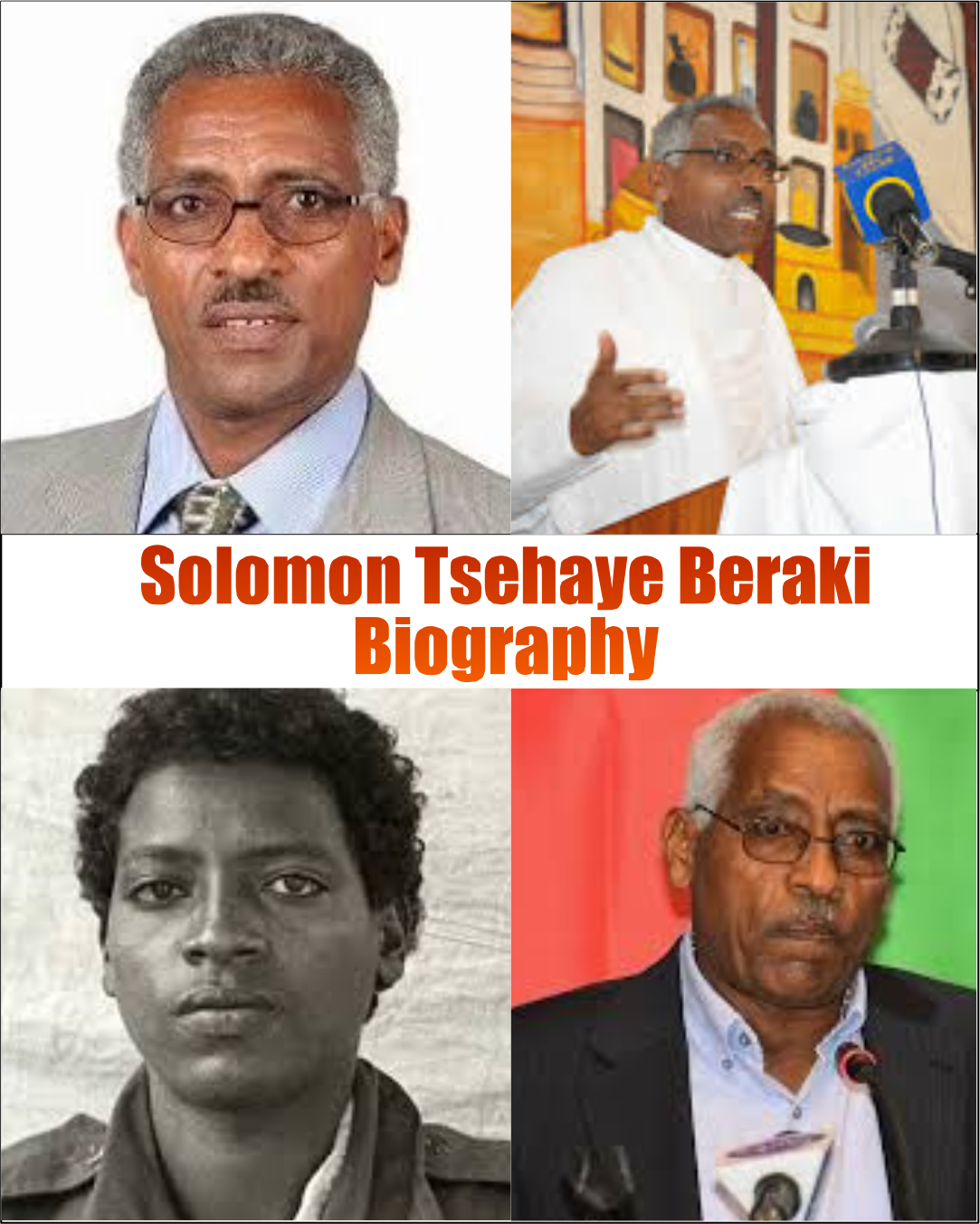
The Solomon Tsehaye Beraki Biography: The Wounded Fighter Who Wrote A Country Soul in the Mountains
Solomon Tsehaye Beraki won a scholarship at twelve, boycotted a military dictatorship’s student programme, joined a guerrilla army at twenty, was wounded in combat, became a barefoot doctor, started writing plays and poetry in a war zone in 1979, and in 1986 wrote the poem that became a nation’s anthem — seven years before that nation existed.
He Wrote a Nation’s Anthem Before the Nation Existed — From Inside a War: The Story of Solomon Tsehaye Beraki
In 1986, a poet sitting in the rear area of a guerrilla army in the Sahel mountains of northern Eritrea wrote a poem.
He had been in those mountains for nine years. He had come in as a combat soldier. He had served as a barefoot doctor — treating wounded fighters with whatever medical knowledge he could acquire in the field after a bullet had put him out of front-line action. He had been writing plays and poems since 1979, performing them for fighters who had no theatre, no libraries, no access to any cultural life except what they made for themselves in the mountains between battles.
The poem he wrote in 1986 began with three words, repeated: Eritrea. Eritrea. Eritrea.
His name has never been famous outside Eritrea. His country has a population of three million. The anthem he wrote is sung by people whose nation he helped imagine into existence from a mountain in the middle of a war.
This is his story.
Solomon Tsehaye Beraki Biography
| Category | Details |
|---|---|
| Full Name | Solomon Tsehaye Beraki |
| Date of Birth | December 1956 |
| Place of Birth | Addi Quitta, Southern Eritrea |
| Nationality | Eritrean |
| Profession | Poet, Academic, Politician, Cultural Official |
| Field of Work | Poetry, Literature, Education, Cultural Affairs |
| Notable Achievement | Wrote Eritrea’s national anthem — one of the most significant cultural contributions in the nation’s history |
| Legacy | Celebrated as one of Eritrea’s most important literary voices and a cultural pillar of Eritrean national identity |
Addi Quitta — A Village, a Scholarship, and the Boy Who Left for Addis
Solomon Tsehaye Beraki was born in December 1956 in Addi Quitta, a village in southern Eritrea.
Southern Eritrea in the mid-1950s was a country at a specific and precarious historical juncture. The United Nations had federated Eritrea with Ethiopia in 1952 — a political arrangement that Eritrean nationalists immediately recognised as a step toward annexation rather than a path toward self-determination. By the time Solomon was five years old, the Ethiopian Emperor Haile Selassie had dissolved the federation and incorporated Eritrea as an Ethiopian province. By the time he was ten, armed resistance had already begun.
Having received his elementary education in Eritrea, Solomon went to Addis Ababa, Ethiopia, for his high school education at the then British-run General Wingate Secondary School. It was a boarding school. He had won a scholarship to study at the school by passing its entrance examination.
See also: Hector Pieterson Biography – The Boy Who Spike Black Revolution
The Derg, the Student Campaign, and the Choice That Changed Everything
Solomon’s education was affected by the coming to power of the military regime — the Dergue — which deposed the emperor in Ethiopia in 1974. Upon seizing power in September 1974, the regime declared that senior high school and university students be mobilised from their schools for an ill-intended and ill-planned students’ campaign to eradicate illiteracy. Considering the chaotic and politically hostile situation surrounding the programme, Solomon boycotted the students’ campaign like many Eritrean compatriots and came back home.
The Derg — the military junta that overthrew Haile Selassie and ruled Ethiopia with increasing brutality until 1991 — had a specific ideological project for Ethiopia’s educated youth. Mobilising students for a literacy campaign was, on its surface, a progressive initiative. In practice, it was a mechanism of political control, a way of directing the energies of students who might otherwise become critics or resisters toward a government-sanctioned programme that kept them in the provinces and away from the urban centres where opposition was organising.
Solomon Tsehaye Beraki looked at the programme and decided it was not for him. He went home to Eritrea.
Solomon joined the Eritrean independence struggle in April 1977.
The War Zone as a Theatre — Culture as a Weapon
It was in the rear of the EPLF, in late 1979, that Solomon began to engage himself in cultural activities by writing plays, acting and composing poetry. He was attracted more and more into arts and culture to the extent that he was transferred in mid-1981 to work as a full-time artist in the Division of Culture of the EPLF. He was appointed head of the Division in 1987 and served in that capacity until the liberation of Eritrea in May 1991.
The EPLF’s attitude toward culture was not peripheral. It was foundational. The front’s leadership understood — with a clarity that many liberation movements have lacked — that a people fighting for the right to exist as a nation need more than weapons. They need a story about who they are and what they are fighting for that is specific enough to be believed and large enough to encompass the diversity of people doing the fighting.
Eritrea’s fighters came from nine different ethnic groups speaking multiple different languages. They were Christian and Muslim. They were from the highlands and the lowlands, from agricultural communities and pastoral ones, from families with different relationships to the Ethiopian state that had been ruling them. What unified them was not a shared language or a shared religion but a shared political claim — that Eritrea had the right to determine its own future.
Did you know?
In later years, Solomon Tsehaye wrote a colossal scholarly work on massé and melqes — Tigrinya’s highest form of poetry — a first volume of an anticipated three-volume study that one commentator said was of the kind that universities teach in their departments.
The poet who had written plays in the mountains between battles became, in independence, one of the most serious scholarly preservers of the poetic tradition he had been practising. The fighter and the academic were the same person, connected by a lifelong commitment to the specific beauty of Tigrinya language.
1986 — A Poem in the Mountains Before the Country Was Born
Poet Solomon Tsehaye Beraki composed the initial version of Eritrea, Eritrea, Eritrea in 1986, synthesising thematic developments into a concise ode to national perseverance, with the chorus’s thrice-repeated Eritrea evoking an unyielding identity forged through adversity.
The year 1986 was not a peaceful year for the Eritrean liberation struggle. The war had been ongoing for twenty-five years. The EPLF had survived a massive Ethiopian military offensive in 1978 — supported by Soviet weapons and Cuban advisers — that had pushed the front back to its base area in the Sahel. The years since had been a slow rebuilding, a patient consolidation of strength, a grinding war of attrition against one of Africa’s largest armies.
In this context, Solomon Tsehaye Beraki wrote the poem that would become a national anthem.
The verses portrayed the enemy’s defeat via blood sacrifice, vindicated offerings, and a resolve that neither succumbed nor ceased. Beraki, drawing from Tigrinya poetic traditions, crafted the text to foster unity across ethnic lines within the EPLF’s ranks, which numbered around 100,000 combatants by the war’s end.
The Sahel Poetry Collection — Giving the War a Literature
In 1994, one year after Eritrean independence, Solomon Tsehaye Beraki published his poetry collection Sahel.
His poetry book entitled Sahel was published in 1994, and the publication of the second edition took place in 2006.
Sahel was the name of the mountain region where the EPLF had maintained its base throughout the war — the rugged, inhospitable terrain of northern Eritrea that had sheltered the liberation movement through its most difficult decades. To name his collection after that landscape was to insist that the poetry was not simply about the war but was of the war — that it had been produced in those mountains, by a person who had lived and fought and healed and written there, and that its authority derived from that physical and historical presence.
The collection gathered poems that had been published across a decade and a half of the independence struggle — in the Netsebraq magazine that the EPLF’s cultural division produced, in radio broadcasts from liberated territory, in the various forms of cultural distribution that the front had developed to maintain the literary life of people fighting a war.
The Netsebraq Magazine and the Cultural Infrastructure of a Liberation Movement
Taking over from its founding editor, the distinguished writer Alemseged Tesfay, Solomon also edited and regularly contributed to a dozen issues of Netsebraq, the arts and culture magazine published in Tigrinya by the cultural establishments of the EPLF and later the Eritrean government.
Netsebraq — the word means spark in Tigrinya — was not a publication in the conventional sense. It was part of the deliberate cultural infrastructure that the EPLF had built in its mountain base, an infrastructure that included a printing press, a radio station, a hospital, schools, and a training programme for teachers — all of it maintained in a war zone, all of it part of the front’s conviction that a people fighting to build a nation needed to practise being a nation while they were still fighting.
The magazine gave fighters access to poetry, fiction, drama, and cultural criticism. It gave writers like Solomon Tsehaye Beraki an audience and a publication record. It gave the liberation movement a literary tradition — not something built after independence from the materials of peace, but something built during the war from the materials of struggle.
Independence, Post-War Work, and the Poet Who Kept Teaching
When Eritrea achieved independence in May 1991 and formally declared statehood in 1993, Solomon Tsehaye Beraki faced the transition that every revolutionary who survives to see their revolution succeed must navigate: the move from fighter to builder, from resister to administrator, from the clarity of opposition to the complexity of governance.
In the post-independence period, Solomon was given a number of opportunities to travel abroad to attend conferences and training programmes on culture and arts, which helped broaden his scope of knowledge and experience.
He served as Director of the Cultural Affairs Bureau in the Ministry of Education of Eritrea, and as of 2019 he was working in the Eritrean Ministry of Education.
The Conflict Inside Him and the Honesty About It
One of the most revealing things Solomon Tsehaye Beraki has said publicly is about the tension he experienced between his administrative responsibilities and his literary work.
“For many years a conflict was going on inside me — a conflict between the performance of my administrative duties and my professional development as a poet and writer.”
This admission — honest, unguarded, and specific — tells us something important about the person behind the anthem. He was not simply a revolutionary who wrote poetry as a political tool. He was a poet who had been a revolutionary, who cared about his literary development as a craftsman and felt genuinely conflicted when administrative duties encroached on the time and mental space that serious writing required.
What Three Words in a Mountain Did
Solomon Tsehaye Beraki won a scholarship from a village in southern Eritrea. He boycotted a military dictatorship’s student programme rather than serve it. He joined a guerrilla army at twenty. He was wounded in combat. He treated the wounded as a barefoot doctor. He wrote plays for fighters who had no theatre. He composed poetry in the classical forms of Tigrinya for people fighting a thirty-year war. He headed the cultural division of the EPLF from 1987 to 1991. He wrote the poem in 1986 that became a country’s anthem in 1993. He published the anthology Sahel in 1994. He served in Eritrea’s Ministry of Education. He is writing a three-volume scholarly study of Tigrinya’s highest poetic forms.
All of this from a village called Addi Quitta that most of the world has never heard of, in a country that most of the world cannot locate on a map, in a language that most of the world does not read.
The chorus’s thrice-repeated Eritrea evoking an unyielding identity forged through adversity.
Eritrea. Eritrea. Eritrea.
Frequently Asked Questions
1. Who is Solomon Tsehaye Beraki?
Solomon Tsehaye Beraki is an Eritrean poet, academic, and politician born in December 1956 in Addi Quitta, a village in southern Eritrea. He is best known for writing Eritrea’s national anthem and for his significant contributions to Eritrean literature, culture, and education.
2. What is Solomon Tsehaye Beraki best known for?
He is best known for composing the national anthem of Eritrea. Writing a national anthem is one of the most significant cultural acts any poet can perform — it requires capturing the essence of a people’s identity, their history, their sacrifices, and their hopes in language that is simultaneously poetic and accessible enough to be sung by an entire nation. Solomon wrote the national anthem of Eritrea, “Eritrea, Eritrea, Eritrea.”
3. What role did Solomon Tsehaye Beraki play in the Eritrean independence struggle?
From April 1977 to 1991, Solomon served as a soldier and barefoot doctor in the Eritrean People’s Liberation Front during the Eritrean War of Independence. Wounded in action, he was reassigned to the rear of the EPLF, where in late 1979, at a time when cultural activities were highly encouraged by the EPLF for all members, Solomon began to engage in writing plays.
4. What was Solomon Tsehaye Beraki’s contribution to Eritrean education and culture?
Solomon has contributed to several issues of the EPLF’s and later Eritrean government’s Netsebraq arts and culture magazine. He has also served as Director of the Cultural Affairs Bureau in the Ministry of Education of Eritrea.
5. What is Solomon Tsehaye Beraki’s lasting legacy?
Solomon Tsehaye Beraki’s most enduring legacy is the national anthem he wrote — a piece of literature that every Eritrean citizen knows and that embeds his poetic voice permanently into the fabric of the nation’s public life. Beyond the anthem, his decades of contribution to Eritrean poetry, theatre, and cultural administration have made him one of the most significant literary and cultural figures in his country’s modern history.