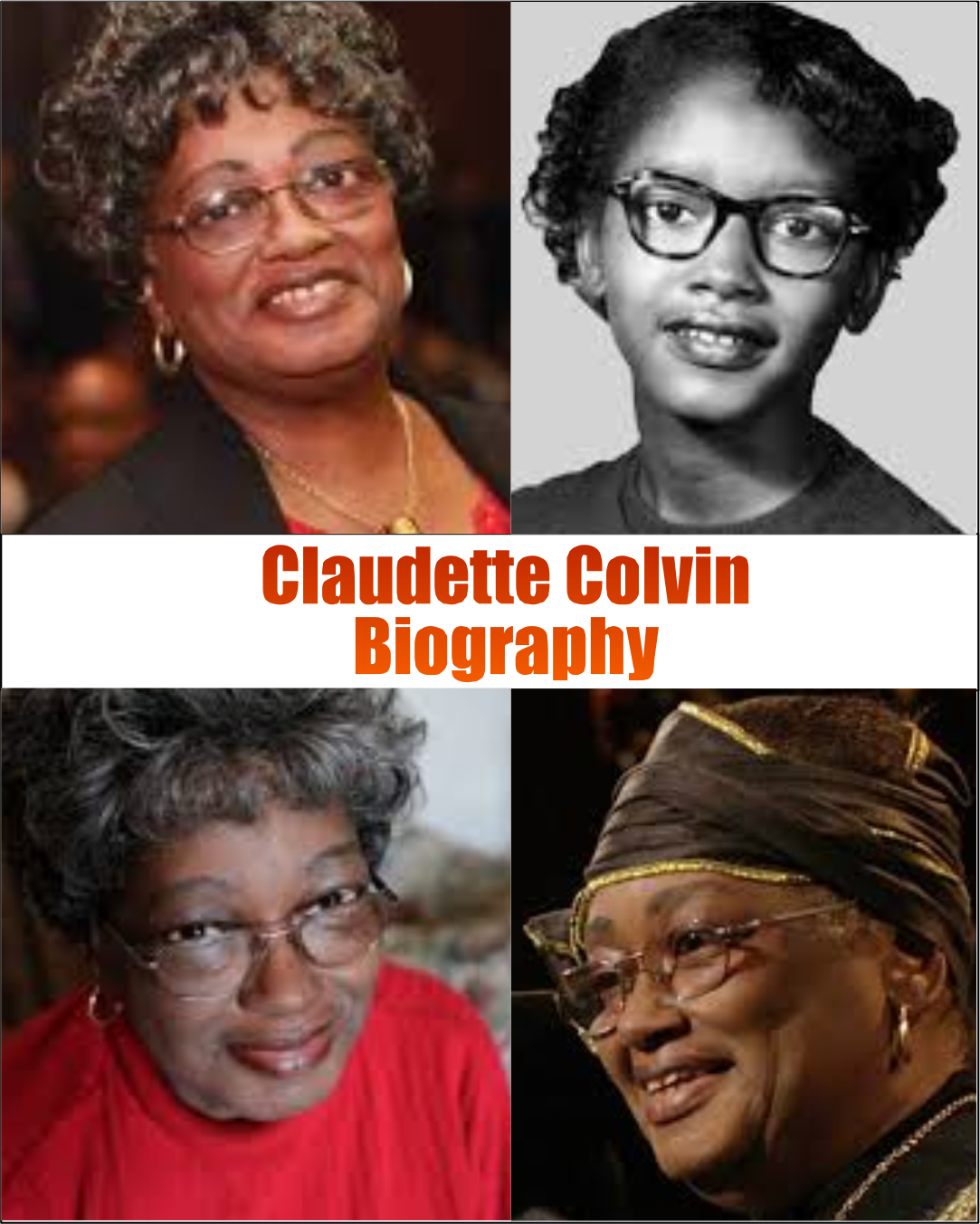
The Claudette Colvin Biography: The Movement Decided She Was Not Good Enough, History Almost Agreed
Claudette Colvin refused to give up her bus seat in Montgomery nine months before Rosa Parks. She was fifteen, pregnant, dark-skinned, and poor. The civil rights movement decided she was not the right face for their cause. She spent 35 years as a nurse’s aide in the Bronx, rarely telling her story. She died on January 13, 2026, at 86 — and the world finally knew her name.
She Went First. They Decided She Was Not Good Enough. She Was 86 When the World Finally Knew Her Name: The Story of Claudette Colvin
On January 13, 2026, Claudette Colvin died of natural causes at the age of eighty-six in the Bronx, New York.
The obituaries ran in every major newspaper in the world. The tributes poured in from historians, civil rights organisations, politicians, and people who had only discovered her story a few years earlier when a book about her won the National Book Award. The city of Montgomery, Alabama — the same city where two adult male police officers had dragged a fifteen-year-old girl off a bus, handcuffed her, and taken her to jail for refusing to surrender her seat — issued a formal statement of condolence. “To us, she was more than a historical figure. She was the heart of our family, wise, resilient, and grounded in faith. We will remember her laughter, her sharp wit, and her unwavering belief in justice and human dignity,” the Claudette Colvin Foundation said.
She was fifteen years old when they made that calculation about her. She was eighty-six when she died. In the years between those two ages, she had earned the recognition that the movement had decided in 1955 she could not have.
Claudette Colvin Biography
| Category | Details |
|---|---|
| Full Name | Claudette Colvin |
| Date of Birth | September 5, 1939 |
| Place of Birth | Birmingham, Alabama, USA |
| Nationality | American |
| Profession | Civil Rights Activist, Nurse’s Aide |
| Field of Work | Civil Rights, Racial Equality, Social Justice |
| Notable Achievement | Refused to give up her bus seat to a white passenger in Montgomery, Alabama in March 1955 — nine months before Rosa Parks’ celebrated act of resistance |
| Legacy | Recognised as an unsung pioneer of the American Civil Rights Movement whose courage helped lay the legal foundation for ending bus segregation |
Montgomery, Pine Level, and the Girl Who Knew the Constitution
Claudette Colvin was born on September 5, 1939, in Birmingham, Alabama. When they took Claudette in, the Colvins lived in Pine Level, a small country town in Montgomery County — the same town where Rosa Parks grew up.
Pine Level. The same small town. Two women whose lives would eventually be woven together by history, born in the same community years apart, shaped by the same landscape of Jim Crow Alabama in which the rules about where Black people could sit, stand, walk, eat, drink, and be were enforced not as policies subject to debate but as the fundamental conditions of existence.
When Claudette was eight years old, the family moved to King Hill, a poor Black neighbourhood in Montgomery where she spent the rest of her childhood. Two days before Colvin’s 13th birthday, Delphine died of polio. Her sister. Two days before her thirteenth birthday. The grief that followed was profound and specific — the loss of a companion, a sibling, someone who had shared the daily texture of the childhood that the Jim Crow South had arranged for them.
See also: Sor Juana Inés de la Cruz Biography: The Illegitimate Child Who Wrote the First Feminist Manifesto in the Americas
March 2, 1955 — The Bus, the Constitution, and Harriet Tubman’s Hands
On March 2, 1955, Claudette Colvin boarded a bus home from school. She had been politicised by the mistreatment of her classmate Jeremiah Reeves and had just written a paper on the problems of downtown segregation.
Jeremiah Reeves was sixteen years old when he was arrested for allegedly raping a white woman in Montgomery. He had actually been having a consensual affair with the woman. He was convicted, sentenced to death, and executed in 1958. Claudette Colvin had watched this happen to a boy she knew, watched the machinery of Alabama’s racial justice system grind through his life, and emerged from the experience with the specific political consciousness that comes from witnessing something monstrous and being young enough that outrage has not yet been tempered by the experience of how slowly things change.
She was also, on the afternoon of March 2, 1955, fresh from Negro History Month at school — her head, as she would later describe it, full of Black history, full of Harriet Tubman and Sojourner Truth and the Constitution and the legal arguments for why what was being done to Black people in Montgomery was unjust by the standards of the very documents the country used to describe itself.
On the bus home, the white section filled up. A white woman was left standing. The driver called out, and the three students sitting in Colvin’s row got up — but Colvin refused.
“I had paid my fare and it was my constitutional right to sit there.”
The white woman refused to sit in the now-empty seats across the aisle from Claudette because sitting across the aisle from a Black girl would have implied equality — and that, in Montgomery in 1955, was the specific implication that the system had been designed to prevent at all costs.
Two adult male police officers pulled Colvin from the bus, kicked her, handcuffed her, and took her to jail. The police officers did not allow Colvin to make a phone call once she reached the jail.
Did you know?
Colvin was convicted on all three charges in juvenile court: disturbing the peace, violating the segregation laws, and assaulting a police officer. She was given a ten-dollar fine. The assault charge — filed against a fifteen-year-old girl who, by her own account, went limp rather than fighting back — was the charge that would later complicate the civil rights movement’s decision about whether to use her case as a test case for desegregation.
She had been charged with assaulting the men who had dragged her off a bus and kicked her. The law, in its Jim Crow form, had managed to make the victim the aggressor.
The Calculation — Why the Movement Chose Someone Else
After the arrest, the response from Montgomery’s civil rights community was immediate and significant.
Rosa Parks and white ally Virginia Durr began fundraising for young Colvin’s case, and more than one hundred letters and a stack of donations streamed into Parks’ apartment. Parks was hopeful that the young woman’s arrest would embolden other young people to action.
For a brief period, it seemed that Claudette Colvin’s case might be the vehicle for the legal challenge to bus segregation that the movement had been planning. It had the essential elements: a clear act of civil disobedience, an unjust arrest, and a young person willing to testify.
Then the leadership made its calculation.
She was deemed too young and her complexion too dark to be the right fit. Then she became pregnant by a man whose name Colvin will not disclose, and that was that.
Too young. Too dark-skinned. And pregnant.
That is not a criticism of Rosa Parks. She was extraordinarily courageous and her contribution to the civil rights movement was real and enormous. It is a criticism of the structural logic that decided a fifteen-year-old girl’s pregnancy made her act of constitutional courage unusable.
Browder v. Gayle — The Legal Victory Nobody Remembers Her For
The story most Americans know ends with the Montgomery Bus Boycott — the 381-day refusal of Black Montgomerians to ride the city’s buses, the economic pressure it created, the image of a tired people finally saying enough. The story most Americans do not know is that the legal victory that actually ended bus segregation in Montgomery was not produced by the boycott itself but by a federal lawsuit.
Colvin became one of four plaintiffs in the Browder v. Gayle case along with Aurelia S. Browder, Susie McDonald, and Mary Louise Smith — women who had sued the bus company arguing that segregation was unconstitutional.
Colvin became one of the plaintiffs on the federal case, Browder v. Gayle, filed in February 1956, which ultimately led to the desegregation of Montgomery’s buses.
New York, 35 Years of Silence, and the Nurse’s Aide Nobody Knew
After the trial, Claudette Colvin left Montgomery. She was pregnant, convicted of a crime, and living in a city where the organisation that had declined to use her case had then used her testimony in a case that ended bus segregation — a case that history would come to associate with the boycott and with Rosa Parks and with Martin Luther King Jr., rather than with the four women who had actually filed it.
She worked as a nurse’s aide in Manhattan, New York. Colvin did not talk about her experience in Montgomery, in part because her mother had warned against it. Colvin’s mother did not want her daughter to receive any negative attention. Colvin lived and worked in New York for thirty-five years before retiring in 2004.
Her story was largely forgotten until 2009, when a book about her life — Claudette Colvin: Twice Toward Justice by Phillip Hoose — won the National Book Award for young people’s literature.
The National Book Award. For a young adult nonfiction book about a woman who had been a nurse’s aide in the Bronx for three decades while the history she had helped make was being told without her name in it. The book existed because a journalist had found her story, tracked her down, and convinced her to tell it.
2021 — The Record Expunged, the Drive Named, and Justice Finally Spelled Out
In 2021, Claudette Colvin did something she had been living with the consequences of for sixty-six years. She applied to have her juvenile criminal record expunged.
Daryl Bailey, the District Attorney for the county, supported her motion, stating: “Her actions back in March of 1955 were conscientious, not criminal; inspired, not illegal; they should have led to praise and not prosecution.”
The judge ordered that the juvenile record be expunged and destroyed in December 2021, stating that Colvin’s refusal had “been recognised as a courageous act on her behalf and on behalf of a community of affected people.”
Courageous. Not disturbing the peace. Not assaulting a police officer. Courageous. The charge that had been used to explain why the movement could not make her its symbol — the assault conviction that had never been dropped from her record — was erased sixty-six years after it was applied to a fifteen-year-old girl who had been sitting in a seat she had paid for.
What the Movement Got Wrong — and What It Got Right
The decision that the Montgomery civil rights leadership made in 1955 — to decline Claudette Colvin’s case as the vehicle for their legal challenge — has been debated by historians ever since, with increasing intensity as her story became better known.
The case against the decision is straightforward. A fifteen-year-old girl performed an act of genuine constitutional courage. She was punished for it. The movement then decided her personal circumstances — her age, her skin tone, her pregnancy — made her unusable, and chose instead to wait for someone whose circumstances were less complicated. The message that sent, to Claudette Colvin and to the countless young Black women who were also navigating complicated circumstances in 1955 Alabama, was that their courage was only valuable if their lives were presentable.
January 13, 2026 — Eighty-Six Years, and She Finally Had Her Name
Claudette Colvin died two months ago. The world that had spent sixty years not knowing her name spent the week after her death writing about her.
Activist Colvin, who died Tuesday at age 86, sparked a crucial examination of segregation laws with her lesser-known bus refusal in 1955.
She lived long enough to have her record expunged. Long enough to have a street named for her. Long enough to see a National Book Award won for the story she had spent thirty-five years not telling. Long enough to hear a District Attorney in Montgomery say that what she had done was courageous, not criminal. Long enough to see the city that had tried to erase her spend the last years of her life trying to honour her instead.
She was more than good enough. She was first.
Frequently Asked Questions
1. Who is Claudette Colvin?
Claudette Colvin is an American civil rights pioneer who at just 15 years of age became one of the first people to refuse to give up her seat on a segregated bus in Montgomery, Alabama.
2. Why was Claudette Colvin’s act of resistance not as widely publicised as Rosa Parks’?
This is the most complex and important question surrounding Claudette Colvin’s story. Civil Rights Movement leaders including the NAACP were actively looking for the right person whose case could serve as a legal and public test of bus segregation laws — someone whose personal circumstances and public image would generate maximum sympathy and minimum criticism.
3. What legal role did Claudette Colvin play in ending bus segregation?
Despite being kept from the public spotlight, Claudette Colvin played a direct and essential legal role in the landmark case that ended bus segregation in the United States. She was one of four Black women plaintiffs in the federal lawsuit Browder v. Gayle — a case brought by the NAACP Legal Defense Fund challenging the constitutionality of Montgomery’s bus segregation laws.
4. How did Claudette Colvin’s act of resistance affect her own life?
The personal consequences of Claudette Colvin’s defiance were significant and long-lasting. She faced hostility and social pressure within Montgomery that made her daily life difficult, and the unwanted pregnancy that Civil Rights leaders had considered a liability became the source of further hardship.
5. What is Claudette Colvin’s lasting legacy?
Claudette Colvin’s legacy has grown considerably in recent decades as historians, educators, and the public have worked to recover and celebrate her contribution. She is now widely taught in American schools as a genuine pioneer of the Civil Rights Movement — a teenager who acted on principle at a moment when doing so required extraordinary personal courage and carried real personal risk.