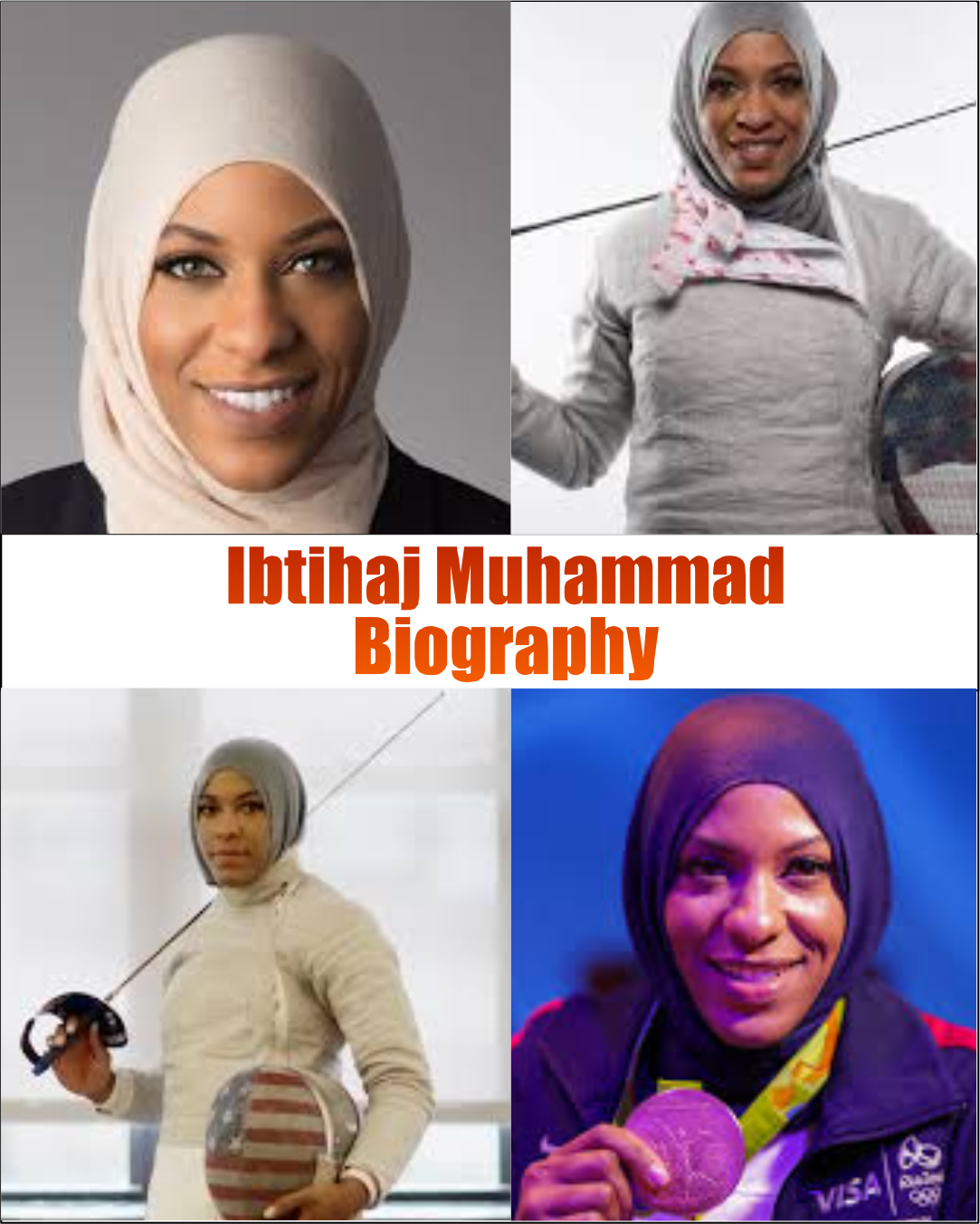
The Ibtihaj Muhammad Biography: The Girl Who Found Fencing and Changed Olympic Forever.
Ibtihaj Muhammad tried swimming, volleyball, tennis, and softball. Every uniform violated her faith. At thirteen she looked across a school parking lot, saw a fencer in full-body gear, and understood immediately. Twenty-three years later she stood on an Olympic podium wearing a hijab — the first American to do so — and a Barbie doll was made in her image. She never set out to make history. She just wanted to play.
She Just Wanted to Play. Sport Had Other Plans: The Story of Ibtihaj Muhammad
The decision that changed American Olympic history was made in a school parking lot in New Jersey. It was not made by a coach, a federation official, or a talent scout. It was made by a thirteen-year-old girl who had been trying to find a sport — any sport — that would let her compete without requiring her to remove the hijab that was as inseparable from her identity as her own name.
She had tried swimming. The swimsuit did not work. Volleyball. The uniform exposed too much. Tennis. Same problem. Softball. The same. Sport after sport, the uniform requirement and the religious requirement were in direct, irreconcilable conflict, and the message the system was sending, consistently and without apparent awareness of what it was doing, was that there was no place in organised athletics for a girl who dressed the way she dressed.
Then, from the parking lot of Maplewood’s Columbia High School, she looked through a window and saw a fencer in full-body protective gear — mask, jacket, gloves, breeches — and understood immediately that she had found her sport.
“What I loved most about fencing was it allowed me to pursue my desire to be involved in sports, but also allowed me to be myself as a Muslim woman.”
Ibtihaj Muhammad Biography
| Category | Details |
|---|---|
| Full Name | Ibtihaj Muhammad |
| Date of Birth | December 4, 1985 |
| Place of Birth | Maplewood, New Jersey, USA |
| Nationality | American |
| Profession | Olympic Fencer, Entrepreneur, Author, Activist |
| Field of Work | Sports, Women’s Rights, Muslim Representation, Social Activism |
| Notable Achievement | First American Muslim woman to compete in the Olympic Games wearing a hijab; won a bronze medal at the 2016 Rio Olympics |
| Legacy | Celebrated globally as a symbol of inclusion, Muslim representation, and the power of sports to break cultural and social barriers |
Maplewood, New Jersey — A Muslim Family in Post-9/11 America
Ibtihaj Muhammad was born on December 4, 1985, in New Jersey and raised in Maplewood, New Jersey. She has two older siblings, Brandilyn and Qareeb, and two younger siblings, Asiya and Faizah.
Born on December 4, 1985 to parents Eugene Muhammad and Denise Garner, Ibtihaj Muhammad is one of six children.
The family she was born into was devout, sports-loving, and deeply community-oriented. Her parents — who had converted to Islam before their children were born — raised all six of their children to be athletes. Sport was not a hobby in the Muhammad household. It was a family value — a way of building discipline, resilience, and the specific physical confidence that carries a person through the parts of life that have nothing to do with athletics.
The complication was always the uniform. Growing up in Maplewood, New Jersey, Muhammad participated in several sports, such as swimming, volleyball, tennis, and softball. Athletics were a challenge, however, as most uniforms did not conform with her Muslim faith, which called for covering her arms, legs, and head.
See also: Yasuke Biography – The African Man Who Walked Into a Feudal Japanese War
The Parking Lot, the Mask, and the Peter Westbrook Foundation
Seeking a sport that would allow Muhammad to wear her hijab, she found fencing while in high school.
The specifics of what fencing requires its athletes to wear aligned perfectly with what her faith required of her — the full-body lame jacket, the breeches, the mask, the glove. The equipment that had been designed for protection against a sabre blade turned out to be, incidentally, exactly the coverage that her religious practice required. Nobody had designed fencing with Muslim women in mind. But the design worked for her, and she was going to use it.
Muhammad began fencing at the age of 13. She got involved with the Peter Westbrook Foundation, a program established by fencing champion Westbrook to bring the sport to underserved communities in the New York area.
Peter Westbrook — the only American fencer to have won a medal at the World Championships and the Olympic Games in the same year, a Black American who had made his path through a sport that had historically belonged to European aristocracy — had built the foundation that became Ibtihaj Muhammad’s entry point into serious fencing. The programme was designed to reach children who would not otherwise encounter the sport. In the mid-1990s, it reached a thirteen-year-old girl from Maplewood who had been looking for somewhere to compete as herself.
Did you know?
Growing up, she found inspiration from the Williams sisters and their confidence playing tennis. Serena and Venus Williams — two Black women from Compton, California who had entered a sport defined by white European tradition and had not simply succeeded in it but had dominated it so completely that the sport had to reconstitute itself around their presence.
That is the template Ibtihaj Muhammad had in her mind when she went to Duke University on a fencing scholarship. Not just to participate. To dominate. To force the sport to make room for her.
Duke University, Three All-American Titles, and the Education That Prepared Her for Everything
Ibtihaj Muhammad attended Duke University on a scholarship. She graduated in 2007 with dual bachelor’s degrees in international relations and African-American studies with a minor in Arabic.
The combination of academic subjects was not accidental. International relations gave her the framework for understanding how power operates between states and peoples — the systemic analysis that would later inform her understanding of what representation in international sport actually means geopolitically. African-American studies gave her the historical vocabulary for understanding her own experience as a Black Muslim woman in a country still working through its relationship with both of those identities. Arabic deepened her connection to the faith that was simultaneously driving her athletic journey and making it more complicated.
From there, she went on to place second at the mid-Atlantic/South Regional and 21st at the Junior Olympics. The following year, she finished 11th for saber at the NCAA Championships, and earned her second consecutive All-America honors. A third would come in 2006.
Three consecutive All-America honours. At Duke — one of the United States’ most competitive academic institutions, where balancing serious academic work with elite athletic training requires the specific kind of time management and mental discipline that separates good athletes from great ones.
The National Team, the World Championships, and the Price of Being First
Muhammad is a five-time World medalist (2011, 2012, 2013, 2015) and at the 2014 World Fencing Championships, won gold with the United States women’s sabre team.
The progression from All-American college fencer to five-time World medallist is, in competitive terms, the credentialing that establishes a person as genuinely world-class. She was not at the Olympics as a symbolic inclusion, a gesture toward diversity, a feel-good story that a television network could use to fill airtime between the marquee events. She was there because she was one of the best sabre fencers in the United States and one of the better ones in the world.
The distinction matters enormously. The conversation around her had already become so dominated by her identity — the hijab, the Muslim American story, the first-ever significance of her presence — that her actual athletic achievement was at constant risk of being treated as secondary. She did not allow that. She kept winning medals at World Championships. She kept her ranking among the elite. She refused to let the symbolic story displace the sporting one.
“I faced a lot of alienation as a member of Team USA. I felt ostracised a lot and not included, but I think that these kind of notches on my belt are really what’s shaped me into the athlete that I am.”
Rio 2016 — The Moment the Whole World Saw
The 2016 Summer Olympics in Rio de Janeiro were, by any measure, one of the most politically charged Games in the modern era. The Zika virus had kept athletes away. Russia’s doping scandal had reshaped the competition landscape. The political climate in the United States — where Donald Trump had been campaigning on explicitly anti-Muslim rhetoric throughout 2015 and 2016 — had made the question of Muslim American identity unusually visible and unusually contested.
Into that context, Ibtihaj Muhammad walked through the opening ceremony of the Rio Olympics as a flag bearer candidate, took her place in the starting lineup of the women’s sabre individual event, and competed.
“I’m hoping just my presence on Team USA changes perceptions people have about the Muslim community.”
Visibly Muslim, Muhammad became “one of the best symbols against intolerance America can ever have,” according to The Guardian in 2016.
The Sport Impact — What Changed After Rio 2016
The most direct and measurable change that Ibtihaj Muhammad produced in sport was not in fencing itself — the participation numbers, the medal counts, the technical development of the sabre discipline. It was in the conversation about who sport belongs to, whose body is a sporting body, and what the image of athletic excellence looks like.
Before Rio 2016, the default image of an American Olympic athlete — the one that appeared in sponsorship materials, in television coverage, in the cultural shorthand for what a Team USA competitor looked like — did not include a hijab. Not because of any explicit policy. Because the people who had been in those positions had not, until that moment, included a Muslim American woman who wore one.
A member of the U.S. National Fencing Team since 2010, Muhammad has had to overcome discrimination, both religious and racial throughout her career but now uses her global platform to speak about inclusion and equality through sport.
The Clothing Company, the Books, and the Business of Being Ibtihaj
The person who stands in the arena and breaks new ground and then does nothing with the ground they have broken is not Ibtihaj Muhammad. She is a builder by temperament and a strategist by education — the International Relations degree from Duke is visible in everything she has done since Rio.
In 2014, Ibtihaj launched her own clothing company, Louella, aiming to bring modest, fashionable and affordable clothing to the United States market.
Louella by Ibtihaj — founded two years before the Rio Olympics, anticipating the platform the Games would give her, building the commercial infrastructure before the fame arrived. The company addresses directly the problem that had defined her entire childhood relationship with sport — the absence of fashionable, affordable modest clothing for Muslim women in the American market. She did not wait for someone else to solve the problem. She built the solution.
Muhammad released her debut memoir in 2018 titled Proud: My Fight for an Unlikely American Dream. The memoir is not a sports biography in the conventional sense — a linear account of training, competition, and medals. It is an honest account of what it costs to compete as a Black Muslim woman in elite American sport — the racism, the Islamophobia, the institutional exclusion, the specific forms of alienation that the American sporting system visited on her while simultaneously benefiting from her presence on its teams.
She is also the author of a series of children’s books — instant New York Times bestseller The Proudest Blue: A Story of Hijab and Family (originally published in 2019), The Kindest Red: A Story of Hijab and Friendship (2023), and The Boldest Blue: A Story of Hijab and Community (2024).
Retirement, the Hajj, and the Life After the Sabre
Muhammad announced her retirement from sport in 2019, after completing her first hajj.
The timing was deliberate and spiritually coherent. She had completed the pilgrimage to Mecca — the fifth pillar of Islam, the journey that every Muslim who is able is required to make at least once — and emerged from it with the clarity that the fencing chapter of her life was complete. Not abandoned. Complete. She had done what she set out to do.
“I feel really content with my career and where I am right now in my life. You know, fencing is not a big part of it anymore, but it’s always been my intention to transcend sport in a way that reaches people not just in the fencing world but outside of it. I think I’ve been able to best do that, not only representing my sport but representing myself.”
Representing myself. That phrase — its simplicity, its precision, its quiet insistence on the primacy of self-definition over the definitions others were eager to impose — is the through-line of the entire Ibtihaj Muhammad story. From the parking lot in Maplewood where she chose fencing because it let her be herself to the retirement statement in 2019 that described her career in terms of self-representation — it is the same principle, held consistently for twenty-three years.
Her net worth is estimated at approximately $2 million — accumulated through the Olympic medal, the clothing company, the books, the State Department ambassadorship, the speaking engagements, and the brand partnerships that followed Rio 2016.
What She Changed About Sport — The Before and After
Before Ibtihaj Muhammad, the unspoken assumption governing American Olympic sport — the assumption embedded in everything from uniform design to marketing imagery to the cultural shorthand of what an elite athlete looked like — was that the Muslim American community did not produce Olympic athletes who competed as visibly Muslim. Not because of any explicit rule. Because it had not happened yet.
After Ibtihaj Muhammad, the assumption is gone. Not because every Muslim American who wants to compete in elite sport now finds the doors open — the institutional barriers she faced are still there, still operating, still requiring the same combination of talent, stubbornness, and faith to navigate. But the symbolic argument — the argument that a Muslim woman in hijab was incompatible with American athletic excellence, incompatible with Olympic podiums, incompatible with the image of what Team USA looked like — that argument cannot be made anymore. The podium happened. The Barbie happened. The medal is in the Smithsonian.
“I know what it’s like to be made to feel different. I faced a lot of alienation as a member of Team USA. I felt ostracised a lot and not included, but I think that these kind of notches on my belt are really what’s shaped me into the athlete that I am.”
What Sport Looked Like Before Her — and What It Looks Like Because of Her
Before her, the question “can a Muslim woman in hijab compete at the highest level of American Olympic sport?” had no empirical answer. It was theoretical — a question that advocates for inclusion could argue in one direction and traditionalists could argue in the other, and neither side had an Olympic podium to point to.
Sport is different because she played.
Frequently Asked Questions
1. Who is Ibtihaj Muhammad?
Ibtihaj Muhammad is an American Olympic fencer, entrepreneur, author, and activist who made history at the 2016 Rio Olympics as the first American Muslim woman to compete in the Olympic Games wearing a hijab. Born on December 4, 1985, in Maplewood, New Jersey, she grew up in a Muslim family and discovered fencing as a teenager — drawn to the sport partly because its full-body uniform allowed her to compete while maintaining her religious practice of wearing a hijab without requiring special accommodation.
2. How did Ibtihaj Muhammad get into fencing and why was it significant for her?
Ibtihaj Muhammad’s path to fencing is itself a story worth telling. Growing up as a Muslim girl in America who wore the hijab, she faced a practical challenge that many young Muslim women in sport encounter — finding athletic activities where the uniform requirements were compatible with her religious observance.
3. What was the significance of Ibtihaj Muhammad’s appearance at the 2016 Rio Olympics?
Ibtihaj Muhammad’s appearance at the 2016 Rio Olympics as a member of the United States fencing team was historically significant on multiple levels simultaneously. She became the first American Muslim woman to compete at the Olympics while wearing a hijab — a milestone that carried enormous symbolic weight for Muslim American communities who had faced intensifying discrimination and political hostility in the years following the September 11 attacks.
4. What has Ibtihaj Muhammad done beyond competitive fencing?
Ibtihaj Muhammad’s impact extends well beyond her athletic career. She co-founded a clothing company called Louella that designs modest fashion for women — a practical and entrepreneurial response to the gap in the fashion market for women who dress modestly for religious or personal reasons.
5. What is Ibtihaj Muhammad’s lasting legacy?
Ibtihaj Muhammad’s legacy operates simultaneously in the worlds of sport, culture, representation, and social advocacy. As an athlete she demonstrated that Muslim American women can compete and excel at the highest level of international sport. As a cultural figure she has expanded the visual representation of Muslim women in American public life at a time when that representation has been politically contested and socially important.