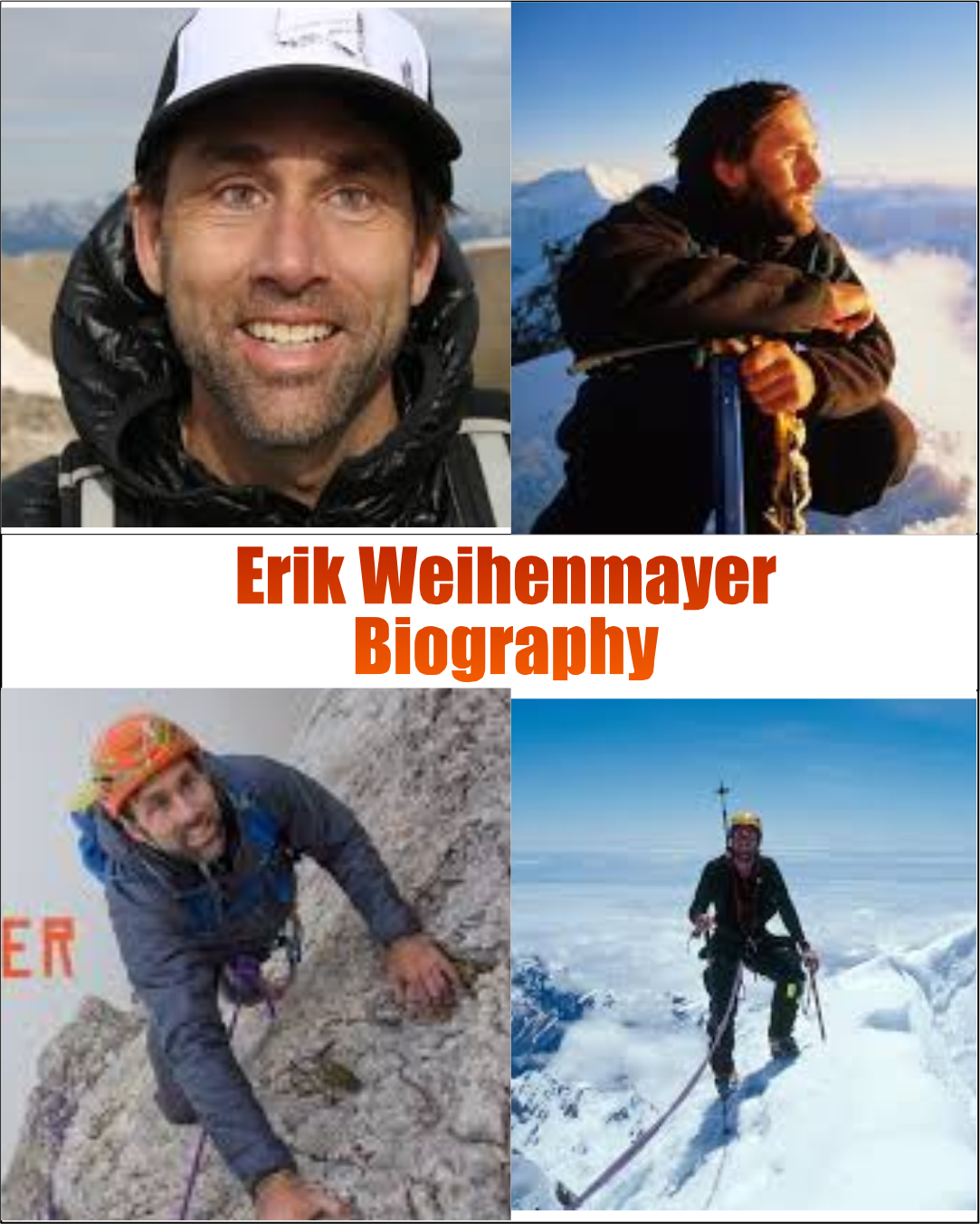
The Erik Weihenmayer Biography: The Blind Man Who Climbed Everest.
Erik Weihenmayer lost his sight at fourteen, became a wrestler and then a mountaineer, summited Everest in 2001 as the first blind person in history, completed the Seven Summits, kayaked the Grand Canyon, and built a movement that has helped hundreds of thousands of people with disabilities find purpose through adventure.
He Climbed Everest Blind. Then His Team Leader Said: Don’t Make This the Greatest Thing You Ever Do.
When Erik Weihenmayer reached the summit of Mount Everest on May 25, 2001, becoming the first blind person in history to stand on top of the world, his team leader Pasquale Scaturro leaned over and said something unexpected.
“Don’t make Everest the greatest thing you ever do.”
Erik Weihenmayer Biography
| Category | Details |
|---|---|
| Full Name | Erik Weihenmayer |
| Date of Birth | September 23, 1968 |
| Place of Birth | Princeton, New Jersey, USA |
| Nationality | American |
| Profession | Athlete, Mountaineer, Author, Motivational Speaker, Activist |
| Field of Work | Adventure Sports, Disability Advocacy, Motivational Speaking, Education |
| Notable Achievement | First blind person in history to summit Mount Everest in 2001; completed the Seven Summits — the highest peaks on all seven continents |
| Legacy | Celebrated globally as a symbol of limitless human potential and one of the most inspiring athletes and disability advocates of the modern era |
New Jersey, Hong Kong, Connecticut — A Childhood That Prepared Him for Loss
Born in New Jersey and diagnosed with juvenile retinoschisis as a toddler, Erik gradually lost most of his sight when he was nine. By the age of fourteen, the condition had left him completely blind.
The family moved frequently — New Jersey, Hong Kong, Connecticut — following his father Ed’s career. His parents and two brothers shaped a household where challenge was normalised and limitation was not accepted as a final answer. When the diagnosis of retinoschisis made his progressive vision loss inevitable, the family did not treat blindness as a tragedy to be mourned indefinitely. They treated it as a new set of conditions to be navigated.
That framing — not denial of difficulty, but refusal to let difficulty become identity — is the philosophical core of everything Erik Weihenmayer has done in sport and beyond it. He did not choose the philosophy because it sounded good. He lived it because his family modelled it before he had words for it.
See also: Nongqawuse Biography – A Girl, a River, a Prophecy
Wrestling, Rock Climbing, and the Discovery of What Blindness Could Not Take
Even as retinoschisis began to rob him of his vision, Erik resisted the idea that blindness would sweep him to the sidelines of life. He established himself as a formidable wrestler in high school, representing Connecticut in the National Junior Freestyle Wrestling Championship.
Wrestling was the first evidence that his body was still an athletic instrument despite what his eyes could no longer do. The sport required physical intelligence — the ability to read an opponent through touch and pressure and balance — rather than visual processing. He was good at it. And being good at it confirmed something he needed confirmed: that the categories of what he could and could not do were not fixed.
“Shortly after going blind, I received a newsletter in Braille about a group taking blind kids rock climbing. I thought to myself, who would be crazy enough to take a blind kid rock climbing? So I signed up.”
He was, it turned out, very good at rock climbing. Not despite his blindness — through it.
Boston College, the Classroom, and the Mountain That Changed His Direction
After graduating with a double major from Boston College, Erik became a middle school teacher and wrestling coach at Phoenix Country Day School in Arizona.
He loved teaching. He was, by all accounts, genuinely good at it — the combination of physical presence, storytelling, and the specific empathy of someone who understood what it felt like to struggle with something that came easily to others made him effective in a classroom in ways that his subsequent career as a public speaker would later demonstrate at much larger scale.
But the mountains kept calling. He joined weekend climbing groups in Arizona. He met climbers who were serious about big peaks. The conversations began to expand toward Denali — the highest mountain in North America, 20,310 feet above sea level, in the Alaska Range.
Denali opened a longer conversation. The Seven Summits — the highest peak on each continent — had been completed by approximately 150 climbers at the time. None of them had been blind.
May 25, 2001 — The Summit Nobody Thought Was Possible
The Everest attempt was funded by the National Federation of the Blind, which pledged $250,000 and sent a team representative. The mission was explicitly stated: to send a message to the world about the capabilities of blind people. This was not simply an athletic adventure. It was a political act — a deliberate, documented demonstration that the assumptions being made about blind people were wrong.
Some Nepalese Sherpas believed he was lying about his sight because he was so sure on his feet.
He navigated the Khumbu Icefall — the most technically dangerous section of the standard Everest route, a constantly shifting maze of ice towers and crevasses — using climbing poles to measure distance, following the sound of bells on his teammates’ packs, and communicating constantly with the climbers around him who were translating the visual environment into tactical information he could use.
On May 25, 2001, Weihenmayer became the first blind person to reach the summit of Mount Everest. Time magazine stated: “There is no way to put what Erik has done in perspective because no one has ever done anything like it. It is a unique achievement, one that in the truest sense pushes the limits of what man is capable of.”
He stood at 29,029 feet. He could not see the view. He could feel the wind and the cold and the specific quiet of a place at the top of the world. Then he came down, listened to Pasquale’s advice, and started thinking about what came next.
Did you know?
In 2004, with Jeff Evans, Sabriye Tenberken, and six blind Tibetan teenagers, he climbed the north side of Everest to 21,500 feet — higher than any group of blind people had ever stood.
A documentary, Blindsight, was released in 2006 and won People’s Choice Awards at the Los Angeles, London, and Berlin Film Festivals.
The Seven Summits, the Grand Canyon, and the Life After the Top
By 2008, he completed the Seven Summits challenge — the highest peak on each continent — as the only blind climber to accomplish the feat.
The list included Aconcagua in Argentina, Kilimanjaro in Tanzania, Elbrus in Russia, Kosciuszko in Australia, Vinson in Antarctica, and Carstensz Pyramid in Indonesia alongside Everest and Denali. Each mountain required a fresh approach to the specific technical challenges its terrain presented without visual information. Each one added to the evidence that the initial assumptions about what a blind person could attempt in elite sport were systematically and comprehensively wrong.
He did not stop at the summits. In September 2014, Weihenmayer and blinded Navy veteran Lonnie Bedwell kayaked the entire 277 miles of the Grand Canyon — considered one of the most formidable whitewater venues in the world. In 2010, he completed the Leadville 100 mountain bike race on a tandem bike, with elevations all above 10,000 feet, becoming the first blind person to complete a world-class competition in that format.
No Barriers — The Movement That Mattered More Than the Summit
In 2005, he co-founded No Barriers, a nonprofit organisation with the tagline: “What’s Within You is Stronger Than What’s in Your Way.”
No Barriers is built around three programmes. No Barriers Warriors helps injured military veterans reclaim purpose through outdoor adventure — leading expeditions from the Himalayas to the Peruvian Andes. No Barriers Youth provides transformative outdoor experiences for young people from underserved communities — foster youth rafting the Grand Canyon, deaf and hard-of-hearing students exploring Machu Picchu. No Barriers for everyone else runs an annual summit that by recent years was reaching over one million people through its events and digital platforms.
Erik’s triumphs over some of the world’s most formidable mountains were fuelling a growing aspiration to take the lessons he learned in the mountains to help others shatter barriers in their lives.
Philosophy, Motivation, and What Blindness Taught Him About Vision
“With an alchemist, you can throw them in the midst of a fiercely competitive environment, strip away their resources, throw roadblocks in front of them, and they’ll still find a way to win — not despite adversity, but because of it.”
The alchemy metaphor is central to his philosophy. Not overcoming adversity. Using it. The distinction is significant — overcoming implies that the adversity is purely a negative force to be survived, while using implies that it has produced something of value: the specific skills, the specific orientation toward problem-solving, the specific team-building capacity that his blindness required him to develop.
“Blindness is just a nuisance. In climbing, you just have to find a different way of doing it.”
Achievements, Recognition, and Net Worth
Erik’s adventures have earned him dozens of awards including an ESPY, Nike’s Casey Martin Award, and the Helen Keller Lifetime Achievement Award. He has appeared on NBC’s Today Show, Oprah, Good Morning America, Nightline, and the Tonight Show. He was featured on the cover of Time, Outside, and Climbing magazines and has carried torches for both the Summer and Winter Olympic Games.
His books — Touch the Top of the World, published in twelve languages; The Adversity Advantage, co-authored with Paul G. Stoltz; and No Barriers — have collectively sold hundreds of thousands of copies. The Everest documentary Farther Than the Eye Can See is ranked by Men’s Journal as one of the top twenty adventure films of all time. His net worth is estimated at approximately $3 million, built primarily through speaking engagements, book royalties, and the No Barriers organisation.
What He Changed About Sport
Before Erik Weihenmayer, the conversation about disability and elite sport was largely confined to Paralympic categories — the appropriate and necessary system of competition designed specifically for athletes with disabilities, operating parallel to but separate from mainstream sport. The assumption governing that separation was structural: disabled athletes competed against other disabled athletes because the limitations created by disability made integrated competition neither fair nor meaningful.
Weihenmayer broke that assumption at its most extreme end. He did not compete in an adapted mountaineering category. There was no adapted category. He climbed the same mountains as the best sighted mountaineers in the world, using the same routes, in the same conditions, and he reached the same summits.
He answered Pasquale’s challenge. He did not let Everest be the greatest thing he ever did.
Frequently Asked Questions
1. Who is Erik Weihenmayer?
Erik Weihenmayer is an American athlete, mountaineer, author, and motivational speaker who became the first blind person in history to reach the summit of Mount Everest on May 25, 2001 — one of the most celebrated athletic achievements of the 21st century.
2. How did Erik Weihenmayer climb Mount Everest without sight?
Erik Weihenmayer’s ascent of Mount Everest in 2001 was a feat of extraordinary physical preparation, technical innovation, and team collaboration. He climbed as part of a team that developed specific communication and navigation techniques to allow him to move safely through some of the most treacherous terrain on earth.
3. What is the No Barriers philosophy and how did it grow out of Erik Weihenmayer’s experiences?
Following his summit of Everest, Erik Weihenmayer co-founded No Barriers USA — a non-profit organisation built around the philosophy that what is within us is stronger than what is in our way. The organisation creates experiential programmes that use outdoor adventure, challenge, and team building to help people with disabilities, veterans, and at-risk youth discover their own capacity to overcome the barriers — physical, psychological, and social — that limit their lives.
4. What has Erik Weihenmayer achieved beyond mountaineering?
Erik Weihenmayer’s achievements extend far beyond his mountaineering record. He is an accomplished author whose memoir Touch the Top of the World, published in 2001, became an international bestseller and was later adapted for television. He has also written The Adversity Advantage — a book exploring how difficulty and challenge can be transformed into sources of strength and growth — which has been widely used in leadership development and educational contexts.
5. What is Erik Weihenmayer’s lasting legacy?
Erik Weihenmayer’s legacy is one of the most powerful and universally resonant in modern sport and disability advocacy. His summit of Everest in 2001 received global media coverage that reached hundreds of millions of people and fundamentally challenged widespread assumptions about what blind people — and by extension all people living with disabilities — are capable of achieving.