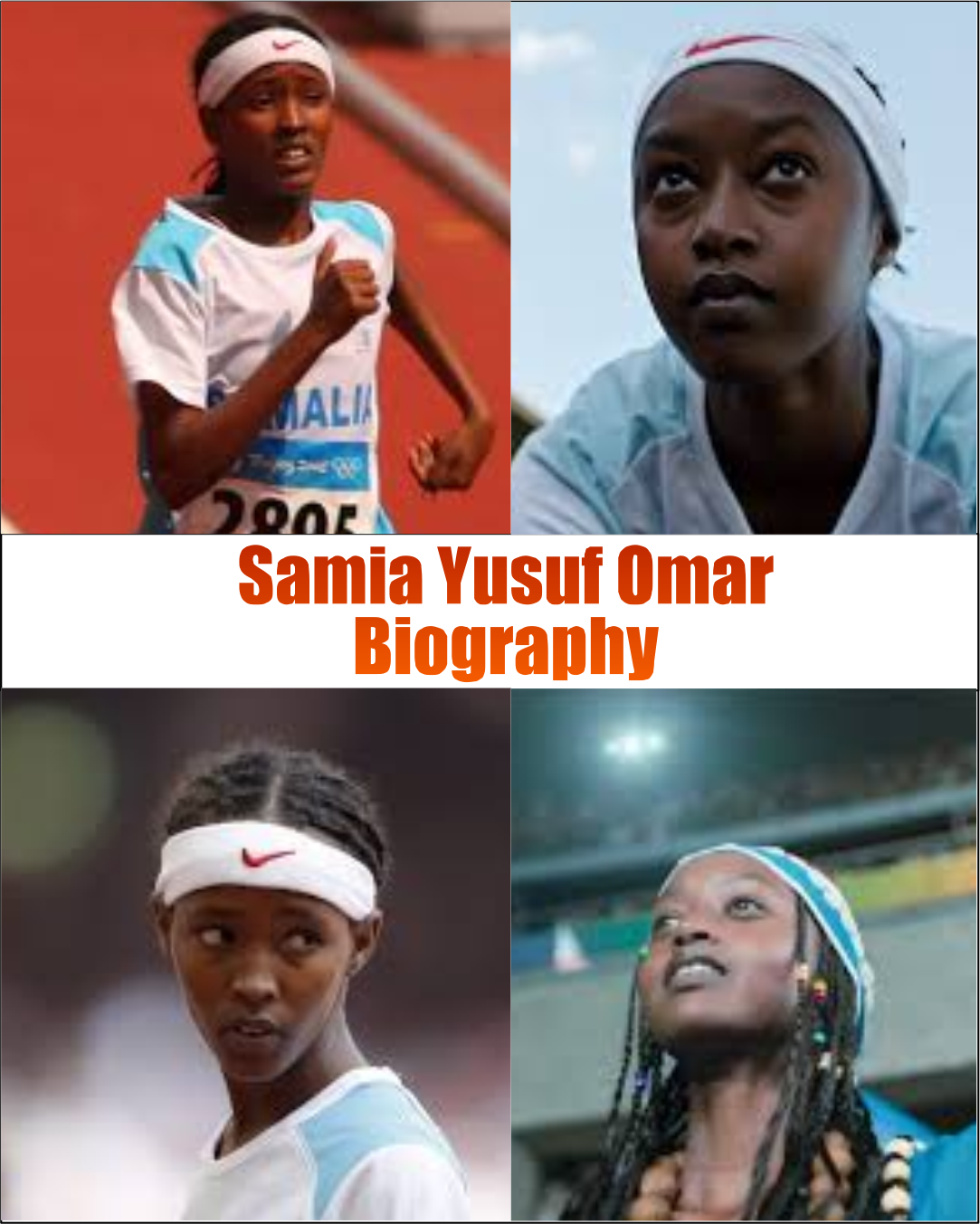
The Samia Yusuf Omar Biography: She Finished Last at the Beijing Olympics and the Crowd Cheered.
Samia Yusuf Omar was seventeen when she ran last in her 200m heat at Beijing 2008. She trained in a war zone, was threatened by Al-Shabaab for being a female athlete, crossed the Sahara, was kidnapped in Libya, and drowned in the Mediterranean in April 2012 at twenty-one — trying to reach Europe to find a coach for the London Olympics she never got to run.
She Finished Last. The Crowd Stood and Cheered. She Died Trying to Come Back: The Story of Samia Yusuf Omar
The camera had already moved on.
The race was over. The other runners had finished, crossed the line, slowed to a jog, begun their celebrations. The television broadcast had cut away from the track to capture the winner’s moment. And still, in lane two of the Bird’s Nest Stadium in Beijing, a seventeen-year-old girl in long black leggings and an oversized white t-shirt was still running.
The crowd rose to give Omar the loudest cheer of anyone in the heat. Charles Robinson, a journalist who watched the race, remembers: “I literally got goosebumps. They were just sort of pushing her.”
Samia Yusuf Omar Biography
| Category | Details |
|---|---|
| Full Name | Samia Yusuf Omar |
| Date of Birth | March 25, 1991 |
| Place of Birth | Mogadishu, Somalia |
| Nationality | Somali |
| Profession | Sprinter, Athlete |
| Field of Work | Athletics, Sport |
| Notable Achievement | Represented Somalia at the 2008 Beijing Olympics at just 17 years old despite having almost no training facilities or coaching support |
| Legacy | Remembered as a symbol of courage, human dignity, and the devastating human cost of the global refugee crisis |
Mogadishu — Growing Up in the Middle of a War
Samia Yusuf Omar was born on 25 March 1991, in Mogadishu, Somalia, the oldest of six children to parents Omar Yusuf and Dahabo Ali.
Mogadishu in 1991 was the year Somalia’s central government collapsed entirely. The civil war that had been building for years consumed the capital the same month she was born. She grew up in a city where the rhythm of daily life was organised around violence — where streets changed hands, where militias controlled neighbourhoods, where the sounds of gunfire were as routine as traffic.
Despite this, she ran. Omar had grown up in Mogadishu and trained there during the Somali Civil War despite receiving harassment from local militia groups. The specific nature of that harassment — directed at a young woman who had the audacity to be seen running in public in a city where militant groups were enforcing increasingly severe restrictions on female movement — tells you everything about the courage that was required simply to show up to training.
See also: Funmilayo Ransome-Kuti Biography – The Woman Who Led 10,000 Into a Palace
Beijing 2008 — The Race Nobody Expected Her to Be In
Omar was selected by the Somali Olympic Committee to compete in the 200 metres at the 2008 Summer Olympics. She said the call-up was unexpected, both because of her young age at the time, and because she was from a minority ethnic group.
She was seventeen. She had never competed internationally at a meaningful level. She had no sponsorship. Because of a lack of funding, Omar competed in equipment donated by the Sudanese team, lining up in a heat which included eventual gold medallist Veronica Campbell-Brown from Jamaica.
Her time was 32.16 seconds — nearly ten seconds behind the heat winner, the slowest 200m time recorded at those Games. On paper, it was a performance that should have been a footnote. In the Bird’s Nest Stadium that night, it was something else entirely.
She finished. She wanted to come back and do better. That was the beginning of the journey that killed her.
The Threats, the Displacement Camp, and the Decision to Leave
She returned from Beijing to a Somalia that had changed again — and to a militant landscape that had decided what had happened in Beijing was a problem.
Al-Shabaab had banned all women from participating in or watching sports. A Somali woman who had just appeared at the Olympic Games — in long black leggings, but still visibly a female athlete competing on an international stage — was exactly the kind of challenge to their authority they had decided they would not tolerate.
Following the Games, she hid away from athletics following threats by militant group Al-Shabaab. She ended up in a Hizbul-Islam displacement camp.
By December 2009, the girl who had been cheered by fifty thousand people in Beijing was living in a camp for displaced persons outside Mogadishu, unable to admit publicly that she was an athlete.
Ethiopia, Sudan, Libya — The Smugglers’ Route to a Dream
Teresa Krug, a journalist who met Omar in Hargeisa, Somaliland, that year, said: “She talked about sports, she watched sports games on YouTube, she played sports when she had any free time.”
She was training in Ethiopia when she could. She was looking for a coach. She had been recommended to Eshetu Tura, a former Ethiopian Olympian, but the pathway to him and to the kind of preparation that would give her a genuine chance at London 2012 kept narrowing.
The route north — the only route available to someone with no visa, no sponsorship, and no institutional affiliation — ran through smugglers.
By late 2011 she was in Libya, having paid smugglers to transport her across from Ethiopia and up through Sudan.
She made it through the Sahara and reached Libya while its civil war was in progress. There she was kidnapped, although it is not clear by whom. Samia’s family was contacted and asked for ransom.
Did you know?
Since 2012, more than 11,300 refugees have died attempting to cross the Mediterranean Sea into Europe. Samia Yusuf Omar was not a statistic when she boarded that boat. She was a named, documented person with a public athletic career and a specific, articulated goal. Her death made the statistic human in a way that numbers alone cannot.
April 2012 — The Mediterranean, the Rope, and the End
In April 2012, Omar boarded an overcrowded migrant vessel carrying approximately 70 people departing from Libya toward Italy. The boat exhausted its fuel supply and drifted in the Mediterranean Sea until intercepted by an Italian naval rescue vessel. During the rescue operation, chaos erupted as migrants scrambled to board the Italian ship using ropes. Omar was knocked into the water, where she briefly treaded before drowning, becoming one of seven fatalities in the incident.
She was twenty-one years old. The London Olympics she had been trying to reach were four months away.
On 19 August 2012, the Corriere della Sera reported that Samia had died. The story came to light during the 2012 Summer Olympics, although Omar’s death had occurred earlier that year in April.
What Her Story Did to Sport
Samia Yusuf Omar never won a medal. She never broke a record. Her net worth was zero and her career statistics consisted of a single Olympic heat that she finished last. By every conventional metric of sporting achievement, her career was negligible.
And yet her story has done more to expose the structural inequality of global sport than most medal-winning performances ever will.
She revealed, with brutal clarity, the gap between what the Olympic ideal claims — universal participation, equal opportunity, the power of sport to transcend circumstance — and what the reality delivers to athletes from the world’s poorest and most conflicted nations. She showed what it actually costs to want to compete when your country is on fire and the organisations that are supposed to support athlete development have no infrastructure, no funding, and no mechanism to protect the people in their care.
What Sport Owes Her
She wanted to be cheered for her performance, not her effort. That preference — the wish to be judged by what she could do rather than by the fact that she was doing it at all — was the most precisely articulated statement of what equality in sport actually means.
Not the opportunity to participate. The opportunity to compete. Not the charity of inclusion. The infrastructure of development — the coaching, the facilities, the safety, the institutional support that allows raw talent to become athletic excellence.
She had the talent. She had the determination. She had the willingness to cross a desert and a sea for the chance to train properly. She did not have the infrastructure. And without it, the talent and the determination and the willingness were not enough.
She did not get to answer that question. She left it for sport to answer without her.
Frequently Asked Question
1. Who is Samia Yusuf Omar?
Samia Yusuf Omar was a Somali sprinter who became one of the most memorable and emotionally significant athletes at the 2008 Beijing Olympics. Born on March 25, 1991, in Mogadishu, Somalia — one of the most dangerous and conflict-ravaged cities in the world — she grew up in circumstances that would have made athletic ambition seem impossible to most people.
2. What made Samia Yusuf Omar’s Olympic appearance so significant?
Samia’s appearance at the 2008 Beijing Olympics was significant not because of her finishing time — she came last in her heat — but because of what her presence in that stadium represented. She had trained on the broken streets of Mogadishu, running in a hijab to avoid harassment, with no coach, no track, and no support from any functioning sporting infrastructure.
3. Why did Samia Yusuf Omar attempt to leave Somalia and what happened to her?
After her return from Beijing, Samia’s life in Mogadishu became increasingly dangerous. The Islamic extremist group Al-Shabaab, which controlled large parts of the city, considered her athletic activities — particularly her running in public and her appearance at an international event without full covering — to be contrary to their interpretation of Islamic law.
4. What did Samia Yusuf Omar’s death reveal about the global refugee crisis?
Samia’s death in the Mediterranean was not unique in the horrifying statistical sense — thousands of refugees and migrants have drowned attempting the same crossing before and after her. What made her death particularly powerful as a symbol was the specific cruelty of the contrast it presented.
5. What is Samia Yusuf Omar’s lasting legacy?
Samia Yusuf Omar’s legacy is one of the most emotionally powerful in modern sport — not because of what she achieved athletically, but because of what her life and death together communicate about human courage, human vulnerability, and the responsibilities of the international community toward people fleeing conflict and persecution.