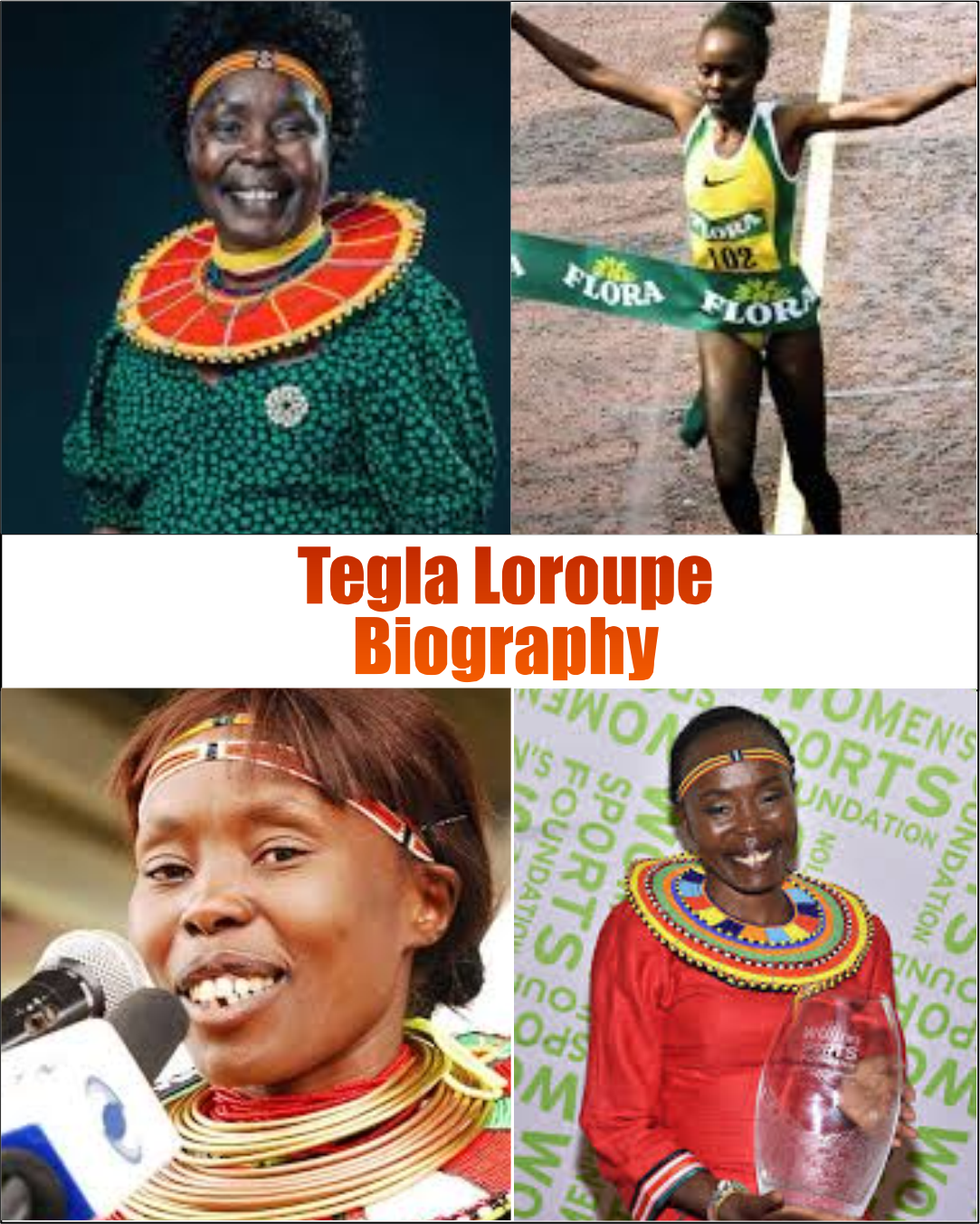
The Tegla Loroupe Biography: She Ran Barefoot to School and Set World Records.
Tegla Loroupe was one of 25 children in a West Pokot village, ran 10km barefoot to school daily, became the first African woman to win the New York Marathon, held the world marathon record, then spent her prize money building peace schools and organising races that made warriors put down their weapons. She is the only person ever to lead two consecutive IOC Refugee Olympic Teams.
She Ran Barefoot to School. She Set World Records. Then She Used Sport to Stop a War: The Story of Tegla Loroupe
Her father had five wives and twenty-four children. He believed women belonged in the fields and the kitchen. When his daughter Tegla — called Chepkite, meaning little one — started running eighteen kilometres a day barefoot to school and back, he saw a child doing chores, not an athlete in the making.
He was profoundly wrong.
Tegla Loroupe Biography
| Category | Details |
|---|---|
| Full Name | Tegla Chepkite Loroupe |
| Date of Birth | May 9, 1973 |
| Place of Birth | Kapsait, West Pokot District, Kenya |
| Nationality | Kenyan |
| Profession | Long-Distance Runner, Peace Ambassador, Humanitarian |
| Field of Work | Athletics, Humanitarian Work, Peace Building, Women’s Empowerment |
| Notable Achievement | First African woman to win the New York City Marathon; set multiple world records in the marathon and broke barriers for African women in long-distance running |
| Legacy | Celebrated as one of Kenya’s greatest athletes and a global peace ambassador whose foundation has transformed lives across conflict-affected communities in East Africa |
The Girl Kenya’s Athletics Federation Called Too Small
When Tegla Loroupe began competing seriously, the institution that should have supported her did not believe in her.
The Kenyan athletics federation, Athletics Kenya, did not support her at first, thinking Loroupe too small and too thin. However, after she won a prestigious cross-country barefoot race in 1988, this changed.
She was fifteen years old and running barefoot against athletes in proper shoes. She won anyway. Athletics Kenya revised its assessment. She began to train to compete internationally the following year, earning her first pair of running shoes in 1989, which she wore only for particularly rough races.
Did you know?
In 1994 and 1998, Loroupe won the 10,000 metres at the Goodwill Games — barefoot — and won bronze medals at the World Athletics Championships in 1995 and 1999 at the same distance. A two-time World Championship medalist, competing at international level without shoes by choice.
The performance was a statement: the surface she ran on mattered less than the legs carrying her.
See also: Nongqawuse Biography – A Girl, a River, a Prophecy
Career — The Records That Remade African Women’s Athletics
At the 1994 New York City Marathon, Tegla Loroupe of Kenya made history as the first African woman to win a major marathon title.
The significance of that victory extended well beyond the finish tape. African men had been dominating marathon running for a decade. Kenyan and Ethiopian male athletes were restructuring the global understanding of what distance running could look like. But African women had not yet broken through at the major marathon level. Loroupe’s 1994 New York victory changed that permanently — it announced that what was happening in African male athletics was not a gender-specific phenomenon but a continental one.
She won New York again in 1995. Then Rotterdam three times between 1997 and 1999. Then Berlin in 1999, London in 2000, Rome in 2000, and Lausanne in 2002.
Between 19 April 1998 and 30 September 2001, Loroupe held the world record for the marathon. She initially set a time of 2:20:47 in the 1998 Rotterdam marathon. In 1999, she broke her own record, setting a time of 2:20:43 in the Berlin marathon — making her the first woman to break the 2:21 barrier.
She notched three world half-marathon titles between 1997 and 1999 and held world records for 20,000m, 25,000m, and 30,000m on the track.
She never won an Olympic medal. It remains the only gap in a career that redefined African women’s athletics.
The Sister Who Died, the Children She Adopted, and the War She Decided to Stop
“I grew up in a pastoral environment where life was really hard because of the local conflicts between the tribes and people stealing cattle.”
The cattle raids that plagued the West Pokot region of Kenya — and the connected territories of Uganda, Sudan, and Ethiopia — were not simply property crimes. They were a cycle of violence in which young men from competing tribes stole cattle, triggered retaliatory raids, and produced a pattern of killing that had been running for generations. Children were orphaned. Communities were destabilised. The hunger for land and water in one of Africa’s most resource-scarce regions found its expression in spears and guns rather than negotiation.
Matters were galvanised when Tegla’s elder sister died leaving three children. Tegla was the one with the means, so she took over, raising the children and sending them to school.
The sister’s death focused something that had been forming across years of running through the same landscapes where the violence happened. Loroupe says she grew up surrounded by conflict. All around her, she saw violence at the hands of warring tribes in Kenya, Sudan, Uganda and Ethiopia.
The Peace Academy, the Orphanage, and the Refugee Team
In Kapenguria, 50 kilometres away from her birthplace, she still lives with her mother, the orphans of her deceased sister and other adopted children. The “Peace and Leadership School” provides education to girls and offers protection from abuse, forced marriage and genital mutilation, which is still widespread in rural Africa.
The school was built with prize money. The orphanage was funded by speaking fees and sponsorship. The infrastructure of the foundation — the annual peace races, the school, the orphanage, the diplomatic work — was assembled from the financial proceeds of a running career, reinvested into the community that the running had come from.
Loroupe once again became the leader of the Refugee Olympic Team for the Tokyo Olympics, having also led the team at the 2016 Rio Olympics. The 2016 team comprised ten athletes who, Loroupe says, “reminded the world of the sufferings and perseverance of millions of refugees around the world.”
She is the only person to have led two consecutive IOC Refugee Olympic Teams — the institutional embodiment of her belief that sport belongs to people regardless of where they were born or what had happened to their country.
Philosophy, Motivation, and What Running Taught Her About Peace
“I was lucky. I had talent and was able to make a success out of running and I felt that I wanted to give things back to the community I grew up in.”
But luck does not explain the peace races. Luck does not explain raising the sister’s three orphaned children. Luck does not explain building a school in a conflict zone with prize money. Those are choices — deliberate, sustained, expensive choices made by someone who understood that the platform running had given her was not her property. It was the community’s.
Dr Moody A. A. Awori, the Kenyan Vice President who attended the foundation stone laying of the Peace Academy, told the crowd: “If we had one hundred Tegla Loroupes, then we would have everlasting peace!”
Achievements, Recognition, and Net Worth
Her athletic record includes: two New York Marathon victories; three Rotterdam Marathon victories; wins in Berlin, London, Rome, and Lausanne; three consecutive World Half-Marathon Championships; world records in the marathon, 20km, 25km, and 30km; two World Championship bronze medals in the 10,000m; and two Goodwill Games 10,000m titles — both barefoot.
Her humanitarian recognition includes: United Nations Ambassador for Sport (2006, appointed alongside Roger Federer); Oxfam Ambassador of Sport and Peace; IAAF Ambassador; UNICEF Ambassador; Champions for Peace member; UN Person of the Year in Kenya (2016); ISPO Cup recipient (2020).
Her net worth is estimated at approximately $2 million — the accumulated proceeds of prize money, sponsorships, and speaking engagements, most of which has been reinvested into the foundation, the school, and the orphanage rather than personal wealth accumulation.
What She Changed About Sport
Before Tegla Loroupe, sport and conflict resolution existed in separate institutional worlds. Diplomats managed conflicts. Athletes ran races. The idea that an athlete’s platform, combined with the shared physical experience of competitive running, could be a genuine mechanism of tribal peacebuilding was untested at scale.
After Tegla Loroupe, it is documented. The warriors who ran together and put down their weapons are the evidence. The school that protects girls from forced marriage is the evidence. The Refugee Olympic Team that she led twice — giving stateless athletes a flag, a uniform, and an Olympic stage — is the evidence.
She took the thing sport gave her — the records, the prize money, the platform, the credibility — and put it entirely in service of the place it came from. The barefoot girl who ran 18km a day to school did not leave West Pokot behind when she set the world marathon record. She carried it with her to New York and Rotterdam and Berlin, and then she brought the world’s attention back to it and said: this is where I come from. These are my people. They deserve peace.
She ran to reach the world. Then she used the world to reach back.
Frequency Asked Questions
1. Who is Tegla Loroupe?
Tegla Loroupe is a Kenyan long-distance runner and humanitarian who is widely regarded as one of the greatest female marathon runners in history and one of the most important peace advocates Africa has produced through sport. Born on May 9, 1973, in Kapsait in the West Pokot District of northwestern Kenya, she grew up in a remote and impoverished community where girls were expected to marry early rather than pursue education or athletic ambitions.
2. What were Tegla Loroupe’s most significant athletic achievements?
Tegla Loroupe’s athletic career produced a record of achievement that places her among the greatest long-distance runners of any era and any nationality. She won the New York City Marathon in both 1994 and 1995 — becoming the first African woman ever to win a major international marathon and opening a door through which generations of African female distance runners have since walked.
3. What is the Tegla Loroupe Peace Foundation and how does it work?
The Tegla Loroupe Peace Foundation was established by Tegla in 2003 in response to the devastating inter-communal conflicts that periodically erupted between pastoralist communities in the border regions of Kenya, Uganda, Sudan, and Ethiopia — conflicts driven by competition over water, land, and cattle that had caused thousands of deaths and enormous human suffering.
4. What barriers did Tegla Loroupe overcome to become a professional athlete?
The barriers Tegla Loroupe faced on her path to athletic success were formidable on every front. She came from the Pokot community in northwestern Kenya where the expectation for girls was marriage and domestic life, not athletic competition. Her family was large and poor, and she was one of more than twenty children. She ran barefoot to school across distances of many kilometres each day — not as athletic training but simply as the only means of getting there — and it was this daily running that first revealed her extraordinary physical gifts.
5. What is Tegla Loroupe’s lasting legacy?
Tegla Loroupe’s legacy operates powerfully across two distinct but related domains — sport and humanitarian work — and her impact in both is genuinely historic. As an athlete she was a pioneer who proved that African women could compete and win at the highest levels of international marathon running at a time when that had never been done before, and whose world records and major victories opened the door for the extraordinary generation of African female distance runners who have dominated the sport in the decades since.