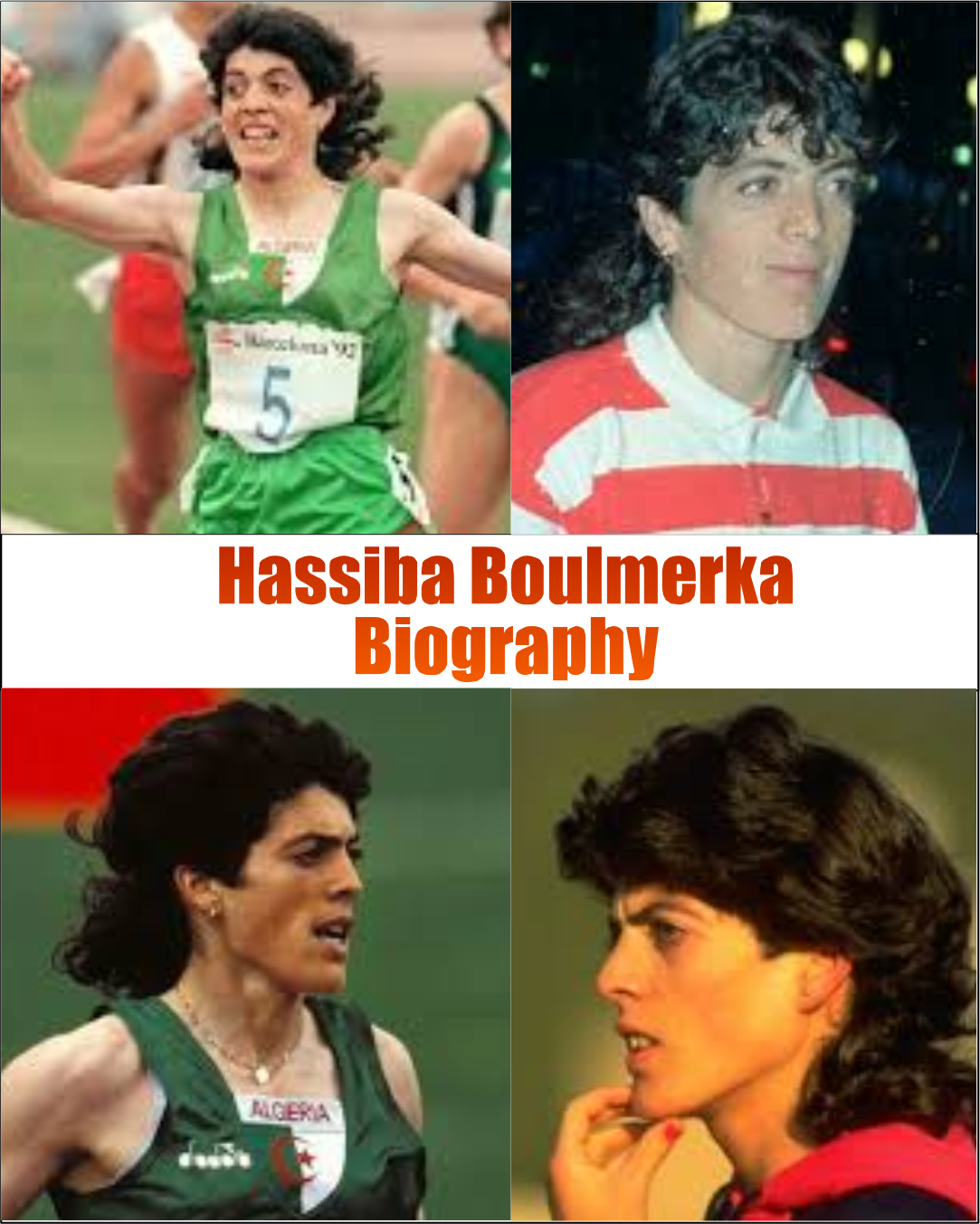
The Hassiba Boulmerka Biography: She Ran Away and Won the Olympic Gold.
Hassiba Boulmerka was spat on, stoned, and denounced from mosques for running in standard athletic gear during Algeria’s Black Decade. Death threats from Islamist militants forced her to train in exile. She won two World Championships and Algeria’s first Olympic gold medal — while a civil war raged at home — then spent her retirement fighting for women’s rights in sport at the IOC.
They Spat on Her in the Street. They Denounced Her From the Mosque. She Won the Gold Anyway: The Story of Hassiba Boulmerka
The stones and the spit came first. Then the death threats. Then the civil war.
This is not simply a story about a great athlete. It is a story about what sport costs when your country has decided that your body, in motion, is a political threat.
Hassiba Boulmerka Biography
| Category | Details |
|---|---|
| Full Name | Hassiba Boulmerka |
| Date of Birth | July 10, 1968 |
| Place of Birth | Constantine, Algeria |
| Nationality | Algerian |
| Profession | Middle-Distance Runner, Athletic Champion |
| Field of Work | Athletics, Women’s Sport, Social Advocacy |
| Notable Achievement | First Algerian and first Arab woman to win an Olympic gold medal — at the 1992 Barcelona Olympics in the 1500 metres |
| Legacy | Celebrated as a pioneer of women’s sport in the Arab world and a symbol of courage in the face of religious and political intimidation |
Constantine — The City That Gave Her Both Her Gift and Her War
Hassiba Boulmerka was born on 10 July 1968 in Constantine, northeastern Algeria.
Constantine is one of Algeria’s oldest cities — built on a rocky plateau in the country’s northeast, surrounded by deep gorges, a city of extraordinary physical drama whose history runs from Numidian antiquity through French colonialism to post-independence Algeria. It is also, for Boulmerka, simply home — the city whose name she carried into every competition as the Constantine Gazelle, the title the Algerian press gave her and that she accepted without false modesty because it was accurate.
Born into a modest family, Boulmerka faced resistance to her athletic ambitions from an early age. Her father initially opposed her running in standard athletic attire, concerned about local perceptions of women competing in shorts and sleeveless vests. A supportive physical education teacher, Aboud Labed, recognised her potential and convinced her father to allow her to compete.
See also: Mary Seacole Biography – The Crying Woman of London Street
The Training, the Sacrifice, and the Weight of Being First
Boulmerka started running seriously at the age of ten, specialising in the 800 and 1,500 metres. She was successful in national and regional races. Her first major international tournament was the 1988 Summer Olympics in Seoul, where she was eliminated in the preliminary heat of both the 800 and 1,500m.
Seoul was education. She was twenty years old, inexperienced at international level, and the gap between her performance and the world’s best was substantial. She returned to Algeria and made a decision with her coach Ammar Bouras that would define the next three years.
“I sat down with my coach Ammar Bouras to talk about what to do. We decided I would work very hard in all areas of my training to get results after two years of solid work. We set out more optimistically to aim for a gold medal in Barcelona. You can’t win gold unless you work extremely hard, making all the sacrifices possible.”
Did you know?
Boulmerka held the African record in the 1500 metres (3:55.30) from 1992 until 2015 — twenty-three years — and set an African mile record in Oslo in 1991 that stood until 2008.
She was a practising Muslim throughout her career and said explicitly that her choice of athletic dress was a matter between her and God, concerning nobody else.
Tokyo 1991 — The Scream That Started a Civil War’s Worth of Trouble
At the 1991 World Championships in Tokyo, Hassiba Boulmerka did something that had never been done before.
She was the first woman from an Arab or African nation to win a world track-and-field championship.
On the last straight of the 1500m final, she sprinted through the field and crossed the line in 4:02.21. She grabbed her hair and howled. “I was screaming for Algeria’s pride and Algeria’s history,” she said. “I screamed finally for every Algerian woman, every Arabic woman.”
Following her 1991 world title, death threats from Islamist militants forced her to relocate her training base to Europe.
She went to Cuba, then to Europe. She trained in exile from the country that had just celebrated her as a champion. She continued preparing for Barcelona.
Barcelona 1992 — Gold, the Fist, and the Civil War That Waited at Home
In the summer of 1992, as the world watched the Barcelona Olympics, a young woman from Constantine crossed the finish line of the women’s 1500 metres in a personal-best time that would echo far beyond the track.
In the final lap, she pushed her way forward to reach the finish line in 3:55.30, becoming the pride of her country. It was Algeria’s first gold medal at the Olympic Games. “As I crossed the line, I thrust a fist into the air.”
“I tried to hold myself together, to be brave…but the tears just started to fall. They were tears of sacrifice, for all the people I loved that I had abandoned for this race. It was a triumph for women all over the world to stand up to their enemies. That’s what made me really proud.”
1995 Gothenburg — The Second Title Nobody Expected
The years between Barcelona and the 1995 World Championships in Gothenburg were not smooth. Algeria’s civil war was at its most intense. She trained largely in exile. Her results in 1994 and early 1995 were inconsistent.
In 1995, she hadn’t won a single race going into the World Championships in Gothenburg, but this did not prevent her from winning her second world title. It was her only victory of that season, and her last major victory.
The second World Championship title was, in some ways, the more remarkable of the two — won without the momentum of a great competitive season, against athletes who had been running better form all year, on pure championship nerve and the specific quality of a person who had learned to perform under pressure by practising it under actual threat of death.
She ran 4:02.42 to win. The Constantine Gazelle had done it again — from exile, from civil war, from the specific circumstances that would have broken most people’s competitive focus entirely.
Retirement, the IOC, and the Advocacy That Followed the Track
After retiring in 1997, feeling worn out by the fights that accompanied her sporting life, Boulmerka was elected to the International Olympic Committee Athletes’ Commission in 1999.
The IOC Athletes’ Commission was the platform from which she continued the argument she had been making on the track — that women’s participation in sport at the highest level was not a concession to be granted or a privilege to be managed, but a right to be protected. The specific experience she brought to those deliberations — having competed under genuine death threats, having trained in exile because her home country was not safe for her — gave her interventions in discussions about women and sport a weight that no amount of theoretical commitment could replicate.
What She Changed About Sport — The Before and After
Before Hassiba Boulmerka, the conversation about Muslim women and international sport was largely theoretical — a debate conducted by institutions about whether religious and cultural constraints could be accommodated within athletic participation frameworks. It was abstract because there was no visible, documented example of what the experience actually looked like from the inside.
After Hassiba Boulmerka, it was documented. Not politely, not without cost, not in conditions that made the argument easy — but documented in gold medals and World Championship titles won under death threats, in training sessions conducted in exile because the home country was too dangerous, in a career built despite the full institutional weight of an armed political movement trying to prevent it.
Nouria Mérah-Benida, who won 1500 metres gold for Algeria at the 2000 Sydney Olympics, explicitly acknowledged Boulmerka’s courageous legacy as inspiration. The direct lineage — Boulmerka to Mérah-Benida, Algeria’s second Olympic gold in the same event eight years later — is the clearest measurement of her impact. She created the possibility. The next generation used it.
Philosophy — What Drove Her Through All of It
“I screamed for joy and for shock, and for much more. I was screaming for Algeria’s pride and Algeria’s history, and still more. I screamed finally for every Algerian woman, every Arabic woman.”
She never ran simply for herself. From the beginning — from the moment Aboud Labed timed her on a short run in Constantine and told her it mattered — she understood that her performance carried meaning beyond the personal. She was running for the idea that Algerian women existed in public, moved in public, competed in public, and did not require anyone’s permission to do so.
With her refusal to conform, she affirmed her individual liberty, her independence, and her attachment to a modern and secular Algeria, without conforming to the diktats of a patriarchal society. She claimed she had a difficult career, with many sacrifices due to training sessions and pressure.
She said it was a matter between her and God. Her choice of dress concerned nobody else. That sentence — delivered by a practising Muslim who had just won a World Championship in standard athletic gear, under death threats, during a civil war — is the most precise and most powerful statement of the argument she made with her entire career.
Frequently Asked Questions
1. Who is Hassiba Boulmerka?
Hassiba Boulmerka is an Algerian middle-distance runner who became one of the most celebrated and historically significant athletes in the history of African and Arab sport. Born on July 10, 1968, in Constantine, Algeria, she rose through the ranks of Algerian athletics during a period of intense political and social turbulence in her country to become the dominant 1500 metres runner in the world in the early 1990s.
2. What made Hassiba Boulmerka’s 1992 Olympic gold medal historically significant?
Hassiba Boulmerka’s gold medal in the 1500 metres at the 1992 Barcelona Olympics was a moment of historic significance that extended far beyond the boundaries of sport. She was the first Algerian ever to win an Olympic gold medal — male or female — and the first Arab woman in history to stand on the top step of an Olympic podium.
3. What threats and pressures did Hassiba Boulmerka face because of her athletic career?
The threats and pressures Hassiba Boulmerka faced because of her athletic career were severe, sustained, and genuinely dangerous. Conservative Islamist groups in Algeria condemned her publicly for competing in shorts — arguing that a Muslim woman running in athletic clothing in front of mixed international audiences violated Islamic principles of modesty.
4. How did Hassiba Boulmerka respond to the political and religious pressure she faced?
Hassiba Boulmerka’s response to the threats and condemnation she faced was one of the most courageous and articulate defences of women’s athletic rights that modern sport has produced. She did not simply ignore the attacks or keep silent — she engaged with them directly and publicly, arguing that her running was an expression of Algerian national pride rather than a violation of Islamic values, and that the attempt to silence her was a political project rather than a genuinely religious one.
5. What is Hassiba Boulmerka’s lasting legacy?
Hassiba Boulmerka’s legacy is one of the most significant in the history of African and Arab sport and in the broader history of women’s athletic rights. She won a second World Athletics Championship gold medal in 1995 in Gothenburg — demonstrating that her 1991 and 1992 victories were not the product of a single exceptional moment but of sustained excellence across the prime years of a great athletic career.