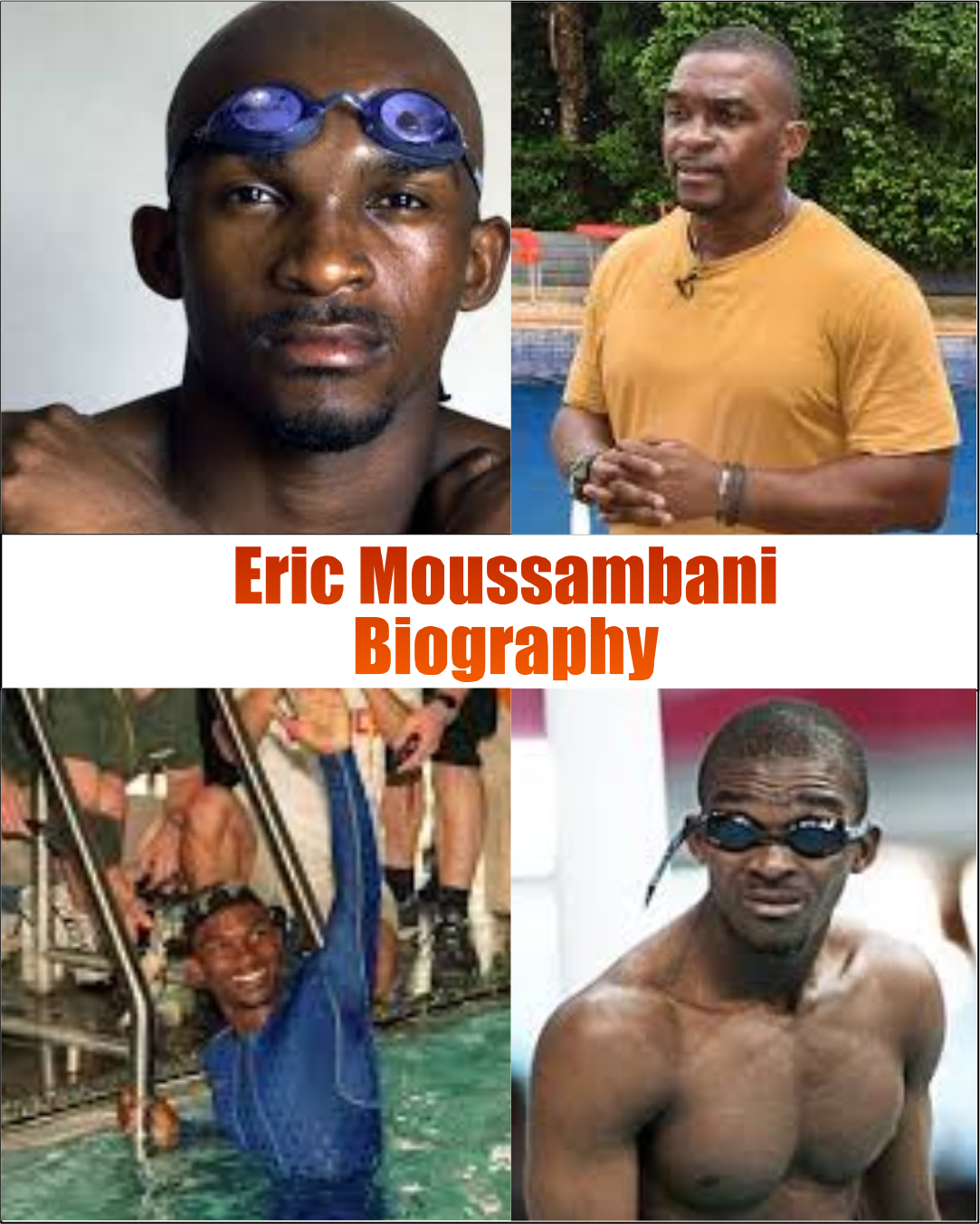
The Eric Moussambani Biography: He Could Not Swim Properly But Changed Olympics.
Eric Moussambani trained three hours a week in a 13-metre hotel pool in Equatorial Guinea, had never seen a 50-metre Olympic pool, wore borrowed shorts and goggles on race day, nearly drowned completing his heat, and won it anyway when both opponents were disqualified. He became the most talked-about athlete at Sydney 2000, cut his time by nearly a minute, and is now his country’s national swimming coach.
He Had Never Seen a 50-Metre Pool. He Got In Anyway. Then the Whole World Stood Up: The Story of Eric Moussambani
The South African coach saw him first.
“Where are you going?” the coach asked. “Swimming,” said Eric Moussambani. The coach handed him competition trunks and goggles and helped him work on his technique.
Eight months after learning to swim in a hotel pool in Malabo, Eric Moussambani walked into the Sydney Olympics and produced one of the most discussed athletic performances of the twenty-first century — not because it was the fastest, but because it was the most honest. An honest account of what Olympic participation actually looks like when you strip away the funding, the facilities, the professional coaching, and the generations of athletic infrastructure, and leave only a person and a pool and the willingness to get in.
Eric Moussambani Biography
| Category | Details |
|---|---|
| Full Name | Eric Moussambani Malonga |
| Date of Birth | May 31, 1978 |
| Place of Birth | Equatorial Guinea, Central Africa |
| Nationality | Equatoguinean |
| Profession | Swimmer, Sports Coach, National Swimming Federation Official |
| Field of Work | Swimming, Sports Administration, Athletic Development |
| Notable Achievement | His extraordinary 100 metres freestyle swim at the 2000 Sydney Olympics became one of the most celebrated and emotionally powerful moments in Olympic history |
| Legacy | Celebrated globally as a symbol of Olympic participation, human determination, and the spirit that sport is about more than winning |
Malabo, Equatorial Guinea — A Country That Had No Pool
Eric Moussambani Malonga was born on 31 May 1978 in Equatorial Guinea.
Equatorial Guinea is a small nation on the western coast of Central Africa — one of the continent’s smallest countries by population, with fewer than one million people at the time of the Sydney Games, sitting between Cameroon and Gabon. It was a small, oil-rich nation that faced numerous developmental challenges, including limited access to advanced sports training and infrastructure.
Swimming was not a developed sport there. There were no Olympic-size pools. There were no competitive clubs. There was no tradition of swimming as an organised athletic discipline. What there was — as in most coastal and river communities across Central Africa — was water. Rivers, the sea, the specific practical knowledge of how to move through water that people who live near it accumulate over generations.
“I started swimming when I left school. We didn’t have a swimming pool. We didn’t have anything, and I went to train at a private hotel pool that was about 13 metres long. I trained on my own and I had no swimming experience. The pool was only available from 5am to 6am and I was only able to train for three hours a week. I used to go swimming in rivers and the sea too.”
See also: Yasuke Biography – The African Man Who Walked Into Japan
The Wildcard System — What It Was Supposed to Do
Understanding Eric Moussambani’s story requires understanding the mechanism that put him in Sydney in the first place.
Moussambani gained entry to the Olympics without meeting the minimum qualification requirements via a wildcard draw designed to encourage participation by developing countries lacking full training facilities.
The wildcard system existed because the IOC had recognised a genuine structural problem: the Olympic movement claimed universal participation as a foundational value, but the qualification standards it maintained effectively excluded athletes from countries with limited sporting infrastructure. A swimmer from Equatorial Guinea — a country with no Olympic-size pools, no professional coaching, no competitive programme — could never reach the qualification standard through conventional means, no matter how talented or determined they were.
Did you know?
Before Sydney 2000, the Equatorial Guinea Swimming Federation had been formed just six months before the Games, and Moussambani had only taken up swimming eight months prior. The federation was younger than his swimming career. Both were younger than the race he was about to swim.
September 19, 2000 — The Heat Nobody Will Forget
Moussambani was a wide-eyed 22-year-old when he made his way to Sydney for the Games: “I’d never even heard of Sydney or Australia, and it was the first time I’d ever been outside my country.”
“When they showed me the Olympic pool, I had never seen one so big, I thought ‘seriously, I can’t.'”
On the morning of September 19, he stepped onto the blocks for the opening heat of the men’s 100m freestyle alongside two other wildcard swimmers — Nigeria’s Karin Bare and Tajikistan’s Farkhod Oripov. Both were disqualified for false starts. Eric Moussambani was alone in lane five of the Sydney International Aquatic Centre, in front of seventeen thousand people, facing 100 metres of water he had never swum before.
“I swam the first 50 metres really well,” he recalls. “I focused all my energy on telling myself to keep going and to make it to the end.”
“The last 15 metres were very difficult.”
Difficult is an understatement. Television footage shows his freestyle deteriorating into something closer to survival — arms churning the water, head lifting desperately for air, pace slowing to what appeared to be the edge of what a human body can sustain. At one point, he grabbed onto the lane rope to prevent himself from going underwater. People near the pool reportedly considered diving in.
“At the end of the race, I felt grateful above all because at least I had been able to represent my country, because I had managed to finish those 100 metres, which I had never done before.”
His time was 1:52.72 — the slowest in Olympic history, more than a minute behind the heat winner of the overall competition. He had won his heat only because both opponents were disqualified. He did not advance. He went home as the most talked-about swimmer in Sydney.
After Sydney — The Improvement Nobody Covered
The story that the media told about Eric Moussambani ended at the pool wall in Sydney. The story that actually happened continued for years.
Speedo, looking to capitalise on his rising popularity, had Moussambani perform promotional work throughout Europe for the next year. He trained properly for the first time — with real coaching, real facilities, real competitive exposure. The results were dramatic.
Moussambani eventually lowered his national record to 57 seconds — almost halving the time of his Olympic performance.
From 1:52.72 to 57 seconds. A reduction of nearly a minute, achieved through proper training from a baseline of fisherman-coached river swimming. The improvement was extraordinary — evidence that what had been absent in Sydney was not talent or determination but infrastructure. Give Eric Moussambani a proper pool, a proper coach, and proper time, and the distance between him and international competition narrowed dramatically.
National Coach, Oil Company Engineer, and the Legacy That Kept Growing
“I’m a different Eric than 20 years ago. I have a wife and four children. I’m not rich but I earn my living.”
He works as an IT engineer at an oil company in Malabo. Three times a week, after his regular working hours, he goes to the pool. In March 2012, Moussambani was appointed coach of the national swimming squad of Equatorial Guinea.
He is coaching the next generation of Equatoguinean swimmers in conditions that are fundamentally different from the ones he grew up in — because of what happened at Sydney 2000.
Thanks to his efforts, Equatorial Guinea now boasts two 50-metre pools — one in Malabo and the other in Bata.
Philosophy — What the Race Was Really About
“Before, nobody knew me and now everyone does. So this is good for me and my people.”
He said that immediately after Sydney, and it captures the specific orientation of his entire relationship with his Olympic moment. He did not experience it primarily as personal achievement or personal humiliation — the two categories that external observers tried to assign to it. He experienced it as representation. As visibility. As his country being seen.
There is no doubting the heart of Moussambani, who carried himself with honour. He put forth his best effort during his one race.
The medal count of the Sydney Olympics lists no achievement for Eric Moussambani. The impact count does not work that way.
What He Changed About Sport — The Before and After
Before Eric Moussambani, the wildcard system existed on paper. It had a theoretical purpose — to encourage participation by developing nations — but its actual function in the global sporting imagination was invisible. Nobody had tested it in a way that made the inequality it was designed to address viscerally, globally, undeniably apparent.
After Eric Moussambani, that inequality was visible. Seventeen thousand people in Sydney and millions watching on television had seen, in real time and in exhaustive detail, exactly what it looks like when a nation with no pools, no coaching, and no competitive infrastructure sends a person to an Olympic Games.
The conversation that followed — about what the wildcard system was actually doing, about whether access without infrastructure was genuine inclusion or a performance of it, about the responsibility the Olympic movement had to nations like Equatorial Guinea for more than just a wildcard invitation — was a more honest conversation than had been happening before he got in the water.
“The time wasn’t good, but I did it.”
Frequently Asked Questions
1. Who is Eric Moussambani?
Eric Moussambani is an Equatoguinean swimmer who became one of the most recognisable and beloved figures in the history of the Olympic Games following his extraordinary appearance at the 2000 Sydney Olympics.
2. What happened at the 2000 Sydney Olympics and why did it capture the world’s attention?
Eric Moussambani was entered in the 100 metres freestyle event at the Sydney Olympics. In his preliminary heat, his two competitors were disqualified before the race even began for false starts — leaving him to swim alone. What the crowd in the Sydney Aquatic Centre then witnessed was unlike anything they had seen at an Olympic swimming competition.
3. How did Eric Moussambani prepare for the Olympics and what challenges did he face?
The circumstances of Eric Moussambani’s preparation for the Sydney Olympics were almost incomprehensibly different from those of his competitors. He had learned to swim just eight months before the Games, taught himself largely through trial and error, and trained in a hotel pool in Malabo — the capital of Equatorial Guinea — that measured only 12 metres in length. He had never swum in a full 50 metre Olympic pool before arriving in Sydney.
4. What did Eric Moussambani do after the Sydney Olympics?
Eric Moussambani’s story did not end in Sydney. His celebrity following the Games opened doors and created opportunities that transformed both his own life and the swimming landscape in Equatorial Guinea. He continued to train and improve — his technique becoming significantly more efficient as he gained access to better coaching and longer pools.
5. What is Eric Moussambani’s lasting legacy?
Eric Moussambani’s legacy is one of the purest and most universally understood in the history of sport. He is known affectionately around the world as Eric the Eel — a nickname given to him by the Sydney crowd and the international media that has stuck with warmth and genuine affection rather than mockery.