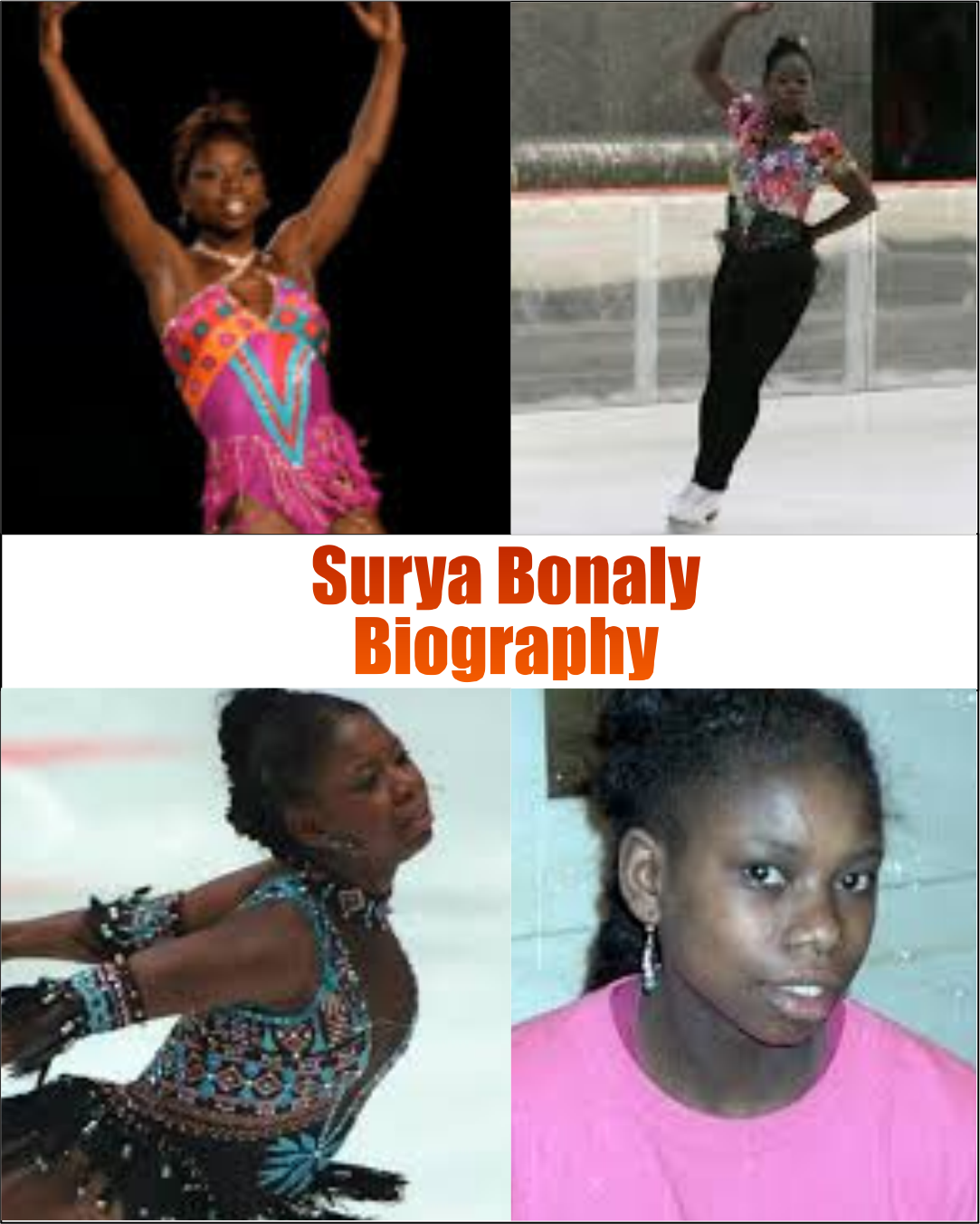
The Surya Bonaly Biography
The Surya Bonaly Biography: She Did the Backflip First.
Surya Bonaly was the first person to land a backflip on one blade at the Olympics in 1998. She was penalised, finished 10th, and called “too athletic” for a sport that rewarded delicacy over power. In February 2026, Ilia Malinin did the same move legally at the Milan Olympics and won gold. The ban had been lifted in 2024 — because of what she started. She said she was simply born too early.
She Was Penalised for the Backflip. He Won Gold for It. She Said: “Somebody Had to Start.”
In February 2026, at the Milan Cortina Winter Olympics, American figure skater Ilia Malinin landed a backflip on one blade during competition. The crowd erupted. The judges rewarded him. He won gold. The internet called it historic.
It was the 1998 Winter Olympics in Nagano, Japan, where the then-24-year-old Bonaly, with just moments left in what would be her final Olympic performance, gave herself, the crowd and the cameras something unforgettable. The judges docked points over the then-banned move. She finished 10th.
The same move. The same Olympic stage. Twenty-eight years apart. One penalised. One celebrated. One Black woman who didn’t fit the mould. One young white man the sport was ready for.
Surya Bonaly Biography
| Category | Details |
|---|---|
| Full Name | Surya Bonaly |
| Date of Birth | December 15, 1973 |
| Place of Birth | Nice, France |
| Nationality | French |
| Profession | Figure Skater, Athletic Champion, Performer |
| Field of Work | Figure Skating, Sport, Performance |
| Notable Achievement | Five-time European Champion and three-time World Championship silver medallist; performed the only one-blade backflip landing in Olympic history at the 1998 Nagano Games |
| Legacy | Celebrated as one of the most athletically gifted and barrier-breaking figure skaters in history and a pioneer of Black representation in competitive skating |
Nice, an Orphanage, and the Parents Who Changed Everything
Surya Varuna Bonaly was born on 15 December 1973 in Nice, France. She was adopted out of an orphanage at the age of eight months by Suzanne Bonaly, a physical education teacher, and Georges Bonaly, a draftsman who worked for the French government.
The name Surya came from a Hindu deity — the sun god — a choice that reflected her adoptive parents’ spiritual eclecticism and their determination to give their daughter a name as singular as the life they intended to help her build. Suzanne, the PE teacher, understood bodies, movement, and athletic potential from the beginning. She saw what her daughter could do and she committed to it fully — eventually becoming Surya’s coach and the most present figure in her competitive career.
She was a gymnast in her youth, winning a silver medal as part of the French national tumbling team. Her tumbling skills would transition into her skating and give her an athletic edge over her peers.
See also: Granville Woods Biography – The Man Who Beat Thomas Edison in Court Twice
Career — Nine Titles, Five European Crowns, and Three Silver Medals That Should Have Been Gold
Bonaly is a three-time World silver medalist (1993–1995), a five-time European champion (1991–1995), the 1991 World Junior Champion, and a nine-time French national champion (1989–1997).
The record speaks for itself: nine consecutive national titles, five consecutive European Championships, three consecutive World Championship silver medals. No French figure skater — male or female — has ever won more World Championship medals. With her three consecutive silvers, she still has more World Championship medals than any French individual skater, ever.
She was the most decorated French figure skater in history. She never won the World title. The three silvers she collected between 1993 and 1995 represent a story that the results column cannot fully tell.
At the 1992 Olympics in Albertville, Bonaly became the first woman ever to attempt a quadruple jump in Olympic figure skating when she landed a four-revolution jump.
Did you know?
Bonaly was described by commentators with racially coded terms like “exotic,” and critics consistently cited her “athletic” style as a deficit in a discipline that historically rewarded delicacy over power.
She skated with force, speed, and an unapologetic presence that didn’t fit neatly into the sport’s traditional aesthetic. The word “athletic” was not a compliment in those discussions. It was a substitution for something the commentators were not prepared to say directly.
The Ruptured Achilles, the Injury, and the Decision to Go Out on Her Own Terms
In May 1996, Bonaly ruptured her Achilles tendon, which almost ended her figure skating career and caused her to miss much of the following season.
She came back. Not at full capacity — her jumping had deteriorated from its previous peak — but with the specific determination of someone who had decided that the terms of her retirement were going to be her own. She won her ninth national title. She qualified for the 1998 Nagano Olympics. She arrived in Japan knowing it was her last Games.
Bonaly was already out of medal contention when she stepped onto the ice for what would be her final Olympic performance. She had pulled her groin muscle before her free skate. She knew the backflip was banned. She did it anyway.
“I just wanted to show the judges, who don’t appreciate what I do, just what I can do. I just wanted to do something the crowd would like.”
She was docked 0.2 points and finished tenth. She went home. The backflip went into the highlight reels and the memory of everyone who was there.
Las Vegas, Minnesota, and the Coach Who Kept Teaching
Bonaly became an American citizen in June 2004. She became a coach in Las Vegas, Colorado, Minnesota, and Switzerland.
Bonaly, now 52 and a coach at Minnesota’s Shattuck-St. Mary’s Figure Skating Center of Excellence, told CBS News she wasn’t at all disappointed to see Malinin celebrated for the move that once cost her points.
She is coaching the next generation of figure skaters at one of the United States’ most respected skating development programmes. The woman who was penalised for innovation is now institutionally positioned to pass on what she knows to young athletes who will compete in a sport whose rules have been changed, partly by the precedent she established.
In 2019, Surya received the Legion of Honor. France’s highest civilian distinction — awarded to the woman who had been given racially coded descriptions by commentators throughout her career as the country’s most decorated figure skater.
Philosophy — What She Understood That the Judges Did Not
Bonaly’s backflip was not reckless. It was liberating. It showed that athleticism did not have to be disguised as delicacy to be worthy.
That sentence — written by a Black woman who had watched Bonaly on television as a child in New Jersey and learned from her that Black women could command an ice rink — captures the philosophical contribution that Bonaly made to her sport that no medal would have captured if she had won one.
“It’s amazing to think it took that long for it to happen at the Olympics, that it was 30 years ago that I was really pushing myself to go forward.”
What She Changed About Sport — Before and After
Before Surya Bonaly, figure skating’s institutional bias toward a specific aesthetic — delicate, balletic, associated with a European classical tradition that was overwhelmingly white — operated without being named. The scoring system rewarded “artistic impression” in ways that were simultaneously subjective and systematically consistent in their outcomes. Athletes who disrupted the aesthetic were scored down. The disruption that was most consistently penalised was, as the record shows, the kind that came from Black athletes who brought different physical vocabularies to the ice.
After Surya Bonaly, the bias had a documented, publicly witnessed example. The podium moment in 1994. The backflip in 1998. The scoring pattern across a decade of competition. Observers interpreted Bonaly’s backflip as signifying her decision to play a game she could win — popularity with fans — rather than placing herself in the position of being determined worthy according to judging criteria that had consistently found her less worthy than competitors whose performances were objectively less athletically demanding.
“I broke the ice for other skaters. Now everything is different. People welcome anyone as long as they are good, and that is what life is about.”
Frequently Asked Questions
1. Who is Surya Bonaly?
Surya Bonaly is a French figure skater widely regarded as one of the most athletically extraordinary competitors in the history of the sport. Born on December 15, 1973, in Nice, France, and adopted by a French couple who were both physical education teachers, she began skating as a child and quickly demonstrated physical gifts — explosive power, exceptional jumping ability, and gymnastic flexibility — that set her apart from virtually every other skater of her era.
2. What made Surya Bonaly’s skating technically extraordinary?
Surya Bonaly possessed a combination of athletic qualities that no other figure skater in the world could match. Her jumping ability was exceptional — she could execute quadruple jumps at a time when very few skaters of any gender attempted them — and her landing power and height were consistently described by coaches and commentators as unlike anything previously seen in women’s figure skating.
3. What happened at the 1998 Nagano Olympics and why is it one of the most memorable moments in skating history?
The 1998 Nagano Winter Olympics produced one of the most extraordinary and emotionally charged moments in the history of figure skating — and it came from Surya Bonaly. Skating in the free skate programme and aware midway through her performance that she was not going to medal, she made a decision that has never been made before or since in Olympic competition.
4. What controversies surrounded the judging of Surya Bonaly’s competitive career?
Throughout her career Surya Bonaly was at the centre of one of the most persistent and uncomfortable controversies in elite figure skating — the question of whether the sport’s judging criteria systematically disadvantaged skaters whose athletic style, physical appearance, and cultural background did not conform to the European classical aesthetic that had historically dominated the sport’s scoring culture.
5. What is Surya Bonaly’s lasting legacy?
Surya Bonaly’s legacy is multidimensional and growing in significance as conversations about race, representation, and fairness in sport have become more prominent in recent years. As an athlete she pushed the physical boundaries of women’s figure skating further than anyone before or since — demonstrating athletic capabilities that the sport’s judging system was not designed to fully reward and that have influenced how subsequent generations of coaches and skaters think about the relationship between athleticism and artistry in competitive skating.