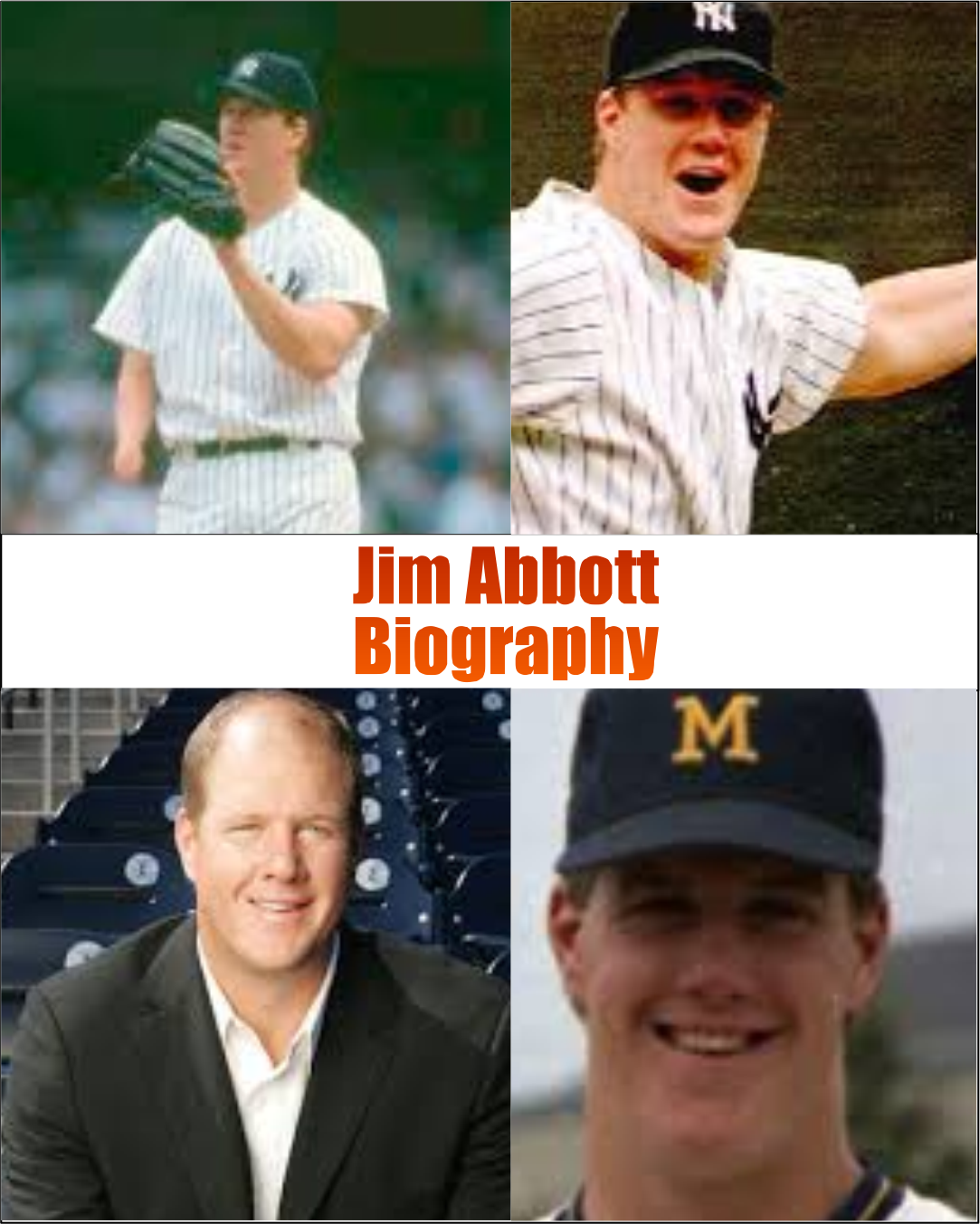
Jim Abbott Biography
The Jim Abbott Biography: He Threw a No-Hitter in Baseball
Jim Abbott was born without a right hand, bounced a rubber ball off a brick wall for hours to teach himself to pitch and catch with the same hand, won Olympic gold, became the first baseball player to win the Sullivan Award, went straight from college to the major leagues without a minor league game, and threw a no-hitter for the New York Yankees in 1993. Thirty years later ESPN made a documentary about him. The letters from disabled children never stopped coming.
He Bounced a Ball Off a Wall for Hours Until He Could Catch It With the Same Hand That Threw It. Then He Threw a No-Hitter: The Story of Jim Abbott
The brick wall in the Abbott family’s yard in Flint, Michigan became the most important training facility in professional baseball that nobody ever saw.
For hours — not minutes, hours — a boy with one hand threw a rubber ball against that wall, watched it come back, and practised getting his glove onto his right forearm stump in time to catch it. Then removing the ball. Then getting his hand back on it in time to throw again. The drill was not assigned by a coach. It was invented by an eight-year-old who had decided that the absence of a right hand was a problem to be solved, not a condition to be accommodated.
“I loved all sports. I loved football, basketball and baseball. But I always seemed to have a talent for throwing things.”
Jim Abbott Biography
| Category | Details |
|---|---|
| Full Name | James Anthony Abbott |
| Date of Birth | September 19, 1967 |
| Place of Birth | Flint, Michigan, USA |
| Nationality | American |
| Profession | Professional Baseball Pitcher, Motivational Speaker, Author |
| Field of Work | Major League Baseball, Disability Advocacy, Motivational Speaking |
| Notable Achievement | Pitched a no-hitter for the New York Yankees in 1993 despite being born without a right hand; won a gold medal at the 1988 Seoul Olympics |
| Legacy | Celebrated as one of the most inspiring figures in sporting history and a powerful symbol of human determination and the refusal to accept perceived limitations |
Flint, Michigan — A City That Made Hard People
James Anthony Abbott was born on September 19, 1967. He grew up in the East Village area of Flint, Michigan.
Flint in the late 1960s was still a city defined by General Motors — a blue-collar town where physical work was the primary currency and toughness was not admired so much as assumed. The Abbott family was not wealthy. They were not connected to the baseball establishment. What they gave their son was something more useful: the refusal to treat his limb difference as a limitation on what he could attempt.
When Jim began school, he was fitted with a mechanical hand made of fiberglass and metal. He hated the prosthesis, which he called a “hook,” because it frightened some of his classmates and made him self-conscious. Eventually his parents stopped making him wear it.
The hook made him different in the wrong way — visibly, awkwardly, in a way that drew attention to what was absent rather than what was present. Without it, he was simply a left-handed boy with a stump where his right hand should be. He could work with that. He could not work with the hook.
“I felt the teasing and the bullying of the playground. I keenly felt the awkward second glances in the school hallways and classrooms.”
See also: Chico Mendes Biography: The Man Who Used Literacy to Save the Amazon
Did you know?
Despite being born without his right hand, Abbott led the American League in fielding percentage twice — in 1992 and 1995 — posting a perfect 1.000% both seasons.
The pitcher who was supposed to be exploitable through bunting — opponents routinely tried to exploit his fielding disadvantage — led the entire American League in fielding percentage. Twice. The technique he invented in his backyard was not a workaround. It was excellence.
High School, the Wall, and the Quarterback Nobody Expected
During his high school years, Abbott played both as a baseball pitcher and a football quarterback.
Quarterback. In American football. A position that requires receiving the snap from centre, reading a defence, avoiding pass rushers, and throwing accurately under pressure — all performed by a person with one hand, in a sport whose entire offensive structure assumes two-handed execution.
He did it well enough that his team reached the finals of the Michigan state championship. Abbott also hit .427 one year for Flint Central, with seven home runs. His right arm ended at the wrist. He placed it at the end of his bat and closed his big left hand around it.
.427 batting average. Seven home runs. One hand on the bat. The accumulation of athletic achievements across multiple sports that Jim Abbott produced in high school — quarterback, pitcher, batter — was not the story of someone compensating for a disability. It was the story of someone who was simply a very good athlete who had invented the tools he needed.
The Toronto Blue Jays drafted him out of high school in 1985. He did not sign. He went to the University of Michigan instead — a decision that produced the credentials that changed the rest of his life.
Michigan, Sullivan Award, Olympic Gold, and the Draft
He had a career record of 26 wins and eight losses at Michigan. As a member of Team USA in 1987, he became the first American pitcher in 25 years to beat a Cuban team on Cuban soil.
The Cuban team. On Cuban soil. In 1987, Cuba was the dominant power in amateur baseball — a nation whose state-supported programme produced players of professional American standard. Beating them in Havana was not a routine achievement. It was the kind of performance that makes people reassess what they think they know.
Around the time he turned 21, he was really being noticed, becoming the first baseball player ever to receive the prestigious James E. Sullivan award, which is given annually to the best amateur athlete in the country. It was a recognition that propelled his name into the pantheon inhabited by the likes of Carl Lewis, Peyton Manning and Michael Phelps.
First baseball player to win the Sullivan Award. An award whose previous recipients included Jesse Owens, Bob Mathias, Bill Bradley, and Carl Lewis — the pantheon of American amateur athletic achievement. Jim Abbott, pitcher, one hand, Flint Michigan, won it.
Straight to the Majors — No Minor Leagues, No Waiting
That spring, he had become only the 16th player to go straight from the draft to the majors without appearing in a single minor league game.
The Angels looked at the Sullivan Award, the Olympic gold, the Cuban game, the Michigan record, and made a decision that the traditional minor league apprenticeship was not required. He reported to spring training in 1989. He made the roster. He debuted on April 8, 1989, at age 21.
His first full season with the Angels produced a 12-12 record with a 3.92 ERA — entirely respectable for a pitcher in his first professional season who had bypassed the developmental league entirely. He was not struggling to survive at major league level. He was competing.
Abbott, out of Flint, Michigan, pitched 10 years in the Major Leagues, finishing third in the American League Cy Young Award voting for the Angels in 1991 before he got to New York and threw that no-hitter.
September 4, 1993 — Yankee Stadium, One Hand, No Hits
The Angels traded him to the New York Yankees after the 1992 season. His Yankees tenure was inconsistent — a 9-11 record entering September, struggles with control, the specific pressure of pitching in New York where inconsistency is treated as failure. Six days before September 4, Cleveland had knocked him out after 3 and 2/3 innings.
Then came the Indians again. Saturday afternoon at Yankee Stadium. 27,225 people in the stands.
Abbott walked the first batter. He retired the next 26 in sequence, mixing fastballs with breaking pitches, working efficiently, fielding three bunts perfectly using the technique he had invented against a brick wall in Michigan twenty years earlier.
“When that final out comes, it’s just like this ecstatic release. You feel like you’re plugged into a wall. It feels electric.”
The Letters, the Legacy, and the Children Who Saw Themselves
The most consequential thing the no-hitter produced was not the entry in the record books.
There had been swarms in college, and at the Olympics, wherever and whenever Abbott pitched. Who could resist such an inspirational story? But what they hadn’t anticipated were the letters. The steady stream of letters. Thousands of letters. So many from kids who, like Abbott, were different.
Thousands of letters. From children with limb differences, from their parents, from people who had watched a one-handed pitcher throw a no-hitter and understood, immediately and viscerally, that the categories of what was possible had just been revised in their direction.
Carson Pickett was born on September 15, 1993 — 11 days after Abbott’s no-hitter. Missing most of her left arm below the elbow, she became, in 2022, the first player with a limb difference to appear for the US women’s national soccer team. She says: “I knew I wanted to be a professional soccer player. To be able to see him compete at the highest level it gave me hope.”
Philosophy — What the Brick Wall Taught Him
“I don’t think about what could have been or what was taken away. My dad used to say to me when I was a kid that what’s been taken away once will come back twice.”
“But if a career can be measured by special moments, lessons learned, and a connection with people then I would stack mine up with anyone’s. Maybe there is an obligation to share.”
The obligation to share. The letters from disabled children had given him that framework — the understanding that his career was not only his, that what he had done had meaning beyond his own trajectory, that the visibility of his success was itself a form of service to people who needed to see it.
His autobiography Imperfect: An Improbable Life was published in 2012. In 2025, ESPN produced a documentary — Southpaw: The Life and Legacy of Jim Abbott — interviewing more than forty people including Hall of Famers Cal Ripken Jr. and George Brett. Abbott’s unprecedented and transformational career earned him international fame and his story affected thousands of disabled and limb-different children across the globe.
His net worth is estimated at approximately $8 million — accumulated through ten years of major league contracts, speaking engagements, the memoir, and ongoing advocacy work. He was inducted into the College Baseball Hall of Fame in 2007.
What He Changed About Sport
Before Jim Abbott, the assumption governing professional baseball was binary and largely unexamined: to pitch at major league level you needed two functioning hands. The fielding requirements, the handling requirements, the basic mechanics of the position — all designed around bilateral function. No one had tested whether the assumption was correct.
After Jim Abbott, the assumption was not only tested but refuted. Not theoretically — empirically, with a ten-year career, a Cy Young third-place finish, a Sullivan Award, Olympic gold, and a no-hitter. The question “can someone pitch in the major leagues with one hand?” was answered on September 4, 1993, in the ninth inning of a game at Yankee Stadium where Carlos Baerga hit a grounder to shortstop Randy Velarde, who fired to Don Mattingly at first base for the final out.
He never thought he had a disability. “It never really occurred to Abbott that he had a disability; at least, it never really occurred to him that there was anything he couldn’t do.”
Frequently Asked Questions
1. Who is Jim Abbott?
Jim Abbott is a former American Major League Baseball pitcher who is widely regarded as one of the most inspiring figures in the history of sport. Born on September 19, 1967, in Flint, Michigan, he came into the world without a right hand — a circumstance that most observers assumed would preclude him from ever competing seriously in baseball, a sport that requires throwing, catching, and fielding with precision and speed.
2. How did Jim Abbott overcome the physical challenge of pitching with one hand?
The technique Jim Abbott developed to pitch and field effectively with one hand was a marvel of athletic ingenuity and years of dedicated practice. He would begin each pitch with his glove resting on the end of his right forearm.
3. What was Jim Abbott’s no-hitter and why was it so significant?
On September 4, 1993, pitching for the New York Yankees against the Cleveland Indians at Yankee Stadium, Jim Abbott threw a no-hitter — one of the rarest and most celebrated achievements in baseball, accomplished when a pitcher retires all opposing batters without allowing a single hit across nine innings. The no-hitter was significant for multiple reasons that went far beyond the normal celebration of such an achievement.
4. What did Jim Abbott achieve before and during his Major League career?
Jim Abbott’s journey to the Major Leagues included a series of achievements that established his credentials at every level of competition. At the University of Michigan he was one of the most dominant college pitchers in the country, winning the Golden Spikes Award — given to the best amateur baseball player in the United States — in 1987.
5. What is Jim Abbott’s lasting legacy?
Jim Abbott’s legacy operates powerfully across sport, disability advocacy, and the broader cultural conversation about human potential and the nature of limitation. Within baseball he is remembered as a genuinely accomplished pitcher whose career achievements — including his no-hitter, his Olympic gold medal, and his decade of Major League service — stand on their own terms entirely apart from the inspirational narrative that surrounds them.