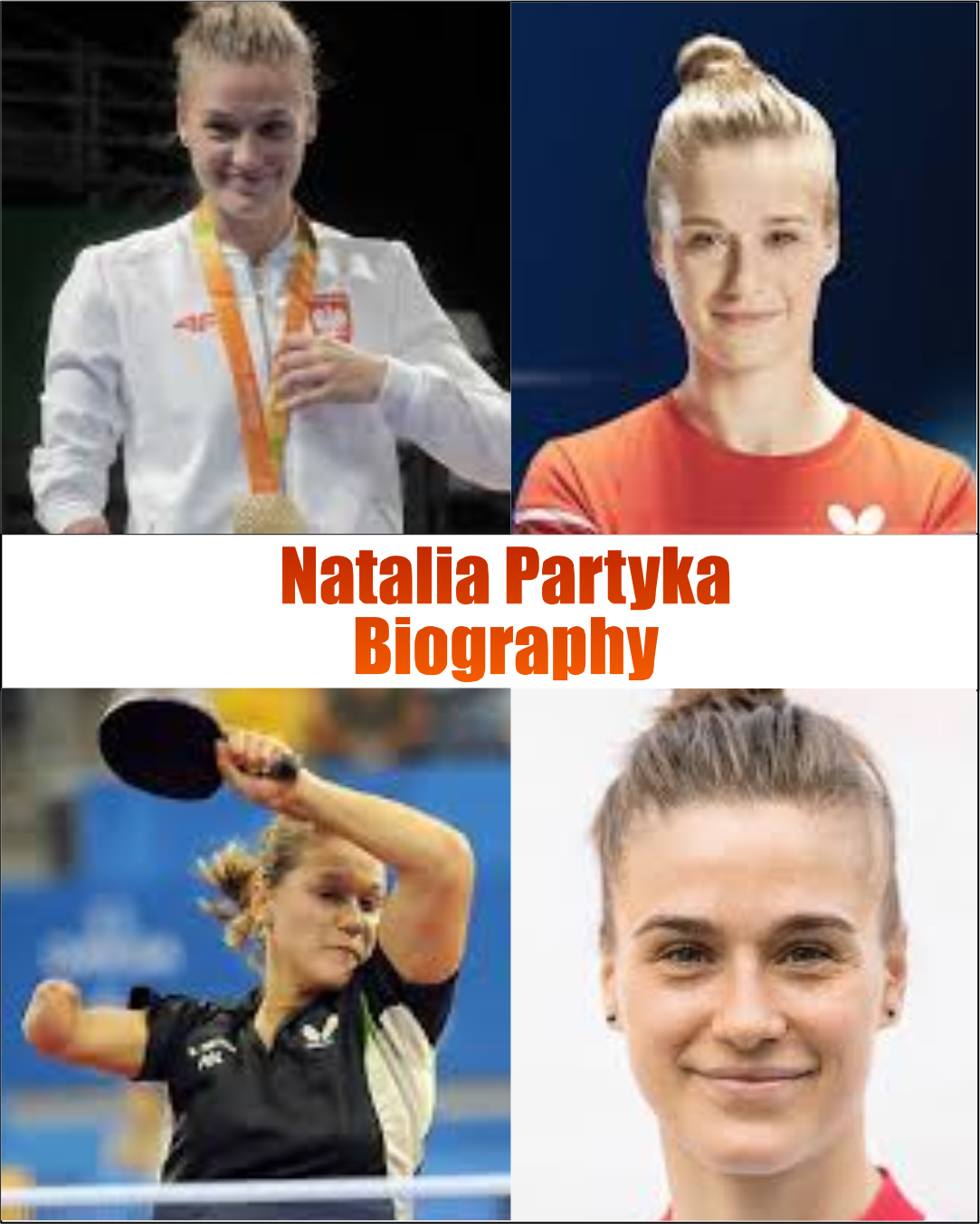
Natalia Partyka Biography
The Natalia Partyka Biography: She Plays Both the Olympics and the Paralympics
Natalia Partyka was born without a right hand and forearm, began playing table tennis at seven with her sister in Gdansk, became the world’s youngest Paralympian at eleven, the youngest Paralympic champion at fifteen, and the first table tennis player to compete simultaneously in the Olympics and Paralympics. She has won five Paralympic singles gold medals, six world titles, and has spent her career dismantling the wall between disabled and able-bodied sport from both sides simultaneously.
She Was the Youngest Paralympian in History. Then She Competed at the Olympics Too. The Wall Between Both Worlds Has Never Fully Recovered: The Story of Natalia Partyka
The table tennis club was close to her house. That is how she describes it — matter-of-factly, without drama, in the way that people who have thought carefully about luck describe the specific accidents that shaped their lives.
“I always underline how lucky I was, as the table tennis club was very close to my home, so I had favourable conditions to grow from the start. I consider myself really lucky to have discovered sport so early and be accepted by the community.”
Natalia Partyka Biography
| Category | Details |
|---|---|
| Full Name | Natalia Partyka |
| Date of Birth | July 27, 1989 |
| Place of Birth | Gdańsk, Poland |
| Nationality | Polish |
| Profession | Professional Table Tennis Player |
| Field of Work | Table Tennis, Paralympic Sport, Olympic Sport |
| Notable Achievement | Has competed at both the Paralympic Games and Olympic Games simultaneously; multiple Paralympic gold medallist and one of the most decorated disabled athletes in the world |
| Legacy | Celebrated globally as a symbol of extraordinary athletic excellence and one of the greatest examples of an athlete competing at the highest level across both Olympic and Paralympic competition |
Gdansk, a Sister, and the Club That Was Close Enough
Natalia Dorota Partyka was born on July 27, 1989, in Gdansk, Poland.
Gdansk — the Baltic port city where Polish history has accumulated in layers, from medieval Hanseatic trading wealth to the Solidarity movement that began here in 1980 and helped end communist rule across Eastern Europe. It is a city that knows something about persistence in the face of systems that say things cannot be done. Whether Natalia Partyka absorbed that quality from the city or simply from herself is impossible to say. Both seem plausible.
Her journey to the top began with her sister Sandra, whom she practiced with at home until she outgrew the family-friendly competition.
See also: Jim Abbott Biography: He Threw a No-Hitter in Baseball
Sydney 2000 — The Youngest Paralympian in History
At the age of 11, when she competed at the 2000 Summer Paralympics in Sydney, she became the world’s youngest ever Paralympian.
The Paralympic Games in Sydney were the largest and most watched in the movement’s history to that point — a Games that had been explicitly designed to follow the Olympic template as closely as possible, using the same venues, the same organisational framework, the same international attention. Into this context walked an eleven-year-old girl from Gdansk who had been playing competitive table tennis for four years.
She did not win gold in Sydney. She competed, represented Poland, gained experience at the highest level of Paralympic sport, and came home as the youngest person ever to have done it. The record has stood since 2000 — no table tennis Paralympian has competed at a younger age.
Four years later, Athens answered the question Sydney had opened.
Did you know?
According to the IPC, most table tennis players use their free arm to serve and to maintain balance. Natalia Partyka, born without a right hand and forearm, doesn’t have that luxury. Even so, she chases down balls with the speed and precision of the world’s best able-bodied players.
The technical disadvantage — one arm where every opponent has two — is real and documented. The results she has produced despite it are the empirical response to every assumption that the disadvantage should be disqualifying.
Beijing 2008 — The Wall Between Two Worlds
The moment that defined Natalia Partyka’s place in sporting history came not from a gold medal but from a qualification.
She was the first table tennis athlete to compete in both the Olympic and Paralympic Games when she qualified for the Beijing 2008 Olympics.
The logic of what she had done was simple and seismic simultaneously. She had qualified for the Olympic Games — not through any accommodation, not through a wildcard designed for athletes with disabilities, not through any mechanism other than playing table tennis well enough to meet the Olympic qualification standard. She had done what able-bodied athletes do: she had won the right to compete by being good enough.
The Career Record — Five Golds, Six World Titles, Four Olympic Games
The Paralympic record she has assembled across six Paralympic Games is one of the most dominant individual records in any sport.
She won four consecutive Paralympic singles gold medals — 2004, 2008, 2012, and 2016. Five-time Paralympic champion including 2004, 2008, 2012, and 2016, and multiple world and European champion among Paralympians.
The consistency across sixteen years of Paralympic singles dominance — four consecutive gold medals, each won against a field of opponents who had had four years to prepare specifically for her — is the record of someone who is not simply the best in a relatively small field but genuinely exceptional by any standard of athletic performance.
At the Olympic Games, her results have been solid rather than spectacular — she reached the last 32 at London 2012, competed in the team event at Rio 2016, and qualified for Tokyo 2020.
Philosophy — What Two Worlds Taught Her About Sport
“Not everyone will become an Olympic or Paralympic champion and not everyone will win medals. But this is not the most essential. What counts is the road we, the athletes, take every day. It is a powerful life lesson well worth participating in. The benefits are countless. If on top of that we succeed, it is remarkable.”
The philosophy is grounded in the specific experience of someone who has competed in both the Olympic and Paralympic systems — who has felt the difference in institutional investment, in public attention, in the way each system values its athletes — and has refused to let that difference define her relationship with her sport.
“Impossible is nothing.”
“I have achieved almost everything in my life through sports. I am grateful that I have lived this beautiful adventure for so many years.”
What She Changed About Sport
Before Natalia Partyka, the boundary between Paralympic and Olympic sport was assumed to be categorical — not simply administrative but fundamental, reflecting a real and unbridgeable difference in athletic capacity. Paralympic athletes competed at Paralympic level. Olympic athletes competed at Olympic level. The two categories did not overlap because they could not overlap.
After Natalia Partyka, the boundary is known to be permeable. One person — then two, with Melissa Tapper — has crossed it in both directions simultaneously. The crossing was not accomplished through accommodation or special arrangement. It was accomplished through qualification, through meeting the standard that the Olympic system sets for all its athletes regardless of how many arms they use to play.
“Even the most difficult dreams are within our reach. I did it, so you also can.”
She did it. The wall between two worlds is not gone. But it has a door in it now. She put it there.
Frequently Asked Questions
1. Who is Natalia Partyka?
Natalia Partyka is a Polish professional table tennis player who is widely regarded as one of the most extraordinary athletes in the history of Paralympic sport and one of the most compelling figures in modern competitive sport of any kind.
2. How does Natalia Partyka play table tennis with one hand and what makes her technique remarkable?
Natalia Partyka plays table tennis using only her left hand — holding the paddle and generating all of her shots, serves, and defensive play exclusively through her left arm and hand. What makes her technique remarkable is not the accommodation she has made for her physical difference but the level of excellence she has reached through it.
3. What makes Natalia Partyka unique in the history of sport?
Natalia Partyka occupies a genuinely unique position in sporting history as one of the very few athletes in the world who has competed at both the Paralympic Games and the Olympic Games simultaneously — not as a curiosity or a symbolic gesture but as a competitive athlete who belongs in both environments on pure merit.
4. What has Natalia Partyka achieved in terms of medals and competitive honours?
Natalia Partyka’s competitive record is one of the most impressive in the history of Polish sport. She has won multiple Paralympic gold medals in both singles and team events across successive Games — establishing a dominance in Paralympic table tennis that has made her the benchmark against which all other competitors in her classification are measured.
5. What is Natalia Partyka’s lasting legacy?
Natalia Partyka’s legacy is one of the most significant in the history of Paralympic sport and in the broader conversation about disability, athletic excellence, and the boundaries of human performance.