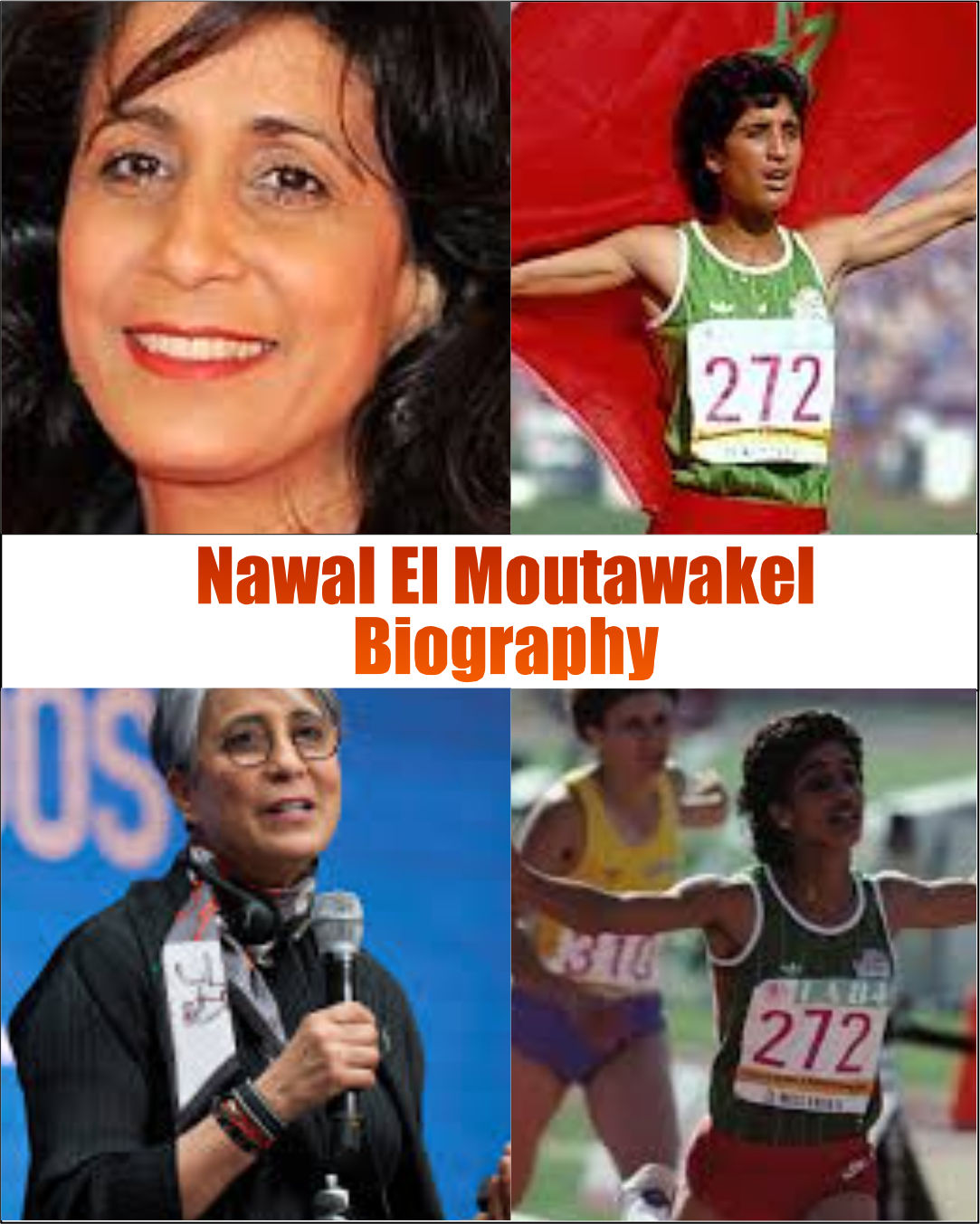
Nawal El Moutawakel Biography
The Nawal El Moutawakel Biography: 54 Seconds in Los Angeles Changed What an Arab Woman Was Allowed to Be
Nawal El Moutawakel won Morocco’s first Olympic gold medal in 54.61 seconds on August 8 1984 — the first Arab, African and Muslim woman to win Olympic gold. The King of Morocco decreed that every girl born that day be named in her honour. She then spent forty years reshaping global sport governance as the first Arab woman elected IOC Vice President — changing who decides what sport becomes.
54 Seconds Changed What an Arab Woman Was Allowed to Be: The Story of Nawal El Moutawakel
At 2 o’clock in the morning on August 8, 1984, the people of Casablanca were awake.
They were awake because the women’s 400 metres hurdles final at the Los Angeles Olympics was being broadcast live, and a twenty-two-year-old from their city was on the start line. The event was making its Olympic debut — it had never been held at the Games before. Morocco had never won an Olympic gold medal. An Arab woman had never won one either.
Fifty-four seconds and sixty-one hundredths later, all three of those facts had changed simultaneously.
Nawal El Moutawakel Biography
| Category | Details |
|---|---|
| Full Name | Nawal El Moutawakel |
| Date of Birth | April 15, 1962 |
| Place of Birth | Casablanca, Morocco |
| Nationality | Moroccan |
| Profession | Sprinter, Sports Administrator, IOC Member |
| Field of Work | Athletics, Sports Administration, Women’s Sport Advocacy |
| Notable Achievement | First woman from Africa, the Arab world, and a Muslim-majority country to win an Olympic gold medal — at the 1984 Los Angeles Olympics in the 400 metres hurdles |
| Legacy | Celebrated globally as a pioneer of women’s sport in the Arab and Muslim world and one of the most influential sports administrators in Olympic history |
Casablanca — A Sports Family and a Father Who Watched Her Train
Nawal El Moutawakel was born on April 15, 1962, in Casablanca, Morocco.
She was born into the right family for what she was going to become. Her father was a judoka. Her mother was a volleyball player. Her siblings competed in athletics. Sport was the household language — not a leisure activity debated against other options but the specific medium through which the El Moutawakel family expressed its energy and its competitiveness.
She started running at the age of 14 and her father used to watch her train.
Her father at the training ground. A judo-practising Casablanca father in 1976, watching his daughter run, not pulling her away from the track to protect her from a social environment that regarded female athletic competition with suspicion. The family environment was the first protection she had — the specific insulation of a household that had already decided that sport was for its daughters as much as for its sons.
See also: Alice Ball Biography – The 23 Year Old Who Solved Leprosy and Had No Credit
August 8, 1984 — The 54 Seconds That Opened a Door
The women’s 400 metres hurdles made its Olympic debut at the 1984 Los Angeles Games. It was the first time the event had appeared at the Olympics — a new discipline, a blank page, no defending champion, no precedent.
In the final, El Moutawakel led from start to finish, improving her personal best by 0.76 seconds, crossing the line in 54.61.
She won by more than half a second. The margin was not close. She had not snuck through on a technicality of absent competitors from boycotting nations — she had run the race of her life and beaten everyone on the track. Bib number 272. She still keeps it in her office.
“It is a historical moment that will forever stay in my mind and in my heart.”
The King’s decree — naming all girls born that day Nawal — was the most extraordinary expression of what her victory meant culturally. A royal act of commemoration, unprecedented in Moroccan history, acknowledging that what she had done was not simply a sporting achievement but a national redefinition.
Did you know?
The spikes she wore during the race in Los Angeles in 1984 have been dipped in silver and are now on display in the Museum of World Athletics — the world’s first 3D virtual sports museum.
The shoes of a twenty-two-year-old from Casablanca, preserved in silver, because what they carried across ten hurdles in 54.61 seconds was larger than a race.
Iowa State, a Master’s Degree, and the Return to Morocco
After Los Angeles, she returned to Iowa State and completed her studies. Upon her return to Morocco in 1990 with a Master’s degree in Physical Education and physiotherapy, she embraced a new career.
She began coaching at grassroots level. Then became National Athletics Director. Then Vice President of the Moroccan Athletics Federation. Then a member of the Moroccan Olympic Committee.
She understood early that being at the track was not enough. Being in the room where decisions were made — the administrative rooms, the federation boardrooms, the government ministries, the international sporting bodies — was where the conditions that determined whether Arab women could compete were actually shaped.
She had won gold on the track. Now she was going to win the argument in the rooms.
IOC Vice President — The First Arab Woman at the Table
In 1995, she became a council member of the International Association of Athletics Federations — the first step into global sport governance. In 1997, she became the first Muslim woman ever elected to the International Olympic Committee.
First Muslim woman. On the committee that governs the Olympic Games — the institution that sets the rules, selects the host cities, determines which sports appear on the programme, shapes the global framework within which every Olympic athlete competes. The woman who had been the first Muslim woman to win Olympic gold was now, fifteen years later, the first Muslim woman inside the institution that organises Olympic gold.
She was Chairwoman of the IOC Evaluation Commission for the selection of the host city for both the 2012 London Olympics and the 2016 Rio Olympics. In January 2010, she was appointed Chair of the IOC’s Coordination Commission for Rio — overseeing the preparation of the Games from the inside, ensuring the world’s largest sporting event was ready for its South American debut.
In July 2012, she was elected Vice-President of the International Olympic Committee — the first woman from a Muslim and Arab nation ever to hold that position. She carried the London Olympic torch through Westminster that same month. She had been the first to win gold for Morocco in Los Angeles twenty-eight years earlier. Now she was carrying the flame through the capital of the country that had hosted the Olympics she was helping to govern.
The Generation She Made Possible
The most concrete evidence of her impact on sport is not the medal, the IOC position, or the royal decree. It is the generation of Arab and African women athletes who came after her — who saw her win in Los Angeles and understood that the door was open.
Her Olympic achievement was the breakthrough that gave Moroccan women much-needed belief in themselves and the courage to take up sport, which had previously been regarded as the preserve of men.
Nezha Bidouane — world 400m hurdles champion in 1997 and 2001. Zohra Ouaziz — World Championships silver medallist in the 5,000m. Hasna Benhassi — Olympic silver medallist in the 800m at Athens 2004. Ghada Shouaa — Syria’s Olympic gold medallist in the heptathlon. Habiba Ghribi — Tunisia’s Olympic silver medallist in the 3,000m steeplechase.
“Since then we saw a lot of Moroccan girls, and the same from Arab countries whom women never attended the Olympic Games, weren’t attending to attend, but attending to win.”
Philosophy — What the 400 Metres Hurdles Taught Her
“For me the 400m hurdles was always a school of life. It teaches you how to start and finish in a strong way, and to overcome every barrier. This is what gave me energy to continue what I am doing today.”
Ten hurdles. Four hundred metres. The event is not only physically demanding — it is psychologically precise. Each hurdle requires a decision: the approach stride, the take-off point, the clearance angle, the landing stride. Ten decisions in fifty-four seconds, any one of which can cost the race. The event rewards people who are comfortable making rapid decisions under pressure and adjusting immediately when a decision produces a suboptimal result.
What She Changed About Sport
Before Nawal El Moutawakel, the institutions governing global sport — the IOC, the IAAF, the major international federations — were overwhelmingly administered by Western men. The decisions that shaped global sport: which events appeared at the Olympics, which cities hosted them, which athletes received resources and which did not — were made in rooms that did not contain Arab women.
After Nawal El Moutawakel, those rooms had a different composition. Not fully — the work of diversifying sport governance is far from complete — but measurably. She was not simply the first Muslim woman in the IOC. She chaired the commissions that selected the host cities for London 2012 and Rio 2016. She oversaw the preparation of the Rio Games. She shaped decisions that affected every athlete who competed in those Games — athlete welfare, facility standards, protocol, the full infrastructure of Olympic hosting — from a position of genuine authority.
She changed what an Arab woman was allowed to be in sport. On August 8, 1984, in fifty-four seconds, she changed it on the track. In the forty years since, she has been changing it in the rooms where sport’s future is decided.
Frequently Asked Questions
1. Who is Nawal El Moutawakel?
Nawal El Moutawakel is a Moroccan former sprinter and sports administrator who made history on August 8, 1984, when she crossed the finish line of the 400 metres hurdles final at the Los Angeles Olympics to become the first woman from Africa, the Arab world, and any Muslim-majority country ever to win an Olympic gold medal.
2. What was the significance of Nawal El Moutawakel’s 1984 Olympic gold medal?
The significance of Nawal El Moutawakel’s gold medal at the 1984 Los Angeles Olympics extended far beyond the boundaries of athletics. She was the first woman from any African nation, any Arab country, and any Muslim-majority nation to stand on the top step of an Olympic podium — a triple historical first whose impact was felt simultaneously across multiple communities that had never before seen one of their own women achieve Olympic glory.
3. How did Nawal El Moutawakel develop as an athlete and what brought her to the Los Angeles Olympics?
Nawal El Moutawakel’s athletic development was shaped by a combination of natural talent, family support, and the opportunity that came from a scholarship to Iowa State University in the United States. Her father was a significant early influence — he recognised her athletic ability and actively encouraged her to pursue sport at a time when female athletic ambition was not universally supported in Moroccan society.
4. What has Nawal El Moutawakel contributed to sports administration and the Olympic movement?
After her competitive career ended Nawal El Moutawakel transitioned into sports administration and became one of the most influential figures in the governance of global sport. She was elected to the International Olympic Committee in 1998 — becoming the first Arab woman and the first African Muslim woman ever to serve as an IOC member.
5. What is Nawal El Moutawakel’s lasting legacy?
Nawal El Moutawakel’s legacy is one of the most multi-dimensional and historically significant in the history of African and Arab sport. As an athlete she broke barriers that had never previously been broken — demonstrating that women from Muslim-majority countries could compete and win at the absolute highest level of international athletics.