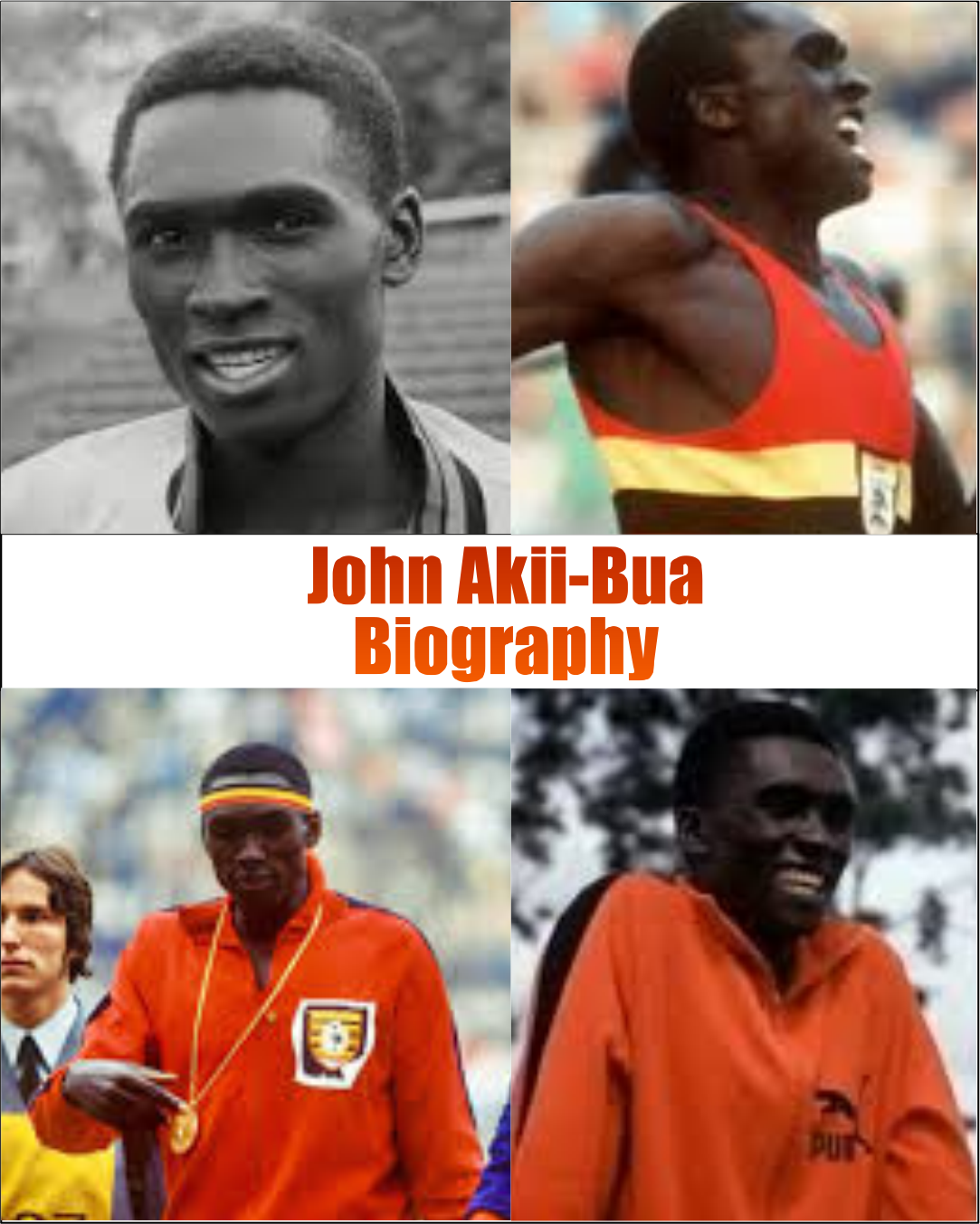
John Akii-Bua Biography
The John Akii-Bua Biography: Uganda’s Only Olympic Champion, Came Home to Nothing
John Akii-Bua was one of 43 children, became Uganda’s first and only Olympic gold medallist in 1972, was celebrated by Idi Amin and then persecuted by him, fled through roadblocks with his pregnant wife — whose baby died in the trauma — was put in a Kenyan refugee camp, freed by a shoe company, returned home to a looted house, and died at 47 with no wealth to declare. His story is the most complete account of what political instability does to sport in Africa.
Uganda’s Only Olympic Champion Fled a Dictator, Lost a Child in Exile, and Died With No Wealth to Declare: The Story of John Akii-Bua
When John Akii-Bua arrived at the anti-corruption checkpoint on his return to Uganda in 1983, the officer asked the standard question: what do you have to declare?
He had been away for four years. He had fled Uganda with his pregnant wife through military roadblocks at night, tailing a West German diplomatic convoy to the Kenyan border. He had watched his wife give birth prematurely during the flight, and buried a child he could not afford a proper funeral for. He had been put in a Kenyan refugee camp. He had been freed by his shoe sponsor Puma and given work in Germany. He had attempted two more Olympic Games — Moscow 1980, Los Angeles 1984 — on borrowed fitness and fading form, long past his athletic prime.
He had come home to a looted house. Everything gone.
“I have no wealth to declare,” he told the checkpoint officer. “Only poverty.”
John Akii-Bua Biography
| Category | Details |
|---|---|
| Full Name | John Akii-Bua |
| Date of Birth | December 3, 1949 |
| Place of Birth | Kampala, Uganda |
| Nationality | Ugandan |
| Profession | Sprinter, Olympic Champion, Police Officer |
| Field of Work | Athletics, 400 Metres Hurdles |
| Notable Achievement | Won gold and set a world record in the 400 metres hurdles at the 1972 Munich Olympics — the first Ugandan and first African to win Olympic gold in a track event |
| Legacy | Celebrated as Uganda’s greatest ever athlete and one of the most gifted track and field performers Africa has ever produced |
Lira, a Family of 43, and the Boy Who Joined the Police
John Akii-Bua was born on December 3, 1949, in Lira, in the Lango sub-region of northern Uganda.
He grew up in the tiny village of Abako in Lira District. His father had eight wives. John was one of 43 children — a number that sounds extraordinary until you understand that in the specific social and agricultural structure of the Lango community in northern Uganda, large extended family households were not uncommon. Forty-three children sharing a father meant forty-three people sharing the labour and the resources and the specific bonds of siblings who know each other across decades of shared life.
His father died in 1964 when John was fourteen. His education ended. At sixteen, he went to Kampala — the capital, the city where something might be possible — and joined the Uganda Police Force. Not as a career ambition but as a practical decision: the police offered structure, income, and housing for a young man from the north with no family wealth to fall back on.
In the police force he found sport. He had been a natural athlete since childhood — fast, coordinated, physically powerful. The police athletics programme gave him a framework. A British-born coach named Malcolm Arnold gave him a direction.
See also: Wangari Maathai Biography: She Planted 51 Million Trees, and They Beat Her Unconscious for It.
Did you know?
In 1971, Akii-Bua set a Ugandan national record in the decathlon with 6,933 points — a record that stood for decades. He was not simply a specialist. He was a complete athlete whose range across multiple disciplines reflected both his physical gifts and the specific breadth of his training.
The decathlon record was a side note to his main event. It would have been the centrepiece of most other careers.
Munich 1972 — Lane 1, World Record, and the Lap That Started a Tradition
He arrived at the 1972 Munich Olympics not ranked among the world’s top ten 400m hurdlers. The pre-race assessments placed Ralph Mann of the United States and William Koskei of Uganda as the primary medal hopes. Akii-Bua was a possibility, not a probability.
He was drawn in Lane 1 — considered the most disadvantageous lane in the 400 metres hurdles because the tighter radius of the inside turn requires more energy to maintain momentum than the wider outer lanes. Every competitor would have preferred a higher number. He ran from Lane 1 anyway.
On September 2, 1972, John Akii-Bua ran the 400 metres hurdles final in 47.82 seconds — becoming the first man in history to break the 48-second barrier in the event, setting a world record from the least advantageous lane on the track.
Idi Amin, a House From the Expelled, and the Gift That Became a Curse
He returned to Uganda a national hero. Idi Amin — who had seized power the previous year — rewarded him with a promotion to Assistant Inspector of Police, named a prominent Kampala road after him, and gave him a house.
The house was one of those confiscated from the Asian community that Amin had expelled from Uganda in 1972 — 70,000 people driven out of the country they had built their lives in, their properties redistributed as political rewards. The house John Akii-Bua was given had belonged to someone who had been expelled. He did not choose this. He received what the dictator chose to give.
His tribe, the Langi, were the primary victims of Amin’s genocide. Over 300,000 Langi people were killed during Amin’s eight-year reign. His own blood brother James Ocen-Bua, who was in the Uganda Army, was killed at the hands of Idi Amin’s forces.
The Roadblocks, the Refugee Camp, and the Baby Who Did Not Survive
In 1979, as Amin’s regime collapsed under the pressure of the Tanzanian invasion and internal opposition, John Akii-Bua made the decision that his life required.
His escape from Uganda in 1979 involved a perilous car journey through roadblocks, eventually tailing a West German diplomatic convoy to the Kenyan border. During the flight, his wife gave birth prematurely to a child who did not survive. The couple did not even have money to bury him.
The Olympic gold medallist and his wife buried their child without money for a proper funeral, fleeing a country he had represented at its highest level, crossing a border at night behind a diplomatic convoy because the roadblocks were too dangerous to approach directly.
In Kenya, he was put in a refugee camp along with 500 other Ugandan refugees. He was freed by his shoe sponsor Puma — the company that had supported his athletic career providing him with equipment and sponsorship — which arranged for him to live and work in Germany.
Return, the Looted House, and the Coaching That Remained
He returned to Uganda in 1983. The house Amin had given him was looted. His legacy was marginalised by a country rebuilding itself after a decade of violence and trying to forget the associations of the previous regime. The road named after him remained. The institutional recognition did not.
He became a coach — for the Uganda Police athletics programme and the national team. The man who had set the world record in the 400 metres hurdles was now teaching young Ugandan athletes the event that had made him famous. He poured what he knew into the next generation without the resources, the facilities, or the institutional support that his knowledge deserved to have behind it.
Philosophy — What He Said About Sport and What Sport Said Back
“He had everything — enormous talent, humour, polished leadership skills, a huge commitment, capacity for work and a very astute mind,” said those who grew up with him.
He described Amin’s violence as Africa’s most unspeakable atrocity. He had watched the dictator who gave him a house kill his brother and 300,000 of his people. He had fled through roadblocks and buried a child without money. He had come home to poverty and coached the next generation anyway.
There is no recorded statement of bitterness from John Akii-Bua about what his country did to his career and his life. The statement that survives him — “I have no wealth to declare, only poverty” — is not a complaint. It is an honest answer to a straightforward question. He was not performing humility. He was reporting the truth.
What He Changed About Sport
John Akii-Bua’s impact on sport operates at a level that medals and records cannot capture alone. His career is the most complete documented case study of what political instability does to athletic development in Africa.
Before Munich 1972, the 400 metres hurdles was understood as a European and American event — a discipline whose world-class practitioners came from the world’s wealthiest athletic programmes. Akii-Bua ran from Lane 1 and broke the world record and demonstrated that the event belonged to whoever was willing to train hard enough and intelligently enough to run it.
After his career — after the boycott, the exile, the refugee camp, the looted house, the poverty — the conditions that had produced and then destroyed his career were visible in a way they had not been before. Every discussion about athletic development in politically unstable African nations now has his story as its reference point. Every conversation about what African athletes need beyond talent — institutional stability, political protection, proper facilities, the basic civic conditions that allow exceptional people to develop exceptional careers — is informed by what happened when all of those things were absent.
Frequently Asked Questions
1. Who is John Akii-Bua?
John Akii-Bua was a Ugandan athlete who became one of the most celebrated and talented track and field performers in the history of African sport.
2. What happened at the 1972 Munich Olympics and why was it so significant?
The 400 metres hurdles final at the 1972 Munich Olympics was one of the greatest individual track and field performances in Olympic history. John Akii-Bua ran the race of his life — producing a technically flawless and physically devastating performance that saw him cross the finish line in a world record time of 47.82 seconds, breaking the previous world record by more than half a second — a margin of improvement that was extraordinary at the highest level of international athletics.
3. What personal and political challenges did John Akii-Bua face after his Olympic triumph?
The years following John Akii-Bua’s Munich triumph were defined by the political catastrophe that engulfed Uganda under the brutal dictatorship of Idi Amin — a regime that caused immense suffering across the country and had direct and devastating consequences for Akii-Bua personally.
4. How did John Akii-Bua’s career develop after his return to Uganda?
John Akii-Bua eventually returned to Uganda following the fall of Idi Amin’s regime and attempted to rebuild both his life and his athletic career in a country that had been devastated by years of political violence and economic collapse.
5. What is John Akii-Bua’s lasting legacy?
John Akii-Bua died on June 20, 1997, in Kampala, Uganda, at the age of 47 — relatively young and in circumstances that reflected the lasting physical and economic toll of the years of exile and disruption he had endured. His legacy however is one of the most celebrated in the history of African athletics.