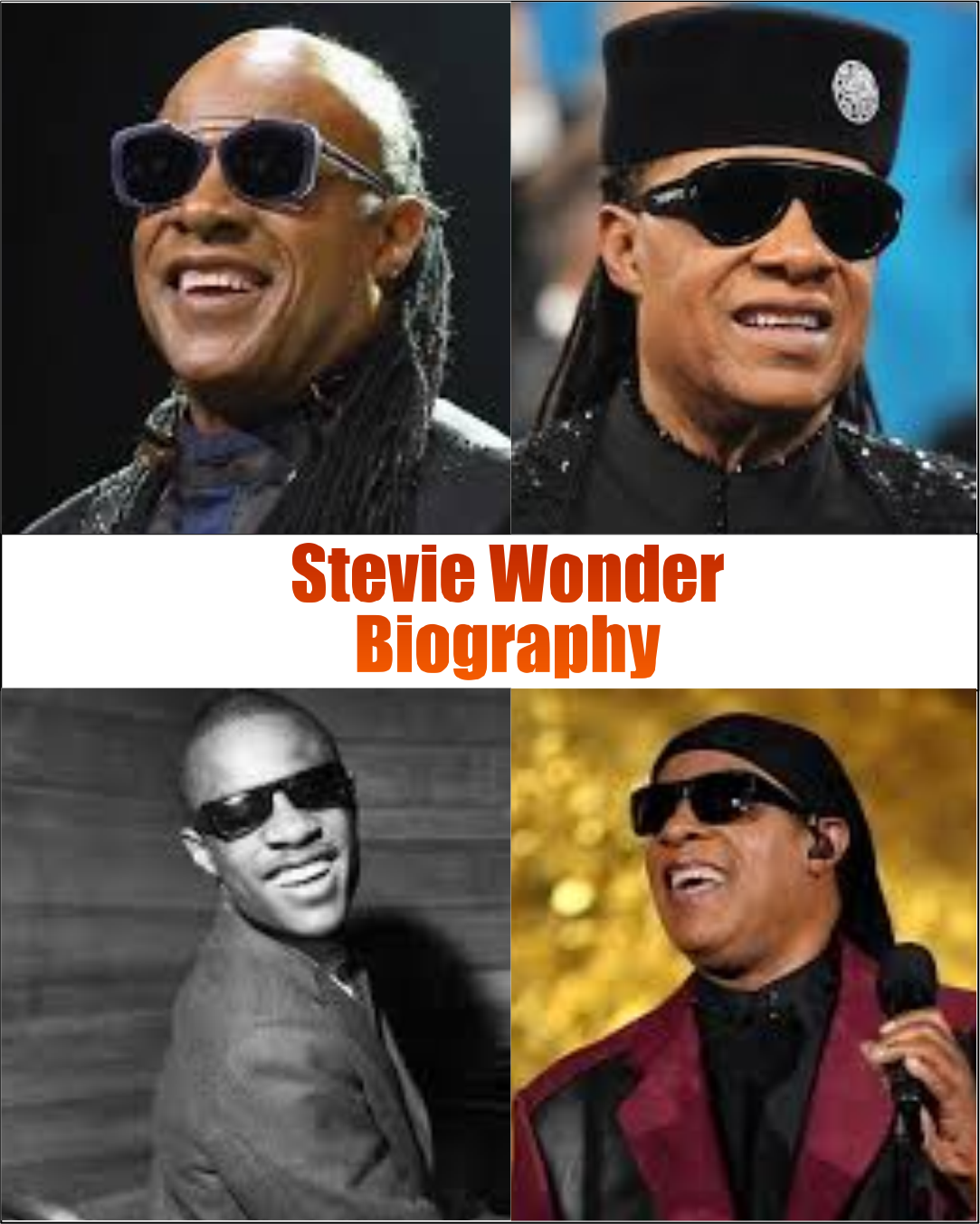
Stevie Wonder Biography
The Stevie Wonder Biography: The Boy Who Couldn’t See But Made the Whole World Listen.
There is a moment in the early 1960s that music historians keep returning to. A thirteen-year-old boy, blind since shortly after birth, stands on a stage and plays a harmonica solo so explosive, so physically joyful, so impossibly alive, that the crowd at the Regal Theater in Chicago loses its collective mind. The song is Fingertips. The boy is Little Stevie Wonder. And in that moment, without being able to see a single face in that roaring audience, he feels something that will drive him for the next six decades.
He feels that music is the most powerful thing in the world.
He has spent his entire life proving it.
Stevie Wonder Biography
| Information | Details |
|---|---|
| Full Name | Stevland Hardaway Judkins (later Stevland Hardaway Morris) |
| Stage Name | Stevie Wonder |
| Date of Birth | May 13, 1950 |
| Age | 76 years (as of 2026) |
| Place of Birth | Saginaw, Michigan, USA |
| Nationality | American |
| Occupation | Singer, Songwriter, Musician, Producer |
| Known For | Hits like Superstition, Isn’t She Lovely, I Just Called to Say I Love You |
| Awards | 25 Grammy Awards, Academy Award, Golden Globe |
Saginaw, an Incubator, and the Accident That Made Him Who He Is
Stevland Hardaway Judkins was born on May 13, 1950, in Saginaw, Michigan, arriving six weeks early – a premature baby placed in a hospital incubator where excess oxygen was pumped to help him breathe. The problem was that too much oxygen caused the blood vessels at the back of his eyes to stop developing properly, causing his retinas to detach. He was permanently blind before he ever had the chance to see the world.
Think about that for a moment. The very medical intervention that kept him alive is what took his sight. It is the kind of cruel irony that could define a person’s entire story as one of loss. Stevie Wonder has spent 75 years making it a story of something else entirely.
When he was four, his mother Lula Mae left his father Calvin Judkins and moved her children to Detroit, later changing her son’s surname to Morris. Detroit in the late 1950s was a city humming with music – Motown was being born in its living rooms and basements, and something about that city’s creative electricity reached even a blind child from a working-class family in the local church choir.
His neighbor Margaret Terry first showed him how to use two hands on the piano. “He played a lot with one finger,” she told the Detroit Free Press years later, “and I showed him how to make it sound better. After that, all he wanted to do was music. He said if he could beat me playing piano one day, that would be the best thing in the world.”
He mastered piano, harmonica, and drums before he was ten years old. He was not learning instruments – he was being inhabited by them.
See also: Solomon Tsehaye Beraki Biography: The Wounded Fighter Who Wrote A Country Soul in the Mountains
Berry Gordy, $2.50 a Week, and a Name That Stuck
It was Margaret’s brother John Glover who changed Stevie’s life forever, introducing him to his cousin Ronnie White of The Miracles. White took Stevie and his mother to audition at Motown, and founder Berry Gordy later said he was “speechless.” He signed the eleven-year-old on the spot.
Because of Wonder’s age, Motown drew up a rolling five-year contract in which royalties would be held in trust until he turned 21. He and his mother were paid a weekly stipend: Stevie received $2.50 per week, and a private tutor was provided when he was on tour. It was, by any modern standard, an exploitative arrangement for a child prodigy. But it got him in the building – and what he built inside that building over the next decade changed American music permanently.
Producer Clarence Paul gave him the name Little Stevie Wonder. Berry Gordy approved it. And the boy from Saginaw stepped into a new identity that fit him so naturally that within two years, the whole country would know it.
In 1963, at thirteen years old, Stevie Wonder became the youngest solo artist ever to reach number one on the Billboard Hot 100 with Fingertips, Pt. 2 – a live recording that captured exactly the kind of raw, explosive energy that made audiences feel like they were witnessing something genuinely historic. He was still in school. He was still receiving $2.50 a week. And he had just topped the American music charts.
The Renegotiation – When Little Stevie Became Simply Stevie
The teenage years brought complications. His voice changed as puberty arrived, and Motown briefly considered whether to drop him. Writer-producer Sylvia Moy saved his career by convincing Berry Gordy to give him another chance, and together they wrote Uptight (Everything’s Alright) – which topped the R&B charts in 1966 and announced that the child prodigy had become something more complex and more interesting: a young adult with things to say.
Through the late 1960s, hit followed hit – My Cherie Amour, Signed, Sealed, Delivered I’m Yours, I Was Made to Love Her. He toured relentlessly, collaborated with everyone, and quietly accumulated the kind of industry knowledge that most artists never develop because they are too busy being told what to do.
When Stevie Wonder turned 21, he stopped being told what to do.
He renegotiated his contract with Motown entirely, refusing to release the music he had been recording until the label granted him full artistic control over his work. It was a negotiation that most artists his age – most artists of any age – would have been afraid to make. He had everything to lose. He had spent a decade building a career that depended on Motown’s infrastructure, Motown’s promotion, Motown’s machine.
He walked into that negotiation anyway. And Motown blinked.
What followed is one of the greatest creative runs in the history of recorded music.
The Classic Period – Five Albums That Rewrote Everything
Between 1972 and 1976, Stevie Wonder released five consecutive albums that music critics and musicians alike still discuss in the same breath as the greatest artistic achievements of the twentieth century.
Music of My Mind (1972) announced the new terms: synthesizer-driven, concept-minded, and entirely his own. Talking Book (1972) gave the world Superstition – a song so rhythmically physical and harmonically rich that it felt less like a track and more like a force of nature. Innervisions (1973) turned social commentary into transcendent art. Fulfillingness’ First Finale (1974) and the double album Songs in the Key of Life (1976) completed a sequence that made him the first Black musician to win the Grammy Award for Album of the Year three times.
Songs in the Key of Life in particular became something rare in popular music – a record that critics loved, audiences adored, fellow musicians revered, and which has somehow only grown in stature with each passing decade. A double album with an EP, released when he was 26 years old, it covered everything from racial justice to romantic loss to pure jubilation in a way that felt simultaneously deeply personal and universally human.
Did you know?
Every album Stevie Wonder released from 1973 to 1986 was a top-five album on the US charts – a consistency of commercial and critical success that no other artist of his era came close to matching.
The Night a Truck Almost Ended Everything
In the middle of his classic period, death came very close.
On August 6, 1973, while on tour in North Carolina, the car Stevie was riding in slammed into the back of a truck. He was in a coma for several days, suffering serious brain damage that initially left doctors uncertain about the extent of his long-term recovery. He was 23 years old, in the middle of creating some of the greatest music of his generation, and suddenly the entire project was in jeopardy.
He recovered. He went back to the studio. He finished Innervisions, which had already been partially recorded, and released it the same year. The album won the Grammy for Album of the Year.
That ability to absorb catastrophe and convert it into creativity is perhaps the defining characteristic of Stevie Wonder’s entire life – from the incubator that took his sight to the truck that nearly took everything else.
25 Grammys, an Oscar, and a President’s Medal
His awards list reads like a summary of everything American popular music has valued across six decades: 25 Grammy Awards, making him one of the most honored recording artists in the history of the ceremony. He won the Academy Award and Golden Globe for Best Original Song for I Just Called to Say I Love You from the 1984 film The Woman in Red. In 1989, he was inducted into the Rock and Roll Hall of Fame at just 38 years old – the youngest living person to receive the honor at the time.
In 2009, the United Nations named him a Messenger of Peace. In 2014, President Barack Obama awarded him the Presidential Medal of Freedom – the highest civilian honor in the United States. He had sold over 100 million records worldwide by that point, a figure that places him among the best-selling musicians in history.
His advocacy work has been as consistent as his music. He campaigned for years to have Martin Luther King Jr.’s birthday declared a federal holiday – a cause he pursued publicly and persistently through the 1980s until Congress finally passed the legislation. He recorded We Are the World for African famine relief and That’s What Friends Are For for AIDS research. His social consciousness was never a separate project from his music – it was always the same thing.
Three Marriages, Nine Children, and One Kidney Transplant
Stevie Wonder has been married three times. His first marriage was to Motown singer-songwriter Syreeta Wright in 1970 – a creative partnership as much as a romantic one, the two writing songs together that became hits for both of them. They divorced amicably in 1972.
He married fashion designer Kai Millard in 2001, and the couple had two sons – Kailand, who now drums for his father on tour, and Mandla, born on Stevie’s 55th birthday – before their divorce was finalized in 2015. In 2017, he married Tomeeka Robyn Bracy in a ceremony that featured live performances by John Legend, Usher, and Pharrell Williams.
He has nine children in total. His first daughter Aisha, born in 1975, was the inspiration for Isn’t She Lovely – one of the most purely joyful songs ever recorded about the arrival of a child. His children span decades and different chapters of his life, some active in the music industry themselves, others living quietly outside the spotlight.
Then, in 2019, came the health scare that shook the world.
At a concert in London’s Hyde Park in July 2019, Wonder stopped the show to tell the audience he would be taking a break for surgery. “I’m going to have a kidney transplant in September,” he said. “I have a donor and it’s all good.” He was characteristically calm about it. His audience was not.
The transplant took place on December 6, 2019. Afterward, he told fans: “I was blessed with a new kidney. I feel like I went from being 70 to being 40. I feel like I’m about 40 right now. I’m feeling great.”
Still Creating, Still Showing Up
In August 2024, Stevie Wonder released Can We Fix Our Nation’s Broken Heart – his first new song in four years. He headlined festivals in the United Kingdom in 2025, confirming in interviews that he had no intention of retiring. He described a concept album called Through the Eyes of Wonder as still in progress – a project he has been developing since 2008, designed to explore his journey making music while blind.
At Christmas 2025, he cancelled his annual House Full of Toys charity benefit concerts – a 26-year tradition of donating toys to children with disabilities – not for health reasons but because he had wanted to expand the shows and ran out of time to plan them properly. He pledged to return with the event in 2026, and personally donated a substantial sum to ensure children did not go without.
At 75 years old, he is still thinking about next year.
What Seven Decades of Music Sounds Like
There is no clean way to summarize what Stevie Wonder means to music. He pioneered the use of synthesizers in R&B at a time when the genre was still built primarily around live instrumentation. He proved that concept albums were not just for rock musicians. He demonstrated that pop music could carry the full weight of social justice, grief, spiritual longing, and pure physical joy – sometimes all in the same song.
He has been cited as an influence by musicians across virtually every genre of popular music – soul, funk, pop, jazz, hip-hop, gospel, and R&B all carry his fingerprints.
But perhaps what matters most about Stevie Wonder’s story is what it says about the relationship between limitation and creativity. The incubator took his sight. The truck nearly took his life. Motown took his royalties for a decade. And from all of that – from all that was taken – he made music that gave back to the world more than most artists could generate from a lifetime of uninterrupted ease.
The boy who couldn’t see made the whole world listen. And 75 years later, the world is still listening.
Frequently Asked Questions
1. Who is Stevie Wonder?
Stevie Wonder is a legendary American singer, songwriter, and multi-instrumentalist widely regarded as one of the greatest musicians of all time, especially for his influence on soul, R&B, and pop music.
2. Is Stevie Wonder blind?
Yes. He was born prematurely and lost his vision shortly after birth due to a condition called Retinopathy of Prematurity, which affected his eyesight permanently.
3. What are Stevie Wonder’s most famous songs?
Some of his biggest hits include Superstition, Isn’t She Lovely, Sir Duke, and I Just Called to Say I Love You, all of which achieved global success.
4. How many awards has Stevie Wonder won?
He has won 25 Grammy Awards, making him one of the most awarded artists in Grammy history, along with other major honors like an Academy Award.
5. Why is Stevie Wonder so influential?
He revolutionized modern music by blending soul, funk, pop, and R&B, while also being a pioneer in the use of synthesizers and socially conscious songwriting.