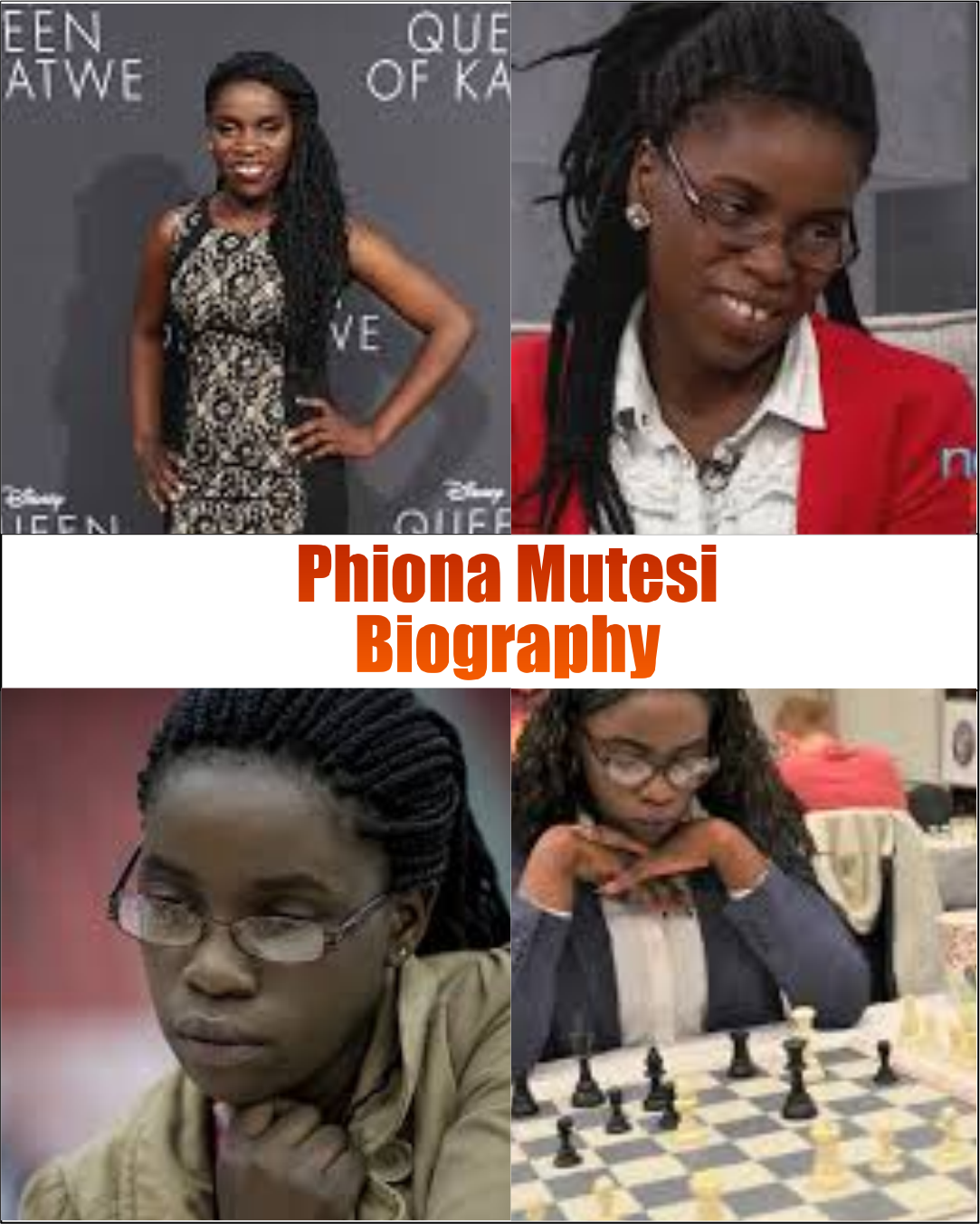
Phiona Mutesi Biography
The Phiona Mutesi Biography: She Just Wanted to Eat and Disney Made Her a Queen
Phiona Mutesi walked into a church in Katwe, Uganda at nine years old because it offered free porridge. She found chess instead. She won national titles, represented Uganda at five Chess Olympiads, became a Disney film, a book, an inspiration to millions — and received nothing from the movie. She then did something braver than winning: she admitted it was not entirely her choice, and built a new life anyway.
She Came for the Porridge. She Found Chess. Disney Made Her a Queen. Then She Told the Truth: The Story of Phiona Mutesi
The most honest thing Phiona Mutesi ever said about chess was also the most ignored.
“My name, like, went so high, and my chess — it was still so low. I wasn’t even the best chess champion in Uganda. It was so hard.”
She said it in 2019. Three years after the Disney film. Two years after a scholarship to a university in the United States. By then she had represented Uganda at five Chess Olympiads. She had received the Woman Candidate Master title — the first ever awarded to a Ugandan female player. She had spoken at the Women of the World Summit in New York. She had been called the most influential athlete in Uganda at the Commonwealth Games Queen’s Baton Relay. Lupita Nyong’o had played her mother on screen.
Phiona Mutesi Biography
| Information | Details |
|---|---|
| Full Name | Phiona Mutesi |
| Date of Birth | 1996 (exact date not widely documented) |
| Age | ~30 years (as of 2026) |
| Place of Birth | Kampala, Uganda |
| Nationality | Ugandan |
| Occupation | Chess Player |
| Title | Woman Candidate Master (WCM) |
| Known For | Inspiring life story featured in the movie Queen of Katwe |
| Background | Rose from poverty in Katwe slum to international chess recognition |
Katwe — Where Survival Is Not a Metaphor
Katwe is the largest of Kampala’s eight slums. The word slum does not adequately communicate what it describes. It is a neighbourhood of approximately 50,000 people compressed into an area that should support a fraction of that number, where drainage channels run alongside homes, where the smell of the lake and the charcoal fires and the density of human habitation combine into something that has to be experienced to be understood. It is also a neighbourhood where communities form and children play and families build something, imperfectly and persistently, against conditions that most of the world would find unsurvivable.
Phiona Mutesi was born in Katwe in approximately 1996. Her birthdate is not recorded — a fact that is not unusual for children born in the slums of Kampala, where the administrative documentation that most people take for granted is a luxury that poverty routinely denies.
Her father died of AIDS when she was three. Her older sister Julia died shortly afterward of causes the family could not fully establish. Her mother Harriet was left with three children — Phiona, her brother Brian, and her younger brother Richard — in a ten-square-foot shack, with no income beyond what she could generate selling charcoal in the informal market and what the children could contribute by selling maize on the streets.
The Porridge That Started Everything
In 2005, her brother Brian had begun attending an after-school programme at Agape Church — a Sports Outreach Institute project run by a young engineer and former footballer named Robert Katende. The programme offered something that the neighbourhood’s children could not easily resist: a free bowl of porridge to anyone who showed up.
One afternoon, Phiona followed Brian. She walked into the church, found a group of children around chess boards, received her porridge, and stayed to watch. She had never seen chess before. She did not know the rules. She watched the pieces move and understood, in the way that certain people understand certain things immediately and instinctively, that this was something she could do.
“At first, I was just interested in the chess because I liked the pieces,” she later said. “They were so nice.”
The pieces were nice. The porridge was there. She came back the next day. And the day after that. And within weeks, she was playing the other children and winning — not because she had studied theory or practised endings but because she had a natural spatial intelligence and a tactical instinct that Katende recognised immediately as something beyond the ordinary.
See also: Vishal Nikam Biography: The Farmer’s Son Who Studied Physics, Trained Bodies, and Won Hearts
Did you know?
When Uganda sent a team to the East African Youth Chess Championship in Sudan — Phiona’s first international trip — she had never been on a plane. She had never left Uganda. She arrived in Khartoum and won every game she played.
The team that had never left Katwe swept the tournament without a single defeat. They came home to Kampala as regional champions, returned to Katwe’s streets, and their faces changed back to the expressions that poverty required.
The Olympiads — Russia, Turkey, Norway, and the World She Had Never Seen
In 2010, FIDE — the international chess federation — paid for a Ugandan delegation to the 39th Chess Olympiad in Khanty-Mansiysk, Russia.
Phiona Mutesi was thirteen or fourteen years old. She had been playing chess for approximately five years. She was going to Siberia to compete against the best female chess players in the world.
Her first opponent, Woman International Master Dina Kagramanov of Canada, came away from their game with a specific assessment that has stayed in every account of Mutesi’s rise: “She’s a sponge. She picks up on whatever information you give her, and she uses it against you.”
The Book, the Film, the Fame — and the Gap She Could Not Close
Crothers published his ESPN Magazine feature in 2011. The piece travelled far beyond the chess community. The story of a girl from Africa’s slums who had learned chess for a bowl of porridge and competed at the Chess Olympiad was exactly the kind of narrative that sports journalism and international media had been designed to amplify.
The book followed in 2012 — The Queen of Katwe: A Story of Life, Chess, and One Extraordinary Girl’s Dream of Becoming a Grandmaster. It was immediately successful. Disney optioned the rights. The film came out in 2016, directed by Mira Nair, with Lupita Nyong’o as Harriet Mutesi and David Oyelowo as Robert Katende.
Phiona Mutesi received no money from the Disney film. The girl whose story had produced a major studio production, a book, and an international speaking career was not financially compensated for the intellectual property of her own life.
Her coach Robert Katende intervened at the moment she needed it most. “You are not defined by chess,” he told her. “Chess is just a door. You decide what is on the other side.”
College, a Computer, and the Life That Chess Actually Built
At the Seattle premiere of Queen of Katwe in 2016, the president of Northwest University — a small Christian liberal arts college in Kirkland, Washington — offered her a scholarship on the spot.
She arrived at Northwest University in 2017. She had never typed on a computer. The first assignment her professors gave — two pages of typed text — took her four days. Her classmates finished it in ten minutes. She spent those four days at the keyboard, finding letters one by one, and she submitted the assignment.
She joined the university chess team. At the 2017 Pan-American Intercollegiate Team Chess Championship, she played Board 2 for Northwest University, won three games and drew one, and the team won the title of Top Small College — taking it from Oberlin College, which had held it for four consecutive years.
She was not the girl who needed chess to survive anymore. She was a college student using chess as one of many things available to her. The distinction mattered. “Right now I feel like there are a lot of things I can do in my life,” she said.
She has become a motivational speaker — appearing at conferences, organisations, and churches across the United States and internationally, using the story of her life not to promote chess specifically but to make the larger argument that opportunity and determination can build something even when circumstances have arranged themselves to prevent it.
Philosophy — The Chess She Actually Learned
“Chess is a lot like my life. If you make smart moves you can stay away from danger, but you know any bad decision could be your last.”
The philosophy she draws from chess is not the philosophy of a grandmaster. It is the philosophy of someone who learned to play in a slum, where every decision has consequences that are not theoretical but material — where food, safety, and the futures of siblings are the real pieces on the board.
She also learned, eventually, to distinguish between playing for herself and playing for the story other people wanted her to embody. That distinction — between authentic participation and performed participation — is one that the sports world rarely discusses honestly. Most athletes who become symbols are expected to perform the symbolism indefinitely. She named the expectation, described the toll it took, and chose a different relationship with the game.
Her net worth is modest — estimated in the low hundreds of thousands, generated through speaking fees, the book and film contracts, and the scholarship that has reduced her personal expenses. She has not accumulated wealth. She has built a life, which is the more significant achievement given where the life started.
What She Changed About Sport — Chess and Africa’s Access Problem
Before Phiona Mutesi, competitive chess was understood, in most of the world’s mental geography, as a European and Asian discipline — a game played at the highest level in Russia, China, India, Armenia, and the United States by players who had been trained since early childhood in institutions specifically designed for that purpose.
After Phiona Mutesi, the conversation about chess in Africa was permanently different. Not because her playing level had reached world class — it had not, and she was honest about that. But because she had demonstrated, with her presence at five Chess Olympiads and her national championship titles, that the talent capable of competing at international level existed in Katwe. It existed in the slums. It existed in children who were selling maize at dawn because the school fees were too expensive.
What was absent was not talent. What was absent was the infrastructure — the coaches, the books, the digital tools, the consistent access to competitive play — that converts raw talent into measurable rating points. Her story is the most compelling single argument available for investing in chess infrastructure in Africa, because it shows exactly what happens when a fragment of that infrastructure reaches a child who needed it and what might happen if more of it did.
Frequently Asked Questions
1. Who is Phiona Mutesi?
Phiona Mutesi is a Ugandan chess player who rose from humble beginnings in the Katwe slum of Kampala to become an internationally recognized chess champion.
2. Why is Phiona Mutesi famous?
She gained global fame after her life story was adapted into the Disney film Queen of Katwe, which showcased her journey from poverty to success in chess.
3. What chess title does Phiona Mutesi hold?
She holds the title of Woman Candidate Master (WCM), awarded by the international chess federation for her achievements in the game.
4. How did Phiona Mutesi learn chess?
She learned chess through a local outreach program led by coach Robert Katende, who introduced the game to children in her community.
5. What impact has Phiona Mutesi made?
Her story has inspired millions worldwide, especially young people in disadvantaged communities, showing that determination and opportunity can change lives.