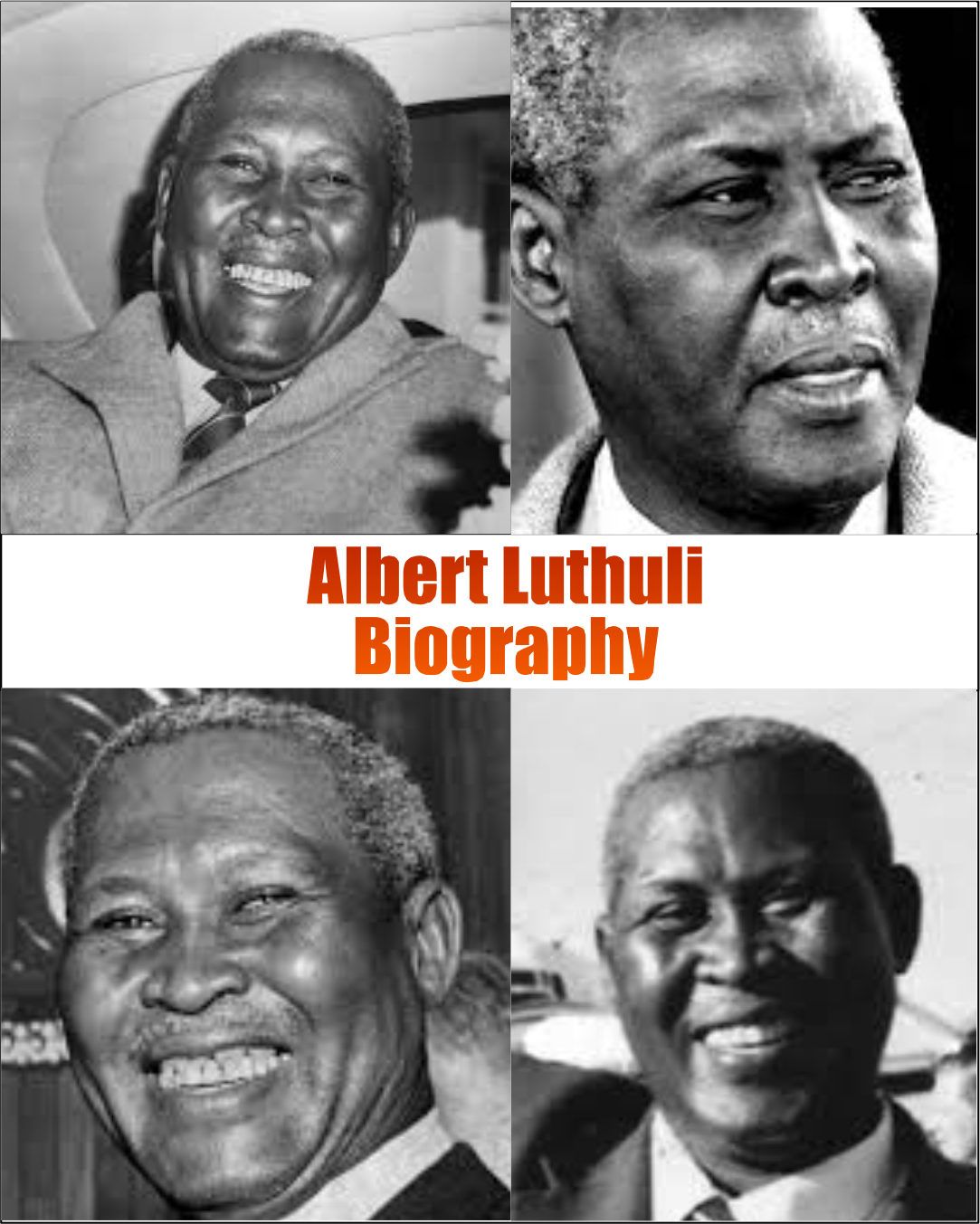
The Albert Luthuli Biography: Africa First Nobel Peace Prize Winner, Confined to a Farm and Then Murdered.
Albert Luthuli was a Zulu chief who saved his community’s sugarcane economy, took the revolutionary step of admitting women to local meetings, led ten million people through non-violent resistance against apartheid, won the Nobel Peace Prize, was confined to his farm, and was murdered by apartheid security police in 1967. A South African court confirmed the murder in October 2025 — 58 years after it happened.
He Won the Nobel Peace Prize and Was Murdered by the Government He Had Shamed. A Court Just Confirmed It 58 Years Later: The Story of Albert Luthuli
On October 2025, a judge in the KwaZulu-Natal High Court in Pietermaritzburg delivered a ruling that corrected fifty-eight years of official South African history.
The inquest ruled that Albert Luthuli died as a result of a fractured skull, cerebral haemorrhage and concussion of the brain associated with assault, and the assault was attributable to members of the security special branch of the South African Police, acting in concert and in common purpose with employees of the South African Railway Company. Seven people were named as being complicit in or having committed the 1967 murder, though their whereabouts were not known.
Murdered. Not struck accidentally by a train while crossing a narrow bridge near his home in Groutville on the morning of July 21, 1967 — which is what the 1967 inquest, held before a magistrate who had written a letter to the Secretary of Justice eight days before the inquest suggesting its conclusion, had determined. Murdered. By the security branch of the same apartheid government that had given him four banning orders, confined him to his farm for years, arrested him for high treason, denied him permission to travel, and stood by while he won Africa’s first Nobel Peace Prize in Oslo in December 1961 — then confined him to the farm again when he came home.
Albert Luthuli Biography
| Category | Details |
|---|---|
| Full Name | Albert John Mvumbi Luthuli |
| Date of Birth | approximately 1898 |
| Place of Birth | Bulawayo, Rhodesia (present-day Zimbabwe), raised in KwaZulu-Natal, South Africa |
| Nationality | South African |
| Profession | Political Leader, Teacher, Chief, Nobel Peace Laureate |
| Field of Work | Anti-Apartheid Activism, Political Leadership, Education, Christian Ministry |
| Notable Achievement | First African and first person from outside Europe and the Americas to receive the Nobel Peace Prize in 1960 |
| Legacy | Celebrated as the father of non-violent resistance in South Africa and one of the greatest moral leaders in African history |
Rhodesia, a Father’s Death, and the Uncle Who Was Chief
Albert John Mvumbi Luthuli — Mvumbi meaning Continuous Rain in Zulu — was born around 1898 in Rhodesia, where his father, John Bunyan Luthuli, a missionary interpreter, had gone from Zululand.
The name Mvumbi is not incidental. Continuous Rain — persistent, inevitable, falling whether or not it is welcome — was the name his family gave him at birth. The people who lived under apartheid’s brutal efficiency and found in Albert Luthuli a leader who kept coming, kept speaking, kept insisting on dignity regardless of what the government did to suppress him — they might have felt, at some point, that the name was prophetic.
After his father’s death, the ten-year-old Albert returned to South Africa and learned Zulu traditions and duties in the household of his uncle, the chief of Groutville, a community associated with an American Congregational mission in Natal’s sugar lands.
His mother washed clothes to pay for his education. He became one of the first three African instructors at the institution that had trained him. The line between those two facts — the washerwoman’s son and the first African instructor — passes through fifteen years of careful, disciplined, vocationally committed work that the missionary school system provided and that Luthuli used precisely as it was intended: as a ladder.
Adams College, Nokukhanya, and the Woman Who Made Everything Possible
At Adams College, in 1925, Nokukhanya met Albert Luthuli when she became one of his students in Zulu and school organisation class. They began a courtship some months later.
Nokukhanya Bhengu was the granddaughter of the Zulu Chief Dhlokolo Bhengu of the Ngcolosi — a woman of royal descent, training as a teacher, sitting in her instructor’s Zulu class and beginning a relationship that would define forty years of South African political history from behind the scenes.
She rejected an initial proposal, wanting them to take more time to make the decision, and ensure that they were compatible in terms of personality and desires for the future. She later recalled having told him: “We must take time with this decision, because what we are aiming at, a lifetime together, is really quite a long time.” After eight more months of courtship, she agreed to become his wife.
They married on January 19, 1927. He and Nokukhanya had seven children.
Nelson Mandela made a personal speech honouring her contribution to South Africa at her funeral in December 1996. The woman who had never become a public figure received a personal tribute from a President at her funeral. Her contribution was real.
Chief of Groutville — The Sugarcane Economy and the Revolutionary Step
In 1935, the elders of Groutville came to him repeatedly with an urgent request. The community’s sugarcane economy was in trouble. The chief’s position was vacant. They needed him.
Luthuli accepted the invitation and saved the community’s economy from collapse.
He left teaching — which he loved — to become chief of a community of five thousand people in the Umvoti Mission Reserve. He accepted a salary significantly lower than what he had been earning as a teacher. He took on the specific obligations of Zulu chieftaincy — the arbitration of disputes, the management of community resources, the representation of his people before the colonial administration — and he discharged those obligations for seventeen years before the apartheid government deposed him.
But he did not discharge them in the conventional way. He changed things.
He took the revolutionary step of admitting women to local meetings.
The ANC, the Defiance Campaign, and the Man Who Would Not Bow
Luthuli joined the ANC in 1945, served as president of the Natal ANC, and in 1952 was elected president general of the national organisation.
The government’s response to his election as ANC President General was immediate and revealing. In November 1952, they ordered him to choose between the ANC and his chieftaincy. They expected him to protect his position as chief — to prioritise the formal authority that came with government recognition over the political commitment that was making him dangerous.
He issued instead one of the most significant political statements in South African history: The Road to Freedom is via the Cross.
In response to his removal as chief of Groutville, Luthuli issued The Road to Freedom is via the Cross — perhaps the most famous statement of his principles: a belief in non-violence, a conviction that apartheid degrades all who are party to it, and an optimism that whites would sooner or later be compelled to change heart and accept a shared society.
He chose the ANC. The government deposed him as chief. The ANC, recognising what he had demonstrated by making that choice, elected him president general by a large majority at the annual conference in December 1952.
Sharpeville, the Passbook, and the Nobel Prize in the Same Year
March 21, 1960. The South African police opened fire on peaceful demonstrators at Sharpeville, killing sixty-nine people and injuring one hundred and eighty. The demonstrators had gathered to protest the pass laws — the system of identity documents that controlled every aspect of Black South African movement and life.
Luthuli responded to this atrocity by openly admonishing the police violence, and publicly burning his passbook.
The passbook. The document that the apartheid state required every Black South African to carry at all times, to present to police on demand, to have stamped before entering certain areas. The mechanism through which an entire system of racial control operated at the individual level — the paper that said, to every Black person who carried it, that their movement was a permission granted by the state rather than a right belonging to themselves.
Luthuli burned it. Publicly. In the immediate aftermath of the government having shot sixty-nine unarmed people for protesting the system it represented. The symbolic clarity of the act was deliberate and complete.
A few days later, a State of Emergency was declared. He was detained for five months in 1960 together with 2,000 other leaders whom he was arrested with under the State of Emergency.
Five months. Released. And then, nine months later, the telephone call he had not expected and to which the government responded with a particular kind of institutional fury.
Martin Luther King, and the Two Men Who Called Each Other Heroes
In December 1959, King wrote Luthuli of his admiration: I admire your great witness and your dedication to the cause of freedom and human dignity. You have stood amid persecution, abuse, and oppression with a dignity and calmness of spirit.
Luthuli told a friend that King’s book Stride Toward Freedom was the greatest inspiration he had read.
Two men, on opposite ends of the Atlantic, fighting versions of the same racial system using versions of the same non-violent method, reading each other’s work, writing each other letters of admiration, issuing joint statements against apartheid and for international boycotts of South Africa.
In September 1962, King and Luthuli jointly issued the Appeal for Action Against Apartheid, organised by the American Committee on Africa, which boosted solidarity between the anti-apartheid and civil rights movements and urged Americans to protest apartheid through nonviolent measures such as boycotts.
During King’s Nobel Peace Prize acceptance speech on 10 December 1964, Luthuli received a special mention. King called Luthuli a pilot of the freedom movement.
Martin Luther King calling Albert Luthuli a pilot. The man who flew before King flew, who had been practising non-violent resistance against racial apartheid since the 1950s, who had been demonstrating that the method could work against a system as brutal as South Africa’s — called a pilot by the man who became the more famous practitioner of the same method.
July 21, 1967 — The Morning Walk That Did Not Come Home
At half past eight on the morning of Friday, July 21, 1967, following a quick breakfast with his wife, Chief Albert Luthuli set out from his home in Groutville on his normal daily routine.
He walked three kilometres to open the family’s general store. He served customers. He left at approximately 10:00 to check on his sugarcane fields. To reach them, he crossed the Mvoti River Bridge — a railway bridge that was not designed for pedestrian traffic but that he and the rest of his family crossed regularly. He had been crossing it for years.
He did not come back.
He was found at the Mvoti River railway line bridge at about 10 am. He was brought to the hospital at 11.45 am, where he was immediately attended to.
He died at 2:25 pm on July 21, 1967. The inquest into his death was reopened in 2024, and in October 2025, the court ruled that the evidence showed Luthuli had died from an assault at the hands of the apartheid-era police.
The Book That Deserves to Be Read
Let My People Go is a book that deserves to be more widely read.
While over 14 million copies of Mandela’s autobiography Long Walk to Freedom have been sold, Luthuli’s account of his own life is comparatively little known.
The comparison is not a criticism of Mandela. Long Walk to Freedom is a great book about a great man. The disparity in their readerships reflects something about how history chooses its emblems — how the man who lived to see the democratic South Africa he had fought for became more visible than the man who was killed before it arrived, whose leadership made the organisations and alliances that produced that democracy possible but who was confined to a farm when the final chapter was being written.
Africa’s first Nobel Peace Prize winner eventually became overshadowed by younger ANC leaders Oliver Tambo and Nelson Mandela.
What Continuous Rain Does
Albert Luthuli was a Zulu chief who admitted women to local meetings in 1936. He was a teacher who loved his work and left it because his community needed him. He was a husband who drew a veil over his marriage in his autobiography to protect the privacy of the woman who made his public life possible. He was a Christian who found in his faith the conviction that racial hierarchy was theologically indefensible and politically intolerable.
He was an ANC president who led ten million people through sustained non-violent resistance against one of the most comprehensively brutal systems of racial domination the twentieth century produced. He was the first African to receive the Nobel Peace Prize. He was murdered by the government he had spent thirty years shaming.
His leadership of Black resistance to apartheid helped to focus world opinion on South Africa’s race policies.
His name was Mvumbi. Continuous Rain. Even after the government killed him, it kept raining.
Frequently Asked Questions
1. Who is Albert Luthuli?
Albert Luthuli was a South African political leader, teacher, Zulu chief, and devout Christian who served as President General of the African National Congress from 1952 until his death in 1967 and became one of the most respected and morally authoritative voices in the global struggle against apartheid.
2. What made Albert Luthuli’s leadership of the ANC distinctive?
Albert Luthuli led the African National Congress during one of the most turbulent and dangerous periods in its history — the years of the Defiance Campaign, the Freedom Charter, the Sharpeville Massacre, and the eventual banning of the ANC by the apartheid government. What distinguished his leadership above all else was the combination of moral clarity, personal courage, and genuine humility that he brought to every dimension of his public life.
3. How did the apartheid government treat Albert Luthuli?
The apartheid government’s treatment of Albert Luthuli was a sustained exercise in political persecution that revealed how deeply threatened the regime was by his moral authority. He was first banned in 1952 — restricted in his movements and his ability to attend meetings or speak publicly — and the banning orders were repeatedly renewed and tightened throughout the remainder of his life.
4. What was Albert Luthuli’s relationship with the Freedom Charter and the broader liberation movement?
Albert Luthuli was a central figure in the Congress Alliance — the coalition of the ANC, the South African Indian Congress, the Coloured People’s Congress, and the Congress of Democrats that together produced the Freedom Charter in 1955.
5. What is Albert Luthuli’s lasting legacy?
Albert Luthuli died on July 21, 1967, under circumstances that remain disputed — he was struck by a train near his home in Groutville while walking along a railway line. He was still under banning orders at the time of his death, still confined to his community, still denied the freedom of movement that every South African citizen deserved.