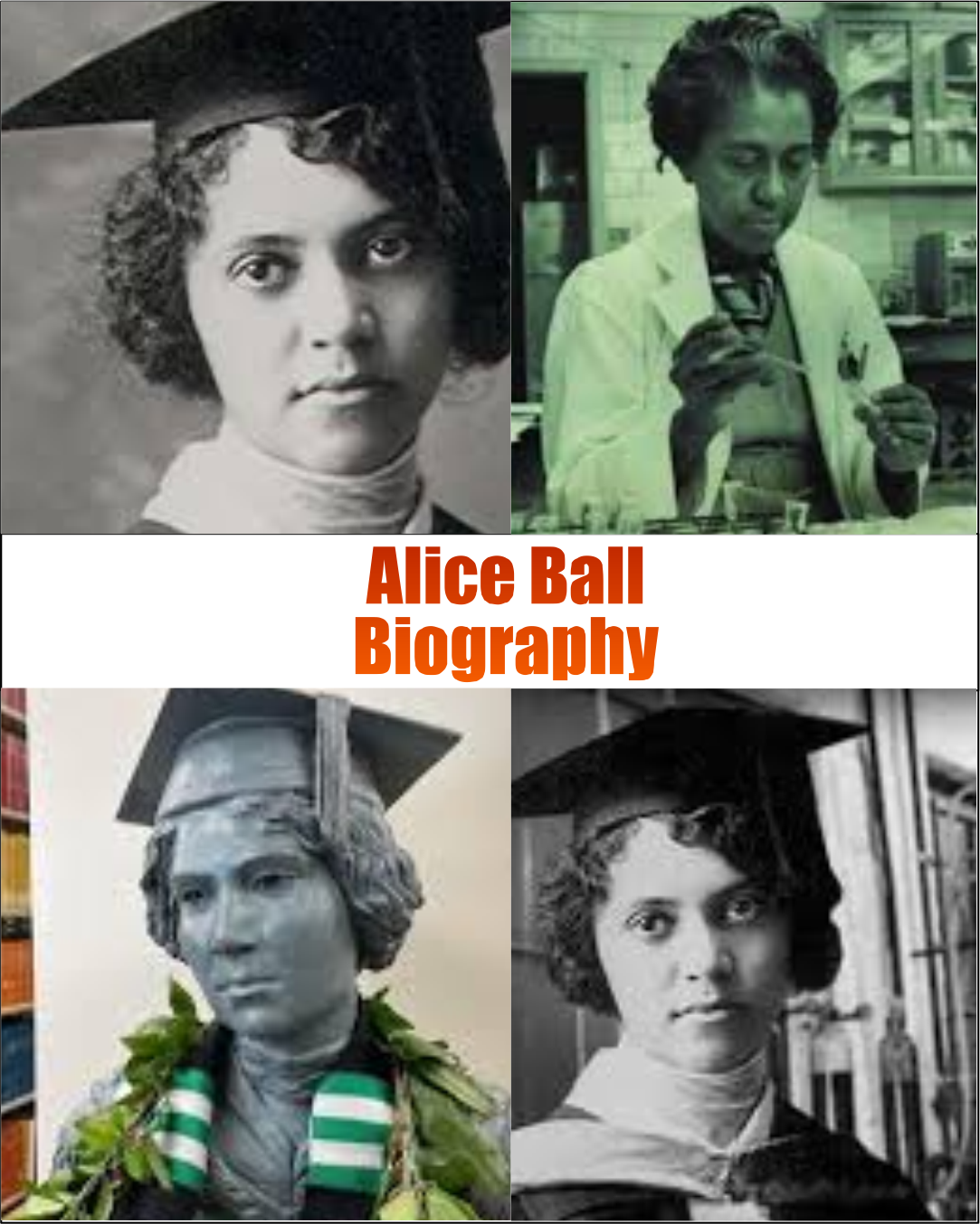
Alice Ball Biography: The 23 Year Old Who Solved Leprosy and Had No Credit.
Alice Ball earned the first chemistry master’s degree given to a Black woman or any woman at the University of Hawaii. At 23 she solved a problem that had defeated medicine for centuries. She died at 24 before publishing her findings. A male colleague published them as his own. For 85 years, almost nobody knew her name.
She Solved Leprosy at 23. A Man Published Her Work as His Own. History Lost Her for 85 Years: The Story of Alice Ball
The problem had been defeating medicine for centuries.
Leprosy — Hansen’s disease — had been one of humanity’s most feared conditions since before the Bible named it. By the early twentieth century, the bacterial cause had been identified, the mechanism of transmission was understood, and Western medicine had been trying, with increasing urgency, to find something that actually worked. The best available treatment was chaulmoogra oil — an ancient Asian folk remedy derived from the seeds of a tropical tree — and it was, in clinical terms, a disaster.
In 1915, a twenty-three-year-old Black woman sitting in a chemistry laboratory at the College of Hawaii solved this problem. She worked on it for less than a year. She worked in every moment she could find outside her teaching schedule. She cracked a chemical puzzle that had defeated everyone who had approached it before her, and she produced an injectable treatment that freed dozens of people from the leprosy colony on Molokai within five years of its development and became the primary global treatment for leprosy for the next twenty years.
She died at twenty-four, before she could publish her findings.
A male colleague published them as his own.
For eighty-five years, almost nobody knew her name.
Alice Ball Biography
| Category | Details |
|---|---|
| Full Name | Alice Augusta Ball |
| Date of Birth | July 24, 1892 |
| Place of Birth | Seattle, Washington, USA |
| Nationality | American |
| Profession | Chemist, Scientist, Researcher |
| Field of Work | Chemistry, Medicine, Pharmaceutical Science |
| Notable Achievement | Developed the first successful injectable treatment for leprosy at just 23 years old — a breakthrough that was stolen and credited to another scientist for decades |
| Legacy | Celebrated as a pioneering Black woman in science; the University of Hawaii honours her annually with Alice Ball Day on February 29 |
Seattle, Daguerreotypes, and a Family That Understood Science
Alice Augusta Ball was born on July 24, 1892, in Seattle, Washington. Her mother, Laura, was a photographer, and her father, James P. Ball, Jr., a lawyer.
The family she was born into was not an ordinary one — not in Seattle, not in 1892, not in a country that had very specific and very limiting ideas about what Black families were permitted to be or achieve. The daughter of daguerreotype pioneers, Alice Ball used her passion for chemistry to develop an injection that stayed in use for 20 years.
Her grandfather, James Presley Ball, was one of the most significant Black photographers in nineteenth-century American history — a daguerreotypist whose portrait studio had documented the lives of prominent Black Americans including abolitionist Frederick Douglass, a man whose work sat at the intersection of science and art in a period when photography was still close enough to chemistry to require practitioners who understood both. The family that Alice Ball grew up in was a family that understood that science was not the exclusive property of white men — a conviction that was, in 1892 America, a radical act of self-definition.
She was one of few in her high school graduating class of 1910 to concentrate in its scientific program. She earned two Bachelor of Science degrees in pharmaceutical chemistry and pharmacy from the University of Washington. Two degrees simultaneously — an achievement that would be remarkable for any student in any era, accomplished by a Black woman in an American university in the early twentieth century, in an institution that had not been designed with her presence in mind and that did not go out of its way to make her feel welcome.
See also: Sor Juana Inés de la Cruz Biography: The Illegitimate Child Who Wrote the First Feminist Manifesto in the Americas
Hawaii, the Master’s Degree, and the First of Many Firsts
After completing her two undergraduate degrees, Alice Ball was offered scholarships at multiple institutions. She chose Hawaii.
She received an offer from the University of California Berkeley, as well as the College of Hawaii, where she decided to study for a master’s degree in chemistry.
In 1915 she became the first woman and first Black American to graduate with a master’s degree from the College of Hawaii. She was also the first African-American research chemist and instructor in the College of Hawaii’s chemistry department.
First woman. First Black American. First African-American research chemist. First female chemistry instructor. Four firsts in a single institution, accumulated by a twenty-three-year-old who had simply decided that the work she was doing mattered and that she was going to do it regardless of who had done it before her.
Her master’s thesis — a forty-four-page analysis of the chemical properties of the kava plant — was technically precise, methodologically rigorous, and entirely readable by the standards of the time. Her thesis investigated the chemical makeup and active principle of Piper methysticum for her master’s thesis. It demonstrated something that would prove consequential almost immediately: she had an exceptional ability to identify and isolate the active compounds in plant-derived substances — to understand, at the molecular level, exactly which components of a complex natural material were responsible for its effects and how to extract those components in a form that could be used medically.
Did you know?
During her stay in Honolulu, Alice Ball attended Central Grammar School from 1903 to 1905, a period when African Americans comprised only 0.2% of Hawaii’s population. She did make a lasting impression on her eighth grade classmate John Scott Boyd Pratt Jr., who wrote in his memoir that Alice Ball was a brilliant student.
She had been in Hawaii as a child, at a school where Black students were virtually nonexistent. She returned as the institution’s first Black graduate student and first female chemistry instructor. The distance between those two visits — measured in years, in achievement, in the specific determination that drove her from one to the other — is one of the most remarkable arcs in the history of American science.
The Problem, the Chemistry, and the Solution Nobody Else Had Found
The chaulmoogra problem was not simple. It was not a matter of dosage or delivery method in the obvious sense. It was a fundamental chemical problem — the active compounds in chaulmoogra oil were, in their natural state, not water-soluble. A human body cannot absorb what is not water-soluble. The oil, in its raw form, either passed through the digestive system causing nausea without being absorbed, or it pooled under the skin causing blisters without being absorbed. The therapeutic potential was real — the compounds were bactericidal against the bacteria that caused leprosy — but the chemistry was in the way.
Ball accepted Hollmann’s challenge and, in a series of arduous but elegant steps, cracked the complex chemical code concealed in the oil. She first identified its two main components: chaulmoogric and hydnocarpic acids.
In Ball’s Method, ethyl esters of the fatty acids found in chaulmoogra oil were prepared into a form suitable for injection and absorption into the circulation.
The technical process — converting the fatty acids of chaulmoogra oil into ethyl esters — is a specific organic chemistry technique that requires both the knowledge to know it should work and the practical skill to execute it correctly at a scale sufficient for medical use. Alice Ball had both. She did it in less than a year, juggling teaching responsibilities throughout, working in whatever laboratory time she could secure.
The Leprosy Colony on Molokai — Understanding What the Cure Actually Meant
To understand what the Ball Method actually did in the world, you have to understand what the leprosy colony on Molokai actually was.
Over the course of 103 years, starting in 1866 until 1969, over 8,000 patients diagnosed with leprosy were exiled to the Hawaiian island of Molokai on the Kalaupapa peninsula.
Exiled. The word is precise. Under the 1865 Act to Prevent Spread of Leprosy, Hawaiian authorities arrested people suspected of carrying the disease and shipped them to Kalaupapa — a remote peninsula on the north coast of Molokai, surrounded by the highest sea cliffs in the world, accessible from the rest of the island only by a narrow mule trail. People who were sent there did not come back. They were effectively imprisoned for the rest of their lives, separated from their children and parents and spouses and communities, living in conditions that were, in the early decades of the colony, genuinely terrible.
December 31, 1916 — The Death That Came Too Soon
She died on December 31, 1916, when only 24 years old. This was before she could publish her work on chaulmoogra oil ester extraction.
The exact cause of her death has been debated and remains somewhat uncertain. She died of accidental chlorine gas inhalation before she could publish her findings. She had taken a leave of absence from her teaching position because of an illness that an article in the Pacific Commercial Advertiser, a Honolulu newspaper, attributed to exposure to chlorine during a demonstration of gas mask use for her students.
She was twenty-four years old. She had solved one of medicine’s most persistent problems. She had not yet published. She had not yet received formal credit for what she had done. She had not yet had the chance to build on the work, to extend it, to apply the same extraordinary chemical intelligence to the next problem that needed solving.
After her untimely death, Arthur Lyman Dean, who was then president of the College of Hawaii, and Richard Wrenshall, a chemistry professor, took credit for her groundbreaking method.
Harry Hollmann’s 1922 Paper — The Man Who Tried to Set the Record Straight
To his credit, Harry Hollmann — the physician who had approached Alice Ball with the chaulmoogra problem in the first place — did not accept Dean’s appropriation without challenge.
On New Year’s Day in 1922, a scientific paper in an obscure medical journal described a drug that would help revolutionize the treatment of leprosy in Hawaii and beyond. The report, by Harry Hollmann, extolled the therapeutic potential of chaulmoogra oil and named the process that transformed chaulmoogra into a 20th-century leprosy medicine: the Ball Method.
He acknowledged her innovation, which transformed chaulmoogra into an easy-to-administer leprosy medicine and coined the term the Ball Method in his 1922 paper published in the journal Archives of Dermatology and Syphilology. “After a great deal of experimental work,” Hollmann wrote, “Miss Ball solved the problem for me.”
Miss Ball solved the problem for me. In a scientific paper published in 1922, six years after her death, a physician stated clearly and for the record that the discovery was hers. He defended her method against Dean’s modifications. He insisted that the name Ball Method was the correct name.
1977, a Historian, and the Rediscovery That Changed Everything
It was not until 2000, owing to the historic work done by Kathryn Waddell Takara and Paul Wermager, that Alice Ball’s name was retrieved from the pages of history, conferred the recognition and honor she deserved. Takara, while researching the contributions of Black women at the University of Hawaii in 1977, came across Alice Ball’s name and was intrigued by the work of the young female chemist.
Kathryn Waddell Takara found the name in 1977. It took another twenty-three years, and the collaborative research of Takara and Paul Wermager, to build the case that eventually restored Alice Ball to the historical record.
In 2000, the University of Hawaii placed a dedication plaque to Ball underneath its only chaulmoogra tree, and Lieutenant Governor Mazie Hirono declared February 29 Alice Ball Day. In 2007, the University of Hawaii posthumously awarded her with the Regents’ Medal of Distinction.
What She Did in Twenty-Four Years
Alice Ball published a co-authored paper on benzoylation in a prestigious journal at twenty years old. She earned two bachelor’s degrees simultaneously. She was accepted by Berkeley and chose Hawaii. She became the first woman and first Black American to earn a chemistry master’s from the College of Hawaii. She became the college’s first female chemistry instructor. She solved a chemical problem that had been defeating medicine for centuries. She developed an injectable treatment that freed dozens of people from leprosy quarantine within five years of her death and continued to be used as the primary global treatment for over two decades.
She died at twenty-four. She had published none of her leprosy research. A colleague published it under his own name. For eighty-five years, the treatment that she developed was distributed around the world, freeing people from isolation and reducing the devastation of a disease that had been imprisoning human beings since biblical times — and the name of the person who had figured out how to do this was sitting in an archive, waiting for a historian doing something else entirely to stumble across it.
Frequently Asked Questions
1. Who is Alice Ball?
Alice Ball was a brilliant young African American chemist who made one of the most significant medical breakthroughs of the early 20th century — developing the first effective injectable treatment for leprosy — before dying at the tragically young age of 24.
2. What was Alice Ball’s medical breakthrough and why was it significant?
Leprosy — now known as Hansen’s disease — had been one of humanity’s most feared and stigmatised diseases for centuries. Patients were typically isolated in remote colonies, separated from their families and communities, with little hope of effective treatment. Chaulmoogra oil, derived from the seeds of an Asian tree, had long been known to have some effect against the disease, but it was difficult to administer effectively.
3. How was Alice Ball’s work stolen and who took credit for it?
Alice Ball died in December 1915 at the age of 24, before she had the opportunity to publish her research findings. The cause of her death remains somewhat uncertain — chlorine gas exposure during a laboratory demonstration has been suggested as a contributing factor. In her absence, Dr Arthur Dean, the president of the University of Hawaii, continued using her extraction method, refined it further, and published the findings without acknowledging Alice Ball’s foundational contribution in any way.
4. When was Alice Ball finally recognised for her contribution?
The restoration of Alice Ball’s rightful place in scientific history was a long and overdue process. Dr Harry Hollmann published an article in 1922 acknowledging that the treatment method had been developed by Alice Ball, but this recognition received limited attention at the time and her name remained largely unknown outside specialist circles for decades. It was not until 2000 — 85 years after her death — that the University of Hawaii formally acknowledged her contribution and honoured her with a memorial plaque placed on a chaulmoogra tree on campus.
5. What is Alice Ball’s lasting legacy?
Alice Ball’s legacy operates on multiple levels simultaneously. As a scientist she made a genuinely life-changing medical discovery that brought relief to thousands of patients suffering from one of history’s most stigmatised diseases. As a young Black woman working in science in the early 20th century she navigated and overcame barriers of race and gender that would have defeated most people, achieving a master’s degree and conducting groundbreaking research at an age when most scientists are still completing their undergraduate studies.