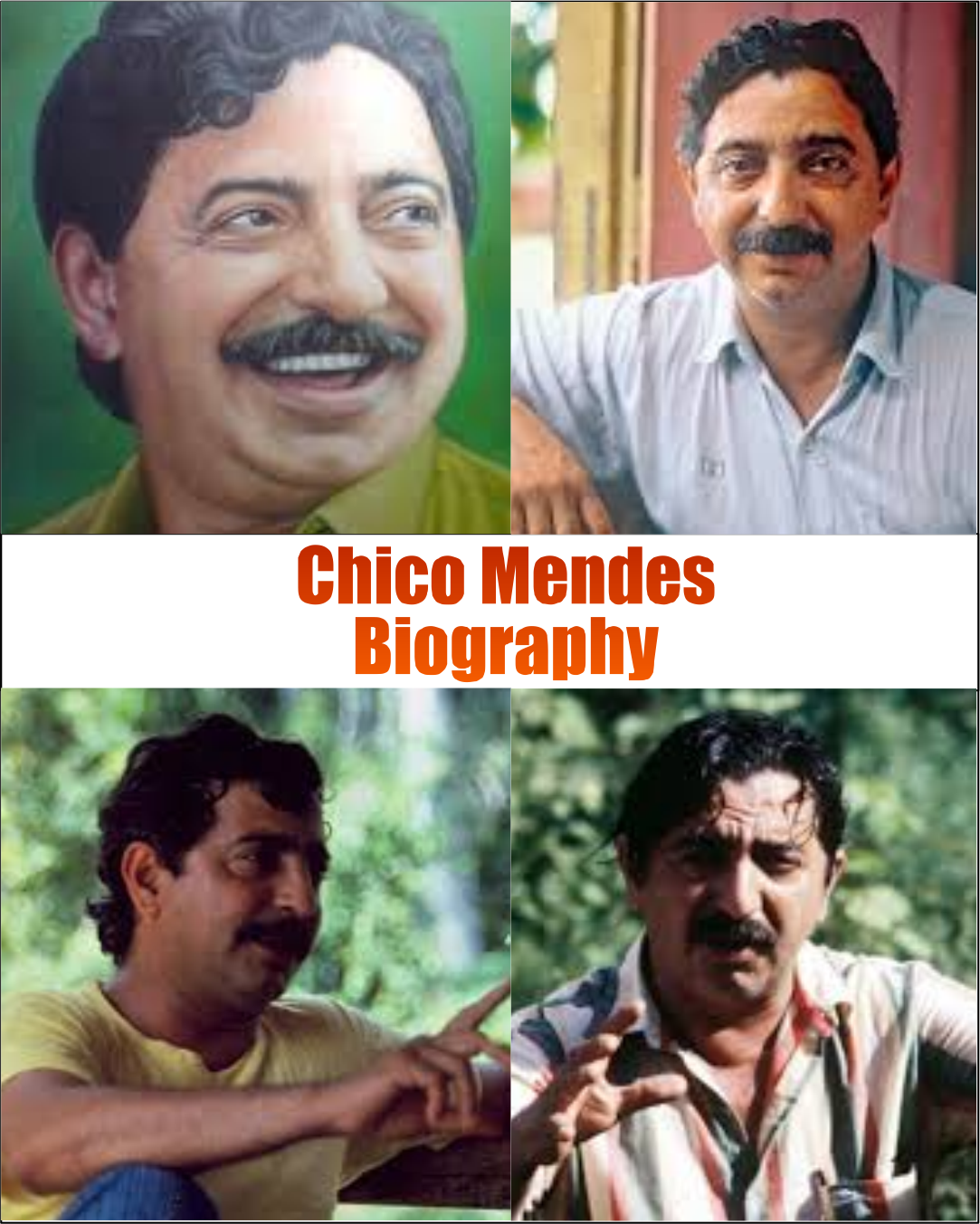
The Chico Mendes Biography: The Man Who Used Literacy to Save the Amazon.
Chico Mendes began tapping rubber at nine years old and could not read until a communist exile hiding in the rainforest taught him at seventeen. He used that literacy to read newspapers, understand injustice, organise workers, invent a new form of conservation, and stand in front of chainsaws with his body. A rancher’s son shot him dead at 44. He was the 90th activist killed in Brazil that year.
He Learned to Read at Seventeen From a Man Hiding in the Forest. He Used That Literacy to Save It: The Story of Chico Mendes
The man who taught Chico Mendes to read was hiding.
His name was Euclides Fernando Távora — a communist activist, a political exile, a man who had fled the Brazilian authorities and disappeared into the western Amazon rainforest, into the rubber estates of Acre, because the forest was vast enough to contain a wanted man and because the rubber tappers who lived there had no particular reason to betray him to the government that had made his life intolerable.
He was twenty-two years old. He was in the Amazon rainforest. He was teaching rubber tappers to read. And the world he was about to change had no idea he existed.
Chico Mendes Biography
| Category | Details |
|---|---|
| Full Name | Francisco Alves Mendes Filho |
| Date of Birth | December 15, 1944 |
| Place of Birth | Xapuri, Acre, Brazil |
| Nationality | Brazilian |
| Profession | Environmental Activist, Trade Union Leader, Rubber Tapper |
| Field of Work | Environmental Conservation, Labour Rights, Amazon Protection |
| Notable Achievement | Led the grassroots movement to protect the Amazon rainforest through non-violent resistance; received the United Nations Global 500 Award |
| Legacy | His assassination in 1988 galvanised global environmental activism and led directly to the creation of protected extractive reserves in the Amazon |
Xapuri, Rubber, and the Economy Built on Debt
Francisco Alves Mendes Filho was born on December 15, 1944, in Xapuri, Acre, in northwestern Brazil.
He and his community, like many others, was made up of the descendants of enslaved or indentured indigenous and non-indigenous Brazilians, forced to work for rubber barons during the rubber booms of the early twentieth century. Chico’s father was a rubber tapper, as was his grandfather.
Three generations of rubber tappers. The grandfather who had worked for the barons during the great rubber boom. The father who had continued after the boom ended. The son born in 1944 into the specific, grinding poverty of the post-boom Amazon, where the rubber estates had lost their global dominance to Southeast Asian plantations but the debt system that had enslaved the tappers persisted long after the profits that had justified it were gone.
From the age of nine, Mendes began working as a rubber tapper for a large landholder.
See also: Hector Pieterson Biography – The Boy Who Spike Black Revolution
The Military Dictatorship, the Chainsaws, and the Bodies in Front of Them
In the 1970s and 1980s, Brazil was in the grip of a military dictatorship that encouraged the clearing of the Amazon for cattle ranching. As part of this policy of expanding the agricultural frontier, rubber tappers were expelled from the rubber plantations by ranchers who wanted to clear the forest. The government offered to relocate these families to colonisation projects elsewhere in the state — where many struggled with poverty, disease, and social dislocation.
The ranchers came with documents. Legal documents, often of dubious provenance, claiming ownership of land that rubber tapping families had lived on and worked for generations. Behind the documents came the tractors and the chainsaws and, when those met resistance, the hired gunmen. Since Mendes’ death, more than one thousand activists and rainforest defenders have been killed in Brazil. In the 1970s and 1980s, that killing had already begun. Rural activists were being murdered at a rate that Brazilian society was treating as background noise. Mendes was the 90th rural activist murdered that year in Brazil.
The system that was doing this was not random violence. It was organised. The ranchers’ union — the Rural Democratic Union, known as the UDR — was a formal organisation that coordinated the expansion of cattle ranching into the Amazon and the suppression of the people who stood in the way. Behind it was the military dictatorship’s explicit policy of Amazonian development and the World Bank loans that were financing the roads and infrastructure that made that development possible.
Chico Mendes responded to all of this with the tool he had. His body.
The Idea That Changed Conservation Forever
In 1985, at a meeting in Brasília that brought together rubber tappers from across the Amazon, Chico Mendes and his colleagues did something that no one in the international conservation movement had thought of doing.
They proposed a new category of protected area.
Mendes and other leaders founded the National Council of Rubber Tappers in Brasília, and Mendes soon became the spokesperson for seringueiros throughout the country.
Brazilian rubber tapper and land rights leader Chico Mendes pioneered the world’s first tropical forest conservation initiative advanced by forest peoples themselves. His work led to the establishment of Brazil’s extractive reserves — protected forest areas that are inhabited and managed by local communities.
The extractive reserve was a radical departure from the dominant model of conservation that had governed thinking in the field since the nineteenth century. That model — the national park model — was based on the premise that human beings and nature were incompatible, that protecting a forest meant removing the people from it, that wilderness required the absence of human activity to be genuinely preserved.
Chico Mendes looked at this model from the perspective of a rubber tapper whose family had been living in the forest for three generations without destroying it — who had in fact been its most consistent protectors because their livelihood depended entirely on its health — and he said, simply and precisely, that the model was wrong.
We realised that to guarantee the future of the Amazon, we had to find a way to preserve the forest while at the same time developing the region’s economy. Not preserve it from people. Preserve it through people.
Washington, the World Bank, and the Man From Xapuri on the International Stage
In 1987 the Environmental Defense Fund and the National Wildlife Federation invited Mendes to attend the annual conference of the Inter-American Development Bank in Washington, D.C., where he spoke to members of Congress about an IDB-funded road project in Acre that threatened the rainforest and its inhabitants.
A rubber tapper from Xapuri, Acre — a man who had learned to read from a communist exile hiding in the forest — standing in front of members of the United States Congress, explaining why a World Bank-funded road project was going to accelerate the destruction of the largest rainforest in the world.
Both the IDB and the World Bank subsequently endorsed the idea of establishing extractive reserves. Bowing to international pressure, the Brazilian government created the first extractive reserve in 1988.
The first extractive reserve — created in 1988, the same year Chico Mendes was killed — was the direct result of his advocacy. The World Bank and the IDB had been funding infrastructure projects in the Amazon with essentially no consideration of the forest communities those projects were displacing. After the Washington visit, they changed their policies.
Among many other honours, Mendes was the 1987 recipient of the Global 500 Award of the United Nations Environment Programme for environmental activism in the face of immense social, political, and logistical obstacles.
The UN Global 500 Award. The year before his death. He received it in Geneva. He returned to Xapuri. He continued organising.
December 22, 1988 — 5:45 p.m., Xapuri
A shotgun blast ripped into him as he stepped outside his wood-frame house in the western Brazilian state of Acre. It was the end of a man who had won global acclaim for championing the sanctity of the forest and the rights of compatriots who eked out a living by extracting latex from rubber trees.
At 5:45 p.m. on Thursday, December 22, 1988, Chico Mendes, trade union leader, rubber tapper, and ecologist, was assassinated in the doorway of his home in Xapuri, Acre.
He stepped outside his back door. He was shot. He died.
He married Ilzamar G. Bezerra Mendes and they had two children. Elenira was four and Sandino was two when their father died.
A four-year-old daughter and a two-year-old son. In a wood-frame house in Xapuri. On the evening of December 22.
The assailant was Darci Alves da Silva, the son of rancher Darly Alves da Silva, who had bought a rubber reserve for logging and whose efforts to deforest the land were thwarted by Mendes. The rancher whose deforestation plans Chico had thwarted sent his son to do the killing.
The Testament He Wrote Three Months Before He Died
Among the papers found after his death was a brief political testament that Chico Mendes had written in September 1988 — three months before a shotgun ended his life at his back door.
He wrote: “Attention, youth of the future, September 6, 2120, centenary of the world socialist revolution that unified all the peoples of the planet in one ideal and one conception of socialist unity, and put an end to all the enemies of the new society. Here remains only the memory of a sad past of pain, suffering and death. Excuse me — I was dreaming when I wrote of these events, which I myself will not see. But I have the pleasure of having dreamed.”
I was dreaming. But I have the pleasure of having dreamed.
What Happened After — 48 Reserves, 12 Million Hectares, and a Legacy Still Growing
The Brazilian government created the 931,537-hectare Chico Mendes Extractive Reserve in 1990, and several more protected areas like it. Numerous books were written about the late activist. Raul Julia played Mendes in the 1994 TV movie The Burning Season. Celebrities like Sting championed the cause of rainforest protection, with Paul McCartney even dedicating a song on his 1989 album Flowers In The Dirt to the slain activist.
A year after his death the country’s first extractive reserve was established. Now, there are at least 48, covering more than 12 million hectares of the Amazon.
Forty-eight extractive reserves. Twelve million hectares. The idea that a rubber tapper from Xapuri presented to members of the US Congress in 1987 — that conservation and human habitation were not opposed but aligned, that the forest peoples were the forest’s best protection — is now embedded in Brazilian law and in the physical landscape of the Amazon at a scale that covers an area larger than most European countries.
In March 1989, a third meeting was held for the National Council of Rubber Tappers, and the Alliance of Forest Peoples was created to protect rubber tappers, rural workers, and Indigenous peoples from encroachment on traditional lands. Mendes’ death legitimized the struggle for conservation and unionization in the Amazon for a global audience.
He did not live to see it. He had the pleasure of having dreamed it.
What the Fugitive Communist Gave the World
There is a line that connects the newspaper clippings Euclides Távora spread on a table in the Amazon rainforest to the forty-eight extractive reserves that cover twelve million hectares of that same forest today. It runs through the hands of a nine-year-old boy tapping rubber trees before dawn, through a seventeen-year-old learning to read from a wanted man, through literacy classes for rubber tappers, through empates, through Washington conferences, through a UN prize received in Geneva and a death threat received in Xapuri, through a political testament written to the youth of 2120, through a shotgun blast at a back door on December 22, 1988.
Chico Mendes did not save the Amazon. Nobody has saved the Amazon — it is still being destroyed, still being burned, still being contested in ways that he would recognise immediately and grieve profoundly. What he did was change the terms of the contest. He demonstrated, in his life and in his death, that the people who lived in the forest sustainably were not obstacles to its preservation but instruments of it. He gave that argument institutional form — extractive reserves, a National Council of Rubber Tappers, an Alliance of Forest Peoples — that survived him and continued working after the shotgun ended his part in it.
They removed the leader. The resistance increased.
Frequently Asked Questions
1. Who is Chico Mendes?
Chico Mendes was a Brazilian rubber tapper, trade union leader, and environmental activist who became one of the most important figures in the global history of environmental conservation. Born on December 15, 1944, in the remote jungle state of Acre in western Brazil, he grew up tapping rubber trees in the Amazon rainforest — a way of life that his community had practised for generations and that depended entirely on the forest remaining intact and alive.
2. What methods did Chico Mendes use to protect the Amazon?
Chico Mendes developed and popularised a form of non-violent direct action known as the empate — a Portuguese word meaning standoff or draw. When ranchers and developers sent teams of workers with chainsaws into the forest to clear land, Mendes and his fellow rubber tappers would gather in large groups and physically place themselves between the trees and the chainsaws — standing their ground peacefully but unmovably until the clearing crews were forced to withdraw.
3. Why was Chico Mendes assassinated and who was responsible?
Chico Mendes was shot and killed on December 22, 1988, at his home in Xapuri, Acre. He was 44 years old. His assassination was ordered by Darly Alves da Silva, a wealthy rancher whose plans to clear forest land had been repeatedly blocked by Mendes and his movement. Darly Alves da Silva and his son Darci Alves Pereira were convicted of the murder in 1990 and sentenced to nineteen years in prison.
4. What impact did Chico Mendes’ death have on environmental policy?
The impact of Chico Mendes’ assassination on both Brazilian and global environmental policy was profound and immediate. The international outcry that followed his murder generated a level of attention to Amazon deforestation that years of activist campaigning had been unable to achieve.
5. What is Chico Mendes’ lasting legacy?
Chico Mendes’ legacy is one of the most significant in the history of environmental activism anywhere in the world. During his lifetime he received the United Nations Global 500 Award and the Better World Society Award in recognition of his contributions to environmental protection — international recognition that reflected how far his influence had reached beyond the rubber tapper communities of Acre.