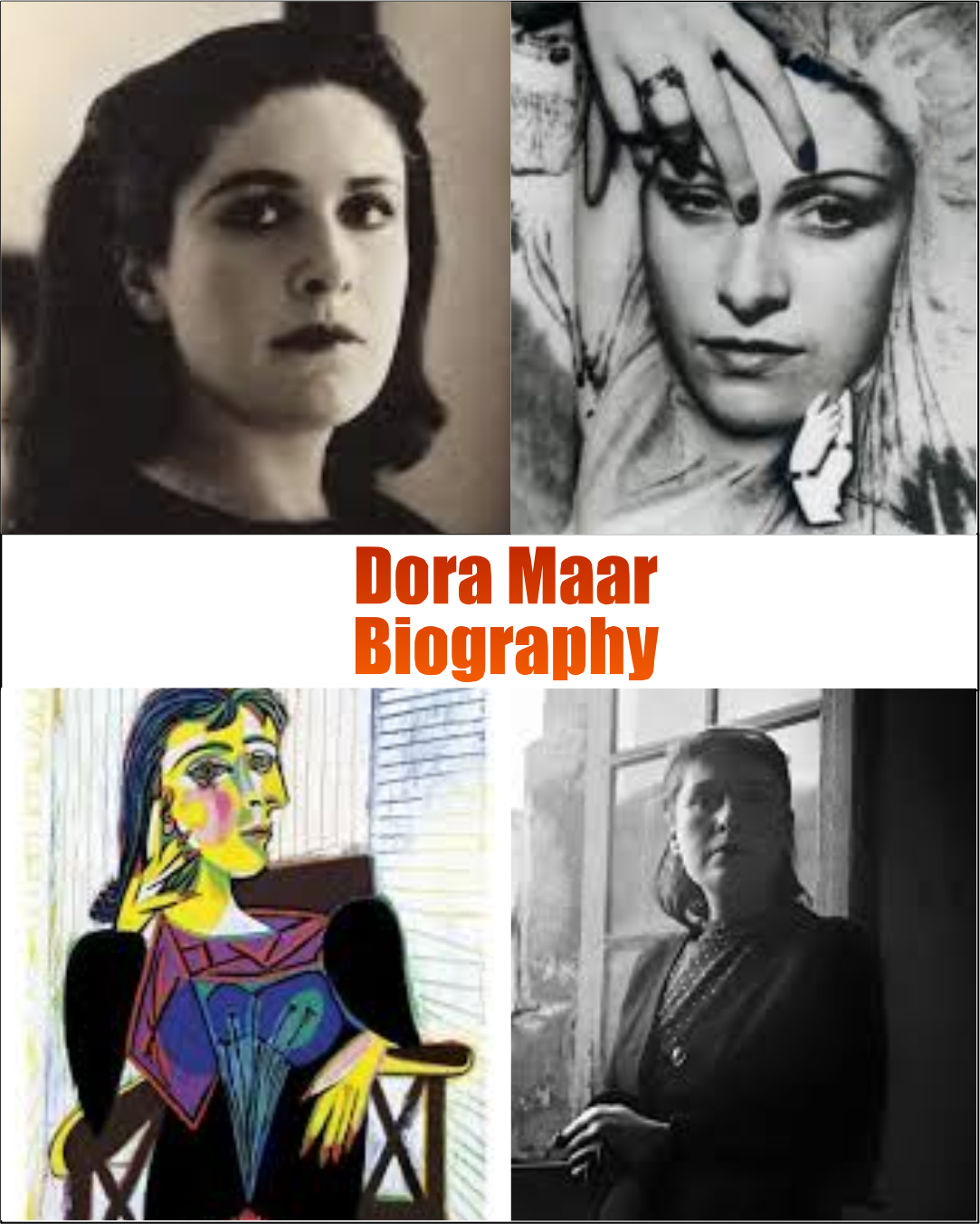
The Dora Maar Biography: She Was Not Picasso’s Muse, Picasso Was Her Subject.
Dora Maar was a pioneering Surrealist photographer with a studio, a political movement, and an iconic career before she ever met Pablo Picasso. He painted her as a weeping woman. She said every portrait of her was a lie. She outlived him by 24 years, kept painting alone in Provence, and died in 1997 with her own work unseen for decades. The Centre Pompidou finally gave her a full retrospective in 2019.
All His Portraits of Me Are Lies. Not One Is Dora Maar: The Story of the Artist History Called a Muse
She said it plainly, without self-pity, with the particular precision of a person who has thought carefully about what they want to say and decided that the accurate version is more dignified than the diplomatic one.
“All his portraits of me are lies. They’re all Picassos. Not one is Dora Maar.”
The portraits in question are among the most famous images in twentieth-century art. The Weeping Woman. Dora Maar Seated. Dora Maar in an Armchair. A series of paintings in which a woman’s face is fractured, distorted, anguished — eyes that do not belong in the same plane of reality, a mouth that has been disassembled and reassembled incorrectly, the specific grammar of Cubism applied to a specific human being in a way that made her a symbol of suffering rather than a portrait of a person.
In the majority of Picasso’s paintings of her, Maar was represented as a tortured, anguished woman.
Dora Maar Biography
| Category | Details |
|---|---|
| Full Name | Henriette Theodora Marković |
| Date of Birth | November 22, 1907 |
| Place of Birth | Tours, France |
| Nationality | French |
| Profession | Photographer, Painter, Artist, Poet |
| Field of Work | Surrealist Photography, Fine Art, Painting, Poetry |
| Notable Achievement | One of the most significant Surrealist photographers of the 20th century; documented the creation of Picasso’s Guernica |
| Legacy | Celebrated as a pioneering artist whose independent creative vision is finally receiving the international recognition it deserves |
Paris, Buenos Aires, and the Girl Who Was Going to Be an Artist
Born Henriette Theodora Markovitch on November 22, 1907, in Paris, Dora Maar spent her early years in Buenos Aires, Argentina, where her Croatian father worked as an architect.
The Buenos Aires years — her childhood, spent in the particular social world of the Argentine capital’s European expatriate community in the 1910s — gave her something that Parisian-born artists of her generation often lacked: a sense of elsewhere. Of cultures that existed outside the Parisian art world’s own high estimation of itself. Of the fact that what passed for the centre of civilisation in a particular intellectual milieu was, from a different angle, simply one city’s way of organising its ambitions.
She returned to Paris in 1926 and studied art at the Union Centrale des Arts Décoratifs, the École de Photographie, the Académie Julian, and the atelier of André Lhote.
See also: Raden Adjeng Kartini Biography: She Wrote Letters That Changed a Country
The Studio, the Streets of London, and the Photographer Before Picasso
In 1931, she established herself as a professional photographer alongside young designer Pierre Kéfer.
The studio they called Kéfer-Dora Maar at 29 Rue d’Astorg was not a hobbyist’s project. It was a commercial operation — specialising in portraits, nudes, fashion and advertising, the studio was hugely successful. She was twenty-three years old. She had a studio. She had clients. She was making a living from photography in a competitive commercial market while simultaneously building the artistic practice that would eventually place her in the company of Dalí and Man Ray in the movement’s landmark exhibitions.
But the commercial work and the artistic work were never entirely separate. She infused the images with a healthy dose of Surrealism. In one advertisement, a bottle of Pétrole Hahn hair oil lays on its side — but instead of oil, out spills a tangle of long, wavy locks.
The advertisement as Surrealist image. The commercial assignment as artistic statement. She understood — with a sophistication that the art world’s tendency to separate high art from commercial work has consistently failed to give her credit for — that the uncanny could operate in every register, that the grammar of dreams did not require a gallery to be effective.
Did you know?
Père Ubu — a close-up image by Maar of what may be an armadillo fetus, set against a dark background — became an icon of the Surrealist movement. Scholar Andrea Nelson of the National Gallery of Art says of it: “It’s compelling but repellent at the same time. You don’t quite know what it is, and you’re trying to figure it out.
It’s surprising, it’s mysterious, it’s completely bizarre and it’s grotesque. It still maintains that power.” This image — one of the most reproduced works of Surrealist photography — was made by Dora Maar before she ever met Picasso. The person history reduced to a weeping woman had already made one of the twentieth century’s most iconic images, entirely on her own terms.
The Café, the Black Lace Gloves, and the Man Who Did Not Remember Their First Meeting
The mythology around the beginning of Dora Maar’s relationship with Pablo Picasso has been told so many times that separating the event from its subsequent elaboration is difficult. But the broad outlines are verified and revealing.
It was during the filming of Jean Renoir’s Le Crime de Monsieur Lange that she first laid eyes on Picasso. Although she was instantly intrigued by the fifty-four-year-old painter, he did not remember that encounter.
He did not remember her. She remembered him. The power differential in that small biographical detail is the seed from which everything else grew.
They met again in 1936 in a much mythologised meeting. This time they were in a restaurant, Picasso was again with Paul Éluard. Dora Maar was sitting at a nearby table wearing black lace gloves and playing with a knife. Occasionally she would accidentally cut herself and a drop of crimson blood would spill over the lace.
Guernica — The Artist Who Photographed Another Artist’s Masterpiece
In 1937, Pablo Picasso began painting Guernica — his response to the bombing of the Basque town by Nazi and Fascist air forces during the Spanish Civil War. The painting would become one of the most significant works of art in the twentieth century. Its creation was documented in a unique and unprecedented way.
Maar took it upon herself to serve as Picasso’s official photographer during the thirty-six-day period in which he painted Guernica. John Richardson writes that “Dora’s expertise would prove immensely useful; she was able to make the first photographic record of the creation of a modern artwork from start to finish.”
The photographs she made of Guernica’s creation are themselves historically significant artworks — a sequential documentation of a painting’s emergence from blank canvas to completed statement, a record of the creative process that has never been matched in the history of modern art. They are taught in art history courses. They are reproduced in every serious analysis of Guernica. They are part of the permanent visual vocabulary of twentieth-century art.
They are credited to Dora Maar. They were made by Dora Maar. They are the product of Dora Maar’s photographic expertise, her access to Picasso’s studio, and her disciplined approach to the task of documentation.
The Abandonment — And What Came After
In 1943, Picasso ended the relationship. He had begun associating with Françoise Gilot, who was twenty-one years old. Gilot was pregnant with his child.
Maar never reconciled herself with the situation, a tension that intensified in 1943 when Picasso began associating with the even younger Gilot. In 1945, Maar had a mental breakdown and was admitted to a psychiatric clinic.
She was left distraught and in the care of controversial psychiatrist Jacques Lacan, who treated her illegally with electroshock therapy.
Electroshock therapy. For a mental breakdown caused partly by the end of a relationship with a man who had also been physically and emotionally abusive throughout their time together. He is not a man, he is an illness, she eventually said of him, with the same precision and the same refusal to soften what was true that had characterised everything she had ever said in public about the relationship.
The Auction of 1997 — When the World Finally Looked
After her death in 1997, the contents of her homes in Paris and in Ménerbes were auctioned off. The sale did generate a good deal of public interest, but only because it included several Picassos that Maar had owned.
She died on July 16, 1997, in Paris, at eighty-nine years old. The world came to the auction of her possessions because it contained Picassos. The Dora Maars were there too — paintings she had made across fifty years of quiet, consistent work that had never left her studios, that had never been exhibited, that no one except she herself had ever really seen.
The painted works of Maar remained unrecognised until their posthumous sale, organised in 1999, which made the public and professionals discover a very personal production that had never left her studio.
Tate Modern, 2019 — Over Four Hundred Works and a Long Overdue Name
The subject of a full-scale Centre Pompidou survey that travelled to Tate Modern in London and the Getty Center in Los Angeles, Maar, for contemporary audiences, especially non-French ones, was until recently virtually unknown as an artist. The travelling exhibition — titled simply “Dora Maar” and featuring well over four hundred works and documents — puts that error to right, offering an in-depth examination of a productive and multifaceted artist, a photographer and painter of real interest and complexity.
Over four hundred works. In the galleries of the Centre Pompidou. Then Tate Modern. Then the Getty Center. The artist who had kept her paintings in her studios for fifty years had her first international retrospective at institutions that define the canon of twentieth-century art — twenty-two years after her death.
She was a figure who truly embodied the “convulsive beauty” ideal expressed by André Breton.
What She Actually Was
Dora Maar was a pioneering Surrealist photographer who established a successful commercial studio at twenty-three, who documented street poverty in Barcelona and London before fascism made political engagement fashionable, whose photograph Père Ubu became one of the movement’s most iconic images, who was exhibited alongside Man Ray and Salvador Dalí in the major Surrealist exhibitions of the 1930s, who photographed the creation of Guernica and in doing so made one of the most significant documentary records in art history, who taught Picasso techniques he did not know, whose political activism shaped his engagement with the Spanish Civil War, who survived a mental breakdown and electroshock therapy to live alone in Provence for fifty years painting abstract landscapes that nobody saw, who returned to photography in her seventies making images that interested nobody, who died in 1997 with her work unseen, and who finally received the retrospective that her work had always warranted at the Centre Pompidou twenty-two years after she was gone.
“So often the first sentence you read about them is that they were the muse of Pablo Picasso,” says scholar Nelson. “But in the case of Dora Maar, she was a really successful and interesting photographer for years and years before she even met Pablo Picasso.”
Frequently Asked Questions
1. Who is Dora Maar?
Dora Maar was a French photographer, painter, and poet who is widely regarded as one of the most significant and technically accomplished artists of the Surrealist movement. Born Henriette Theodora Marković on November 22, 1907, in Tours, France, she grew up partly in Argentina before returning to Paris where she trained at the École des Beaux-Arts and the Académie Julian.
2. What made Dora Maar’s photography significant?
Dora Maar’s photographic work during the 1930s was remarkable for its technical sophistication, its political consciousness, and its fearless engagement with Surrealist ideas. Her commercial photography — for advertising clients and fashion publications — demonstrated a mastery of composition, lighting, and visual narrative that established her reputation quickly in Paris’s competitive creative world.
3. What was Dora Maar’s relationship with Pablo Picasso and how did it affect her career?
Dora Maar and Pablo Picasso were romantically involved from approximately 1936 to 1943 — a relationship that was intense, creatively stimulating, and ultimately deeply damaging to her. During this period she made one of her most historically significant contributions to art history — documenting the creation of Picasso’s Guernica in 1937 through a series of photographs that recorded the painting’s development from initial sketches to completed masterpiece.
4. What did Dora Maar do after her relationship with Picasso ended?
After her relationship with Picasso ended in 1943, Dora Maar underwent a significant personal and creative transformation. She experienced a serious mental health crisis that required hospitalisation and treatment, and during her recovery she became deeply interested in Catholic mysticism — a spiritual engagement that shaped the rest of her life and her subsequent artistic work.
5. What is Dora Maar’s lasting legacy?
Dora Maar died on July 16, 1997, in Paris at the age of 89. After her death, the auction of her estate — which included works by Picasso, her own photographs and paintings, and personal documents — drew enormous international attention and prompted a significant reappraisal of her place in art history.