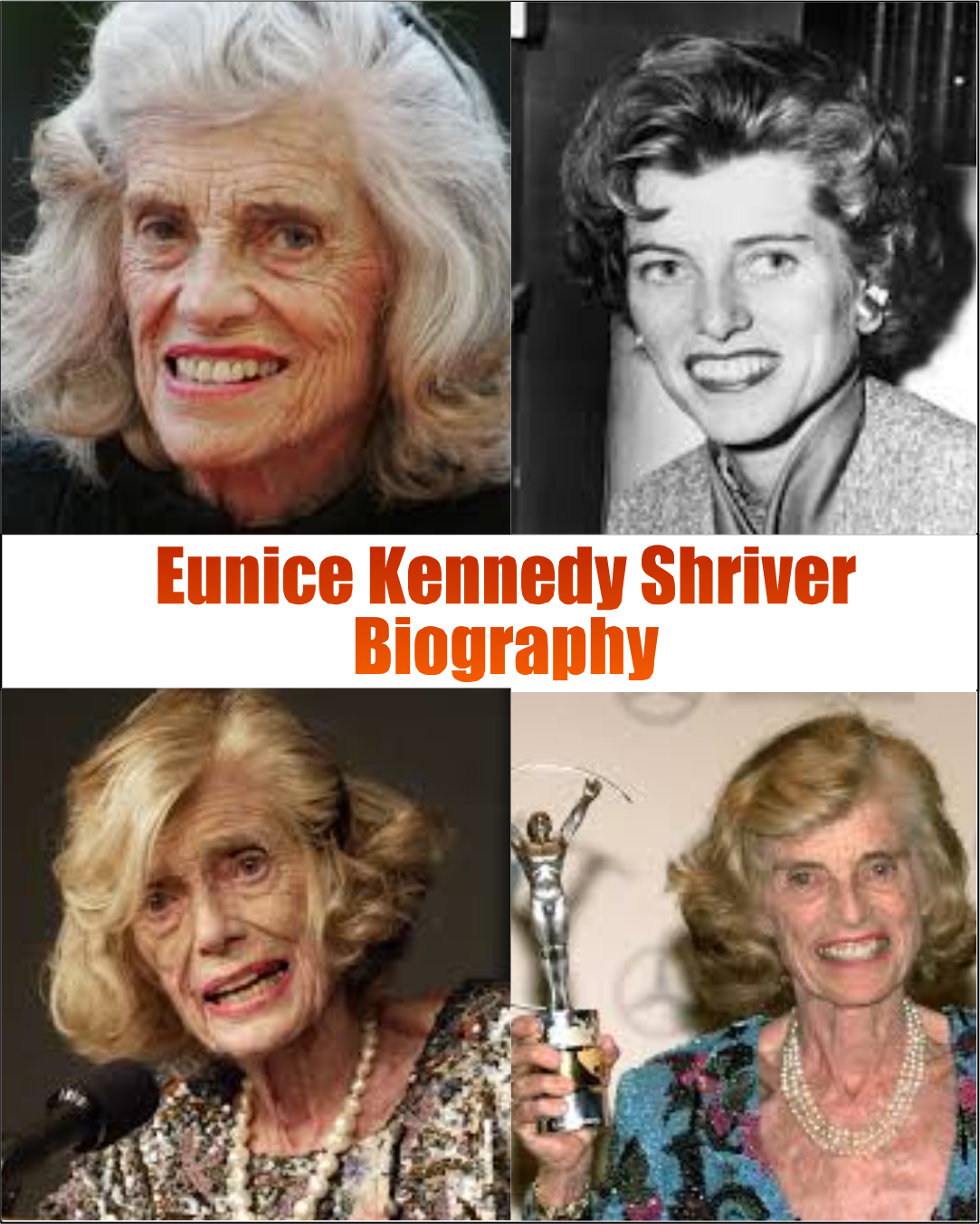
Eunice Kennedy Shriver Biography
The Eunice Kennedy Shriver Biography: From Backyard Camp to Most Inclusive Movement in Sport
Eunice Kennedy Shriver grew up swimming and sailing with her intellectually disabled sister Rosemary — then watched Rosemary be lobotomised and hidden from the world. She spent the rest of her life making sure that never happened to anyone else’s child. The backyard camp she started in 1962 became the Special Olympics — now serving 6 million athletes with intellectual disabilities in 200 countries. She was not an athlete. She changed sport more than most athletes ever will.
She Started With a Backyard Camp for Children Nobody Else Would Take. She Built the Biggest Inclusive Sports Movement in History: The Story of Eunice Kennedy Shriver
The woman who called her said simply: my child has been rejected from summer camp because he has a mental disability. What should I do?
Eunice Kennedy Shriver did not pause to consult an organisation, a policy document, or a government programme. There were none to consult. In the early 1960s, children with intellectual disabilities were being excluded from virtually every aspect of public life — from schools, from parks, from sports programmes, from the basic civic participation that their families had paid taxes to support.
“I said, ‘You don’t have to talk about it anymore. You come here a month from today. I’ll start my own camp. No charge to go into the camp, but you have to get your kid here, and you have to come and pick your kid up.'”
Eunice Kennedy Shriver Biography
| Category | Details |
|---|---|
| Full Name | Eunice Mary Kennedy Shriver |
| Date of Birth | July 10, 1921 |
| Place of Birth | Brookline, Massachusetts, USA |
| Nationality | American |
| Profession | Humanitarian, Activist, Philanthropist, Founder |
| Field of Work | Disability Rights, Intellectual Disability Advocacy, Sport, Education |
| Notable Achievement | Founded the Special Olympics in 1968 — one of the most significant humanitarian sporting organisations in human history |
| Legacy | Celebrated as one of the greatest humanitarians of the 20th century whose founding of the Special Olympics transformed the lives of millions of people with intellectual disabilities worldwide |
Brookline, the Kennedy Family, and the Sister Nobody Was Supposed to Know About
Eunice Mary Kennedy was born in Brookline, Massachusetts, USA, on July 10, 1921, the fifth of nine children of Joseph P. and Rose Fitzgerald Kennedy.
The Kennedy family that produced a president, two senators, and eventually Eunice herself was also the Kennedy family that had a secret. Rosemary Kennedy — Eunice’s older sister, the third of nine children — had an intellectual disability. Born into the prominent Kennedy family, she was deeply influenced by her sister Rosemary, who had IDD and underwent a lobotomy that left her incapacitated.
The lobotomy was performed in 1941, when Rosemary was twenty-three, without her consent and without the knowledge of her mother. Joseph Kennedy Sr. authorised it. Rosemary’s ordeal “was the fuel that powered the engine that was Eunice Kennedy Shriver,” historian Eileen McNamara told PBS.
Stanford, Social Work, and the Foundation
Eunice Kennedy received a B.S. degree in sociology from Stanford University in 1943.
At Stanford, she was an athlete — competing in various sports, developing the physical intelligence and competitive orientation that would later inform her conviction that sport was not a luxury for people with intellectual disabilities but a necessity. Eunice Kennedy Shriver went on to become an athlete in college.
After graduation she worked in the Special War Problems Division of the State Department, then as a social worker at a women’s prison in West Virginia, then with the House of the Good Shepherd and the Chicago Juvenile Court — accumulating, across the 1940s and early 1950s, a direct and sustained experience of what it meant to be at the margins of American society. The intellectually disabled. The incarcerated. The young mothers under state care. She was not designing policy from a distance. She was in the rooms with the people the system had decided were someone else’s problem.
In 1957, she took over the direction of the Joseph P. Kennedy Jr. Foundation. The foundation was created to serve two major objectives: to seek the prevention of intellectual disability by identifying its causes, and to improve the means by which society deals with people who have intellectual disabilities.
See also: Funmilayo Ransome-Kuti Biography: The Woman Who Led 10,000 Into a Palace
Did you know?
In 1962, she wrote an article about Rosemary published in the Saturday Evening Post — one of the most widely read magazines in America — publicly acknowledging for the first time that the President’s sister had an intellectual disability. She wrote: “Like diabetes, deafness, polio, or any other misfortune, it can happen in any family. It has happened in the families of the poor and rich, of governors, senators, Nobel prizewinners, doctors, lawyers, writers, men of genius, presidents of corporations — the President of the United States.”
The President of the United States. Her brother John was in the White House. She named his family publicly in an argument against the shame and secrecy that surrounded intellectual disability. It was an act of personal and political courage that helped shift the cultural conversation permanently.
Camp Shriver 1962 — The Summer That Started Everything
In 1962, Shriver also created Camp Shriver, a summer camp for children with IDDs at her family’s estate in Maryland. With funding from the Joseph P. Kennedy Jr. Foundation, the camp provided a wide array of recreational activities, including horseback riding, sailing, swimming, and soccer games. Shriver also invited park district and school officials to visit the camp, to show that children with IDDs could engage in — and benefit — from the same type of activities as other children.
She recruited high school students as counsellors. She ran the camp herself. She observed what happened when children who had been excluded from organised sport were given access to it — and what she observed was not the cautious, limited participation that the institutional consensus had predicted but genuine, enthusiastic, improving athletic performance.
July 1968 — Soldier Field, 1,000 Athletes, and a Movement Is Born
The first Special Olympics were held in Chicago in 1968, sponsored by the Chicago Park District and the Kennedy Foundation, and saw the participation of 1,000 contestants from 26 states and Canada.
“The Chicago Special Olympics prove a very fundamental fact — that exceptional children can be exceptional athletes and that through sports they can realise their potential for growth. But they are only 1,000 out of one-and-one-half million children who should be competing in games like this all over America.”
She said this at the opening ceremony. Not as a celebration of what had been achieved — as a statement of the scale of what remained to be done. One thousand athletes. One and a half million who should be competing. The gap between those two numbers was not a reason to congratulate herself. It was the next task.
Career, Recognition, and What Sport Gave Her
Eunice Kennedy Shriver was not a professional athlete. She competed in college. She swam with her siblings. Her relationship with sport was the relationship of someone who understood its value from the inside — who had felt what physical competition and athletic achievement do for a person’s sense of themselves and their place in the world — and who spent her life ensuring that the people most systematically excluded from that feeling could access it.
She was awarded the Presidential Medal of Freedom in 1984 by President Ronald Reagan for her work on behalf of persons with disabilities. In December 2008, Sports Illustrated named Shriver the first recipient of Sportsman of the Year Legacy Award.
Sports Illustrated’s Sportsman of the Year. Not for athletic performance. For what she had done to sport — for the expansion of sport’s moral and practical definition that the Special Olympics represented. In 2017, ESPN posthumously named Shriver the Arthur Ashe Courage Award recipient for her pioneering efforts.
Philosophy — What Sport Was Actually For
She recognised that individuals with intellectual and developmental disabilities had unique gifts and talents to share with their communities.
The recognition was not theoretical. It was experiential — she had watched Rosemary swim like a deer. She had watched the children at Camp Shriver discover capabilities that the medical establishment had decided they did not possess. She had built the evidence base, camp by camp and year by year, that the assumption of athletic incapacity was wrong.
“I suppose the fact that I had seen my sister swim like a deer — in swimming races — and do very, very well just always made me think that they could do everything.”
What She Changed About Sport
Before Eunice Kennedy Shriver, sport’s definition of who it was for had an invisible upper limit and an invisible lower limit simultaneously. At the upper end, it was for the fastest and strongest. At the lower end — and this was the invisible limit — it was not for people whose intellectual capacity fell below a certain threshold. The Olympics existed. The Paralympics existed for physical disabilities. But the intellectually disabled were excluded from organised athletic competition entirely. Not by explicit rule. By the accumulated assumption that their participation was not appropriate, not meaningful, not something sport had a framework to accommodate.
After Eunice Kennedy Shriver, sport had the Special Olympics. A framework built specifically to include people who had been excluded — not as a concession or a charity initiative but as a genuine sporting competition with trained athletes, professional coaching, international competition, and the full emotional and developmental architecture of organised sport.
Frequently Asked Questions
1. Who is Eunice Kennedy Shriver?
Eunice Kennedy Shriver was an American humanitarian, activist, and philanthropist who is best known as the founder of the Special Olympics — one of the most transformative sporting and humanitarian organisations in the history of the world. Born on July 10, 1921, in Brookline, Massachusetts, she was a member of the celebrated Kennedy family — sister of President John F. Kennedy, Senator Robert F. Kennedy, and Senator Edward Kennedy — but carved out a legacy of her own that stands independently and entirely on its own terms.
2. What was Eunice Kennedy Shriver’s personal motivation for her advocacy work?
The personal motivation behind Eunice Kennedy Shriver’s lifelong advocacy for people with intellectual disabilities was rooted in the experience of her sister Rosemary. Rosemary Kennedy was born with an intellectual disability — a fact that the Kennedy family largely kept private in an era when intellectual disability was deeply stigmatised and when public knowledge of such a condition in a prominent family was considered a source of shame.
3. How did Eunice Kennedy Shriver create the Special Olympics and what was its original vision?
Eunice Kennedy Shriver began what would become the Special Olympics in her own backyard — literally. In 1962 she opened her Timberlawn estate in Maryland as a summer day camp for children and adults with intellectual disabilities, providing them with physical activities, sports training, and the experience of being treated as capable, valued, and worthy of investment.
4. What impact has the Special Olympics had globally since its founding?
The growth and impact of the Special Olympics since Eunice Kennedy Shriver founded it in 1968 has been one of the most remarkable stories in the history of humanitarian sport. From approximately 1,000 athletes at the first Games in Chicago, the organisation has grown to serve more than 6 million athletes in more than 170 countries — making it one of the largest sporting organisations in the world.
5. What is Eunice Kennedy Shriver’s lasting legacy?
Eunice Kennedy Shriver died on August 11, 2009, at the age of 88. Her legacy is one of the most significant in the history of humanitarian work and one of the most powerful examples in modern history of an individual using personal experience, social privilege, and determined action to change the world for millions of people who had no voice of their own. The Special Olympics she founded has given dignity, opportunity, joy, and community to more than 6 million athletes worldwide and has changed the attitudes of hundreds of millions of people toward intellectual disability through the visibility and excellence of its participants. She was awarded the Presidential Medal of Freedom — the United States’ highest civilian honour — in recognition of her contributions to American society and to humanity.