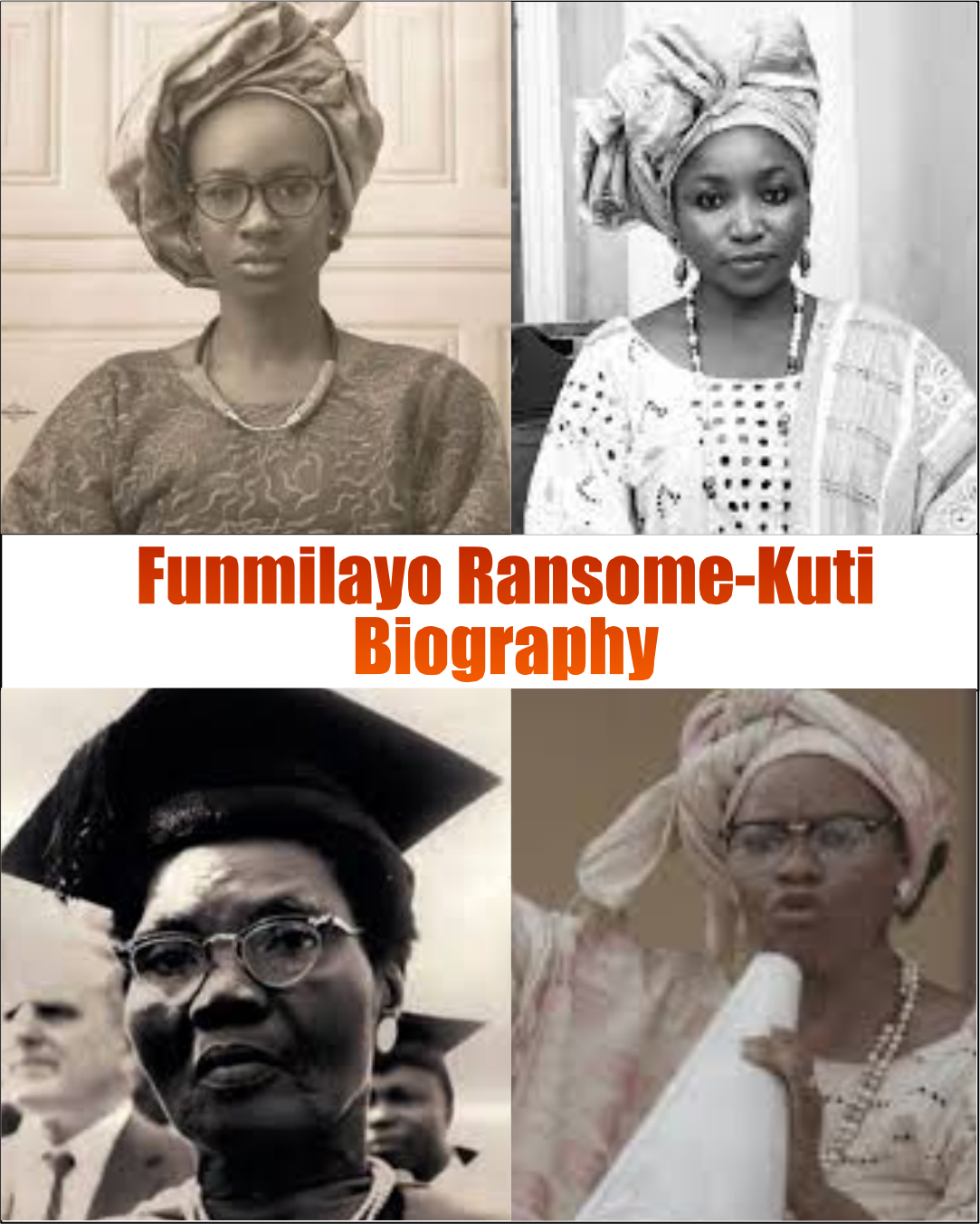
The Funmilayo Ransome-Kuti Biography: The Woman Who Led 10,000 Into a Palace.
Funmilayo Ransome-Kuti dropped her English name in Britain as her first act of resistance. She led 10,000 women to a king’s palace, forced a monarch to abdicate, went to London as Nigeria’s only female delegate, met Mao Zedong, was accused of communism, had her passport seized — and at 76 was thrown from a second-floor window by soldiers. Nigerian newspapers reported her death with the headline: Fela’s Mum Is Dead.
The morning after Funmilayo Ransome-Kuti died, two Nigerian newspapers carried the announcement of her passing with the same headline.
Fela’s Mum Is Dead.
At least two Nigerian news outlets reported her death with the headline: “Fela’s Mum is Dead.”
She was seventy-seven years old. She had spent more than four decades fighting the British colonial government, a traditional ruler, two Nigerian federal governments, and the specific, daily injustice of a system that taxed women without representing them, stripped girls naked in the streets to assess their age for taxation purposes, and used a king’s authority as the machinery of colonial extraction.
She had led ten thousand women to a palace and forced a monarch to flee. She had gone to London as the only woman in Nigeria’s official delegation to protest a proposed constitution. She had met Mao Zedong in China. She had been accused of communism by the British and Nigerian governments simultaneously, had her passport seized, been denied entry to the United States, and founded a national women’s organisation with twenty thousand members at a time when women in Nigeria had no vote, no representation, and no formal mechanism for political participation.
She had organised some of the first preschool classes in Nigeria. She had established literacy classes for market women. She had been the first woman appointed to the Western House of Chiefs. She had been conferred the chieftaincy title of Oloye. She had inspired Kwame Nkrumah in Ghana. She had received the Lenin Peace Prize. She had built schools across Abeokuta for decades after her husband died.
And at seventy-six years old, she had been thrown from a second-floor window by Nigerian soldiers raiding her son’s compound.
The newspapers called her Fela’s Mum.
That headline is the best argument for this article that I can offer. Because Funmilayo Ransome-Kuti was not Fela’s mum. Fela was her son. The distinction is not cosmetic. It is the entire point.
Funmilayo Ransome-Kuti Biography
| Category | Details |
|---|---|
| Full Name | Frances Abigail Olufunmilayo Thomas Ransome-Kuti |
| Date of Birth | October 25, 1900 |
| Place of Birth | Abeokuta, Ogun State, Nigeria |
| Nationality | Nigerian |
| Profession | Political Activist, Educator, Women’s Rights Champion |
| Field of Work | Women’s Rights, Political Activism, Education, Anti-Colonial Resistance |
| Notable Achievement | Led the historic Abeokuta Women’s Revolt of 1949 that forced a traditional ruler to abdicate; first Nigerian woman to drive a car |
| Legacy | Celebrated as the mother of Nigerian feminism and grandmother of Afrobeats legend Fela Kuti |
Abeokuta, a Family That Valued Education, and the Name She Refused to Keep
Funmilayo Ransome-Kuti, born Frances Abigail Olufunmilayo Thomas on October 25, 1900, in Abeokuta, Ogun State, Nigeria, came from a family that valued education, moral integrity, and social responsibility.
Her father was Daniel Olumoyewa Thomas, a farmer and trader, and her mother was Phyllis Moyeni Dese, a dressmaker. Abeokuta — the rock city, founded in 1830 by the Egba Yoruba as a defensible settlement during the nineteenth century wars — was by 1900 a community with a significant Christian mission presence, an emerging educated class, and the specific tensions of a society navigating the intersection of traditional Yoruba authority and British colonial administration.
She was the first female student to attend the Abeokuta Grammar School, which she attended from 1914 to 1917. The first. Not the first of her year. The first female student the school had ever admitted. She arrived in an institution that had been designed without her in mind and made herself impossible to ignore.
In 1919, she went to Britain to study. She went to Britain to study at Wincham Hall Schools for Girls in Cheshire, where she was taught subjects such as French, elocution, music and dress-making. But before she returned to Nigeria in 1922, she demonstrated the first sign of her rejection of British imperialism: dropping her Christian names of Frances Abigail and adopting her Yoruba name — Oluwafunmilayo, shortened to Funmilayo — meaning God has given me joy.
In 1928, she established one of the first preschool classes in Nigeria. Before the protests. Before the women’s union. Before the palace sieges and the London delegations and the Lenin Peace Prize. A preschool class, quietly organised in Abeokuta, for children who would otherwise not have access to early education. The radical feminist and the nursery school teacher were the same woman.
The Market Women, the Ladies Club, and the Making of a Movement
The political awakening that eventually produced the most significant women’s movement in Nigerian history began, in 1932, with a ladies club.
In 1932, when her husband became principal of the Abeokuta school, she helped organise the Abeokuta Ladies Club, initially a civic and charitable group of mostly Western-educated Christian women. The organisation gradually became more political and feminist in its orientation, and in 1944 it formally admitted market women — women vendors in Abeokuta’s open-air markets — who were generally impoverished, illiterate, and exploited by colonial authorities.
The admission of market women into the Ladies Club in 1944 was the most consequential structural decision Funmilayo Ransome-Kuti ever made. The educated Christian women of the club and the illiterate market women of Abeokuta’s streets were, in the colonial social hierarchy, not supposed to belong to the same organisation. Their worlds were officially separate — separated by education, by religion, by the specific social categories that colonial administration reinforced.
She stated: “The true position of Nigerian women had to be judged from the women who carried babies on their backs and farmed from sunrise to sunset, not women who used tea, sugar, and flour for breakfast.”
That line — direct, precise, and pointed — contains the entire political philosophy of her movement. The women who carried babies on their backs. Not the women who had been to England and returned with French and elocution. The market women. The farmers. The women whose labour was sustaining the colonial economy while colonial policy was extracting from them everything they earned.
The Taxation, the Stripping, and the System That Made the Revolt Inevitable
Tax policies began in 1918 and required girls as young as 15 to pay three shillings a year as income tax. Men did not have to pay the tax until they were 18. Government agents often raided the girls’ homes, stripping them naked to ascertain their age to tax them. Agents worked on commission, and extortion was common.
Read that again slowly. Government agents — men, operating on commission — stripping girls naked in their homes to assess whether they were old enough to be taxed. In Abeokuta. Under British colonial administration. In the twentieth century.
This was not a historical aberration or an administrative mistake. It was a system. A system in which the colonial government taxed women from the age of fifteen, used the Alake of Abeokuta — the traditional ruler, Sir Ladapo Ademola II — as its local enforcement mechanism, and gave its agents financial incentives to maximise collection through whatever methods they found effective.
Funmilayo Ransome-Kuti heard this. She had been hearing it since she admitted the market women to her club. She began building a response.
Did you know?
Ransome-Kuti organised training sessions for demonstrations — teaching the women how to protest effectively, how to maintain discipline in large gatherings, how to communicate their demands clearly.
She was not simply a figurehead at the front of the march. She was the strategist who prepared the army. A decade before the big protest, she was running what amounted to civil disobedience training sessions in Abeokuta. The women who marched in 1947 had been prepared.
November 1947 — Ten Thousand Women and a King’s Palace
In November 1947, an estimated crowd of ten thousand women, led by Ransome-Kuti, charged to the Alake’s palace, singing and dancing in protest against the authorities and demanding an end to the unfair taxation. They argued that since they were inadequately represented in local government, they should not be required to pay separate taxes from men.
Ten thousand women. Singing and dancing. In front of a king’s palace.
The singing and dancing is not incidental. It was deliberately chosen — a form of protest that was simultaneously joyful and defiant, that used the cultural forms the women owned to occupy a space that power had designated as off-limits to them. They did not arrive as suppliants. They arrived as a community asserting its right to be heard.
The women’s revolt against taxation had been rumbling for more than a decade. The Abeokuta Women’s Revolt would come to be known as reminiscent of the Aba Women’s Riots of 1929. The Aba Women’s Riots — the massive 1929 uprising of Igbo and Ibibio women in eastern Nigeria against colonial taxation — had been one of the most significant acts of collective resistance in Nigerian colonial history. The Abeokuta Women’s Revolt took its place in the same tradition and exceeded it in organisation, duration, and ultimate effectiveness.
The AWU organised women in Abeokuta to protest against colonial taxation and other unfavourable policies under the slogan: No taxation without representation.
A king, forced from his throne by ten thousand women led by a schoolteacher from Abeokuta who had learned to drop her English names in Britain twenty-seven years earlier.
London, the Only Woman, and the Article That Called Britain Out
She was also the only woman to join the Nigerian delegation to London in 1947 to lodge a formal protest with the Secretary of State for the Colonies. During this visit, she informed British unions and the crown of what was happening in Abeokuta. She became a well-known figure to the British press and public, had articles published in the Daily Worker and was even invited by the mayor of Manchester to speak on the condition of women in her country.
The Daily Worker was a British communist newspaper — not because Funmilayo Ransome-Kuti was a communist, but because it was the newspaper willing to publish an African woman’s account of what British colonial rule was actually doing to Nigerian women. The mainstream British press was not lining up to give her space. The communist press was.
In an article published in the Daily Worker, she noted that before the British arrival in Nigeria, life was mainly agricultural and there was a fairer division of labour between men and women: “The men cultivated the land and it was chiefly the duty of women to reap. Women owned property, traded and exercised considerable political and social influence in society. They were responsible for crowning the kings on coronation days. Whatever disabilities there existed were endured by men and women alike.”
We had equality till Britain came. That is the argument of the article in six words. Not that pre-colonial Yoruba society was perfect — but that the specific disabilities women were now enduring had been introduced and were being maintained by colonial administration, not by Yoruba tradition. The British were not liberating Nigerian women. They were taxing them, stripping them, and using their own traditional rulers as instruments of extraction.
China, Mao Zedong, and the Communist Label That Could Not Stop Her
One of the trips the organisation sponsored was to China to discuss Nigerian women and culture, where she met Mao Zedong.
The visit to China — in the early 1950s, at the height of the Cold War, in the context of the McCarthy era paranoia that was classifying any Black or African activist with international connections as a communist — provided the colonial and postcolonial authorities exactly the pretext they had been looking for.
Despite the fact that her Christian and democratic principles were well known, the British and Nigerian governments labelled her a communist sympathiser, and in 1957, the government of Nigeria refused to renew her passport until public outcry led it to relent. The following year, her alleged communist connections caused the United States to deny her a visa to attend an International Women’s Organization conference — a tactic frequently used at the time against radical feminists.
The passport seized. The American visa denied. A woman who had been running night literacy classes for market women in Abeokuta since the 1940s, labelled a communist because she had met the leader of China and because the organisations she worked with had Soviet connections.
The House of Chiefs, the Schools, and the Husband She Lost
She was conferred the chieftaincy title of Oloye in Yorubaland and was the first woman to be appointed to the Western House of Chiefs.
On 6 April 1955, Israel Ransome-Kuti died from prostate cancer after an extended period of illness. Funmilayo was hit hard by the loss of her husband, having struggled over the past several years with the question of whether to abandon her political work in order to spend more time with him. Over the next two decades, alongside her political work, Ransome-Kuti began investing time and money to establish new schools throughout Abeokuta — a project that arose from the deep belief in the importance of education and literacy that both she and her husband had shared.
Thirty years of marriage, marked by equality and mutual respect. A partnership between two people who shared the conviction that education was the foundation of everything else. His death did not diminish her work — it deepened it. The schools she built in the years after 1955 were a continuation of the conversation they had been having together since 1925.
February 18, 1977 — The Soldiers, the Window, and the End
At the age of seventy-six, she was thrown from a second-floor window during a military raid on her son Fela Kuti’s Lagos compound on February 18, 1977.
The Kalakuta Republic — Fela Kuti’s commune in Lagos, which he had declared independent of the Nigerian state — was raided by approximately one thousand soldiers on the orders of the military government. The raid was brutal. Buildings were burned. People were beaten and assaulted. Fela himself was severely injured. His wife was also attacked.
And Funmilayo Ransome-Kuti — seventy-six years old, the woman who had forced a king to abdicate, who had gone to London as Nigeria’s only female delegate, who had met Mao Zedong and received the Lenin Peace Prize and been appointed to the House of Chiefs — was dragged by her hair and thrown from a second-floor window.
She sustained injuries from which she never recovered. She died in Lagos General Hospital on April 13, 1978, at the age of seventy-seven.
What the Headline Got Wrong
Funmilayo Ransome-Kuti was not Fela’s mum. She was the Lioness of Lisabi. She was the woman who organised the first preschool classes in Nigeria. She was the woman who taught market women to read at night in Abeokuta. She was the only woman in Nigeria’s 1947 London delegation. She was the first woman appointed to the Western House of Chiefs. She was the founder of the Abeokuta Women’s Union, which grew to twenty thousand members. She was the woman who led ten thousand women to a king’s palace and forced him to flee.
Fela Kuti — the legendary Afrobeat musician, the political radical, the man who declared his commune independent of the Nigerian state — was her son. He learned his politics at her table. He learned his refusal to be silenced from her example. He learned his willingness to face military power without backing down from a woman who had been doing exactly that since 1944, two years before he was born.
The headline should have read: The Mother of Nigeria Is Dead.
The car is mentioned in Nigerian school textbooks. The ten thousand women who marched to a palace are sometimes not.
Frequently Asked Questions
1. Who is Funmilayo Ransome-Kuti?
Funmilayo Ransome-Kuti was a Nigerian educator, political activist, and pioneering women’s rights advocate who is widely regarded as the mother of Nigerian feminism. Born on October 25, 1900, in Abeokuta, in present-day Ogun State, Nigeria, she dedicated her life to fighting for the rights of women, the poor, and the politically marginalised at a time when both colonial rule and deeply entrenched traditional patriarchy made such advocacy extraordinarily dangerous.
2. What was the Abeokuta Women’s Revolt and why does it matter?
The Abeokuta Women’s Revolt of 1947 to 1949 was one of the most remarkable acts of organised political resistance in Nigerian colonial history, and Funmilayo Ransome-Kuti was its driving force. The revolt was directed primarily against the Alake of Abeokuta — the traditional ruler — and the colonial tax system that placed an unfair and crushing burden on market women and the poor.
3. What was Funmilayo Ransome-Kuti’s contribution to women’s education in Nigeria?
Education was the foundation of everything Funmilayo Ransome-Kuti believed and built. She was herself one of the first Nigerian women to study in England, attending Wincham Hall College in Cheshire, and she returned to Nigeria with both a British education and a fierce determination to extend educational opportunity to Nigerian women and girls.
4. What international recognition did Funmilayo Ransome-Kuti receive?
Funmilayo Ransome-Kuti was recognised and celebrated well beyond the borders of Nigeria during her lifetime. She was invited to international conferences on women’s rights and peace across Europe and Asia, meeting figures including Mao Zedong in China and receiving the Lenin Peace Prize from the Soviet Union in 1970 — one of the highest international honours available at the time and a recognition of her lifelong commitment to justice, peace, and the rights of ordinary people.
5. How did Funmilayo Ransome-Kuti die and what is her lasting legacy?
Funmilayo Ransome-Kuti died on April 13, 1978, from injuries sustained when soldiers of the military government of General Olusegun Obasanjo attacked the Kalakuta Republic — the compound belonging to her son Fela Kuti — in February 1977. She was thrown from a window during the attack and never fully recovered from her injuries. She was 77 years old. Her legacy today is immense and growing. She is celebrated as the grandmother of the Afrobeats movement through her son Fela, as the mother of Nigerian feminism, and as one of the greatest political activists in African history.