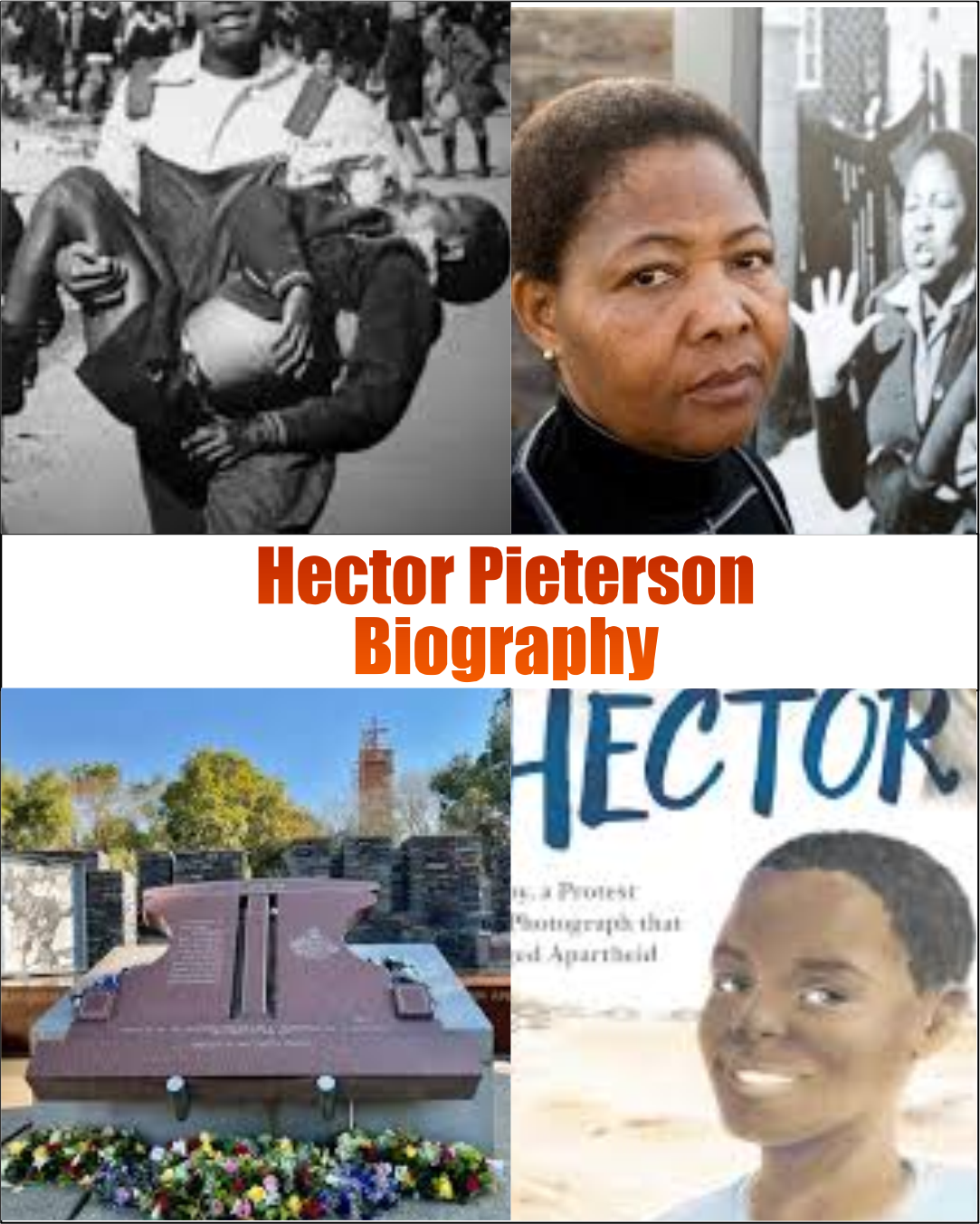
The Hector Pieterson Biography: The Boy Who Spike Black Revolution.
Hector Pieterson was not supposed to join the march. He was too young. His sister was seventeen and had ironed her uniform the night before. He tagged along anyway. Sam Nzima took six photographs in the chaos. One of them ended apartheid.
The night before the march, Antoinette Sithole ironed her school uniform.
She was seventeen years old, a student at a Soweto school, and she had spent weeks helping to organise what would happen the following morning – thousands of Black students walking through the streets of Soweto in protest against the apartheid government’s decision to impose Afrikaans as the medium of instruction in their schools. The planning had been careful, the secrecy deliberate, the determination absolute. She packed her school bag with placards. She pressed the creases into her uniform. She was ready.
Her younger brother watched her.
The night before the protest, Sithole ironed her school uniform and packed her school bag with placards, while her younger brother, thirteen-year-old Hector Pieterson, looked on enviously. Younger students were not supposed to be part of the protest.
Not supposed to be. Those three words contain the entire weight of what followed.
Hector Pieterson Biography
| Category | Details |
|---|---|
| Full Name | Hector Pieterson (also spelled Hector Peterson) |
| Date of Birth | 1964 |
| Place of Birth | Soweto, Johannesburg, South Africa |
| Nationality | South African |
| Ethnicity | Black South African |
| Profession | Student |
| Notable Achievement | His death on June 16, 1976 became the defining symbol of the Soweto Uprising and the global struggle against apartheid |
| Legacy | June 16 is celebrated as Youth Day in South Africa; the Hector Pieterson Museum in Soweto honours his memory |
Soweto, Orlando West, and the System That Built the Setting
To understand June 16, 1976, you have to understand what Soweto was and how it came to exist.
Soweto had its origins in the informal housing and infrastructure built by Black workers arriving from rural areas to pursue livelihoods in and around Johannesburg, particularly during the 1920s and 1930s. The name itself is an acronym – South Western Townships – a bureaucratic designation for the vast residential area southwest of Johannesburg that the apartheid state had created specifically to house the Black workers whose labour the white economy required while keeping them geographically and legally separated from the white city they served.
Zolile Hector Pieterson was born on 19 August 1963 in Soweto. His full name was Zolile – the name his family used – but the world would know him as Hector, the second name that appeared in the news reports and on the photograph caption that ran in newspapers across the globe the morning after he died. He grew up in Orlando West, one of Soweto’s oldest neighbourhoods, in the specific daily texture of Black urban South African life under apartheid – the pass laws that controlled where his parents could go, the inferior education system that funnelled Black children toward labour rather than learning, the police presence that treated his community as a population to be managed rather than citizens to be served.
The language policy that triggered the uprising of June 16, 1976 was not an isolated provocation. It was one link in a chain of policies designed to ensure that Black South Africans remained permanently subordinate – that their education prepared them for servitude rather than citizenship, that their language was suppressed rather than developed, that their children grew up understanding their place in a system designed specifically to keep them there.
Students from various schools began to protest in the streets of the Soweto township in response to the introduction of Afrikaans, considered by many Black South Africans as the language of the oppressor, as the medium of instruction in Black schools.
See also: Sor Juana Inés de la Cruz Biography – The Illegitimate Child Who Wrote the First Feminist Manifesto in the Americas
June 16, 1976 – Cold, Cloudy, and the Morning That Would Not End
June 16, 1976 dawned cold and cloudy.
It is estimated that 20,000 students took part in the protests. They were met with fierce police brutality, and many were shot and killed.
The plan had been for a peaceful march. The students carried placards. They sang. They moved through Soweto’s streets in the specific way that communities move when they have decided that something must be said and the time for saying it has arrived – not as a mob but as a community, with the dignity that comes from collective purpose. “We were a little bit scared, you know, but we felt free already. It was like: Now we are taking the streets of Soweto with a message,” Antoinette Sithole later recalled.
As the march passed Hector’s primary school, he joined it. He was too young. He joined anyway. The stubbornness of a twelve-year-old boy who wanted to be where his sister was, who wanted to be part of something that felt important, who could not yet fully understand the danger he was walking into – that stubbornness placed him on Vilakazi Street on the morning of June 16, 1976.
The police intercepted the march. The students refused to disperse. Someone – the accounts dispute exactly who gave the order or fired the first shot – opened fire on a crowd of schoolchildren.
Sam Nzima, the Film in the Sock, and Six Photographs That Became One
Sam Nzima was forty-two years old. He was a photojournalist with The World – one of the few Black newspapers in apartheid South Africa, written by Black journalists for Black readers in a media landscape as segregated as everything else.
Nzima got his start in photography by taking portraits with a second-hand Brownie camera. When he made it to The World in 1968, there was nowhere else for a Black photographer in apartheid-era South Africa to go. Black photographers were not allowed to work for The Star. We were only allowed to interview Blacks, and we were not allowed to write about whites.
He had been sent to cover the protest. He anticipated trouble – the relationship between Soweto’s students and the South African police was not one that suggested a calm morning. What he did not anticipate, even as he watched the chaos unfold, was what he actually saw.
“I did not expect to see a thirteen-year-old boy being shot by the police. So many were injured. So many were killed. But Hector Pieterson was the first.”
Did you know?
An important question scholars continue to raise is: to what degree does a powerful photograph reduce commemoration to the name of one person, thus overlooking the tragedies of other individuals who were killed on the same day? Due to the wide reach of Nzima’s photograph, it was initially believed that Hector Pieterson was the first student to be killed by the police.
But oral testimonies suggest that Hastings Ndlovu was not only the first to be gunned down, but was also deliberately sought out by the police. Hastings Ndlovu – fifteen years old, shot before Hector, his death less photographed and therefore less remembered – is buried in the same cemetery at Avalon. History remembered one face. Two boys died.
The Clinic, the Pronouncement, and the Sister Who Kept Telling the Story
In the chaos, Sithole later recounted, she saw her brother being carried by another protester, and together they rushed for help. Though they reached a clinic, Pieterson had already died.
He had been shot directly. The clinic could not undo what the bullet had done. Antoinette Sithole – seventeen years old, the girl who had ironed her uniform the night before, who had packed her placards, who had not meant to bring her little brother to this – stood in a clinic in Soweto and understood that the morning she had planned to participate in had become something entirely different.
For Sithole, the events of that day are still fresh in her memory. “I sometimes feel like what happened to me was fate. Maybe I was left to keep on telling what happened on that day.”
She has kept telling it. For decades – first to anyone who asked, then at the Hector Pieterson Memorial, then at the museum that opened in 2002 two blocks from where her brother was shot.
“Most people know our history, but don’t fully know it. So they’re coming here and we sort of embrace with them what really happened because they’ll be seeing people like me, other people sharing the same story. It makes us proud and brave to talk about our history.”
Proud and brave. To talk about the morning your brother was shot. To stand in front of strangers and describe what it looked like when he fell. To do that, day after day, year after year, because you have decided that the keeping of this particular truth is too important to be left to photographs alone.
The UN Resolution, the International Outcry, and the Beginning of the End
The photograph that Sam Nzima had hidden in his sock was published in The World the morning after Hector died. It was picked up by international wire services immediately. By the end of the week, it had appeared in newspapers across Europe, North America, and the rest of Africa.
That photo was published around the world, provoking international outrage at South Africa’s apartheid regime. On June 19, 1976, three days after the uprising began, the United Nations Security Council passed Resolution 392, which condemned South Africa’s government.
The UN Security Council had been discussing apartheid for years. Resolutions had been passed before. What Resolution 392 had that previous resolutions had not was the photograph – the specific, undeniable, visceral evidence of what apartheid actually looked like when it was photographed at the moment of its violence rather than described in diplomatic language. A limp twelve-year-old boy in a school uniform. An eighteen-year-old running with the boy’s body in his arms. A seventeen-year-old girl whose face contained every possible human response to what she was witnessing.
The uprising sparked unrest throughout South Africa, with 575 deaths from violence by the end of February 1977. The riots were a key moment in the fight against apartheid as they sparked renewed opposition against apartheid in South Africa both domestically and internationally.
What had begun as a protest against a language policy became, in the days and weeks after June 16, a confrontation with the entire apartheid system. The students who had marched against Afrikaans instruction found themselves at the front of a movement that was now addressing everything – the pass laws, the bantustans, the systematic degradation of Black South African life that had been decades in the making.
Sam Nzima’s Decades Without Credit
The story of the photograph does not end with its publication. It continues – in ways that are themselves an indictment of the systems that produced the uprising – with the question of who owned the image and who received its benefits.
While Nzima’s photograph quickly became known as the most evocative photograph to emerge from the struggle against apartheid, initially few people associated the photograph with him.
The World newspaper owned the copyright. Sam Nzima, who had hidden the film in his sock at personal risk while police searched his cameras, who had produced one of the most significant photographs in the history of photojournalism, received neither credit nor compensation for decades. After The World was closed down by the government in 1978, Nzima refused job offers from The Daily Mail and The Star in fear of the security police killing him. He moved back to Lillydale, where he was kept under surveillance by security police.
June 16, Youth Day, and the Museum on Vilakazi Street
June 16 has been observed as a public holiday in South Africa called Youth Day since 1994. The date on which Hector Pieterson died is now the date on which South Africa honours its young people – all of them, the children who were not supposed to be there, the students who ironed their uniforms and packed their placards, the eighteen-year-olds who ran with dying children in their arms, the photographers who hid their film in their socks.
The Hector Pieterson Memorial and Museum opened in Soweto in 2002, not far from the spot where twelve-year-old Hector was shot on June 16, 1976. Hector’s older sister, Antoinette, who was seventeen at the time and appeared running alongside her brother in the famous photo, gave tours at the museum.
Every year, the Hector Pieterson Memorial and Museum receives more than a hundred thousand visitors.
The museum is two blocks from where he fell. The street where he fell is Vilakazi Street, Orlando West – the same street where Nelson Mandela grew up, the same street where Archbishop Desmond Tutu once lived. It is the only street in the world on which two Nobel Peace Prize laureates have resided. On one end of it, the homes of the men who negotiated South Africa’s freedom. On the other end, the corner where the boy who was not supposed to be there showed the world what freedom was going to cost.
What 12 Years and One Morning Accomplished
Hector Pieterson was born in 1963. He was 12 years old and one month from his thirteenth birthday when he was shot. He had never been to high school. He had never voted. He had never had a job or a girlfriend or a chance to find out what he was going to become.
What he accomplished – and the word is uncomfortable but accurate, because his death accomplished things that decades of diplomatic language had not – was to put a face on apartheid that the world could not unsee. Not the face of a political leader, not the face of a statesman or an activist or a person who had chosen to stand in the path of the system. The face of a child who tagged along after his sister because he wanted to be where the action was.
Pieterson became a symbol of the Soweto Uprising and the struggle against apartheid after the photojournalist Sam Nzima of The World newspaper took a series of photographs of Pieterson being carried by eighteen-year-old student Mbuyisa Makhubo.
Hector Pieterson was not supposed to be there. He joined the march anyway. The march was supposed to be peaceful. The police fired anyway. Sam Nzima was supposed to have empty cameras. He had hidden the film in his sock.
History is sometimes made by the things that were not supposed to happen – the twelve-year-old who followed his sister, the photographer who kept his film, the photograph that the police could not find in time to destroy.
He was not supposed to be there.
Frequency Asked Questions
1. Who is Hector Pieterson?
Hector Pieterson was a 12-year-old South African schoolboy who was shot and killed by apartheid police on June 16, 1976, during the Soweto Uprising — a mass student protest against the apartheid government’s decree that Afrikaans be used as the medium of instruction in Black township schools. He was among the first students killed that day, and a photograph taken moments after he was shot.
2. What was the Soweto Uprising and why did it happen?
The Soweto Uprising of June 16, 1976 was a pivotal moment in South African history. Thousands of Black school students in Soweto took to the streets to protest the apartheid government’s decision to enforce Afrikaans — the language associated with white minority rule — as the primary language of instruction in Black township schools.
3. Who took the famous photograph of Hector Pieterson?
The iconic photograph was taken by South African photojournalist Sam Nzima, who was covering the student march that day. The image shows Hector Pieterson’s limp body being carried by fellow student Mbuyisa Makhubo, with Hector’s sister Antoinette Sithole running alongside in visible anguish. Sam Nzima faced serious repercussions from the apartheid government for taking and releasing the image, and Mbuyisa Makhubo — the young man carrying Hector in the photograph — was forced to flee South Africa and was never seen by his family again.
4. How old was Hector Pieterson when he died?
Hector Pieterson was only 12 years old when he was shot and killed on June 16, 1976. His extreme youth made his death particularly devastating as a symbol of the apartheid regime’s willingness to use lethal force against children.
5. What is Hector Pieterson’s lasting legacy?
Hector Pieterson’s legacy is profound and enduring. June 16 is now observed as Youth Day in South Africa — a public holiday that honours the courage and sacrifice of the young people who rose up against apartheid in 1976 and all the generations of young South Africans who contributed to the liberation struggle.