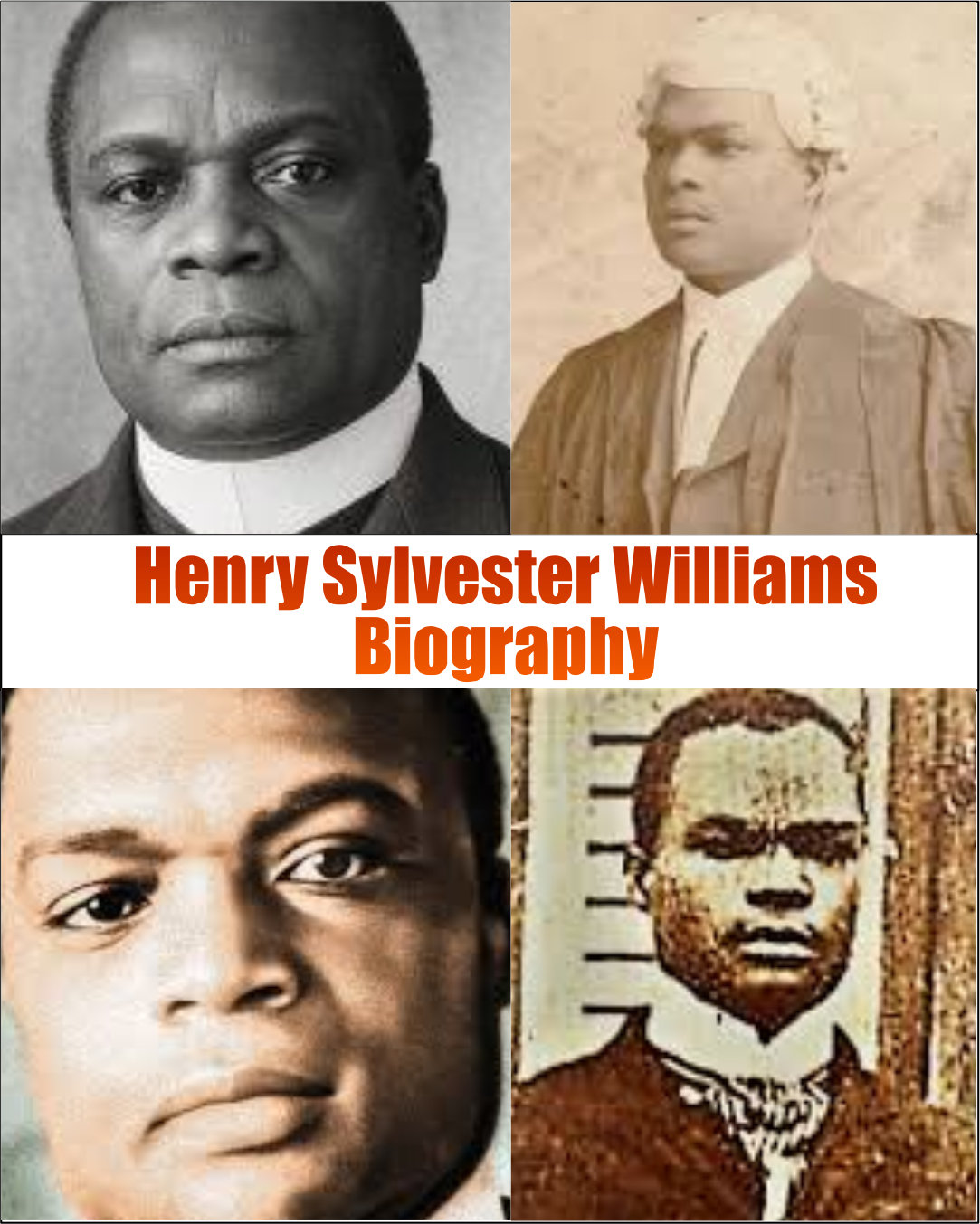
The Henry Sylvester Williams Biography: The Carpenter Son Who Invented Pan-Africanism.
Henry Sylvester Williams coined the term Pan-African, organised the first Pan-African Conference in London in 1900, became the first Black barrister in Cape Colony South Africa, and was one of the first people of African descent elected to public office in Britain. He died at 42, forgotten. The movement he invented eventually freed a continent.
He Invented Pan-Africanism, Died at 42, and Watched W.E.B. Du Bois Get the Credit: The Story of Henry Sylvester Williams
There is a line that runs from a three-day conference held at Westminster Town Hall in London in July 1900 to the independence of Ghana in 1957, to the formation of the Organisation of African Unity in 1963, to every subsequent African Union summit, to every Black Power organisation, to the civil rights movement’s intellectual architecture, to Marcus Garvey and Malcolm X and C.L.R. James and George Padmore.
The line is direct. The influence is documented. The movement that produced all of those subsequent events has a name — Pan-Africanism — and that name was coined by one person, who organised the first conference that gave the movement its institutional beginning, and who was dead at forty-two, largely forgotten, while the people he had inspired were building on the foundation he had laid.
His name was Henry Sylvester Williams. He was the son of a carpenter from Trinidad. He had been a schoolteacher, a law student who could not pay his fees, a temperance lecturer who walked to every part of the British Isles speaking in church halls to earn enough money to stay in school, a man who sent letters about the condition of African people to Queen Victoria and received replies from the Colonial Secretary informing him that Black people were — in the Colonial Secretary’s exact words — “totally unfit for representative institutions.”
He read that letter. He filed it. He kept organising.
Henry Sylvester Williams Biography
| Category | Details |
|---|---|
| Full Name | Henry Sylvester Williams |
| Date of Birth | February 19, 1869 |
| Place of Birth | Arouca, Trinidad |
| Nationality | Trinidadian-British |
| Profession | Lawyer, Political Activist, Pan-Africanist |
| Field of Work | Pan-Africanism, Law, Political Activism, Civil Rights |
| Notable Achievement | Organised the first Pan-African Conference in London in 1900 — the founding moment of the organised Pan-African movement |
| Legacy | Celebrated as the father of Pan-Africanism whose vision of African unity and dignity inspired generations of leaders including W.E.B. Du Bois and Kwame Nkrumah |
Arouca, a Carpenter, and the Boy Who Wanted to Be a Lawyer
Henry Sylvester Williams was born on 19 February 1869 in Port of Spain, Trinidad, the eldest of five children.
Williams, then a student in Britain, organised the African Association in 1897, and the first-ever Pan-African Conference in 1900. He is thus the progenitor of the OAU/AU.
He attended the Normal School in Port-of-Spain and qualified as a primary school teacher at the age of 17, and was put in charge of a school a year later. For the next five years he served as a headteacher.
A headteacher at eighteen. In colonial Trinidad, where formal education was controlled by the mission societies and the crown colony administration, the position of headteacher required both academic ability and the specific kind of personal authority that causes a room full of children to listen. Williams had both. He spent five years teaching before the ambition that had been forming alongside the teaching finally insisted on being addressed.
He wanted to be a lawyer. Specifically, he wanted to be the kind of lawyer who could stand up in court and argue that the things being done to African people across the British Empire were illegal — were violations of the principles that the empire claimed to operate by, contradictions of the rights it claimed to uphold.
In 1891, he went to New York.
New York, Halifax, London — The Education Nobody Was Going to Give Him for Free
In 1891 he went to New York City, where he worked at odd jobs for two years.
New York in the early 1890s was a specific education in the conditions that would later define his political work. This was a time when the gains made by Black Americans in the Reconstruction years were being rapidly lost: Blacks were being disfranchised, subjected to a Jim Crow mentality, and virtually re-enslaved economically. Williams’ experience in the United States doubtless stimulated his racial consciousness.
He had come from the Caribbean, where the colonial system operated with the particular British combination of formal racial hierarchy and theoretical commitment to certain legal rights. What he found in the United States was a different but related system — more violent, more explicit, and in some ways more instructive because its mechanisms were closer to the surface. The America he encountered in the early 1890s was the America of convict leasing, of lynching statistics that the NAACP would later publish in devastating annual reports, of Supreme Court decisions systematically dismantling the legal architecture of Reconstruction.
He observed. He absorbed. He went to Halifax.
After two years in the USA, he moved in 1893 to Dalhousie University, in Halifax, Nova Scotia, to study for a law degree, but did not complete his degree.
See also: Professor Bolanle Awe Biography – The Woman Who Write Nigeria Into History
Did you know?
Williams became the first person of African descent to speak in the House of Commons. Not in the context of a parliamentary debate — he was never a Member of Parliament — but in a speech to MPs and political figures that predated his formal entry into British politics.
A Trinidadian barrister’s student, speaking in the chamber of the British legislature about the condition of African people under British rule, while still completing his law degree. The precedent was established quietly and without ceremony. Nobody recorded it as a historic moment at the time. It was simply something he did, because the opportunity existed and because he had something to say.
The South African Woman, the Writers’ Club, and the Organisation That Started Everything
His good friend, Trinidad attorney Emmanuel Mzumbo Lazare, who at the time was in London taking part in Queen Victoria’s 60th anniversary celebrations, mentioned to Williams a South African woman, Mrs A. V. Kinloch, whom Lazare had heard discuss the oppressions the Black races of Africa lived under at a meeting of the Writers’ Club in London.
Kinloch was touring Britain on behalf of the Aborigines’ Protection Society, speaking specifically about conditions in South Africa — about the dispossession of land, the legal structures of racial subordination, the specific ways in which the colonial system in southern Africa was grinding Black communities into permanent economic and political inferiority.
Williams met her. He listened. And something that had been building across five years of New York odd jobs and Halifax law school debt and British temperance lectures crystallised into a specific project.
On September 24, 1897, Williams founded the African Association and served as its honorary secretary. The purposes of the association were to encourage a feeling of unity and to facilitate friendly intercourse among Africans in general. It also sought to promote and protect the interests of all subjects claiming African descent.
Williams stated clearly at the founding meeting: “The time has come when the voice of Black men should be heard independently in their own affairs.”
July 23-25, 1900 — Three Days in Westminster That Changed History
The three-day gathering took place at Westminster Town Hall on 23, 24, and 25 July with delegates comprising men and women of African blood and descent from West and South Africa, the West Indies, the United States and Liberia.
Approximately thirty delegates. From across the Atlantic world. Gathered in the capital of the most powerful empire on earth, in a hall a short walk from the Houses of Parliament, to make the argument that the peoples of Africa and the African diaspora had rights, interests, and the capacity to organise in their own behalf.
The conference was attended by eminent Black activists from all over the world, as well as a number of the British political bigwigs of the day — Liberal Party people, Fabian Society folk, the Cobden girls — who believed social justice was for everybody.
Dr. Mandelle Creighton, Bishop of London held a tea party at Fulham Palace, his official residence, for the delegates. Samuel Coleridge Taylor, one of Britain’s most acclaimed composers at the time, provided the musical offering and later joined the committee.
Cape Town, the First Black Barrister, and the Racism That Would Not Let Him Stay
After the conference, Williams toured Jamaica, Trinidad, and the United States to establish branches of the Pan-African Association. He founded the journal The Pan-African in 1901 — designed to spread information concerning the African and his descendants in the British Empire and to be the mouthpiece of the millions of Africans and their descendants throughout the world. It collapsed after a few issues for lack of funding.
In 1902, he was called to the English bar. He was finally, after years of temperance lectures and odd jobs and near-poverty, a qualified barrister.
In 1903, he went to South Africa.
In 1903 he went to practise as a barrister in South Africa, becoming the first Black man to be called to the bar in the Cape Colony.
The first Black barrister in the Cape Colony. In South Africa, in 1903, where the system of racial subordination that Kinloch had described to him at the Writers’ Club in London was being constructed with increasing legal precision and increasing brutality. He practised there for two years. He visited Liberia, Sierra Leone, Guinea — travelling through the continent whose interests he had spent a decade arguing for, seeing the conditions of colonialism directly.
Eventually, Williams grew frustrated with racism in the Cape Colony and it was difficult for him to practice law. He returned to London.
Trinidad, the Final Years, and the Death Nobody Marked
In 1908, Henry Sylvester Williams returned to Trinidad. He had been away for seventeen years. He had founded the African Association, organised the first Pan-African Conference, coined the term Pan-African, practised law in South Africa, been one of the first people of African descent elected to public office in Britain, toured three continents, launched a journal, established the institutional vocabulary of a movement that would reshape the world.
He was thirty-nine years old. He had come home to practise law in Port of Spain.
When he went on to Trinidad, Sylvester Williams established several local branches of the Pan-African Association. One of his closest colleagues in Trinidad was James Hubert Alfonso Nurse. Mr Nurse headed the Arouca branch of the Pan-African Association, and in 1903 would father the boy who would become the renowned young communist and Pan-Africanist known as George Padmore.
What Du Bois Got and What Williams Left
The history of Pan-Africanism that most people know begins with W.E.B. Du Bois. The five Pan-African Congresses that Du Bois organised between 1919 and 1945 shaped the intellectual framework of African decolonisation. Du Bois is taught in universities. Du Bois has institutes named for him. Du Bois appears in syllabi on African-American studies, African studies, and twentieth-century political history with a regularity that reflects the genuine significance of his intellectual contributions.
Even those which mention his name and acknowledge him as the legitimate father of Pan-Africanism tell little more than the fact that he was a barrister from Trinidad who convened a conference at London in 1900.
A barrister from Trinidad who convened a conference. That is what most historical accounts give Henry Sylvester Williams — a single sentence describing the act that Du Bois then took and built upon for the next fifty years. The foundation is acknowledged. The man who built the foundation is summarised.
Marylebone, a Plaque, and the 100 Great Black Britons List
A memorial plaque on the site of his former London home at 38 Church Street, Marylebone, was unveiled on 12 October 2007.
The house where he had lived while organising the 1900 conference has a plaque. It was unveiled ninety-six years after his death. The plaque is the primary physical marker of his presence in a city whose political history he helped shape.
Williams was named 16th on the 100 Great Black Britons list.
Sixteenth. On a list compiled by popular vote to identify the most significant Black Britons in history. A man whose name is not taught in British schools, whose conference is not in the standard curriculum of British history education, whose connection to the decolonisation of Africa is not commonly known by British people of any background — ranked sixteenth by a public that, when given the opportunity to think about it, recognised his significance.
The Carpenter’s Son and the Movement That Outlived Him
Henry Sylvester Williams was the son of a carpenter from Arouca, Trinidad. He taught school for five years before deciding he needed to be a lawyer. He worked odd jobs in New York and dropped out of Dalhousie law school because he could not afford the fees. He lectured about temperance in church halls across Britain to pay for his Gray’s Inn education. He met a South African woman at a writers’ club and decided to organise a conference.
He coined the term Pan-African. He founded the African Association. He convened the first Pan-African Conference at Westminster Town Hall in July 1900. He wrote to Queen Victoria about the condition of African people under the system she presided over. He received a letter from Joseph Chamberlain saying Black people were totally unfit for representative institutions. He became the first Black barrister in Cape Colony South Africa. He was among the first people of African descent elected to public office in Britain. He came home to Trinidad and died at forty-two.
He was aware of the problems of colonialism in the Caribbean, of racism in North America, racism in Britain, and of colonialism in general. He had been to the three corners of the triangle that spread across the Atlantic, from Africa to North America and Europe.
He had seen the whole system. A movement. That freed a continent. That the son of a carpenter from Arouca, Trinidad named.
Frequently Asked Questions
1. Who is Henry Sylvester Williams?
Henry Sylvester Williams was a Trinidadian lawyer, orator, and political activist who is widely recognised as the father of the Pan-African movement.
2. What was the Pan-African Conference of 1900 and why does it matter?
The Pan-African Conference of 1900 was the first formal international gathering explicitly dedicated to addressing the rights, dignity, and political future of African and African-descended people around the world. Organised by Henry Sylvester Williams and held in Westminster Town Hall in London from July 23 to 25, 1900, it brought together delegates from Africa, the Caribbean, the United States, and Britain — representing the first time that Black people from across the diaspora had gathered collectively to discuss their shared condition and assert their collective political voice.
3. What was Henry Sylvester Williams’ relationship with W.E.B. Du Bois?
The relationship between Henry Sylvester Williams and W.E.B. Du Bois was one of the most consequential intellectual partnerships in the early history of the Pan-African movement. Du Bois, already an established American scholar and activist, attended the 1900 Pan-African Conference at Williams’ invitation and played a significant role in its proceedings — most notably in co-authoring the Address to the Nations of the World.
4. What challenges did Henry Sylvester Williams face in his activism and legal career?
Henry Sylvester Williams operated in an environment of pervasive racial hostility and institutional resistance that made every aspect of his public life more difficult than it would have been for a white man of equivalent ability and education. As a Black barrister in London at the turn of the 20th century he navigated a legal profession that had very few people of colour and that reflected the racial attitudes of an empire at the height of its confidence.
5. What is Henry Sylvester Williams’ lasting legacy?
Henry Sylvester Williams died on March 26, 1911, in London at the age of 42 — far too young, and before he could see even a fraction of the movement he had founded reach its full potential. His legacy however is immense and enduring. The Pan-African movement he initiated grew across the 20th century into one of the most powerful intellectual and political forces in the history of decolonisation — directly shaping the independence movements that liberated African nations from colonial rule, the Caribbean political consciousness that produced leaders like Eric Williams and Michael Manley, and the African American civil rights tradition that drew consistently on Pan-African ideas and solidarity.