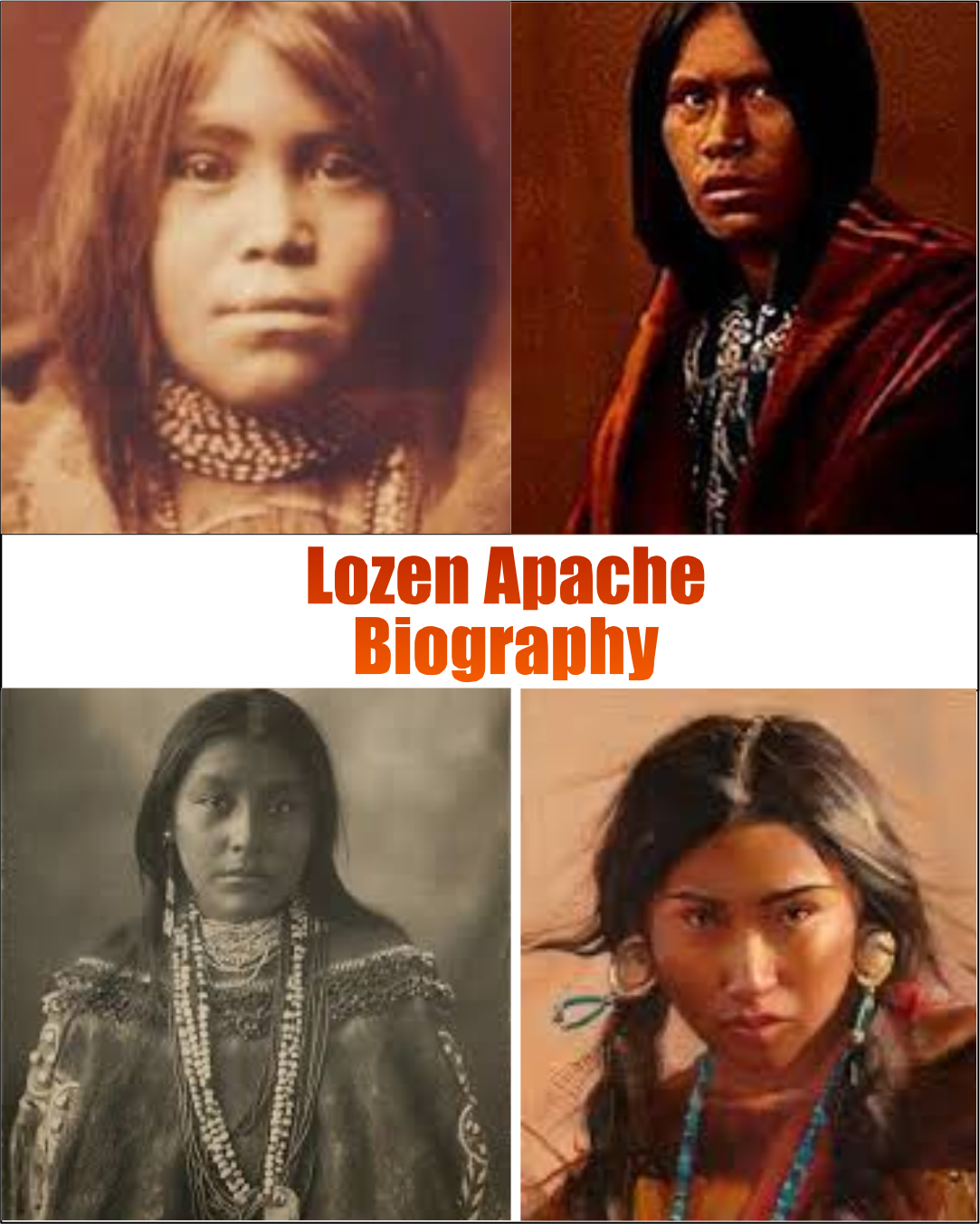
The Lozen Apache Biography – The Woman Who Fought For Forty Years.
Lozen was born into a desert war. She rejected marriage at puberty, became an Apache warrior and prophet, crossed the Rio Grande on horseback under fire to lead women and children to safety, fought forty years against two governments, and died of tuberculosis in an Alabama prison with no mountains to disappear behind.
She Fought Two Governments for Forty Years. She Died in a Prison in Alabama. The History Books Almost Forgot Her: The Story of Lozen.
There is a photograph taken on September 10, 1886, at a rest stop during the transfer of Apache prisoners of war toward Florida. Geronimo is in it, recognisable even in defeat. Behind him, in the back row, fifth and sixth from the right, are two women. One of them is Dahteste. The other, according to Apache oral accounts, is Lozen.
She is not posed heroically. She is standing where they put her – in the back row, among the prisoners, surrounded by the soldiers of the United States Army who had spent years and thousands of men trying to catch her and had finally succeeded not through military superiority but through exhaustion, through the burning of water sources and the rounding up of every Apache band until there was simply nowhere left to run.
She had been fighting since she was twelve years old. She had fought the Mexican army and the American army and the Texas Rangers and the Arizona Rangers simultaneously.
Her name was Lozen. Almost nobody outside Indigenous communities knew it for a hundred years after she died.
Lozen Apache Biography
| Category | Details |
|---|---|
| Full Name | Lozen |
| Date of Birth | Approximately 1840 |
| Place of Birth | Present-day New Mexico or Arizona, USA |
| Nationality | Native American — Chihenne Chiricahua Apache |
| Profession | Warrior, Healer, Prophet, Spiritual Leader |
| Field of Work | Military Strategy, Spiritual Guidance, Medicine |
| Notable Achievement | One of the most skilled Apache warriors and strategists of the 19th century; fought alongside Geronimo in the Apache Wars |
| Legacy | Celebrated as a symbol of Apache resistance, female courage, and spiritual power |
Ojo Caliente – Born Into a Desert Already at War
Lozen was born around 1840 near Ojo Caliente – Warm Springs – in what is now New Mexico, into the Chihenne band of the Chiricahua Apache.
The Chihenne – Warm Springs Apache – were one of the bands that constituted the broader Chiricahua Apache nation, people whose ancestral territory covered a vast area of what is now southeastern Arizona, southwestern New Mexico, and northern Mexico. This territory was known as Apacheria, and the Apache had defended it against Spanish colonisers, Mexican authorities, and American expansion for generations.
As a child, Lozen witnessed a Mexican ambush near Janos, Chihuahua, where soldiers lured her band with promised gifts, then attacked, killing many Apaches. She and Victorio escaped, but the trauma shaped her lifelong resistance.
The gift that arrived with soldiers behind it. The ambush disguised as generosity. That formative violence – the specific lesson that promises made by armed strangers could be mechanisms of destruction – was the first thing that shaped Lozen’s understanding of the world she had been born into.
See also: Raden Adjeng Kartini Biography – She Wrote Letters That Changed a Country
The Ceremony, the Council, and the Choice That Defined Everything
When she reached the age of her womanhood ceremony, she was courted by many men but let it be known that she would never marry. Instead, she undertook and succeeded at the hardship of a dikohe – a warrior in training. Afterward, the Council accepted her, and she became a warrior. She also studied medicine and became a renowned medicine woman with extensive knowledge of the medicinal properties of plants and minerals.
The womanhood ceremony – the coming-of-age ritual that marked the transition from girl to woman and, in Apache tradition, opened the path to the roles that adulthood required – was the moment at which Lozen declared who she was going to be. Not a wife. Not a mother in the conventional sense. A warrior. A medicine woman. A person who would spend her life in service to her community’s survival rather than its reproduction.
Her name, Lozen, is derived from the Apache word meaning savvy horse-hijacker – a name that describes a specific practical skill and a specific kind of courage.
Did you know?
As early as age twelve, it was said that Lozen had supernatural powers that helped her defeat her enemies. Harlyn Geronimo, the great-grandson of Geronimo, said Lozen would lift her hands, walk in a circle, and chant until the veins in her arms turned dark blue, indicating the direction from which the enemy would approach.
The level of tremor in her hands told her the strength of the pursuing party. The Apache trusted this completely. Whether it was a heightened form of sensory awareness – the desert-trained perception of someone who had spent decades learning to read landscape, sound, and wind – or something beyond what Western empirical categories can accommodate, the historical record is clear: the people who fought alongside her believed in it, acted on it, and survived because of it more times than can be counted.
Victorio’s Right Hand – The Years of Resistance
Through the 1860s and into the 1870s, Lozen fought alongside her brother in the sustained, brutal campaign against the encroachment of Mexican and American forces on Apache territory.
In 1871, the U.S. government offered to establish a reservation for the Apaches under Cochise and Victorio at Warm Springs, New Mexico. After consulting with his sister, Victorio agreed.
After consulting with his sister. Not as a courtesy. As a necessity. The war chief who would later describe her as his right hand was already, in 1871, treating her judgement as essential to his decisions. The reservation at Warm Springs was one they could accept – their own territory, the landscape they knew, the water sources that had sustained their community for generations.
Then the government changed its mind.
The tribe was subsequently moved to less favorable locations, and in 1876 they fled from the San Carlos reservation in Arizona, eluding capture for the next three years.
The Rio Grande Crossing – One of the Great Acts of Leadership in American History
In the midst of one of Victorio’s campaigns, as American cavalry pressed close and the band was attempting to cross the Rio Grande in flood, a woman went into labour.
Lozen stayed behind.
In the fall of 1880, a woman in Victorio’s band entered labour. Lozen remained behind with her, until she had given birth, then escorted mother and infant across New Mexico to the Mescalero Apache reservation, eluding American and Mexican forces along the way.
That journey – a warrior and prophet, alone with a woman who had just given birth and a newborn infant, crossing the Chihuahuan Desert, moving through a landscape patrolled by two military forces who both wanted her dead or captured – took weeks. The military forces did not catch her. The mother and infant arrived safely. Lozen delivered them and then went looking for her brother.
She found out, at the Mescalero Reservation, what had happened while she was away.
Tres Castillos – The Death That Changed Everything
She learned it at the Mescalero Reservation. Mexican and Tarahumara Indian forces under Mexican commander Joaquin Terrazas had killed Victorio and most of his warriors in the Battle of Tres Castillos, fought on three stony hills in northeastern Chihuahua.
Victorio was dead. The brother who had called her his right hand. The man who had accepted her into the warrior path, who had consulted her on decisions that shaped the lives of hundreds of people, who had described her as a shield to her people – dead on three stony hills in Chihuahua, killed in an ambush while she was escorting a mother and infant to safety.
Most people, receiving that news, would have been broken by it. Lozen was not broken by it.
Knowing the survivors would need her, Lozen immediately left the Mescalero Reservation and rode alone southwest across the desert, threading her way undetected through U.S. and Mexican military patrols.
Geronimo’s War – The Last Campaign
After Geronimo’s surrender in 1886, Lozen and many other warriors were imprisoned in Florida.
The years between Tres Castillos and that surrender were the final campaign of the Apache Wars – the last sustained resistance of any Indigenous nation against the complete military occupation of their territory. Geronimo’s band, which included Lozen and her companion Dahteste, was pursued relentlessly.
It is said that Victorio fell on his own knife rather than die at the hands of the Mexicans. Almost all the warriors at Tres Castillos were killed, and many women died fighting, the older people were shot, while almost one hundred young women and children were taken for slaves.
She used her power to locate their enemies – the U.S. and Mexican cavalries – as Geronimo’s band of 140 followers, including Naiche, Cochise’s son, evaded five thousand U.S. troops and three thousand Mexican soldiers.
Florida, Alabama, and the End the Desert Could Not Prevent
Taken into U.S. military custody after Geronimo’s final surrender, Lozen travelled as a prisoner of war to Mount Vernon Barracks in Alabama.
Alabama. Not the desert. Not the mountains. Not the Chihuahuan landscape she had crossed alone with a newborn infant, not the Sierra Madre where she had found the survivors after Tres Castillos, not the Rio Grande she had ridden into on horseback with her rifle above her head. Alabama. Flat, humid, forested – a landscape that her entire life’s training had given her no tools for and that offered her none of the weapons she had spent forty years learning to use.
There were no mountains to vanish behind, no sand to whisper through her fingers, no wind to warn her of anything. Just walls.
What the History Books Did With Her
“The stories of Geronimo, Crazy Horse, and Custer pale beside the tale of another warrior – one who fought relentlessly, successfully, and against all odds almost continuously for forty years. But you’ve probably never heard of her.” – Peter Aleshire, author of Warrior Woman.
The reason most people have not heard of her is not mysterious. The history of the American West was written primarily by the people who won it – by the military officers who filed reports, by the journalists who followed the army, by the novelists and filmmakers who shaped the popular imagination of the frontier. In that history, the people on the other side were either noble savages to be mourned or dangerous enemies to be celebrated in defeat. The woman who outran every man in her band, who crossed a flooding river leading women and children to safety and then crossed it back to stand with the warriors – she did not fit the available categories.
The unmarked grave in Alabama does not diminish her. It is simply the last indignity of a long line of indignities inflicted by the governments she fought. It does not change what she did.
She was a shield. For forty years. In the desert. Against everything.
Frequently Asked Questions
1. Who is Lozen?
Lozen was a 19th century Chiricahua Apache warrior, healer, and prophet who is widely regarded as one of the most remarkable military figures in Native American history. Born around 1840, she was the younger sister of the respected Apache leader Victorio and chose a path radically different from the domestic roles typically assigned to women in her society.
2. What made Lozen exceptional as a warrior?
Lozen’s reputation among her people rested on several extraordinary qualities. She was physically formidable — skilled in hand-to-hand combat, expert on horseback, and capable of enduring the extreme physical demands of guerrilla warfare across the harsh desert terrain of the American Southwest.
3. What role did Lozen play in the Apache Wars?
Lozen was an active participant in the Apache Wars — the decades-long series of conflicts between Apache bands and the armies of the United States and Mexico that dominated the latter half of the 19th century. She fought under her brother Victorio until his death at the Battle of Tres Castillos in 1880 — a devastating defeat that killed most of his band.
4. Was Lozen ever captured or defeated?
Lozen was never defeated in battle, but she was among the Apache prisoners taken following Geronimo’s surrender in 1886. Along with hundreds of other Chiricahua Apache — including warriors, women, children, and elders — she was transported by the US government to Fort Marion in Florida as a prisoner of war.
5. What is Lozen’s lasting legacy?
Lozen’s legacy is one of extraordinary courage, spiritual depth, and unwavering commitment to her people at a time of existential crisis. For decades after her death her story was largely confined to oral traditions within Apache communities, known primarily through the accounts of those who had fought alongside her.