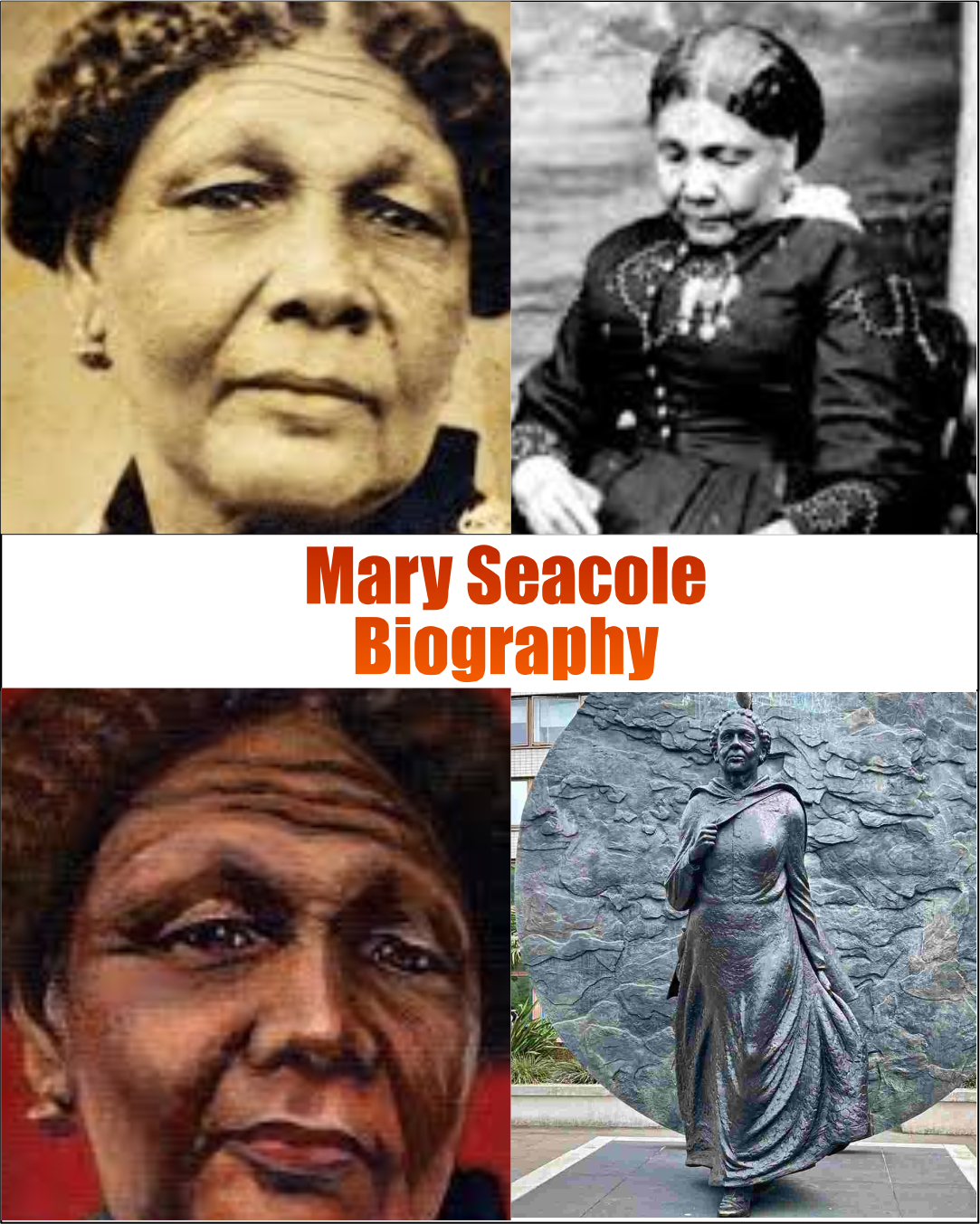
The Mary Seacole Biography: The Crying Woman of London Street.
Mary Seacole was rejected by the War Office, rejected by the army medical department, rejected by Florence Nightingale’s team. She stood in a London street and cried. Then she funded her own passage to the Crimea, built a hotel two miles from the front line, and nursed soldiers under fire – while the history books forgot her for a hundred years.
She Was Rejected by Everyone. She Went Anyway. Then England Forgot Her: The Story of Mary Seacole
She stood in a London street and cried.
Not from self-pity – that was not in her character, as anyone who had followed her from Kingston to Panama to the Crimean peninsula would have understood immediately. She cried because she had just been rejected, for the fourth time, by the fourth institution she had approached for permission to do the thing she had crossed an ocean to do. The War Office had said no. The army medical department had said no. The Secretary of War had said no. And now one of Florence Nightingale’s own companions had looked at her – at her face, at her credentials, at the references she carried from military officers who had watched her work – and said no.
She questioned whether racism was a factor in her being turned down. She wrote: “Was it possible that American prejudices against colour had some root here? Did these ladies shrink from accepting my aid because my blood flowed beneath a somewhat duskier skin than theirs?”
She rode out to the battlefields under active fire to nurse the wounded. She became, in the words of the soldiers who named her Mother Seacole, the most beloved figure of the entire Crimean campaign.
And then, when the war ended, England forgot her for a hundred years.
Mary Seacole Biography
| Category | Details |
|---|---|
| Full Name | Mary Jane Seacole |
| Date of Birth | 1805 |
| Place of Birth | Kingston, Jamaica |
| Nationality | Jamaican-British |
| Profession | Nurse, Healer, Businesswoman, Author |
| Field of Work | Medicine, Nursing, Humanitarian Care |
| Notable Achievement | Provided medical care to wounded British soldiers during the Crimean War despite being rejected by British nursing authorities |
| Legacy | Celebrated as a pioneering figure in nursing history; honoured with a statue outside St Thomas’ Hospital in London |
Kingston, Blundell Hall, and the Doctress Who Taught Her Everything
Mary Seacole was born in Kingston, Jamaica in 1805. Her father was a Scottish soldier and her mother was a free black Jamaican woman and doctress skilled in traditional medicine who provided care for invalids at her boardinghouse.
The boardinghouse was called Blundell Hall. Mary’s mother ran a lodging house called Blundell Hall, which was much respected by local people in Kingston, Jamaica’s capital city. But she was also a healer and taught Mary many of her skills using traditional Jamaican medicines.
The word doctress requires definition, because its meaning is both specific and significant. The role of a doctress in Jamaica was a mixture of a nurse, midwife, masseuse, and herbalist, drawing strongly on the traditions of Creole medicine. It was not a diminished version of a doctor. It was a distinct practice – one that drew on African herbal traditions, Indigenous Caribbean plant knowledge, and the practical medical wisdom accumulated over generations of women who had been healing their communities without access to formal medical institutions that would not have admitted them anyway.
Cuba, Haiti, the Bahamas, and the Education of a Traveller
During 1825, her travels included Cuba, Haiti and the Bahamas, returning to Kingston in 1826 to nurse her patroness in a long illness.
The early travels are not incidental biographical detail. They are part of a deliberate education – the accumulation of medical knowledge across different environments, different disease profiles, different communities with different healing traditions. She was building a medical practice through experience rather than institution, through observation rather than textbook, through the patient bodies of the people she healed rather than the cadavers of a formal anatomy class.
Mary married Edwin Horatio Hamilton Seacole on 10th November 1836. They set up a store at Black River, but Edwin became unwell and delicate so Mary would nurse him as best as she could. Sadly, Edwin died in 1844, followed closely by the death of her mother. These deaths devastated Mary.
Two losses in rapid succession – husband and mother, the two people around whom her personal world was organised. The grief that followed is not recorded in clinical detail in her autobiography. What is recorded is what she did next: she rebuilt. She returned to doctressing. She continued travelling. She absorbed loss the way she absorbed medical knowledge – by moving through it, not around it.
The cholera outbreak in Panama was not a peripheral event in her medical education. It was the central one. Her practice in Panama was far broader than nursing – diagnosis, prescription, preparation of herbals and pharmaceutical medicine, a little minor surgery, and doing a postmortem on a cholera victim to learn more about the effects of cholera.
She performed a postmortem on a cholera victim. In Panama. In 1851. To understand the disease better. That act of practical clinical investigation – done outside any institutional framework, funded by no research grant, recognised by no professional body – places her in a category of medical practitioner that the formal hierarchy of Victorian medicine would never have acknowledged but that the sick soldiers of the Crimea would have recognised immediately. She knew things about cholera that many formally trained doctors did not.
Did you know?
She herself contracted cholera in Panama and recovered from it – giving her an immunity and a firsthand understanding of the disease’s course that no textbook could replicate. The woman who would later nurse cholera victims in the Crimea had survived cholera herself. The practical knowledge of what the disease felt like from the inside, what recovery required, what interventions helped – that knowledge was written in her own body before she ever applied it to anyone else’s.
1853, Yellow Fever, and the Military’s Unsolicited Endorsement
In 1853, Seacole returned to Jamaica just as a yellow-fever epidemic swept the island. She was frequently called upon to tend the sick and dying, successfully treating the tropical fever with locally picked medical herbs. The medical authorities at Up Park military camp recognised Seacole’s skill and asked her to provide them with nurses.
When she arrived in London the following year and applied to the War Office to serve as a nurse in the Crimea, she carried this institutional endorsement with her. The British military in Jamaica had asked her to provide nurses. The British military in London told her her services were not required.
London, the Rejections, and the Street Where She Cried
Mary travelled to England and approached the British War Office, asking to be sent as an army nurse to the Crimea where she had heard there were poor medical facilities for wounded soldiers. She was refused.
She did not stop at the War Office. Her attempt to apply in-person at the War Office to serve as a war nurse was unsuccessful. As was her offer to join Florence Nightingale’s team of nurses who were already out in the Crimea working in British military hospitals.
She had an interview with one of Nightingale’s companions. She gave the same reply, and Seacole read in her face the fact that had there been a vacancy, she should not have been chosen to fill it.
Four rejections. The War Office. The army medical department. The Secretary of War’s wife, Elizabeth Herbert. A companion of Florence Nightingale. Each one delivered the same message in slightly different language: your help is not wanted here.
In her disappointment, Mary cried in the street.
Then she stopped crying. She found Thomas Day. She and Thomas Day, a relative of her late husband, set up the so-called British Hotel near where fighting had been in Balaclava.
She funded her own passage. She went anyway.
The British Hotel, Two Miles From the Front, and Mother Seacole
The British Hotel was not a hotel in any conventional sense. This hotel was actually a storehouse, a canteen, and resting place that brought comfort to and lifted the spirits of army personnel.
Her hotel near Balaclava was much closer to the fighting than Nightingale’s famous military hospital at Scutari, which was situated hundreds of miles from the frontline. This geographical fact is one of the most important distinctions between the two women’s work – and one that history’s long preference for Nightingale over Seacole has consistently obscured. Nightingale worked in a hospital behind the lines, reforming nursing practice and sanitation in an institutional setting. Seacole worked in a storehouse two miles from the fighting, riding out to the battlefield to nurse soldiers while the battle was still happening.
A newspaper correspondent embedded with the troops wrote: “I have seen her go down under fire with her little store of creature comforts for our wounded men; and a more tender or skillful hand about a wound or broken limb could not be found among our best surgeons.”
Under fire. She rode out under active fire to bring supplies and medical care to men who were still being shot at. The surgeons – formally trained, institutionally recognised – are being compared unfavourably to a Jamaican doctress who funded her own trip to the war after four government bodies refused to send her.
The British army’s adjutant general’s office wrote: “This excellent woman frequently exerted herself in the most praiseworthy manner in attending wounded men, even in positions of great danger, and in assisting sick soldiers by all means in her power.”
Bankruptcy, the Gala, and the Autobiography That Became a Bestseller
The end of the war brought financial ruin. The end of the war left Seacole and Day with expensive and unsaleable stores on their hands. They went bankrupt and Mary returned to England a financially ruined woman.
She returned to England in 1856 penniless, having given away any profit she made.
The woman who had funded her own passage to the Crimea, who had built and stocked a hotel from her own resources, who had ridden under fire to bring supplies to wounded soldiers – came home bankrupt. She had spent everything she had on the work. There was nothing left.
In 1857, a fund-raising gala was held for her over four nights on the banks of the River Thames. Over 80,000 people attended.
Eighty thousand people. Over four nights. On the banks of the Thames. For Mary Seacole – the woman the War Office had turned away, the woman whose face had told Florence Nightingale’s companion that she should not fill a vacancy even if there was one. Eighty thousand people came to a riverside gala to celebrate what she had done in a war that the government had refused to let her formally participate in.
The same year she published her autobiography, The Wonderful Adventures of Mrs Seacole in Many Lands, which became an instant bestseller.
And then she died in 1881. And England forgot her.
A Hundred Years of Forgetting – and a Nurse Who Remembered
England, of course, did forget Mary Seacole.
For a century, her name was not taught in schools. Her autobiography went out of print. The soldiers who had called her Mother were gone. The journalists who had written about her riding under fire had been replaced by journalists who had never heard of her. The institutional memory of Victorian Britain – shaped by the same racial hierarchies that had refused her passage to the Crimea – simply decided not to maintain her record.
Twenty-five years ago, it would have been difficult to find many people who recognized the name of Mary Seacole except for a few nurses in her home country of Jamaica.
The memory of Mary Seacole was first honoured by the nurses of Jamaica, when in 1954 they named their projected headquarters Mary Seacole House. The Jamaican nurses remembered. While Britain forgot, the country she had come from kept her name on a building and in their professional consciousness. It was the Jamaican nursing community that maintained the record until the broader restoration of her reputation became possible.
In 1990, Seacole was posthumously awarded the Jamaican Order of Merit. In 2004, she was voted the greatest Black Briton in a survey by the black heritage website Every Generation. The greatest Black Briton. Not the greatest Black nurse. Not the greatest Black woman. The greatest Black Briton – across every field, every century, every possible candidate.
The Mary Seacole Memorial Statue Appeal was founded to educate the public about Mary Seacole and get the statue off the ground. The statue was unveiled at St Thomas’ Hospital in 2016. A statue outside a London hospital – outside the kind of institution that would not have admitted her as a patient in her own lifetime, let alone as a nurse – in the city where she stood in the street and cried after her fourth rejection.
What She Actually Was
The comparison to Florence Nightingale has followed Mary Seacole through every stage of her recovery from historical obscurity – the Black Florence Nightingale, the Florence Nightingale of Jamaica – as though the only way to measure her significance was against a white woman who had institutional support and government sanction and the full apparatus of Victorian England behind her.
Hopefully she will eventually have her own place in history instead of being a black Nightingale.
She was not a black Nightingale. She was Mary Seacole – a Jamaican doctress who inherited her practice from her mother, who survived cholera and performed postmortems to understand it better, who funded her own passage to a war she was refused permission to serve in, who built a hotel two miles from the front line and rode under fire to bring care to soldiers who called her Mother, who wrote the first autobiography published by a woman of African descent in Britain, who was celebrated by eighty thousand people on the banks of the Thames and then forgotten for a century by the country that had cheered for her.
The Times War Correspondent Sir William H Russell wrote of Mary in 1857: “I trust that England will not forget one who nursed her sick, who sought out her wounded to aid and succour them, and who performed the last offices for some of her illustrious dead.”
England forgot. It took a hundred years and the persistence of Jamaican nurses to make it remember. The statue stands outside St Thomas’ Hospital now. The curriculum argument continues. The name is known again – not everywhere, not by everyone, not with the instinctive recognition that Florence Nightingale commands.
Frequently Asked Questions
1. Who is Mary Seacole?
Mary Seacole was a 19th century Jamaican-born nurse, healer, and humanitarian who is celebrated for her extraordinary courage and compassion in providing medical care to wounded soldiers during the Crimean War of 1853 to 1856.
2. Why was Mary Seacole rejected by British nursing authorities?
When news of the suffering of British soldiers in the Crimea reached London, Mary Seacole travelled from Jamaica to Britain and applied to join Florence Nightingale’s nursing corps. She was refused — on multiple occasions and by multiple organisations — despite her documented medical experience and her genuine desire to serve. The rejections were widely attributed to racial discrimination.
3. How did Mary Seacole’s work differ from Florence Nightingale’s?
Both women made vital contributions to the care of soldiers during the Crimean War, but their approaches and environments were distinctly different. Florence Nightingale worked primarily in military hospitals, focusing on sanitation, organisation, and professional nursing practice. Mary Seacole worked closer to the front lines, often venturing directly onto the battlefield to treat the wounded where they fell.
4. What did Mary Seacole write and why does it matter?
In 1857, Mary Seacole published her autobiography, The Wonderful Adventures of Mrs Seacole in Many Lands. It was one of the first autobiographies written by a Black woman in Britain and remains a remarkable document — vivid, candid, and written with a warmth and wit that bring her personality immediately to life.
5. What is Mary Seacole’s lasting legacy?
Mary Seacole’s legacy has grown considerably since the late 20th century as historians and the public have worked to recover and celebrate her contributions. In 2004 she was voted the Greatest Black Briton in a public poll, reflecting the depth of affection and admiration she inspires. A statue of her was erected outside St Thomas’ Hospital in London — one of Britain’s leading teaching hospitals — making her the first named Black woman to be honoured with a public statue in the United Kingdom.