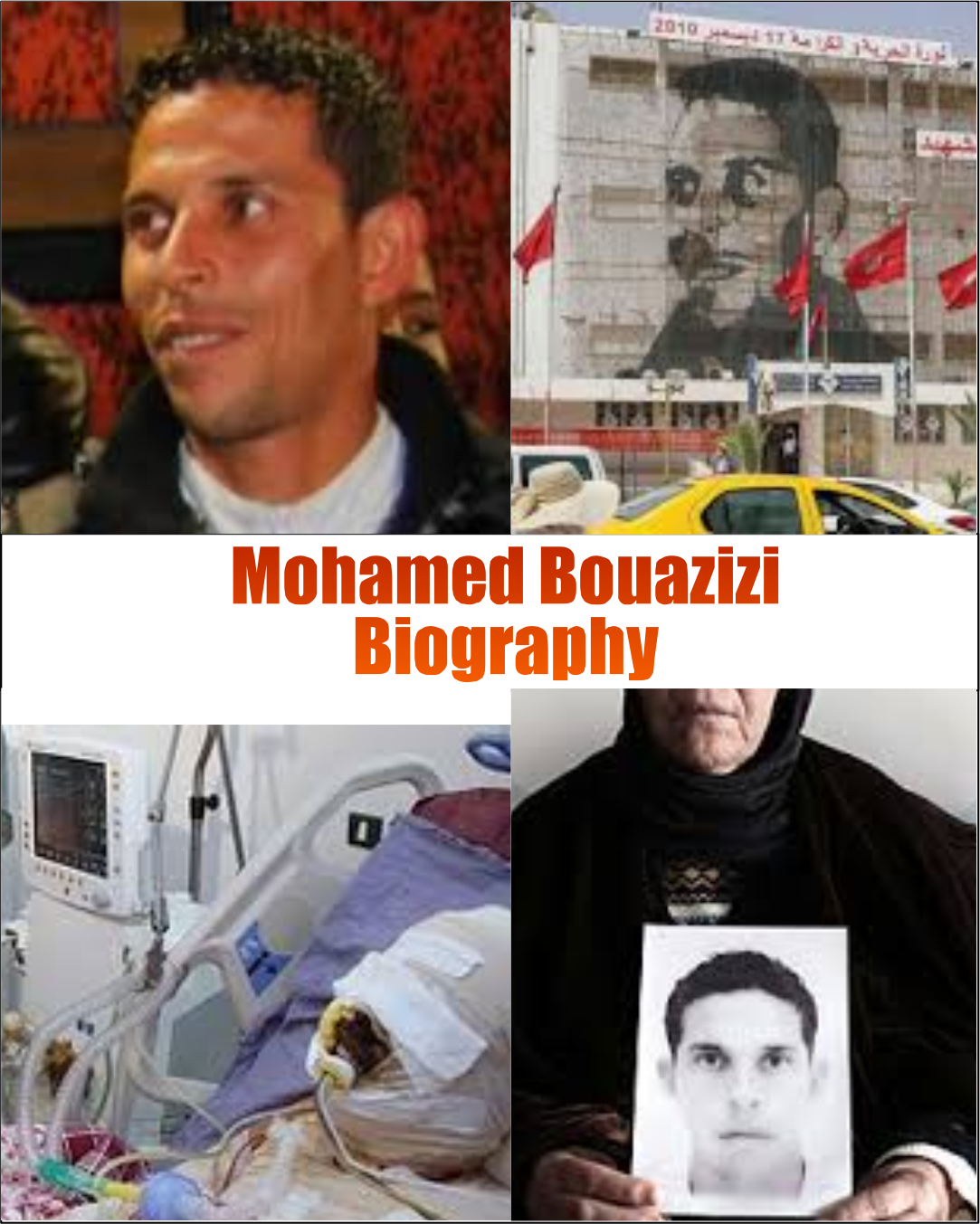
The Mohamed Bouazizi Biography: A Man Who Wanted a Van.
Mohamed Bouazizi earned $73 a week selling fruit in Sidi Bouzid. His aspiration was to own a van to grow his business. History turned him into the spark of the Arab Spring, the symbol of a generation’s rage, the face of revolution. His family say it was the humiliation — not the poverty — that killed him. He was 26. He never knew what he had started.
History Made Him a Symbol. He Just Wanted a Van: The Story of Mohamed Bouazizi
The aspiration was modest. It was the kind of dream that does not make headlines, does not inspire speeches, does not generate the vocabulary of revolution. Mohamed Bouazizi wanted a van.
His aspiration, his family said, was to own a van to help him grow his business.
He never got the van. What he got instead — what history gave him in place of the van, in exchange for his life — was a square in Paris named after him, a postage stamp from the Tunisian government, the Sakharov Prize from the European Parliament, the title of Person of the Year from The Times of London, and the particular immortality of having his act of despair become the act that toppled four governments, destabilised a region, and set in motion one of the most significant political upheavals of the twenty-first century.
Mohamed Bouazizi Biography
| Category | Details |
|---|---|
| Full Name | Mohamed Bouazizi |
| Date of Birth | March 29, 1984 |
| Place of Birth | Sidi Bouzid, Tunisia |
| Nationality | Tunisian |
| Profession | Street Vendor |
| Field of Work | Informal Economy, Street Trading |
| Notable Achievement | His act of protest in December 2010 triggered the Arab Spring — a wave of pro-democracy uprisings that swept across the Arab world |
| Legacy | Celebrated globally as a symbol of dignity, resistance against oppression, and the power of one individual to change the course of history |
Sidi Bouzid — A Town That Perfected the Art of Being Forgotten
Tarek el-Tayeb Mohamed Bouazizi was born on 29 March 1984 into a very poor family in Sidi Bouzid, in the center of Tunisia.
Sidi Bouzid. A provincial town in the rural heartlands of central Tunisia, approximately a hundred miles south of the capital. His early life in Sidi Salah, a small village near the central Tunisian town of Sidi Bouzid, was defined by economic struggle. The region was known for two things: agricultural production and unemployment. The unemployment rate among young people in Sidi Bouzid hovered around thirty percent — not the official figure, which was consistently understated by a government that preferred comfortable statistics, but the lived reality that every family in the town understood from direct experience.
He was three years old when his father died. The household that had depended on Tayeb’s construction wages in Libya lost that income entirely and never fully replaced it. The stepfather — the uncle his mother married — provided what he could. It was not enough. And so the oldest son, as oldest sons in poor Tunisian families have always done, began working.
His brief education at a small school near the city was interrupted by the requirement for work, with Bouazizi taking on jobs from as early as 10.
$73 a week. For eight people. In a country where prices were rising, where the global food crisis of 2007-2008 had pushed commodity costs beyond what ordinary incomes could absorb, where the government that had been ruling for twenty-three years was simultaneously enriching its inner circle and suffocating the economic life of everyone outside it.
Did you know?
Early reporting of Bouazizi’s self-immolation described him as a university graduate distraught over unemployment — something that was often repeated and fitted neatly with the narrative of the Arab Spring being driven by an overeducated and underemployed youth.
The truth was that he had dropped out of school as he became the main breadwinner for his extended family. The myth of the frustrated graduate was more politically legible than the truth of the school dropout who sold fruit to feed his family. History chose the myth. His family have spent fifteen years correcting it.
See also: Lozen Apache Biography – The Woman Who Fought For Forty Years
The Corrupt Economy of Sidi Bouzid’s Streets
Before December 17, 2010, there was every other day of Mohamed Bouazizi’s life as a street vendor in Sidi Bouzid.
The harassment was not an occasional inconvenience. It was a structural feature of the economic system he was operating in. “Because he worked illegally, they demanded bribes from him. The police always harassed Mohamed,” his cousin Ali said.
Over the years, when the burdens of being the main breadwinner weighed ever heavier on Bouazizi’s shoulders, the palaces of Tunisia’s elite grew taller and broader.
“I’m so fed up and tired,” Mohamed had told his cousin Lasaad a week before the self-immolation. “I can’t breathe anymore.”
He could not breathe. Not a metaphor. A physical description of a life in which every avenue of relief had been systematically blocked — by the permit system, by the bribe demands, by the inspector who took his scales, by the governor who would not see him. He could not breathe anymore, and he said so, one week before he stopped breathing entirely.
December 17, 2010 — The Morning That Would Not End
For many it was a typical Friday morning in Sidi Bouzid. Typical was the sight of the poverty-stricken street vendors hawking their wares on the roadside, and typical too was the sight of police officers harassing them in the hunt for bribes.
The exact details of what happened next are disputed. Bouazizi’s family say that at about 10:30 a.m. he was approached by municipal inspectors who requested a bribe. When he refused, a female inspector, Faida Hamdy, slapped him in the face and confiscated his electronic scales and produce.
The slap. It is the detail that appears in every account of what happened on December 17, and it is the detail that Bouazizi’s family consistently identify as the specific, irreversible trigger — not the confiscation of his goods, not the years of harassment, not the poverty, but the slap. His family believe it was the humiliation, not the poverty, that led him to self-immolation after he went looking for justice only to have it denied to him.
He did not go to the governor’s office seeking revolution. He went seeking redress. He had been publicly humiliated, his goods had been confiscated, and he wanted someone in authority to acknowledge that what had happened to him was wrong.
The governor would not see him.
Bouazizi doused himself with paint thinner and lit himself on fire.
He stood in the street in front of the governor’s office. He poured paint thinner over himself. He lit a match. And the morning that had begun with a slap and a confiscated set of scales became the morning that changed the Arab world.
The Samsung Phone, Facebook, Al Jazeera, and the Revolution That Needed a Witness
History had given Mohamed Bouazizi’s act every element of the tragedy except the mechanism of transmission. What made December 17, 2010 different from the similar act of Abdesslem Trimech nine months earlier — a street vendor who had self-immolated in similar circumstances with almost no political consequence — was a Samsung phone and a Facebook account.
Bouazizi’s cousin Ali Bouazizi received a call about the self-immolation, ran to the governor’s office and used his Samsung cell phone to record his cousin’s body being loaded into an ambulance. Ali Bouazizi then spent the afternoon filming the protest that Mohamed Bouazizi’s self-immolation unleashed. He uploaded the footage to his Facebook and sent it to the Arab news network Al Jazeera, which played the images on TV that evening.
The cousin with the phone. The Facebook account. The Al Jazeera broadcast. The technology that connected a provincial town in central Tunisia to the living rooms of the Arab world in real time. What Bouazizi had — and what Trimech lacked — was a spectator with a camera and connections to the political opposition.
In an attempt to quell the unrest, Ben Ali visited him in hospital on December 28, 2010.
The president of Tunisia — a man who had been in power for twenty-three years, who had presided over the system that had humiliated Mohamed Bouazizi in a provincial street — came to the hospital and sat beside the comatose body of the man whose despair was dismantling his regime. It was too late for the visit to mean anything. It was not too late for it to be photographed, published, and recognised by everyone who saw it as exactly the gesture of a man trying to contain a flood with a teacup.
January 4, 2011 — The Death That Finished What He Had Started
Bouazizi died on the 4 January 2011. By then, protests had spread across the country.
He had been in a coma for eighteen days. He died of burns covering ninety percent of his body, in Ben Arous, Tunisia, at twenty-six years old. He had never regained consciousness. He had never known that the protests had begun, that they had spread, that his name was being chanted in the streets of Tunis, that his face was on banners being carried by people demanding the end of a government he had never had the political vocabulary to formally oppose.
Simmering public anger and sporadic violence intensified following Bouazizi’s death, leading the then-president of Tunisia, Zine El Abidine Ben Ali to step down on 14 January 2011, after 23 years in power.
Egypt, Libya, Syria, Yemen — and the Weight He Carried Without Knowing It
The success of the Tunisian protests inspired protests in several other Arab countries, plus several non-Arab countries, such as in China.
Egypt. Hosni Mubarak, thirty years in power. Gone by February 11, 2011 — thirty-eight days after Mohamed Bouazizi’s death. Libya. Muammar Gaddafi, forty-two years. Gone by October 2011. Yemen. Ali Abdullah Saleh, thirty-three years. Gone by February 2012. The cascade of authoritarian governments falling across the Arab world in 2011 — governments that had seemed, until December 2010, as permanent as geography — traced their ignition to a slap on a provincial street and a comatose man in a Tunisian hospital.
The wars that followed some of those falls — in Libya, in Syria, in Yemen — were not Mohamed Bouazizi’s responsibility. He had not sought regime change. He had not planned a revolution. He had gone to the governor’s office seeking justice for a confiscated set of scales. The consequences of what his act unleashed — the liberation and the wars, the democracies and the chaos — were not things he had mapped or intended.
The Awards, the Squares, and the Myth That Grew Around Him
In 2011, Bouazizi was posthumously awarded the Sakharov Prize jointly along with four others for his and their contributions to “historic changes in the Arab world”.
The Times of the United Kingdom named Bouazizi as Person of 2011. The Jerusalem Post named him Person of the Jewish Year 5771. Time magazine named “The Protester” as Person of the Year.
On 4 February 2011, Bertrand Delanoë, the mayor of Paris, announced that a square in Paris would be named after him. Mohamed-Bouazizi Square was unveiled four days later.
In February 2011 the main square in Tunis was renamed after Bouazizi.
The Tunisia He Left Behind — and the Honest Question
Following the revolution, some Tunisians have felt disappointed. Many still struggle to pay their bills in a country where prices are high compared to incomes. Unemployment also remains high — for young people between the ages of 15 and 30, it is more than 30 percent — and corruption is still prevalent.
Out of desperation, some have embarked on the dangerous journey crossing the Mediterranean Sea to Europe. Others have followed Mohamed Bouazizi’s example of self-immolation.
The uncomfortable question that fifteen years of Arab Spring history has produced is one that Mohamed Bouazizi’s family are better positioned than anyone to answer. Was it worth it? Did the revolution that his act ignited produce the Tunisia that would have given him the dignity he sought?
His family take solace in the knowledge that his death was not in vain, as his action spurred a people’s revolution and shook up despotic governments in Tunisia and elsewhere in the Arab world. It spread awareness among Arab youths that they could voice their frustrations and fight for their dignity when faced with injustice, corruption and autocratic rule.
The Van That History Took
Mohamed Bouazizi was twenty-six years old. He sold fruit from a cart in Sidi Bouzid. He earned $73 a week for a family of eight. He wanted a van. He was slapped in a public street. He was denied access to the governor. He poured paint thinner on himself and lit a match.
He never knew he had started a revolution. He never knew four governments fell. He never knew his face would be on banners in Cairo and Tripoli and Sana’a. He never knew his name would be on a square in Paris and on a Tunisian postage stamp and in an annual European Parliament prize for human rights.
He knew he could not breathe anymore. He knew the governor would not see him. He knew that he had been publicly humiliated by a system that had arranged the world so that people like him had no recourse, no dignity, and no van.
Frequently Asked Questions
1. Who is Mohamed Bouazizi?
Mohamed Bouazizi was a 26-year-old Tunisian street vendor from the impoverished town of Sidi Bouzid whose desperate act of protest on December 17, 2010 ignited a wave of popular uprisings that swept across the Arab world and toppled governments that had seemed immovable for decades.
2. What happened on December 17, 2010 and what triggered Mohamed Bouazizi’s protest?
On the morning of December 17, 2010, Mohamed Bouazizi was selling fruits and vegetables from his cart without a permit — as he had done for years — when a municipal official named Faida Hamdi confiscated his cart and produce. Accounts differ on whether she also slapped him publicly, but what is consistent across all versions of the story is that the encounter was humiliating and represented the accumulated weight of years of arbitrary harassment, corruption, and official indifference to the dignity of ordinary poor people.
3. How did Mohamed Bouazizi’s protest trigger the Arab Spring?
The speed and scale with which Bouazizi’s act of protest spread into a mass political movement was extraordinary. Videos of his self-immolation and of the subsequent protests in Sidi Bouzid spread rapidly through social media platforms at a time when Facebook and YouTube had become genuinely powerful tools for political communication in ways that authoritarian governments had not yet learned to fully control.
4. What does Mohamed Bouazizi represent beyond his individual story?
Bouazizi’s story resonated so powerfully across the Arab world and beyond because it was not simply a personal tragedy — it was a recognisable human experience magnified to its extreme conclusion. He represented millions of young people across the Arab world who faced the same combination of poverty, unemployment, official corruption, arbitrary harassment, and the daily indignity of having no recourse against those in authority who abused their power.
5. What is Mohamed Bouazizi’s lasting legacy?
Mohamed Bouazizi’s legacy is one of the most significant of the 21st century so far. The Arab Spring that his protest ignited produced some of the most dramatic political transformations the modern Arab world had seen in generations — the fall of Ben Ali in Tunisia, the removal of Hosni Mubarak in Egypt, the overthrow and death of Muammar Gaddafi in Libya, and years of ongoing conflict and political upheaval across the region.