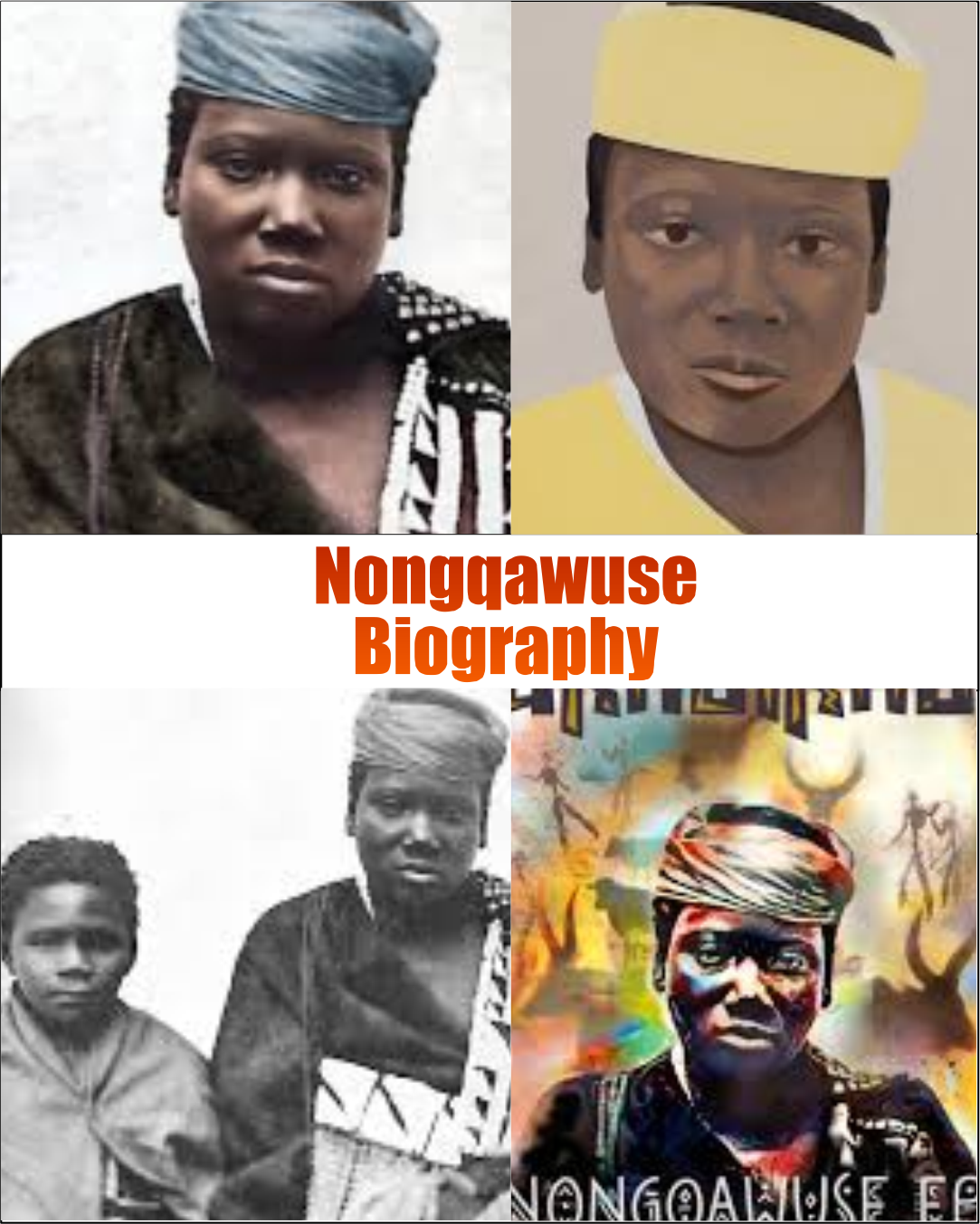
The Nongqawuse Biography: A Girl, a River, a Prophecy.
In April 1856, a fifteen-year-old Xhosa orphan went to chase birds from her uncle’s crops and came back with a message from the ancestors. What followed – 400,000 cattle slaughtered, 40,000 people dead, a nation broken – is one of history’s most debated events. Was she a prophet, a pawn, a traumatised child, or a revolutionary? The answer depends on who is telling the story.
She told her uncle Mhlakaza that she had met the spirits of two of her ancestors. She claimed that the spirits had told her that the Xhosa people should destroy their crops and kill their cattle – the source of their wealth as well as food. The ancestors had promised that the dead would arise, that new grain would replace the old, that new cattle would come, and that the British settlers would be swept into the sea.
What happened next – across the following fifteen months – is one of the most catastrophic and most debated events in the history of southern Africa. The Xhosa lost over 400,000 cattle, as well as all their corn and seed corn for the coming season. An estimated 40,000 people starved to death. The survivors streamed into the small colonial towns of the Eastern Cape in search of food and work. The colonial governor used the catastrophe to seize over 600,000 acres of Xhosa land and imprison the Xhosa chiefs. A nation that had resisted British expansion for generations was broken – not by military defeat but by the consequences of following a prophecy that did not come true.
And at the centre of all of it was a fifteen-year-old girl by a river.
Nongqawuse Biography
| Category | Details |
|---|---|
| Full Name | Nongqawuse |
| Date of Birth | Approximately 1841 |
| Place of Birth | Eastern Cape, South Africa |
| Nationality | South African |
| Ethnicity | Xhosa |
| Profession | Prophetess |
| Notable Achievement | Her prophetic visions triggered the Xhosa Cattle Killing Movement of 1856 to 1857 — one of the most catastrophic events in Xhosa history |
| Legacy | Remembered as a deeply controversial figure whose story reflects the desperation and trauma of a people under colonial pressure |
The Gxarha River – A World Already Broken Before She Spoke
Nongqawuse was born in 1841 near the Gxarha River in independent Xhosaland, close to the border of the recently established colony of British Kaffraria in Eastern Cape South Africa.
Little is known of Nongqawuse’s parents, as they died when she was young. Her parents died during the Waterkloof campaigns of the Eighth Frontier War of 1850 to 1853.
She was an orphan by the age of twelve, the product of a war that the Xhosa had fought and lost against British forces. The Eighth Frontier War – the last of a series of violent confrontations between the Xhosa and the Cape Colony – had been particularly brutal, involving the systematic burning of Xhosa crops and villages and the killing of large numbers of civilians alongside combatants. It had ended in Xhosa defeat and the formal annexation of British Kaffraria – Xhosa territory, claimed by the British crown.
She was an orphan living with her uncle Mhlakaza at the Gxarha River in independent Xhosaland, close to the border of the recently colonized territory of British Kaffraria.
The Xhosa had been militarily defeated by the British during the long and bloody Eighth Frontier War. Even worse, they had seen their cattle herds decimated by the alien disease of bovine lung sickness, thus giving credence to the prophetic message that all belonging to them had been defiled and was therefore bad.
The economic and spiritual foundations of Xhosa life – cattle as wealth, as bride price, as the medium of connection between the living and the ancestors – were collapsing under a disease that had arrived from Europe without being invited and was leaving nothing in its place.
A defeated people. A dying cattle herd. An orphaned girl. A river. An April morning in 1856.
What She Said She Saw – and What Happened Next
In April 1856, fifteen-year-old Nongqawuse and her friend Nombanda, who was between the ages of eight and ten, went to scare birds from her uncle’s crops in the fields by the sea at the mouth of the River Gxarha.
When she returned she said that she had seen a man, who had told her that the whole community would rise from the dead, and that all cattle now living must be slaughtered. The girls returned home and told their families what had happened but they were not believed.
The initial response was scepticism. This is important to note – not everyone heard the prophecy and immediately began slaughtering cattle. There was doubt. There was questioning. There was the normal human response to an extraordinary claim.
However, when Nongqawuse described one of the men, Mhlakaza – himself a diviner – recognised the description as that of his dead brother and became convinced she was telling the truth.
See also: Sor Juana Inés de la Cruz Biography: The Illegitimate Child Who Wrote the First Feminist Manifesto in the Americas
Did you know?
Nongqawuse predicted that the ancestors’ promise would be fulfilled on February 18, 1857, when the sun would turn red. On that day the sun rose the same colour as every other day, and the prophecy was not realised.
The Xhosa historian Gqoba reported that on that day the Believers withdrew into their houses all day, fastened tightly behind their doors, peeping outside occasionally through little holes in their dwellings until the sun disappeared. History does not record what it felt like to be inside one of those houses, watching through a hole in the wall as the sun rose the wrong colour and refused to change.
The Amagogotya – The Ones Who Refused
Not all Xhosa people believed Nongqawuse’s prophecies. A small minority, known as the amagogotya – the stingy ones – refused to slaughter and neglect their crops.
The naming of the resisters – amagogotya, the stingy ones – reveals the social pressure operating within the movement. To refuse to slaughter was not simply a theological disagreement. It was a moral failure, a selfishness, a refusal to trust completely when trust was what the ancestors demanded. The believers and the non-believers were not two equally respected positions in a debate. The believers were the righteous. The non-believers were the obstacle to the prophecy’s fulfilment.
This refusal was used by Nongqawuse to rationalise the failure of the prophecies during a period of fifteen months.
By the time the movement finally exhausted itself in mid-1857, the Xhosa had lost over 400,000 cattle, as well as all their corn and seed corn for the coming season. An estimated 40,000 people starved to death, and the survivors streamed into the small colonial towns of the Eastern Cape in search of food and work.
The population of British Kaffraria decreased from 105,000 to fewer than 27,000 due to the resulting famine.
Governor Grey – The Man Who Made the Catastrophe Worse
The colonial governor at the time was Sir George Grey. And the catastrophe that the cattle-killing produced – devastating as it was on its own terms – was made structurally irreversible by what Grey did with it.
Grey had been watching the movement develop. He had not stopped it – perhaps could not have stopped it, perhaps chose not to. What he did, with the efficiency of a colonial administrator who understood opportunity when suffering created it, was use the aftermath to accomplish what military force had not been able to complete. A people broken by famine cannot resist land seizure. Chiefs in prison cannot organise. A population scattered into colonial towns in search of food becomes a colonial labour force. The cattle-killing handed Grey the tools for a final dispossession that the Eighth Frontier War had not achieved.
This observation – that the colonial government benefited enormously from the cattle-killing and used it deliberately – is central to one of the most persistent alternative interpretations of what happened in 1856.
The Interpretations – What History Has Never Agreed On
History is not kind to Nongqawuse. There is little evidence to discern who she actually was and why she in particular made the prophecies she did, let alone whether the prophecy was true or not. There are only varying perspectives and speculations based on the evidence available.
The interpretations divide broadly into four positions, each with historical evidence behind it and each saying something different about what Nongqawuse actually was.
On Bradford’s reading, Nongqawuse was not simply deluded or manipulated. She was – consciously or not – striking at the economic foundation of the system that used women as exchange objects. The cattle, in this interpretation, were not incidental targets. They were the specific form of value through which women’s subordination was organised and maintained.
After the Prophecy Failed – Capture, Robben Island, and Alexandria
When the movement finally collapsed, Nongqawuse faced the anger of the people whose cattle and crops and kin she had, directly or indirectly, contributed to destroying.
Nongqawuse was captured by colonial forces in March 1858. The chief of Bomvana gave Nongqawuse to Major Gawler, and she stayed at his home for a period. She was taken to Robben Island for her own safety – but her people were broken.
The photograph that most people associate with Nongqawuse was taken during this period of captivity, at the instigation of her captor’s wife. One day, Mrs. Gawler decided to dress her, along with the Mpongo prophetess Nonkosi, and have their portrait taken by a photographer. This is the widely circulated image of Nongqawuse that most people are familiar with.
The Valley That Still Bears Her Name
The valley where Nongqawuse allegedly met the spirits is still called Intlambo kaNongqawuse – Xhosa for Valley of Nongqawuse.
The landscape remembered her when the history books were still arguing about whether to condemn or rehabilitate her. The valley by the Gxarha River, on the Wild Coast, carries her name into the present – not as a monument built by admirers or a museum erected by a state, but simply as the place name that accumulated around the spot where a girl went to chase birds and came back changed.
The story of Nongqawuse was told and re-told orally in the Eastern Cape, South Africa, throughout the nineteenth and twentieth centuries. The story activated the imaginative and creative energy of twentieth-century writers, to the point of being revisited several times and adapted to different literary genres – plays, poetry, short stories, novels, and films.
What the Girl by the River Was
Nongqawuse was fifteen years old. She was an orphan. She had grown up at the intersection of Xhosa traditional spiritual practice and Christian apocalyptic theology, in a household presided over by an uncle who was simultaneously a traditional diviner and a frustrated Christian convert. She lived in a community that had just lost a war, was losing its cattle to a European disease, and was watching its land be taken acre by acre by a colonial government that was not finished.
She went to chase birds from a field by a river and came back with a message.
The valley still bears her name. The argument has not stopped. Both of those things, together, are what she left behind.
Frequently Asked Questions
1. Who is Nongqawuse?
Nongqawuse was a young Xhosa girl born around 1841 in the Eastern Cape of present-day South Africa who became the central figure in one of the most tragic episodes in African colonial history. At approximately 15 years of age, she claimed to have received visions from ancestral spirits at a river near her home.
2. What was the Xhosa Cattle Killing Movement and why did it happen?
The Xhosa Cattle Killing Movement of 1856 to 1857 was a mass act of prophetic sacrifice in which large numbers of Xhosa people slaughtered their cattle and destroyed their grain stores in response to Nongqawuse’s prophecy. Nongqawuse’s uncle Mhlakaza, a spiritual adviser, amplified and promoted the message, and the Xhosa paramount chief Sarhili gave it his support — decisions that gave the prophecy enough authority to drive mass action.
3. What were the consequences of the Cattle Killing?
The consequences were catastrophic beyond any reasonable measure. When the promised day of resurrection and renewal came and passed without the ancestors rising or the colonisers departing, the Xhosa people faced a humanitarian disaster of staggering proportions. With their cattle killed and their crops destroyed, mass starvation followed.
4. Was Nongqawuse responsible for what happened?
This is the most complex and contested question surrounding her story. Nongqawuse was a young teenager when she reported her visions — a child, by any reasonable measure, who cannot bear sole responsibility for the decisions made by adult leaders, chiefs, and advisers who chose to act on her words. Her uncle Mhlakaza played a significant role in interpreting and promoting the prophecy, and Chief Sarhili’s endorsement gave it the authority that drove mass compliance.
5. What happened to Nongqawuse and what is her lasting legacy?
After the failure of the prophecy, Nongqawuse and her uncle Mhlakaza were arrested by British colonial authorities. Mhlakaza died in custody. Nongqawuse was eventually released and lived out the remainder of her life on a farm in the Eastern Cape under a different name, dying around 1898.