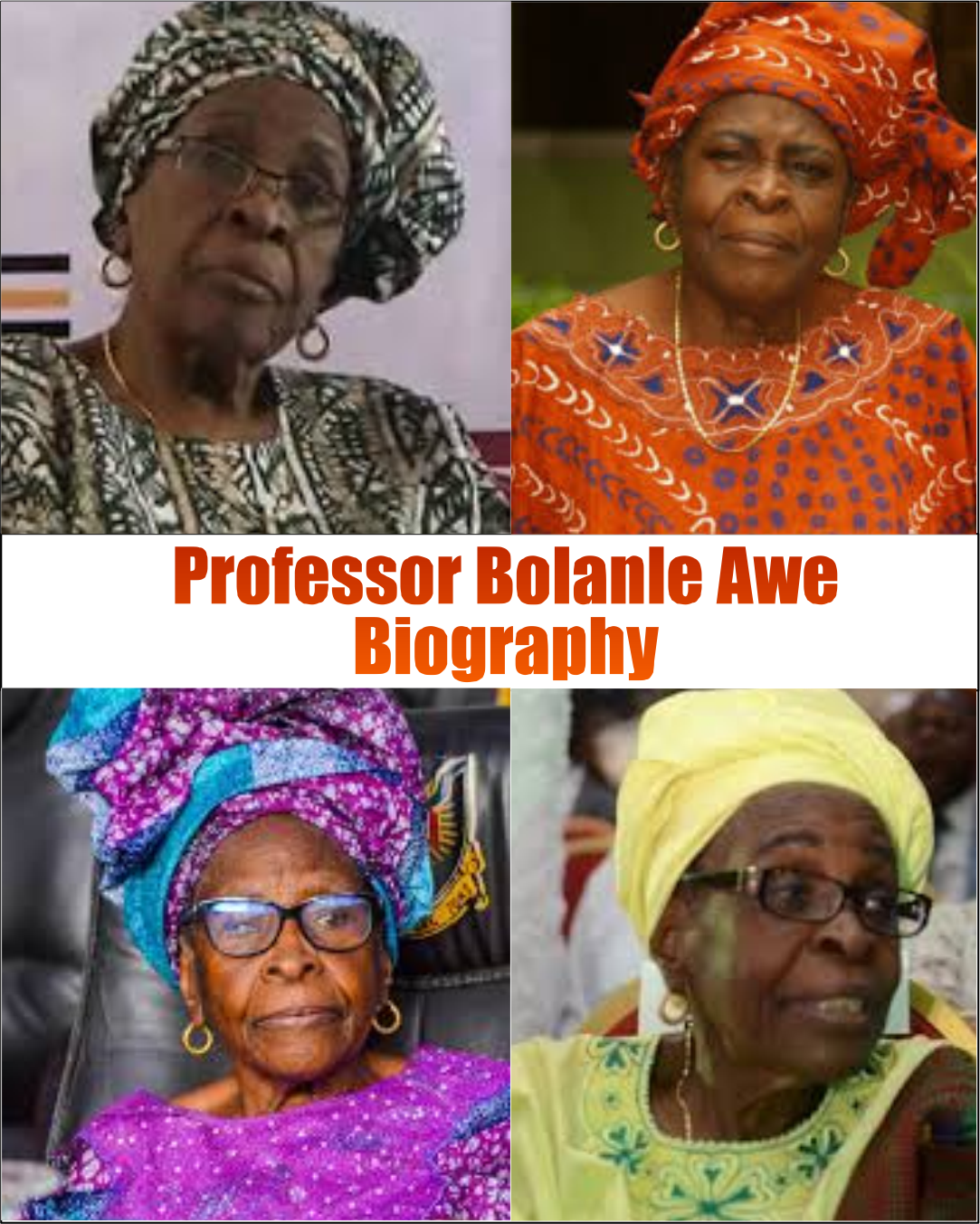
The Professor Bolanle Awe Biography: The Woman Who Write Nigeria Into History.
Bolanle Awe joined the University of Ibadan on October 1, 1960 – the exact day Nigeria became independent. She was the first woman on the history faculty. She spent the next six decades insisting that the women Nigerian history had forgotten were worth finding – and then finding them herself.
She Joined the History Department on Independence Day and Spent Sixty Years Making Sure Women Were in It: The Story of Professor Bolanle Awe
Professor Bolanle Awe Biography
| Category | Details |
|---|---|
| Full Name | Professor Bolanle Awe |
| Date of Birth | 1933 |
| Place of Birth | Ondo, Ondo State, Nigeria |
| Nationality | Nigerian |
| Ethnicity | Yoruba |
| Profession | Historian, Academic, Scholar |
| Field of Study | African History, Women’s History, Yoruba History |
| Educational Institution | University of Ibadan, Nigeria |
| Academic Title | Professor of History |
| Specialisation | Precolonial Nigerian States, Yoruba Political History, Women in African History |
| Notable Achievement | One of the first Nigerian women to attain a full professorship |
| Career Highlight | Spent the core of her academic career at the University of Ibadan |
| Contribution to Academia | Pioneered the study of women’s history in Nigeria and helped reshape African history from an African perspective |
| Published Works | Contributed to major scholarly works on Nigerian and Yoruba history including research on women’s roles in precolonial society |
| Public Service | Served in advisory and public policy roles related to education and national development in Nigeria |
| Legacy | Regarded as a trailblazer for women in Nigerian academia and a foundational figure in Nigerian historiography |
| Awards & Recognition | Recipient of multiple national and academic honours recognising her contributions to Nigerian history and education |
| Influence | Inspired generations of Nigerian women to pursue careers in academia and historical scholarship |
On October 1, 1960, Nigeria became an independent nation. Flags rose across Lagos. Crowds gathered at Tafawa Balewa Square. A new country took its first breath as a sovereign state, inheriting – among everything else – the question that every new nation must eventually answer honestly: whose history will you choose to tell?
On that same day, in Ibadan, a twenty-seven-year-old woman walked into the Department of History at the University of Ibadan and became its first female lecturer.
She joined the Department of History, University of Ibadan on October 1, 1960 – the date of Nigeria’s independence.
See also: Most accurate biography of sport legends
The coincidence of those two arrivals – a nation and a woman, both beginning something on the same morning – is either a remarkable accident of timing or, depending on how you read history, entirely appropriate. For the next six decades, Professor Bolanle Awe would spend her career doing what the new nation itself was struggling to do: deciding which stories counted, which voices deserved to be heard, and what was lost when the answers to those questions were left entirely to the people who had always been in charge of giving them.
She is 92 years old. She is still in Ibadan. And the history of Nigeria is richer, more honest, and more complete because she refused – for sixty years, in the face of considerable institutional resistance – to pretend that half the population had not been there all along.
Ilesa, a Cocoa Trader’s Daughter, and a Mother Who Was a Teacher First
Bolanle Awe was born on 28 January 1933 in the town of Ilesa, Colonial Nigeria, to Samuel Akindeji Fajembola and Mosebolatan Abede. Her father was originally from the town of Ibadan and was a manager at John Holt and Co., a shipping and general merchandise company. Her mother was from the town of Ilesa and was a member of the Abede family, a branch of the Royal House of Bilayirere, one of the four royal houses of Ilesa. Her mother was a teacher.
Two lines of inheritance – the commerce of her father’s world, the intellectual life of her mother’s. John Holt and Co. was not a small local enterprise. It was one of the largest British trading companies operating in West Africa, its network reaching across the colonial economy from Liverpool to Lagos, its offices staffed by Nigerians whose work sustained an extractive system even as their children would be among the generation to dismantle it. Samuel Fajembola navigated that world with the particular dignity of a man who understood its terms without being defined by them.
Her mother understood something different. Mosebolatan was among the first set of girls to be trained at United Missionary College, Ibadan. A woman from a royal house of Ilesa, formally trained as a teacher in the mission school system – a woman who had pushed through the specific barriers that colonial Nigeria placed before educated women and had emerged with a profession, a vocation, and presumably the conviction that education was worth the pushing. Young Bolanle absorbed this conviction before she had words for it.
She was born in a community where practitioners of Islam, Christianity, and the Yoruba religion lived harmoniously. That detail – the religious diversity of Ilesa, the coexistence of traditions that elsewhere produced conflict – shaped a mind that would later resist the tendency to flatten complexity into single narratives. History, as Professor Awe would come to practise it, was always about the multiple truths that existed simultaneously in the same community at the same time. Ilesa gave her that instinct early.
She attended Holy Trinity School, Omofe-Ilesha, before moving with her family to Ibadan when she was eight years old. She later continued her education at St James Primary School, Okebola, Ibadan and St Anne’s School, Ibadan. The family followed her father’s work to Ibadan – the great, sprawling, turbulent Yoruba city that would become the base of her entire professional life. She arrived at eight and has never really left.
The Perse School, St Andrews, and the Oxford That Did Not Quite Know What to Do With Her
The pathway from Ilesa to Oxford ran through Cambridge – specifically through the Perse School for Girls, where a headmistress named Ms. Scott decided that this Nigerian girl should speak better English and arranged private lessons to ensure it.
The Principal of the school, Ms. Scott, was anxious that she should be able to speak good English. So she organised lessons for her just to make sure she spoke good English. Then they encouraged her to travel outside Cambridge – first to get acclimatised in Cambridge itself.
The anxiety about her English – the institutional assumption that a girl from Nigeria would need remediation, would need to be polished up to the standard that the school imagined it was maintaining – is a small but precise illustration of the colonial educational encounter. Bolanle Awe received the English lessons. She already spoke excellent English. She took the A-levels. She passed. And then she went to St Andrews.
She graduated with an MA Honours in History from St Andrews University, Scotland in 1958. St Andrews in the late 1950s – one of the oldest universities in Britain, its history faculty dominated by scholars who had largely been trained to think of African history as the history of what Europeans did in Africa, not what Africans did in Africa. A young woman from Ilesa arriving to study history there was navigating a discipline that had not yet fully decided whether her continent had a history worth studying.
She managed. She excelled. And then she went to Oxford.
The conversation she later gave reveals the reluctant attitude of the largely white British academic community towards students from the colonies as well as the challenges of being a woman in Nigerian academia. Oxford in 1958 – specifically Somerville College, the women’s college where she read for her DPhil – was simultaneously a place of genuine intellectual opportunity and a place with very specific ideas about which kinds of knowledge counted and which people were qualified to produce it. A Nigerian woman working on African history at Oxford in the late 1950s was, in the most precise sense, working against the grain of the institution she was inside.
She worked on the DPhil. She finished it. She obtained a DPhil in History from the University of Oxford, England in 1964. A doctorate from Oxford, in history, at thirty-one years old. She had already been teaching in Ibadan for four years by the time the degree was formally conferred.
Did you know?
Professor Awe was one of the first people to critique the Western liberal feminist position which universalises women’s subjugation under patriarchal rule. As an advocate of nuanced intersectional thought, she argued that we can better serve women’s causes by understanding the history of oppression from culture to culture.
This position – which would later become central to what Western academia called intersectionality – was being articulated by a Nigerian historian in Ibadan in the 1970s, decades before the term entered mainstream academic vocabulary. She was not following a trend. She was ahead of one.
October 1, 1960 – The Day She and Nigeria Both Started
On her return to Nigeria in 1960, she joined the Department of History, University of Ibadan on 1st October, 1960, as an Assistant Lecturer, thereby becoming the first Nigerian woman to be formally appointed a lecturer in a Nigerian tertiary institution.
The date carries weight that accumulates the more you think about it. Nigeria’s independence was not simply a political event. It was an epistemological one – a moment when the question of whose knowledge counted, whose history was worth writing, whose experience was worth preserving, became urgently open in a way it had not been under colonial administration. The British had answered those questions in the way that colonial powers answer them: by centering themselves, by treating African history as a background against which European action took place, by staffing the universities they built with the scholars they trained to think in their own image.
Bolanle Awe walked into the Department of History on the day the British walked out. The timing was not coincidental. She had been preparing for this moment – in Ilesa, in Ibadan, in Cambridge, in St Andrews, in Oxford – for thirty years.
In 1967, she moved to the University of Lagos when her husband transferred his services from the University of Ibadan to that University. She got appointment in its School of African and Oriental Studies where she taught history and General African Studies, a compulsory course to all students of the university. The move to Lagos – following her husband, as women of her generation were expected to do, placing his career trajectory above her own institutional continuity – is a detail she has mentioned without bitterness in interviews. It is also a detail that contains, within it, the entire argument of her subsequent life’s work. Talented, Oxford-educated women interrupted their careers to follow husbands. The history books recorded the careers of the men they followed. She was going to fix that.
In December 1969, she came back to Ibadan when her husband again decided to return to the University of Ibadan as a Professor and Head of his former department. She was now appointed a Senior Research Fellow in the Institute of African Studies of the University, where she was eventually promoted to Professor of Oral History in 1976.
Professor of Oral History. The title itself is a statement of method and of argument. Oral history – the systematic collection and analysis of spoken testimony as historical evidence – was not, in 1976, fully accepted by the mainstream of academic historiography as legitimate. Written sources were primary. Documents were real. The memories of old people, transmitted across generations through speech and song and communal gathering, were supplementary at best and anecdotal at worst.
Bolanle Awe disagreed. She disagreed because she understood something that a British-trained scholar working primarily from colonial archives could not easily understand: that for the people whose history she was recovering – Yoruba women, pre-colonial communities, societies that organised themselves through oral transmission rather than bureaucratic documentation – the archives were not the primary source. The voices of the living and recently living were.
Efunsetan Aniwura – The Woman History Almost Lost
The clearest demonstration of what Professor Awe’s method could recover is her work on Efunsetan Aniwura.
Her use of oral history helped restore the narratives of previously overlooked or misrepresented women such as Efunsetan Aniwura.
Efunsetan Aniwura was the Iyalode of Ibadan in the nineteenth century – a title that made her the most powerful woman in one of West Africa’s largest and most politically complex cities. She was a wealthy trader, a military commander who supplied arms to Ibadan’s armies, a political figure of sufficient importance that her removal from the Iyalodeship was a matter of state significance. She was also, in the popular imagination shaped by a twentieth-century play and its adaptations, a villain – a tyrannical woman who killed her slaves and whose downfall was deserved.
Bolanle Awe went to the sources. She collected oral testimony. She cross-referenced. She found a more complicated, more historically coherent picture – a powerful woman whose power threatened men who had the means to construct the narrative of her downfall and the motivation to make that narrative stick. She is one of the few historians who incorporate oral traditions in evidence. She has been able to trace back histories before the arrival of Europeans.
The recovery of Efunsetan Aniwura’s actual historical record is not simply an exercise in correcting a single wrong narrative. It is a demonstration of what happens systematically when powerful women are written about by the people their power threatened – and what happens when a historian decides to go looking for the evidence those writers had reasons to suppress.
She applied the same rigour to the broader landscape of Nigerian women’s history. Her publications include University Education For Women In Nigeria (1964), Nigerian Women And Development In Retrospect (1989), Historical Patterns, Customs and Traditions Restricting Access of Girls to Education (1990), Writing Women Into History: The Nigerian Experience (1991), and Nigerian Women In Historical Perspective (1992). That list spans nearly three decades of sustained, systematic effort to do one thing: put Nigerian women back into the historical record from which they had been omitted. Not as footnotes. Not as background. As subjects – as agents who made decisions, built institutions, exercised power, and shaped the world around them in ways that mattered.
WORDOC, the Ministry of Women Affairs, and the Commissioner Who Taught History
The academic work and the public service ran in parallel throughout her career – not as separate tracks but as two expressions of the same conviction.
She co-founded the Women’s Research and Documentation Centre – WORDOC – at the Institute of African Studies, University of Ibadan. The Centre is a resource centre for research in women’s and gender studies, and an advocacy platform for issues that affect women in the Nigerian society and polity.
WORDOC was not simply a library or a research institute. It was an argument made institutional – a physical space that said: this knowledge exists, it matters, it deserves a building and a budget and a staff and a mandate. She co-founded WORDOC in the 1980s, recognising the erasure of women in historical discourse, creating an important resource hub for women’s studies.
Alongside the academic institution-building, she moved into government. She spent short spells away from the university system as a Commissioner for Education and, later, of Trade, Industries and Cooperatives in Western State, 1975 to 1978. A historian of women’s education serving as Commissioner for Education – the alignment between her research agenda and her government role was not accidental. The questions she was asking in the archive about why Nigerian women had been excluded from formal education were the same questions she was now in a position to address through policy.
She was the pioneer Chairperson of the National Commission for Women from 1990 to 1992, and was instrumental in the formal creation of the Ministry of Women Affairs in Nigeria.
She built the institution that built the Ministry. The Ministry of Women Affairs – a permanent feature of Nigerian federal government structure – exists in part because Bolanle Awe chaired the commission whose work demonstrated that women’s issues required dedicated ministerial attention. The historian who had spent three decades documenting the systematic exclusion of women from Nigerian public life used her government access to create a permanent institutional mechanism for their inclusion.
From 1994 to 1999, she served as the founding Country Director of the John D. and Catherine T. MacArthur Foundation in Nigeria – directing American philanthropic investment into reproductive health, women’s rights, and higher education across Nigeria’s major universities. The MacArthur Foundation directorship placed her at the intersection of international funding and local institutional development at precisely the moment when Nigerian civil society was navigating the transition from military rule.
Oxford Comes Back to Her – and Nigeria Honours What It Took Too Long to See
The formal honours accumulated across decades – each one a belated acknowledgment that what she had been doing was worth the institutional recognition it had not always received in time.
In 1983, Awe was made an Officer of the Order of the Federal Republic of Nigeria. She later served as Pro-Chancellor of the University of Nigeria, Nsukka. At the celebration of the 70th anniversary of the founding of the University of Ibadan, she was conferred with a well-deserved honorary doctorate degree.
Somerville College, Oxford – the institution where she had read for her DPhil six decades earlier – now counts her among its eminent alumni, citing her as a pioneering feminist historian whose use of oral history helped restore the narratives of previously overlooked women. The institution that had received her with the particular wariness that the British academic establishment of the 1950s reserved for colonial students was now, seven decades later, celebrating what she had built with the training it had given her.
She received the Iyalode of Itan title – a honorific that places her in the tradition of the great Yoruba women leaders whose history she had spent sixty years recovering. The naming is precise in the way that Yoruba cultural naming always is. Itan means history. Iyalode means the great woman leader who speaks for the women of the community. Iyalode of Itan – the great woman who speaks for history. The community had named her what she had always been.
Professor Toyin Falola – one of Africa’s most distinguished historians – placed her among Nigeria’s intellectual heroes in terms that require no elaboration: “Awe was one of those pioneering women who began to use the master’s tools of academic knowledge and power to demolish the house built on male hegemony.”
The master’s tools. Used to demolish the master’s house. Audre Lorde’s famous phrase, borrowed here to describe a Nigerian historian who had walked into the most prestigious academic institutions the British empire had built, learned their methods and their standards and their rigours, and then turned all of that learning toward the recovery of the women those institutions had decided did not belong in history.
92 Years Old, Still in Ibadan, and the History That Continues Without Her
Professor Bolanle Awe is 92 years old. She lives in Ibadan – the city her father’s work brought her to at eight years old, the city where she became the first female lecturer in a Nigerian university on the day Nigeria became a country, the city where she built WORDOC and the National Commission for Women and the scholarly record of Nigerian women’s history.
She was happily married with children for some 55 years to Professor Olumuyiwa Awe of blessed memory. The marriage that had moved her from Ibadan to Lagos and back – that had required her to subordinate her institutional continuity to her husband’s career decisions – lasted fifty-five years. The woman who had documented the ways that social structures constrained women’s lives had lived inside those constraints and built something extraordinary anyway.
Awe represents a difference in the Nigerian academic world – the difference of antidote: decorum instead of decadence, comity rather than chaos, decency rather than animosity. If her male peers stand in the progress of others, she opens doors for them. Today, she stands taller than the male gatekeepers.
Taller than the gatekeepers. Not despite them, but over them – having spent sixty years building an edifice of scholarship and institution-making so solid that the people who once controlled the gates are now seeking entry to the structure she built beyond them.
The history of Nigeria that exists today – the history that includes Efunsetan Aniwura and the Iyalode tradition and pre-colonial women traders and the systematic documentation of how Nigerian women have shaped their communities across centuries – is richer than it would have been without her. Not marginally richer. Fundamentally richer. The discipline itself is different because she practised it.
On October 1, 1960, a young woman walked into a history department and a country walked into independence simultaneously. The country is still figuring out whose stories it will tell. Professor Bolanle Awe spent her life making sure that when Nigeria finally decides to tell the whole truth, the women will be in it.
They are. Because she put them there.
Frequently Asked Questions
1. Who is Professor Bolanle Awe?
Professor Bolanle Awe is one of Nigeria’s most celebrated historians and academics. Born in 1933 in Ondo, Nigeria, she built a distinguished career at the University of Ibadan where she became one of the first Nigerian women to attain a full professorship. She is widely recognised for her groundbreaking contributions to African history, Yoruba political history, and the documentation of women’s roles in Nigerian society.
2. What is Professor Bolanle Awe known for?
She is best known for pioneering the study of women’s history in Nigeria at a time when women’s contributions to Nigerian and African history were largely undocumented and overlooked. She was instrumental in reshaping how African history was studied and taught — shifting the perspective from a colonial framework to one that centred African voices and experiences. Her work on Yoruba political structures and precolonial Nigerian society remains foundational in Nigerian historiography.
3. What awards and honours has Professor Bolanle Awe received?
Professor Awe has received numerous national and academic honours throughout her career in recognition of her contributions to Nigerian education and historical scholarship. She has been celebrated by the Nigerian academic community and government institutions as a trailblazer whose work elevated the standard and direction of historical research in Nigeria.
4. What did Professor Bolanle Awe contribute to women’s rights in Nigeria?
Beyond her academic work documenting women’s history, Professor Awe was herself a living symbol of what Nigerian women could achieve in intellectual and professional life. At a time when women in senior academic positions were extremely rare, her ascent to a full professorship demonstrated that Nigerian women could lead in the highest levels of scholarship. Her research also gave historical legitimacy and visibility to the roles women played in precolonial Nigerian society — roles that had been systematically marginalised by colonial historical narratives.
5. Where did Professor Bolanle Awe study and work?
Professor Awe received her education and built her academic career in Nigeria, with the University of Ibadan serving as her primary professional home. The University of Ibadan is Nigeria’s oldest and one of its most prestigious universities, and Professor Awe spent the core of her distinguished career there as a professor of history. Her association with the university helped cement Ibadan’s reputation as a centre of serious African historical scholarship.