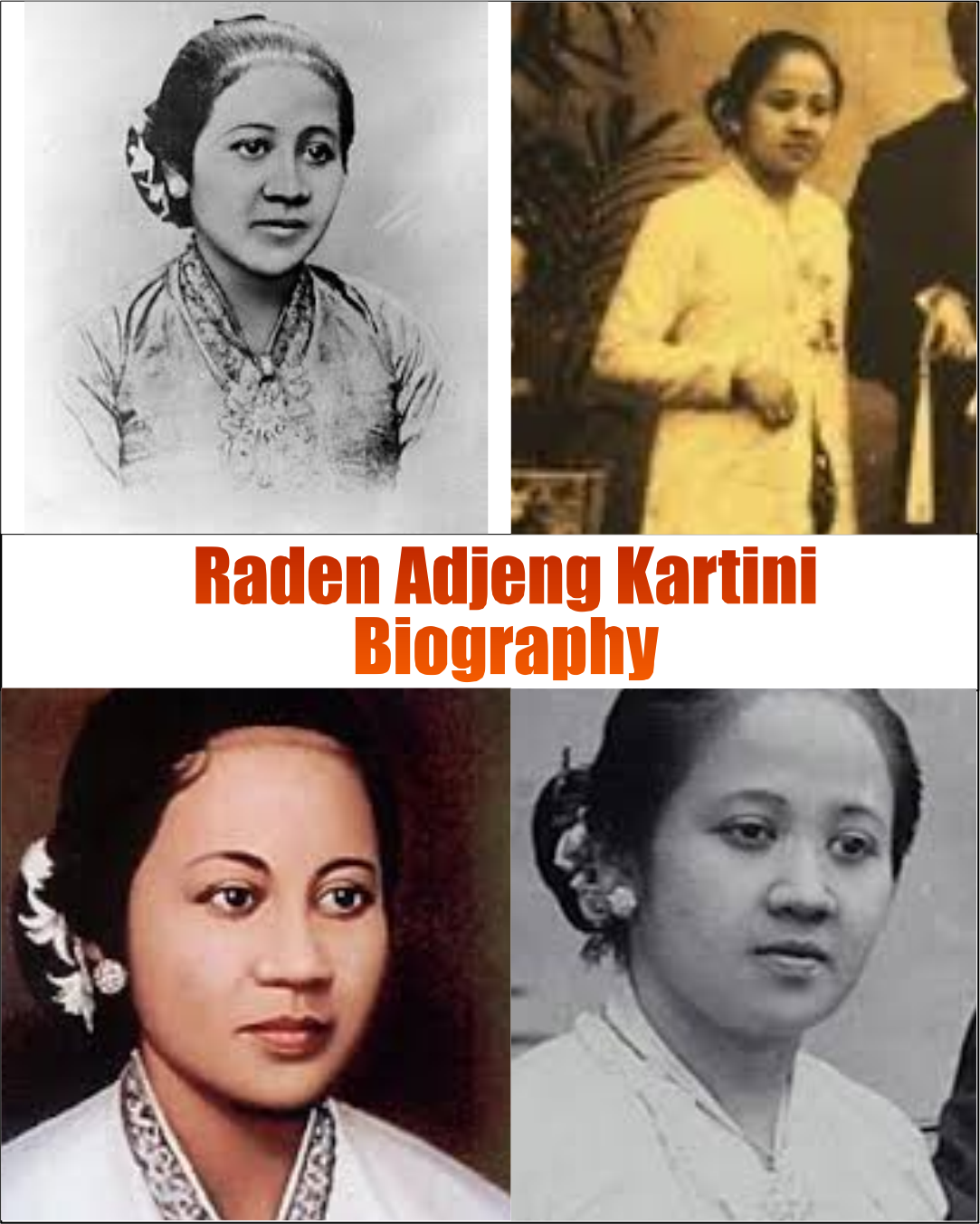
The Raden Adjeng Kartini Biography: She Wrote Letters That Changed a Country.
Kartini was locked in purdah at twelve, became the fourth wife of a man twenty-six years her senior, opened Indonesia’s first school for girls, and died at twenty-five giving birth to her only child. Her letters – written in Dutch from a closed room – eventually freed millions of Indonesian women she never met.
The room was not a punishment. That is the first thing to understand about the seclusion that shaped Raden Adjeng Kartini’s life and, through her letters, eventually shaped Indonesia itself.
Kartini walked into that room at twelve years old, carrying everything she had absorbed at a Dutch school where she had encountered Western ideas about what women could be. She emerged from it, in the only way available to her – through words, through letters, through the Dutch language the colonial system had given her as a tool – with the most significant feminist manifesto that nineteenth-century Asia had produced.
She was twenty-five years old when she died. She had been free of the room for three years. Her letters had not yet been published. The schools that would bear her name had not yet been built. The national holiday that now marks her birthday had not yet been imagined.
She wrote into a darkness she could not see the end of. The light came after she was gone. That is, in the most honest accounting, both the tragedy and the achievement of Raden Adjeng Kartini.
Raden Adjeng Kartini Biography
| Category | Details |
|---|---|
| Full Name | Raden Adjeng Kartini |
| Date of Birth | April 21, 1879 |
| Place of Birth | Jepara, Central Java, Dutch East Indies (present-day Indonesia) |
| Nationality | Indonesian |
| Profession | Women’s Rights Activist, Writer, Educator |
| Field of Work | Women’s Education, Social Reform, Literature |
| Notable Achievement | Pioneer of women’s education and emancipation in Indonesia and Southeast Asia |
| Legacy | April 21 is celebrated annually as Kartini Day in Indonesia in her honour |
April 21 is observed every year as Kartini Day — a national celebration honouring her contributions to women’s emancipation and education. Her face has appeared on Indonesian currency, and she is formally recognised as a National Hero of Indonesia. More than a century after her death, she remains one of the most beloved and influential figures in Indonesian history.
Mayong, Two Mothers, and a Father Who Was Progressive Enough to Create a Problem He Could Not Solve
Kartini was born on 21 April 1879 in the village of Mayong, Java. Her parents were Raden Adipati Sosroningrat, a member of the Javanese gentry, and Ngasirah, the daughter of a religious scholar.
Kartini was the fifth child and second-eldest daughter in a family of eleven, including half-siblings. She was born into a family with a strong intellectual tradition. Her grandfather, Pangeran Ario Tjondronegoro IV, became a regent at the age of 25, while Kartini’s older brother, Sosrokartono, was an accomplished linguist.
Her father was, by the standards of colonial Java, a genuinely progressive man. Her father, the Regent of Jepara, was educated by a Dutch tutor in the 1860s, spoke Dutch fluently and was widely read in Western literature. He too educated his children, and so, from the age of six, Kartini and her sisters attended a Dutch elementary school.
That decision – to send his daughters to the Dutch school – was the most consequential thing Raden Adipati Sosroningrat ever did, though not in the way he had probably intended. The Dutch school gave Kartini language, ideas, and the specific vocabulary of European feminist thought that was, by the 1890s, circulating through the Netherlands with increasing energy. She went in as a Javanese girl from a noble family. She came out with a framework for understanding what was being done to her and the language to articulate it.
Then, at twelve years old, the framework collided with the tradition.
See also: Professor Bolanle Awe Biography – The Woman Who Write Nigeria Into History
The Room, the Books, and the Letters That Escaped When She Could Not
During her period of seclusion she wrote letters to many friends abroad, read magazines and books, and rebelled against the strong tradition of gender discrimination. Her father gave her books on Javanese culture to balance her western education and subscribed to a Literary Box, a box of magazines, children’s books, modern novels and foreign news, which was changed every week by a local library.
The Literary Box. That weekly delivery of magazines, novels, and foreign news to a girl locked in a room is one of the most poignant details in Indonesian history. Her father, progressive enough to have sent her to the Dutch school, conservative enough to enforce her seclusion at twelve – threading the needle between the two by ensuring that the room at least contained windows, even if they were made of paper rather than glass.
Through those windows she found her correspondents. Kartini regularly corresponded with feminist Stella Zeehandelaar as well as numerous Dutch officials with the authority to further the cause of Javanese women’s emancipation from oppressive laws and traditions.
Stella Zeehandelaar was a young Dutch feminist – part of the same movement that was reshaping European conversations about women’s education, women’s legal status, and women’s political participation. Her correspondence with Kartini, which began in 1899, is one of the most extraordinary epistolary exchanges of the early twentieth century – a Dutch feminist and a Javanese noblewoman in a locked room, thinking together across a colonial divide about what women deserved and what the world was doing to prevent them from getting it.
The letters were not polite. They were honest, searching, sometimes angry, and always specific in their targets. She wrote about the suffering of the rural poor. She wrote about her own position with clear-eyed precision: “It is a disgrace for a girl not to marry, to remain an unprotected woman. There is no one yet who does it, who dares do it.”
She was describing her own situation. She was twenty years old. She was in a room. And she was one of the only people in her society articulating, in writing, the precise mechanisms of the system that had put her there.
Did you know?
Eleanor Roosevelt wrote the preface to a 1960s English edition of Kartini’s letters, noting one line she thought the whole world should remember: “We feel that the kernel of all religion is good and beautiful.”
A Javanese noblewoman in purdah in colonial Java, writing to a Dutch feminist correspondent, articulating a religious pluralism and a humanist spirituality that the American president’s widow found worthy of bringing to the world’s attention sixty years after the letters were written.
The Scholarship, the Impossible Choice, and the Marriage She Did Not Want
In 1903, two things happened simultaneously that defined the remainder of Kartini’s short life.
She had recently been offered a scholarship to study abroad, and the marriage dashed her hopes of accepting it.
The scholarship to Holland – the thing she had been working toward, the opportunity to study formally in the country whose language and ideas had shaped her intellectual life – arrived at the same moment as the marriage proposal her father had arranged. The two could not coexist. A married Javanese woman could not travel to Europe alone to study. The scholarship required an unmarried woman. The marriage required that she stop being one.
Raden Adipati Djojo Adiningrat was a widowed progressive leader. He learned about Kartini and approached her father to discuss the possibility of an arranged marriage. The couple agreed that Kartini would continue her plans for the school. Kartini married Joyodiningrat on 8 November 1903. There was a 26-year age difference between Kartini and her husband. She became the fourth wife of Joyodiningrat, who had 12 children at the time.
She became the fourth wife of a man twenty-six years her senior who already had twelve children. The woman who had spent four years writing letters arguing against polygamy accepted polygamy as the condition of her own marriage.
Being married gave her more freedoms as a woman and she realized her dream of opening a school for native girls.
The First School, the Syllabus She Wrote Herself, and the Twenty-Five-Year-Old Who Ran Out of Time
In 1903, Kartini obtained permission to open in her own home in Rembang the first ever all-girls school, for daughters of Javanese officials. She created her own syllabus and system of instruction. The school aimed at the character development of young women, while at the same time providing them with practical vocational training and general education in art, literature and science.
She wrote the syllabus herself. There was no template for it – no existing model for what education designed specifically for Javanese girls, by a Javanese woman, drawing on both Javanese and Western intellectual traditions, should look like. She was inventing it in real time, in a regency house in Rembang, drawing on everything she had read in the room and everything she had argued about in five years of letters to Dutch feminists and colonial officials.
She opened it in 1903. She was twenty-four years old. She had approximately twelve months left to live.
Kartini died at the age of 25 of complications after the birth of her first child. She died on 17 September 1904, in Rembang Regency, Java.
Through Darkness to Light – The Letters That Changed Indonesia After She Was Gone
Seven years after her death, one of her correspondents, Jacques H. Abendanon, published a collection of Kartini’s letters, in Holland in 1911 as Door Duisternis Tot Licht – Through Darkness to Light. An English language version followed in 1920 under the unfortunate title Letters of a Javanese Princess – Kartini was an aristocrat but never a princess. Translations were later released in Malay in 1922, Arabic in 1926, Sundanese in 1930, Javanese in 1938, Indonesian in 1938 and Japanese in 1955.
The publication history traces the spread of her ideas across the world she had never seen from outside a room – from Dutch feminist circles to Malay-speaking readers to Arab scholars to Japanese intellectuals. Each translation was a new audience encountering a Javanese woman’s argument for women’s education, delivered in letters written from confinement, and finding in it something that spoke directly to their own circumstances.
The book enjoyed great popularity and generated support in the Netherlands for the Kartini Foundation, which in 1916 opened the first girls’ schools in Java, thus fulfilling Kartini’s ambition.
The Kartini Schools. Named for her. Built in the country she had wanted to change. Opening in 1916 – twelve years after her death, three years after her own school had closed with her passing. The institution she had invented in a regency house in Rembang became a network, and the network became a movement, and the movement became the foundation on which Indonesian women’s education was eventually built.
April 21 – The Holiday, the Currency, and the Continuing Argument
In 1964, Kartini was recognised by President Soekarno as a national hero – pahlawan nasional – and every year on her birthday, April 21, Indonesia celebrates Kartini Day.
Kartini Day – Hari Ibu Kita Kartini, Our Mother Kartini Day – is not simply a commemorative holiday. It is a national argument, renewed annually, about what Indonesia owes its women and how far the country has come from the closed room in Jepara. Every April 21, Indonesian women dress in traditional Javanese batik, Indonesian schoolchildren perform ceremonies in her honour, and the question that Kartini had spent her brief life asking – what do women deserve? – is posed again to the country she never saw free.
The argument is not resolved. Despite Kartini’s efforts, her tireless fight to bring gender equality and to break the Dutch colonial patriarchal system carries on in the contemporary Indonesian society. The constitution of independent Indonesia guaranteed women equal rights in education, voting, and economic participation – the specific rights Kartini had argued for in her letters. The practical reality of Indonesian women’s lives in the twenty-first century is more complicated, and more contested, than any constitutional guarantee.
What She Was Writing Toward
Raden Adjeng Kartini wrote letters because letters were the only thing she could write. Not books – her father refused to allow publication of the articles she had begun to compose. Not journalism. Not political manifestos. Letters, addressed to specific people, ostensibly private, gradually leaking into the world as their recipients shared them and copied them and eventually published them.
The form that was imposed on her by the constraints of her situation – private correspondence, the most intimate and most easily dismissed of literary genres – turned out to be exactly right for what she was doing. Letters allow a vulnerability that manifestos cannot. They allow the contradiction of a woman arguing against polygamy while accepting a polygamous marriage. They allow the doubt of someone who sees the system clearly but cannot escape it. They allow the humanity that political argument tends to suppress.
Kartini remains a dangerous woman, and perhaps that is why hardly anyone outside Indonesia has even heard of her, let alone read the collection of letters she wrote in Dutch between 1899 and 1904.
Dangerous. Not because she advocated violence or revolution or the dismantling of colonial rule. Dangerous because she articulated, with complete clarity, the mechanism by which societies constrain their women – and because that mechanism is not specific to colonial Java. It operates wherever tradition is used to justify enclosure, wherever respectability requires silence, wherever the protection of women is indistinguishable from the control of women.
She did not live to see any of it. She was twenty-five years old and she had written everything she had time to write.
Through darkness. Toward light.
Frequently Asked Questions
1. Who is Raden Adjeng Kartini?
Raden Adjeng Kartini was a 19th century Indonesian noblewoman, writer, and pioneering advocate for women’s rights and education. Born on April 21, 1879, in Jepara, Central Java, she grew up in a privileged Javanese aristocratic family yet used her position not for personal comfort but as a platform to challenge the deep inequalities facing women in colonial Indonesian society.
2. What is Raden Adjeng Kartini known for?
Kartini is best known for her passionate advocacy of education and equality for women at a time when Javanese women — even those from noble families — were confined by a strict system of social rules that severely limited their freedom and opportunities.
3. What challenges did Kartini face in her own life?
Despite her remarkable intellectual gifts and her passionate belief in women’s freedom, Kartini faced the very constraints she fought against in her personal life. As a Javanese noblewoman she was subjected to the tradition of pingitan — a period of seclusion in which young aristocratic women were confined to the home and kept from public life until marriage.
4. What did Kartini write and why does it matter?
Kartini’s most enduring legacy is her collection of letters, published posthumously in 1911 under the Dutch title Door Duisternis tot Licht — translated into English as Out of Darkness Comes Light and later as Letters of a Javanese Princess. These letters, written primarily to her Dutch pen friend Rosa Abendanon, reveal a mind of extraordinary breadth and sensitivity — engaging with questions of colonial injustice, religious interpretation, the education of women.
5. How did Kartini die and what is her lasting legacy?
Kartini died on September 17, 1904, just four days after giving birth to her first child. She was only 25 years old. Despite her tragically short life, the impact she left behind has proven extraordinary. Schools established in her name — known as Kartini Schools.