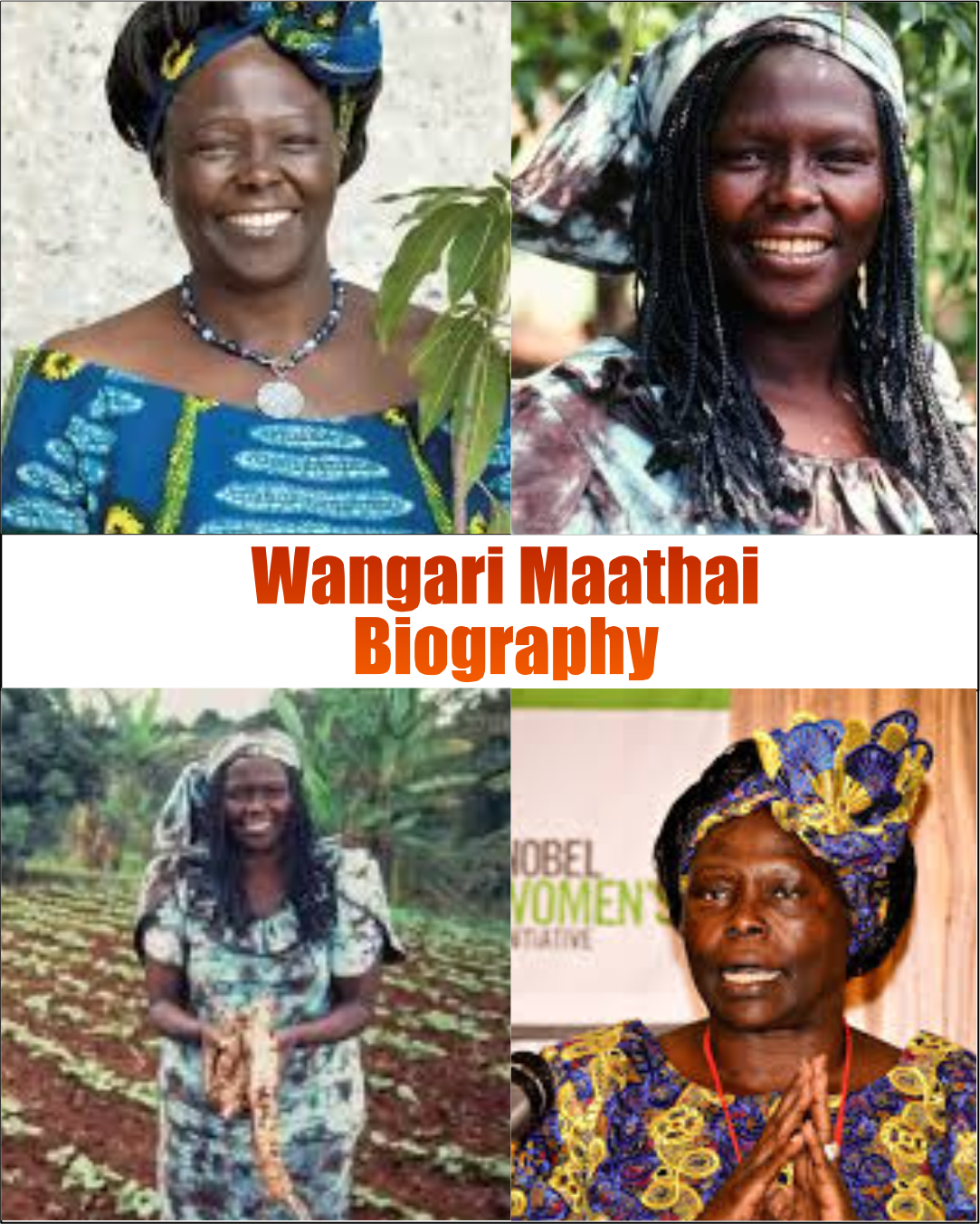
The Wangari Maathai Biography: She Planted 51 Million Trees, and They Beat Her Unconscious for It.
Wangari Maathai was the first woman in East and Central Africa to earn a doctorate. She started planting trees in 1977 with rural Kenyan women. The government called her subversive, evicted her with 24 hours notice, beat her unconscious, and jailed her repeatedly. She planted 51 million trees, won the Nobel Peace Prize, and died at 71 of ovarian cancer — with a forest still growing in her name.
She Started With a Nursery in Her Backyard. They Beat Her Unconscious. She Planted 51 Million Trees Anyway: The Story of Wangari Maathai
The nursery started in her backyard.
Not a metaphor. An actual nursery — seedlings in containers, watered and tended by hand, ready to be distributed to women in rural Kenya who would plant them in the depleted soil of the highland farms where they spent their days collecting water that was increasingly far away, gathering firewood from forests that were increasingly gone, feeding families on soil that was increasingly exhausted.
Starting with a small tree nursery in her backyard, Wangari Maathai launched Kenya’s Green Belt Movement, a grassroots tree-planting organisation composed primarily of women working to curtail the devastating social and environmental effects of deforestation and desertification.
Fifty-one million trees. Planted by rural women. In the ground of a country whose government called the organisation that planted them subversive. By a woman who received the Nobel Peace Prize and was beaten unconscious by police in the same decade.
This is the story of how both of those things were simultaneously true.
Wangari Maathai Biography
| Category | Details |
|---|---|
| Full Name | Wangari Muta Maathai |
| Date of Birth | April 1, 1940 |
| Place of Birth | Ihithe, Nyeri District, Kenya |
| Nationality | Kenyan |
| Profession | Environmental Activist, Academic, Politician, Nobel Laureate |
| Field of Work | Environmental Conservation, Women’s Rights, Democracy, Education |
| Notable Achievement | Founded the Green Belt Movement which planted over 51 million trees across Africa; first African woman to receive the Nobel Peace Prize in 2004 |
| Legacy | Celebrated globally as a symbol of environmental courage, women’s empowerment, and the inseparable connection between ecology and human dignity |
Nyeri, the Mission School, and the Kennedy Airlift
Wangari Muta Maathai was born in Nyeri, a rural area of Kenya, in 1940.
She grew up in Nyeri County, located in the central highlands of Kenya, and had a bucolic childhood spent in the rural Kenyan countryside.
The rural Kenyan countryside of Wangari Maathai’s childhood was not the depleted landscape it would become. The rivers ran clear. The forest covered the slopes of Mount Kenya. The soil was deep and rich from generations of careful farming by the Kikuyu community into which she had been born. The women who farmed that land knew its properties intimately — they knew which plants grew in which conditions, where the water collected after rain, how the forest on the mountain maintained the streams in the valley below.
Wangari watched. She absorbed. And decades later, when she was trying to explain to rural Kenyan women why planting trees on their farms was not simply an environmental gesture but a practical solution to the specific problems making their lives harder — the firewood that was further away, the water that was lower in the streams, the soil that no longer held moisture after rain — she was drawing on the knowledge she had accumulated watching her mother and grandmother farm the highlands of Nyeri in the 1940s.
See also: Hector Pieterson Biography – The Boy Who Spike Black Revolution
Did you know?
She became chair of the Department of Veterinary Anatomy and an associate professor in 1976 and 1977 respectively. In both cases, she was the first woman to attain those positions in the region. The pattern was already establishing itself — everywhere she went, in every institution she entered, she arrived first.
First woman with a doctorate in East and Central Africa. First woman to chair her department. First woman to become associate professor in her field. First African woman to win the Nobel Peace Prize. The firsts accumulated not because she was collecting them but because the institutions had never previously thought to make the space.
1977 — The Problem She Could See and the Solution Nobody Had Thought Of
The problem was specific and visible. Rural Kenyan women were walking further for water. They were walking further for firewood. The rivers that had run clear in Wangari’s childhood in Nyeri were running brown with eroded soil. The forest on the slopes of Mount Kenya — the forest that regulated the water table and held the soil against the rain — was being cleared for commercial agriculture.
She saw that deforestation was linked to the drying up of local water supplies, increased food insecurity, and wildlife habitat loss.
The connection seems obvious now, stated plainly. In 1976, in Kenya, it was not obvious to the institutions that were supposed to be addressing development — the government ministries, the international aid organisations, the development economists with their models and their matrices. They were working on the problem of poverty as an economic problem, as an infrastructure problem, as a governance problem. Nobody was working on it as a soil problem. As a tree problem.
Wangari Maathai was working in the National Council of Women of Kenya, listening to rural women describe what their daily lives were becoming. Instead of cooking traditional food grown locally, people were relying on imported goods and fertilisers which degraded the soil, which meant that women had to walk further to collect firewood for heating and cooking.
“Women needed income and they needed resources because theirs were being depleted. So we decided to solve both problems together.”
The ecology made the economics. That was the argument. Not plant trees because trees are beautiful. Plant trees because trees make the water come back, which makes the soil hold, which makes the crops grow, which means the children eat.
The Skyscraper, the Park, and the Government That Called Her Subversive
In 1989, the Kenyan government announced plans to build a sixty-two-story skyscraper in Uhuru Park — the largest public park in Nairobi, a green space in the heart of the capital that was used daily by thousands of people who had no other access to open air in the city.
The building was going to include offices for Daniel arap Moi’s ruling party, a four-story bronze statue of Moi himself, and a conference centre. Maathai regularly protested plans to privatise parts of Kenya’s forests and give them to the government’s political supporters.
She organised. She wrote letters. She sent them to the Kenyan government, to the British High Commissioner, to the international press, to the foreign investors financing the project. She staged protests in the park itself. She made the project visible and controversial in a way that the government had not anticipated and could not easily contain.
Her vocal opposition to the location of the proposed complex led the government of President Daniel Arap Moi to label both Maathai and the Green Belt Movement “subversive.” She was vilified in Parliament and in the press and forced to vacate her office of ten years with 24 hours notice.
Karura Forest, Tear Gas, and Being Beaten Unconscious
The Uhuru Park campaign was a victory. The government escalated.
Her willingness to speak out on critical social matters has on various occasions provoked the police to break into her home, place her under arrest, club her into unconsciousness, and otherwise discourage her from engaging in political activity.
Clubbed into unconsciousness. Not a dramatic turn of phrase. A description of what the Kenyan police did to Wangari Maathai — a university professor, a Nobel Peace Prize laureate in waiting, a woman who had been making the environmental case for trees in a country being deforested — during protests in the 1990s.
Over the years she was regularly arrested and attacked by the Kenyan police forces.
The most significant confrontation was at Karura Forest — a large urban forest on the outskirts of Nairobi that was being illegally allocated for development by politically connected individuals.
The Marriage He Ended — and the Judge Who Said She Was Too Educated
Alongside the political battles was a personal one that received less attention in the international coverage of her life but that she herself wrote about with characteristic directness.
Her marriage to Mwangi Mathai ended in divorce in 1979. During the process, she publicly criticized the judge who had presided over her case, and as a result, she was sentenced to six months in jail for contempt of court. (A judge freed her after three days.)
When her marriage broke down in the late 1970s, her husband reportedly stated she was too strong-minded for a woman. A judge in the divorce proceedings declared that her husband’s reasoning was valid.
Too strong-minded for a woman. A judge, in a court of law, affirming that a woman’s intelligence and independence were valid grounds for her husband to leave her. Wangari criticised the judgement. She was sentenced to prison for contempt. A different judge freed her after three days.
1997, the Presidential Race, and the Stolen Victory
In 1997, Maathai decided to run for the Kenyan presidency against an entrenched incumbent. However, because of a false, widely-distributed report that Maathai had withdrawn from the presidential race, she received a negligible number of votes.
A false report that she had withdrawn. Distributed widely. During the election. She received negligible votes not because the Kenyan electorate did not know or respect her — she was, by 1997, one of the most recognisable and admired figures in the country — but because voters who arrived at polling stations believing she had already withdrawn had no reason to vote for her.
Despite this disappointment, Maathai continued to try to reform the political process so that government addressed the concerns of ordinary Kenyans.
She continued. That phrase — she continued — appears in every stage of Wangari Maathai’s life as the most important fact about her. She continued after the divorce. She continued after the police beat her. She continued after the park battle. She continued after the fraudulent presidential election. The specific form of courage she embodied was not the dramatic, once-only defiance of a single moment but the sustained, grinding, unglamorous refusal to stop.
In December 2002, Professor Maathai was elected to parliament with an overwhelming 98% of the vote.
October 8, 2004 — Oslo, and a Prize That Redefined What Peace Meant
Wangari Maathai was the first African woman to receive the Nobel Peace Prize and the first laureate to have been selected for activities focused primarily on environmental sustainability.
The Norwegian Nobel Committee’s decision to award the Peace Prize to an environmental activist was not universally welcomed. Some critics argued that peace and environmental conservation were separate domains — that the Peace Prize should go to diplomats and conflict mediators, not tree planters. The Committee’s response to this argument was itself a statement: the committee commended her “holistic approach to sustainable development that embraces democracy, human rights, and women’s rights in particular.”
In response to being awarded the Nobel Prize, she stated: “I believe the Nobel committee was sending a message that protecting and restoring the environment contributes to peace; it is peace work. That was gratifying. I always felt that our work was not simply about planting trees. It was about inspiring people to take charge of their environment, the system that governed them, their lives and their future.”
“Although initially the Green Belt Movement’s tree planting activities did not address issues of democracy and peace, it soon became clear that responsible governance of the environment was impossible without democratic space.”
The Pan African Green Belt Network, the Congo Basin Fund, and the Global Work
The work expanded continuously beyond Kenya’s borders.
Leaders of the Green Belt Movement established the Pan African Green Belt Network in 1986 in order to educate world leaders about conservation and environmental improvement. As a result of the movement’s activism, similar initiatives were begun in other African countries, including Tanzania, Ethiopia, and Zimbabwe.
In 2005, she was appointed Goodwill Ambassador to the Congo Basin Forest Ecosystem by the eleven Heads of State in the Congo region. The following year, she founded the Nobel Women’s Initiative with her sister laureates Jody Williams, Shirin Ebadi, Rigoberta Menchú Tum, Betty Williams, and Mairead Corrigan.
The Congo Basin — the second largest rainforest in the world, after the Amazon, a carbon sink of global significance whose protection or destruction will affect the climate of the entire planet — had Wangari Maathai as its Goodwill Ambassador. The woman who had started with a backyard nursery was working at the continental scale, arguing with heads of state about the protection of a forest whose importance was not local but planetary.
In December 2009, the United Nations Secretary-General named Maathai a UN Messenger of Peace with a focus on the environment and climate change.
September 25, 2011 — The Ovarian Cancer, and the Forest Still Growing
Professor Maathai died on 25 September 2011 at the age of 71 after a battle with ovarian cancer. Memorial ceremonies were held in Kenya, New York, San Francisco, and London.
She died in Nairobi. In the city where she had stood in Uhuru Park and refused to let a government build a skyscraper. In the country where she had been beaten and jailed and evicted and fraudulently eliminated from a presidential election. In the place she had loved and fought for and planted and replanted for thirty-four years.
Memorial ceremonies in four cities. Not because she had been a head of state or a military leader or a figure whose power had come from authority over other people. Because she had been a woman with a backyard nursery and a conviction that the connection between trees, soil, water, women, and democracy was a connection that, once you saw it, you could not unsee — and that once you could not unsee it, you had an obligation to act on it.
I am sure by now there is a tree planted just for her in Nyeri, in the face of Mount Kenya, just the way she’d like it.
What She Was Actually Doing
Wangari Maathai was a biologist who understood that the problems of rural Kenyan women — the firewood, the water, the soil — were ecological problems that required ecological solutions. She was a political scientist who understood that ecological problems in an authoritarian state were political problems that required political confrontation. She was a community organiser who understood that solutions that came from within communities, owned by the people who needed them, were more durable than solutions delivered from above. She was a diplomat who understood that Kenya’s forests had global significance and needed global advocacy.
She held all four of those understandings simultaneously, and she acted on all four at once, and the government called her subversive because she was — she was subverting the arrangement by which public land was sold, forests were cleared, and rural women were supposed to accept their shrinking lives without objecting.
She died of ovarian cancer in Nairobi, in the city she had refused to let them take from the people.
The trees are still growing.
Frequently Asked Questions
1. Who is Wangari Maathai?
Wangari Maathai was a Kenyan environmental activist, academic, and politician who became one of the most celebrated and consequential figures in the history of both the environmental movement and the struggle for democracy and women’s rights in Africa. Born on April 1, 1940, in the Nyeri District of Kenya, she grew up in a rural farming community and went on to become the first woman in East and Central Africa to earn a doctoral degree.
2. What was the Green Belt Movement and why was it significant?
The Green Belt Movement was founded by Wangari Maathai in 1977 under the auspices of the National Council of Women of Kenya, and it grew into one of the most remarkable and impactful grassroots environmental organisations in African history. The movement’s approach was deceptively simple — organise rural women into community groups and pay them a small stipend to plant trees on degraded land, farms, school compounds, and public spaces.
3. What political struggles did Wangari Maathai face in Kenya?
Wangari Maathai’s environmental and democratic activism brought her into direct and dangerous conflict with the authoritarian government of President Daniel arap Moi, who ruled Kenya from 1978 to 2002. She was arrested multiple times, beaten by police, and subjected to sustained harassment and public vilification by the government and its supporters.
4. What was Wangari Maathai’s contribution to women’s empowerment?
Wangari Maathai’s contribution to women’s empowerment operated on both a practical and a philosophical level simultaneously. On the practical level, the Green Belt Movement gave hundreds of thousands of rural Kenyan women direct economic participation, organisational skills, environmental knowledge, and a platform from which to engage with local and national governance.
5. What is Wangari Maathai’s lasting legacy?
Wangari Maathai died on September 25, 2011, after a battle with ovarian cancer. She was 71 years old. Her legacy is vast, multi-dimensional, and continuing to grow. The Green Belt Movement she founded continues its work across Africa, and the 51 million trees planted under her leadership represent a living, breathing monument to what grassroots environmental activism can achieve.