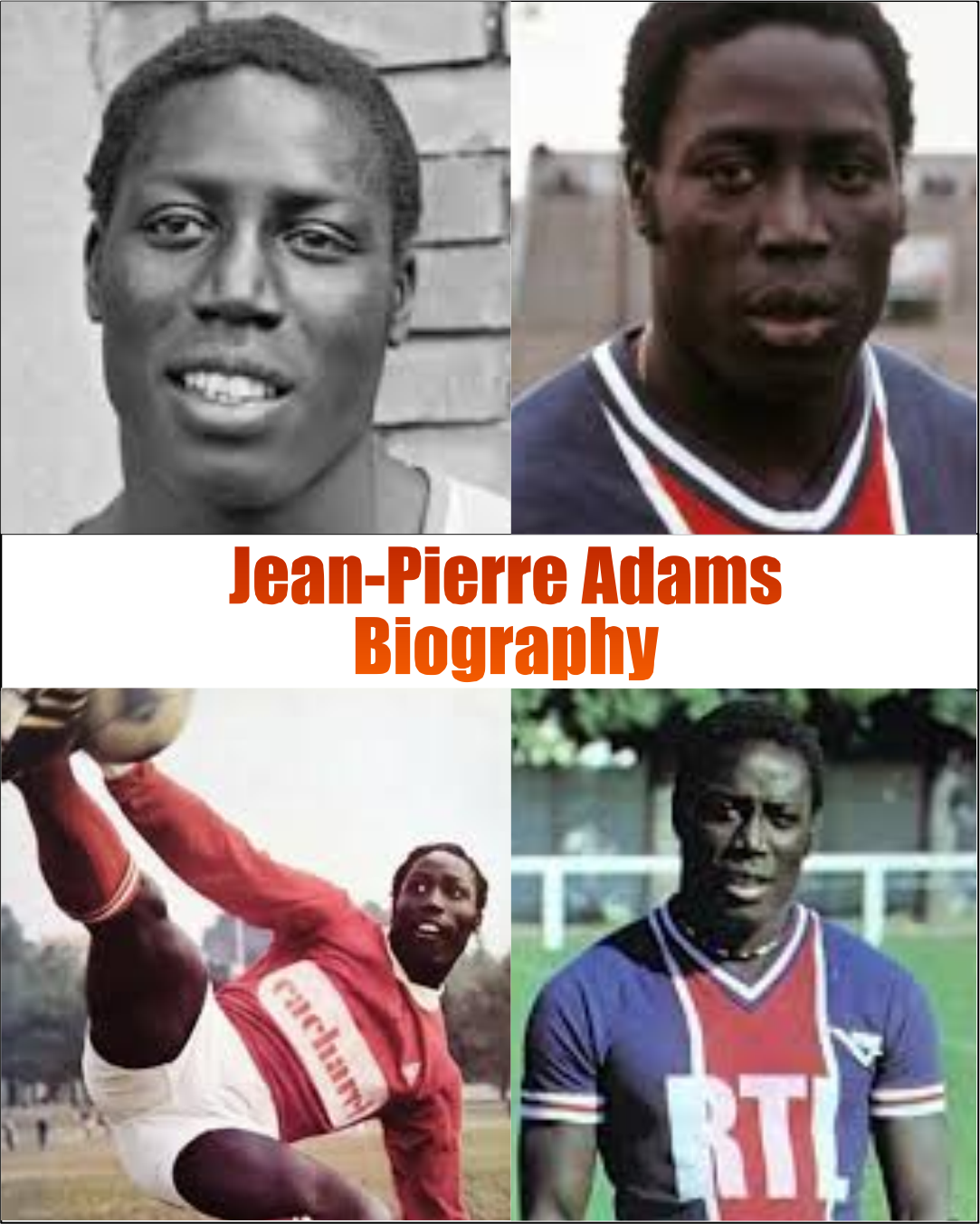
Jean-Pierre Adams Biography
The Jean-Pierre Adams Biography: He Never Came Back and His Wife Never Left.
Jean-Pierre Adams was one of France’s finest defenders — born in Senegal, raised in France, 22 caps for Les Bleus, half of the celebrated Black Guard partnership. On March 17, 1982, he went into hospital for a routine knee operation and never woke up. His wife Bernadette cared for him every day for 39 years. He died on September 6, 2021. His story changed how French sport discusses medical negligence, duty of care, and the meaning of devotion.
He Went In for a Knee Operation. He Never Woke Up. His Wife Never Left: The Story of Jean-Pierre Adams
At nine o’clock on the morning of March 17, 1982, Jean-Pierre Adams called his wife from the hospital. He told her the doctors were coming to administer the anaesthetic. He sounded calm. It was a routine procedure — a damaged tendon, the kind of injury that footballers collect the way they collect bruises.
At noon she called the hospital for the first time. The doctors told her he was still in surgery.
He came out of that operating theatre alive. He never came back.
Jean-Pierre Adams Biography
| Category | Details |
|---|---|
| Full Name | Jean-Pierre Adams |
| Date of Birth | March 10, 1948 |
| Place of Birth | Dakar, Senegal |
| Nationality | French |
| Profession | Professional Footballer, Defender |
| Field of Work | Football, French First Division |
| Notable Achievement | Represented the French national football team 22 times and was one of the first Black players to achieve prominence in French football |
| Legacy | Remembered as a symbol of tragic injustice in medical care and one of the most sorrowful stories in the history of French sport |
Dakar, a Grandmother’s Pilgrimage, and the Boy Who Arrived in France Alone
Jean-Pierre Adams was born on 10 March 1948 in Dakar, Senegal.
His father was Senegalese. His family was devoutly Catholic — the specific West African Catholicism that had arrived with the French missionaries and taken root in ways that shaped families for generations. When Jean-Pierre was ten years old, his grandmother took him on a religious pilgrimage to France. When they arrived in Montargis in the Loiret department, she enrolled him in a local Catholic school.
He was adopted by a French couple shortly after his arrival in the country.
His grandmother left. The couple who adopted him gave him stability and a home in France, but the separation from his family in Dakar at ten years old — arriving in a country whose language he was still learning, left behind by the grandmother who had brought him — was not a small thing to carry. He carried it with the specific resilience of a child who has no alternative.
“I was like a little lost puppy without a collar,” he said later.
See also: Chico Mendes Biography – The Man Who Used Literacy to Save the Amazon
Nîmes, PSG, and the Garde Noire
Adams started his career in Fontainebleau, where he helped the local side win its amateur championship, before moving to Nîmes to sign for the city’s then first division side. Within two years, not only had Nîmes finished runners-up but Adams was playing for France — one of the first Black players to do so.
He moved to Nice and then to Paris Saint-Germain — the clubs at the centre of French football’s competitive landscape in the 1970s. At international level, he found the partnership that would define his career.
With the national team, Adams formed a central defensive partnership known as the Garde Noire — Black Guard — alongside Marius Trésor. It was the first time France had ever had two Black players in the centre of defence.
The name carried weight beyond its literal meaning. Two Black men at the heart of the French national team’s defence, in the 1970s, at a time when Black players in European football at the highest level were still uncommon enough to attract comment — being called the Black Guard was simultaneously a statement of their racial identity and an acknowledgment of their defensive quality. They wore the name with pride.
Did you know?
Jean-Pierre and Bernadette met at a dance in Paris in 1968. Their relationship faced immediate resistance. “I can’t hide the fact that it was very difficult for my family at the beginning,” Bernadette recalled. “At the time, a Black man and a white woman being together wasn’t well-regarded.”
Her parents were eventually won over. They married in April 1969. The marriage that would endure fifty-two years — thirty-nine of them defined by circumstances neither of them had chosen — began with families who needed to be persuaded that it was acceptable.
March 17, 1982 — The Morning That Did Not End
By 1982, Jean-Pierre Adams was thirty-four and transitioning into coaching. The playing career was winding down through the lower divisions. He was training to become a youth coach — a natural next chapter for a footballer who had given the game everything and wanted to continue giving.
While training to be a coach in Dijon, he damaged a tendon in his leg. He went to Lyon hospital where he met a doctor who loved football and assured him he needed to undergo a knee operation.
The operation was scheduled for March 17. When the day arrived, the hospital was on strike.
“The female anaesthetist was looking after eight patients, one after the other, like an assembly line. Jean-Pierre was supervised by a trainee, who was repeating a year, who later admitted in court: ‘I was not up to the task I was entrusted with.’ Given it was not a vital operation, that the hospital was on strike, they were missing doctors and this woman was looking after eight patients in two different rooms, someone should have called me to say they were going to delay the operation.”
The Legal Battle, the Football Family, and the Fight for Compensation
The justice system that was supposed to address what happened moved with a particular slowness.
It wasn’t until 1989 that the medical staff were found guilty of involuntary injury — and even then it still needed nearly five more years to decide the family’s dues. “The process lasted nearly 12 years. I think it’s designed to discourage people,” Bernadette said.
Twelve years of legal proceedings to establish that the people who had put Jean-Pierre Adams into an irreversible coma through incompetence and negligence bore responsibility for it. Twelve years during which Bernadette was simultaneously providing round-the-clock care, raising two sons who were growing up without a functioning father, and fighting a legal system that was, by her own account, designed to exhaust claimants into dropping their cases.
Eventually, Bernadette received an annuity — a court-ordered payment that allowed her to fund the care without financial ruin. “If I hadn’t had the support of football, I would have been completely broke.”
Thirty-Nine Years — The House of the Beautiful Sleeping Athlete
The kids learned to talk to him, to watch football games with him. Every year they got him a cake on his birthday. The kids blew out his candles and the whole family sang. They wrapped presents and then unwrapped them. Everyone always got him the same thing, the only thing he needed: the long-sleeved T-shirts he wore all day.
His closet remained trapped in amber, full of 1970s clothes he once wore around Parisian nightclubs. Bernadette stopped celebrating their wedding anniversary after 1982.
She talked to him every day. “I talk to him all the time — about TV, what’s in the mail, anything! There is always movement around him. He is always next to us.” She told him his sons had become fathers. She told him he was a grandfather. She informed him of the things happening in the world around the bed where he lay, because the alternative — treating him as already gone — was something she was not willing to do.
What His Story Changed About Sport
Jean-Pierre Adams did not change football tactics. He did not break records or win tournaments that reshaped the sport’s competitive history. His impact on sport operated at a different level entirely — the level of what sport owes its athletes when the systems around them fail.
His case became, in France, the most visible and most discussed example of medical negligence within sport — the specific failure of duty of care that occurs when a non-emergency procedure is performed by under-qualified staff on an overwhelmed day, without adequate consent, without adequate oversight, with devastating and irreversible consequences.
The twelve-year legal battle Bernadette fought — and eventually won — contributed to conversations in French medical and sporting institutions about the standards that should govern the care of athletes in non-emergency surgical situations. The specific conditions that had made his injury possible — a hospital on strike, an overloaded anaesthetist, a trainee who admitted inadequacy — were the conditions that the case put on record as unacceptable.
Philosophy — What Bernadette’s Devotion Said About Sport’s Values
The story of Jean-Pierre Adams is, at its deepest level, a story about Bernadette. What she did — for thirty-nine years, without institutional mandate, without legal obligation, without the certainty of return — is the most demanding expression of the principle that a person is more than their function.
Jean-Pierre Adams, as a footballer, had a function. When the function ended — when the knee operation took his consciousness and his ability to perform any athletic act — the question of what he was worth became unavoidable. The institution’s answer would have been to place him in professional care and move on. Bernadette’s answer was the house with his name. The birthday cakes. The PSG shirts. The conversations about the mail.
“Jean-Pierre dreamed big enough for both of them.”
She said that about the man she had danced with in Paris in 1968, before the career, before the Garde Noire, before the morning that did not end. He dreamed big enough for both of them. She cared big enough for both of them. The balance held for fifty-two years, thirty-nine of them in the House of the Beautiful Sleeping Athlete.
Frequently Asked Questions
1. Who is Jean-Pierre Adams?
Jean-Pierre Adams was a Senegalese-born French professional footballer who became one of the most prominent Black players in the history of French football during the 1970s. Born on March 10, 1948, in Dakar, Senegal — then still a French territory — he moved to France as a young man and developed into a commanding and highly respected central defender who played for several major French clubs including Nice, Paris Saint-Germain, and Nîmes.
2. What happened to Jean-Pierre Adams in 1982?
In March 1982, Jean-Pierre Adams entered hospital for a routine knee operation — the kind of procedure that footballers of his era underwent regularly and from which they almost universally recovered without complication. During the operation an anaesthesia error occurred that deprived his brain of oxygen for a critical period. The result was catastrophic and irreversible brain damage that left him in a persistent vegetative state — a coma from which he never recovered. He was 34 years old.
3. How did Jean-Pierre Adams’ family respond to his condition?
The response of Jean-Pierre Adams’ wife Bernadette to his condition is one of the most profound and moving stories of devotion in the history of sport. For decades after the accident Bernadette refused to place her husband in a long-term care institution. Instead she cared for him at their home in Nîmes — washing him, feeding him, speaking to him, and maintaining his physical dignity through the decades of his unconscious state.
4. What was Jean-Pierre Adams’ significance to French football and to Black representation in sport?
Jean-Pierre Adams’ significance to French football extends beyond his individual performances on the pitch. He and Marius Trésor — his central defensive partner for both club and country — were among the first Black players to achieve genuine prominence and public recognition in French professional football at a time when Black players in European football were still rare enough to be notable.
5. What is Jean-Pierre Adams’ lasting legacy?
Jean-Pierre Adams’ legacy is one of the most complex and emotionally layered in the history of French sport. As a footballer he is remembered as a distinguished and accomplished defender who represented his country with distinction and contributed to the development of French football at a significant moment in its history.