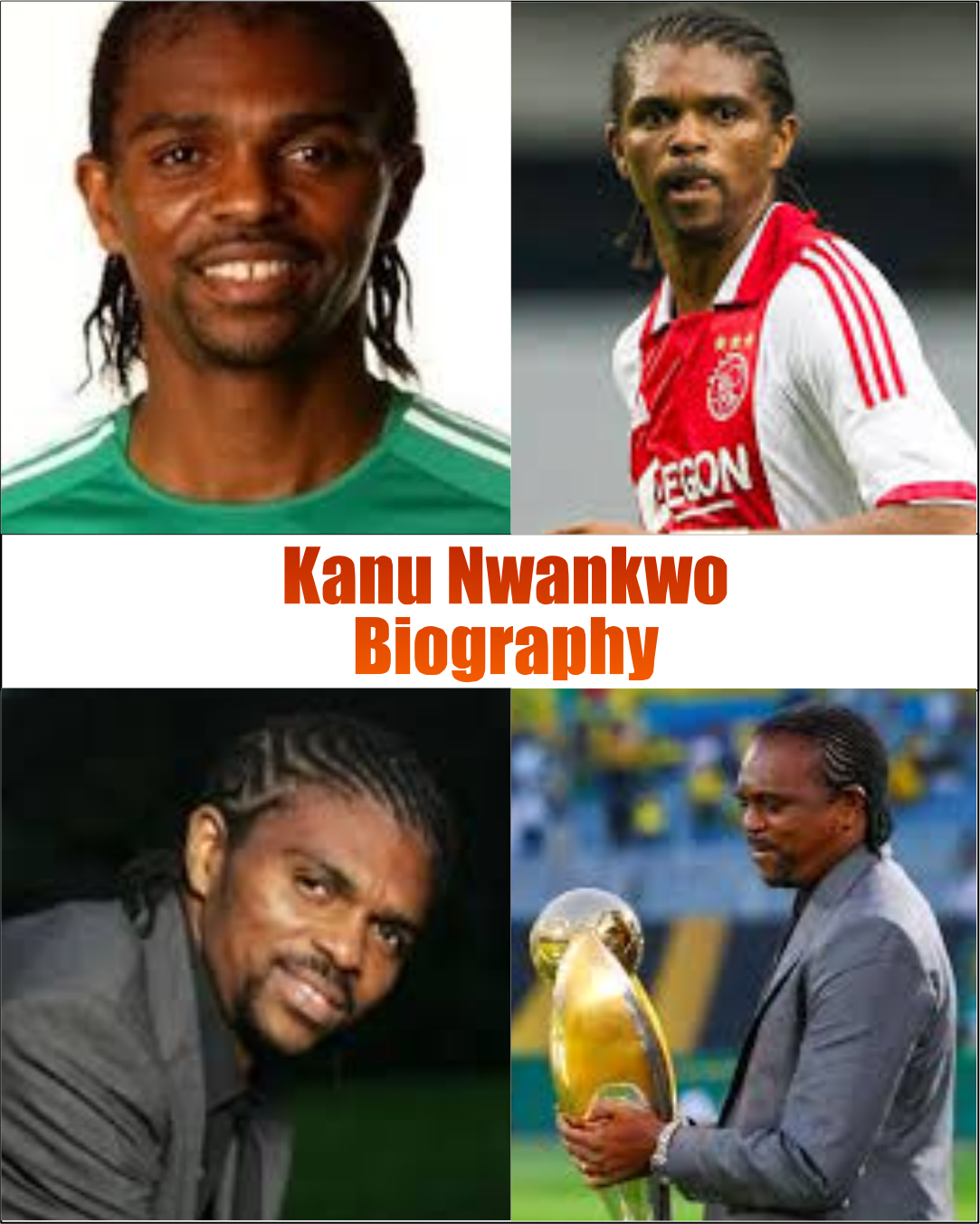
Kanu Nwankwo Biography
The Kanu Nwankwo Biography: He Scored With a Broken Heart and Saved Hundreds of Children
Kanu Nwankwo scored twice in four minutes against Brazil to win Olympic gold for Nigeria in 1996 — then discovered his heart had been defective the entire time. Inter Milan’s president paid for the surgery. Kanu came back to win the Champions League, three FA Cups, two Premier League titles, and African Footballer of the Year twice. Then he built a foundation that has funded over 700 heart surgeries for African children who could not afford them. His best trophy, he says, is seeing a child smile after surgery.
He Scored Against Brazil With a Defective Heart. Then He Used That Heart to Save Children: The Story of Kanu Nwankwo
The goal that changed Nigerian football history was scored by a man whose heart was, at that precise moment, broken.
Not metaphorically. Physiologically. The aortic valve in Nwankwo Kanu’s heart had been failing to close properly since birth — a congenital defect that nobody had detected, that no medical examination had caught, that had been quietly present through every training session, every youth tournament, every Champions League match at Ajax. On July 27, 1996, in the Olympic Stadium in Athens, Georgia, with Nigeria trailing Brazil 3-2 in the semi-final of the Atlanta Olympics with four minutes left, Kanu scored twice to win 4-3 in extra time.
Kanu Nwankwo Biography
| Category | Details |
|---|---|
| Full Name | Nwankwo Kanu |
| Date of Birth | August 1, 1976 |
| Place of Birth | Owerri, Imo State, Nigeria |
| Nationality | Nigerian |
| Profession | Professional Footballer, Humanitarian, Ambassador |
| Field of Work | Football, Humanitarian Work, Children’s Healthcare Advocacy |
| Notable Achievement | Won the Olympic gold medal in 1996, the UEFA Champions League, two Premier League titles, and was African Footballer of the Year twice |
| Legacy | Celebrated as one of Africa’s greatest footballers and the founder of the Kanu Heart Foundation which has saved hundreds of children’s lives |
Owerri, the Streets, and the Boy They Called Papilo
Kanu Nwankwo was born on August 1, 1976, in Owerri, the capital city of Imo State, Nigeria. He hails from Arochukwu Local Government Area in Abia State.
Owerri’s nickname is the Eastern Heartland — the city at the centre of Igboland in southeastern Nigeria, a place that takes pride in its cultural depth and its commercial energy. Kanu grew up in the Amakohia district, where football was played on whatever surface was available — streets, compounds, open land — with whatever was available to kick.
He was discovered by Iheanyi Ajaero on the streets of Owerri. The talent was visible from the beginning — not in the technical sophistication that formal training produces, but in the raw combination of height, coordination, and instinct that makes scouts look twice. He was tall and lanky in the way that Nigerian football has produced many great players — a frame that appeared awkward at rest but became graceful in motion.
See also: Rosalind Franklin Biography – An Equal Who Never Got Deserved Equal Credit
Japan 1993, Ajax, and the Champions League at Eighteen
At the 1993 FIFA Under-17 World Championship in Japan, a seventeen-year-old Kanu captained Nigeria to the title.
With five goals, he was the second joint-scorer in the tournament with Peter Anosike and Manuel Neira, behind compatriot and captain Wilson Oruma. The tournament’s Most Valuable Player award followed — the recognition that he was not simply talented but decisive, the kind of player who performed on the biggest stage rather than retreating from it.
Ajax Amsterdam came calling. His talent caught international attention, leading to his transfer to Ajax Amsterdam in 1993, where he quickly established himself as a promising young player.
Did you know?
Kanu captained the Nigeria national team that won gold at the 1996 Atlanta Olympics, and scored two late goals in the semi-finals against Brazil to overturn a 2-3 scoreline into a 4-3 win in extra time.
The goals were scored in the 76th and 77th minutes — four minutes of football that produced one of the greatest comebacks in Olympic football history, achieved by a twenty-year-old playing with a heart condition that nobody yet knew about.
The Medical Examination That Changed Everything
After Atlanta, Inter Milan signed him for approximately $4.7 million. The transfer required a medical examination. The medical examination found something that should have been found years earlier.
Soon after returning from the Olympics, Kanu underwent a medical examination at Inter, which revealed a serious heart defect.
The aortic valve — the valve that controls blood flow from the heart to the rest of the body — had been failing to close properly since birth. The condition had been present through every training session in Owerri, through every Champions League match at Ajax, through the two goals against Brazil in Atlanta. He had been competing at the highest level of professional football with a heart that was, in strict medical terms, not functioning correctly.
Arsenal, the Invincibles, and Three FA Cups
In February 1999, after just twelve games for Inter, Kanu was signed by Arsenal for roughly $7.5 million. Initially his career was revived under Arsène Wenger, and he was named African Footballer of the Year for the second time in 1999.
At Arsenal, Kanu found the manager and the system that suited him best. Wenger’s technical, possession-based game was perfectly calibrated for a tall, elegant forward with exceptional close control, unusual angles, and the specific footballing intelligence that Ajax had refined from the raw material Owerri had produced.
He won two Premier League titles and three FA Cups with Arsenal. He was a member of the 2003-04 Invincibles — the Arsenal side that went the entire Premier League season without losing a single match, the only team in English top-flight history to achieve this. A member of the Arsenal Invincibles, he was named by the club as one of its greatest ever players.
The most celebrated individual moment of his Arsenal career came against Chelsea at Stamford Bridge in October 1999. Trailing 2-0 with fifteen minutes remaining, Kanu scored three goals in the final fifteen minutes to win 3-2 — a hat-trick in fifteen minutes that included one of the most technically demanding finishes in Premier League history. He single-handedly demolished the well-organised Chelsea defence to score a hat-trick.
The Kanu Heart Foundation — His Best Trophy
“My best trophy is seeing a child happy after undergoing a successful heart surgery,” Kanu said.
The Kanu Heart Foundation was founded in 2000 — four years after his own surgery, while he was still playing for Arsenal, while the trophies were still accumulating. The timing was deliberate. He did not wait until retirement to begin giving back. He started while the platform was largest, while his name could attract the attention and the donors that the foundation needed.
The Kanu Heart Foundation has spent about $4.2 million, an average of $10,000 per person, on surgeries outside Nigeria. It has funded the construction of five hospitals across the continent to treat children with undiagnosed heart disease.
The foundation has funded over 500 heart surgeries for children across Africa. The foundation having sponsored over 700 successful open-heart surgeries.
“Our waiting list has over 150 cases. That gives us pressure, and we are now planning to build a hospital in Nigeria soon,” he said.
He is also a UNICEF Goodwill Ambassador and has used sports to preach peaceful coexistence among Christians and Muslims in conflict areas of Nigeria.
Philosophy — What the Surgery Taught Him About Football
“My life is for football, but my heart is for the people.”
The statement is not a slogan. It is a precise description of how Nwankwo Kanu has organised his life since the surgery — the football as the means, the people as the purpose. Everything the football gave him — the contracts, the trophies, the platform, the name recognition — has been placed in service of the children who were born with the same defect that his football career and Massimo Moratti’s generosity gave him the means to survive.
“Never give up. Even when life puts you down, rise again.”
His son Sean, nineteen years old, is already playing professional football in Poland. “He has the talent, and I encourage him a lot. I know it is difficult because there is pressure on him to emulate me, but gradually I believe he will be a superstar,” Kanu said.
What He Changed About Sport
Kanu Nwankwo did not change the rules of football. He did not invent a new position or a new tactical system. What he changed was the understanding of what an African footballer could be — in Europe, in the world, in the cultural imagination of sport.
Before him, African players in European football were understood primarily as physical assets — fast, powerful, exciting. Kanu was none of those things. He was slow. He was elegant. He played football with an aesthetic that seemed to operate at a different pace from everyone around him and consistently won anyway. His touch, his vision, his ability to receive the ball in impossible positions and produce something unexpected — these were intellectual qualities, not athletic ones. He demonstrated that African football intelligence operated at the same level as European football intelligence.
He also demonstrated that a footballer’s value to society extends beyond their performance record. The Kanu Heart Foundation exists because a president of Inter Milan chose generosity over commercial logic, and because the Nigerian boy who received that generosity decided to spend the next twenty-five years paying it forward to children who had no Massimo Moratti to make that choice for them.
Still, Kanu said he feels the pressure to do more.
The trophies are won. The career is complete. The heart continues.
Frequently Asked Questions
1. Who is Kanu Nwankwo?
Kanu Nwankwo is a Nigerian former professional footballer widely regarded as one of the greatest African players in the history of the sport. Born on August 1, 1976, in Owerri, Imo State, Nigeria, he rose from humble beginnings to become one of the most technically gifted and celebrated strikers of his generation — winning major honours at the highest levels of club and international football across a career that spanned nearly two decades.
2. What heart condition did Kanu Nwankwo face and how did he overcome it?
In 1996, at the peak of his early career and shortly after leading Nigeria to Olympic gold, Kanu Nwankwo was diagnosed with a serious heart defect — a faulty heart valve that had gone undetected and that doctors warned could be fatal if not treated immediately.
3. What were Kanu Nwankwo’s greatest footballing achievements?
Kanu Nwankwo’s career produced a record of achievement that places him among the most decorated African footballers of his era. At international level his most celebrated moment came at the 1996 Atlanta Olympics where he was the central figure in Nigeria’s extraordinary run to the gold medal — scoring crucial goals including the stunning winner in extra time against Brazil in the semi-finals that remains one of the most celebrated goals in Nigerian football history.
4. What is the Kanu Heart Foundation and what has it achieved?
The Kanu Heart Foundation was established by Kanu Nwankwo in 1999 — directly inspired by his own experience of confronting a life-threatening heart condition and recognising that the medical care that had saved his life was completely inaccessible to the vast majority of children in Nigeria and across Africa who faced similar diagnoses.
5. What is Kanu Nwankwo’s lasting legacy?
Kanu Nwankwo’s legacy operates simultaneously across football, humanitarian work, and national identity in ways that make him one of the most complete and significant public figures Nigeria has produced. As a footballer he demonstrated that an African player could overcome physical adversity, compete at the absolute highest level of European club football, and produce moments of technical brilliance that ranked among the finest of his generation anywhere in the world.