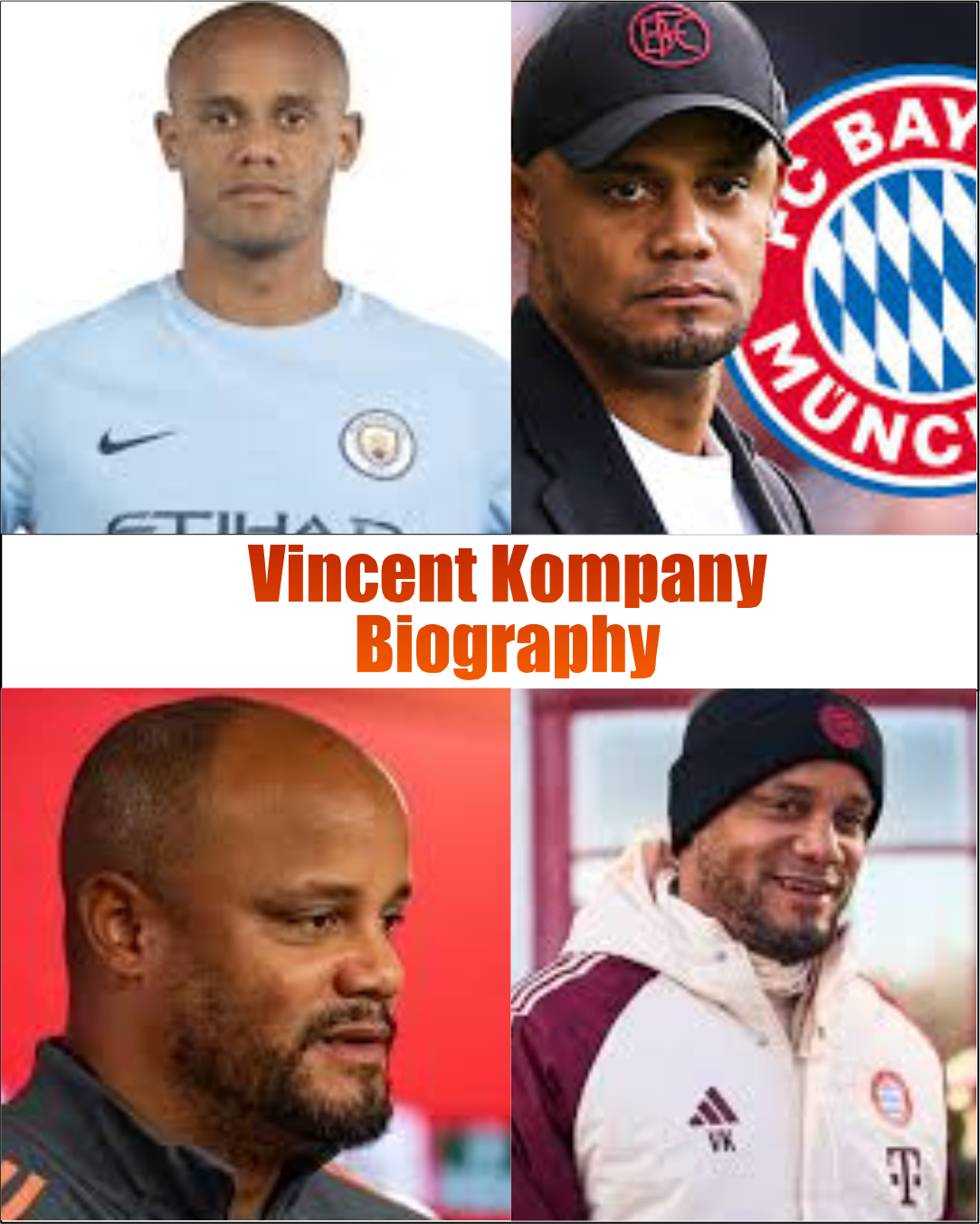
Vincent Kompany Biography
The Vincent Kompany Biography: He Scored the Most Important Goal of His Career at the Worst Possible Moment.
Vincent Kompany grew up in Brussels being called monkey by opponents, was expelled from school, survived his parents’ divorce and eviction, played through 37 injuries that cost him two full years of football, earned an MBA while winning Premier League titles, scored a thirty-yard thunderbolt against Leicester that won a title race by one point, and built his career as European football’s most articulate voice against racism — from the inside.
Everyone Told Him Not to Shoot. He Shot Anyway. That Was Always the Point: The Story of Vincent Kompany
When Vincent Kompany picked up the ball thirty yards from the Leicester City goal on May 6, 2019, every voice on the Manchester City bench did the same thing simultaneously.
Don’t shoot.
His teammates shouted it. His manager Pep Guardiola, the most analytically precise football mind of his generation, gestured frantically. The statistics were not in favour of a centre-back shooting from distance — particularly this centre-back, who had scored exactly zero goals from outside the box in eleven years at Manchester City.
Kompany shot.
“I just felt it was the right thing to do.”
That sentence — quiet, certain, delivered without drama — is the entire Vincent Kompany philosophy in eleven words.
Vincent Kompany Biography
| Information | Details |
|---|---|
| Full Name | Vincent Jean Mpoy Kompany |
| Date of Birth | April 10, 1986 |
| Age | 40 years (as of 2026) |
| Place of Birth | Uccle, Brussels, Belgium |
| Nationality | Belgian |
| Occupation | Football Manager, Former Professional Footballer |
| Playing Position | Centre-back |
| Known For | Captaincy and leadership at Manchester City F.C. |
| Current Role | Manager of Bayern Munich |
Brussels, a Refugee Father, and the Boy Who Was Called a Monkey
Vincent Jean Mpoy Kompany was born on April 10, 1986, in Uccle, a municipality in the Brussels Capital Region of Belgium.
His father Pierre arrived in Belgium from the Democratic Republic of Congo in 1975 — a refugee, initially sleeping on park benches, facing rejection from his Belgian girlfriend’s rural family because of racial prejudice, eventually building a life as an engineer and taxi driver. Pierre Kompany would go on to become Belgium’s first Black mayor — a trajectory that tells you everything about what the family valued and what they were capable of.
His mother Jocelyne was Belgian, socialist, what Vincent described with affection as borderline communist. The household that produced him was shaped equally by Pierre’s experience of what racism does to a person and Jocelyne’s conviction that injustice required active opposition rather than polite tolerance.
As a mixed-race child, Kompany encountered racism early on — racial slurs directed at him and his teammates during youth tournaments, which his parents actively challenged to instill resilience and a sense of identity.
They called him monkey. During matches. In youth tournaments. In a country where football was supposed to be the great equaliser. He heard it regularly enough that it stopped being shocking and started being information — information about the world he was competing in and what he was going to have to decide to do about it.
See also: Albert Luthuli Biography: Africa First Nobel Peace Prize Winner, Confined to a Farm and Then Murdered
Anderlecht — The Third Youngest Belgian Golden Shoe Winner in History
He joined Anderlecht’s academy at fourteen, and by seventeen was starting for their first team. In his debut season, he helped Anderlecht win the Belgian First Division title. He won the Belgian Golden Shoe — a prize covering all positions — at seventeen, becoming the third youngest winner in the award’s history.
The Belgian Golden Shoe at seventeen. In a season where he was simultaneously dealing with his parents’ divorce, eviction from the family home, and expulsion from school. The capacity to compartmentalise personal chaos and produce elite performance was not something he learned later. He arrived with it already operational.
He won two Belgian First Division titles at Anderlecht. He won the Belgian Ebony Shoe. Half of Europe’s biggest clubs wanted him. He stayed at Anderlecht an extra season to keep developing. “I decided I would rather be a good player than a famous player,” he said. The distinction — between fame and quality, between opportunity and readiness — ran through every decision he made.
Hamburg, an Achilles, and the First Real Test of His Comeback Character
In 2006 he moved to Hamburg SV for €10 million. It should have been the platform that launched him into European football’s elite. Instead, it produced the first real test of his relationship with injury.
He played six league games in his first season. Then an Achilles tendon injury in November ended his campaign entirely. Six games. Then nothing. For a player who had been developing at full velocity since fourteen, the enforced stillness was its own kind of challenge.
He came back. He played 23 games in his second season. He disagreed with Hamburg’s management over permission to play in the Olympics — and the disagreement was serious enough to accelerate his exit. Manchester City came calling.
The signing fee was £6 million. Within three years, it would be understood as one of the great bargain acquisitions in Premier League history. As Francis Lee — a former City chairman — would later say: “The best centre-back ever to play for Manchester City.”
The Injury List — 37 Problems, One Stubborn Answer
By November 2016, Kompany had suffered 37 injuries since joining City. He had missed over two full years of playing time — 730-plus days when he should have been on the pitch and was not.
Thirty-seven injuries. Muscular strains, primarily — the kind that recur because the scar tissue from the previous strain makes the surrounding muscle vulnerable to the next one. Each comeback followed the same ritual: rehabilitation, gradual return to training, careful reintegration, and then — sometimes within minutes, sometimes within weeks — another strain, another scan, another timeline.
He played the 2016 League Cup Final against Liverpool. He was named Man of the Match. Days later, he was injured again. He played twelve minutes of a Champions League semi-final before being forced off. The pattern was so consistent that some City supporters had begun quietly suggesting that his best days were behind him — that the player who had driven the club to their first league title in 44 years was now too fragile to be relied upon.
He proved them wrong. Every time. Not through defiance or stubborn public declarations but through the simple, repeated act of coming back and performing — sometimes brilliantly, always with the specific authority of a leader whose presence changed how the team around him played.
“Setbacks, racism — everything fed my desire,” he told an interviewer. The desire did not diminish because the body kept breaking down. If anything, it intensified. Each return was evidence that the gap between injury and performance had not widened beyond what determination could close.
The 2012 Title, Agueroooo, and the Header That Started Everything
The 2011-12 Premier League season was the year that Manchester City became something different — not an ambitious project still becoming, but a genuine champion.
Kompany’s contribution to that title is embedded in the folklore in two specific moments. First, the header against Manchester United in April — a towering, perfectly timed strike that won a Manchester derby and put City in control of the title race. The image of Kompany rising above Rio Ferdinand, fist raised before the ball had even crossed the line, is one of the defining images of Premier League history.
Second — though he did not score it — Sergio Agüero’s last-minute goal against QPR on the final day, with City needing a win to take the title from United on goal difference. Kompany was on the pitch. He had captained the team through a season of extraordinary pressure. When Agüero’s shot hit the net, Kompany was already running — arms out, face transformed, eleven years of racism and injuries and expulsions and evictions and comebacks released in a single moment of collective joy.
The Rivalry With Terry, Ferdinand, and Vidic — The Defensive Elite of an Era
The Premier League of Kompany’s peak years was defined by an extraordinary generation of central defenders. John Terry at Chelsea — commanding, brutal, technically precise, with three Premier League titles of his own. Rio Ferdinand at Manchester United — elegant, reading the game from distance, organising with the assurance of someone who had never doubted their own ability. Nemanja Vidic — physical, ferocious, the embodiment of defensive intent.
Kompany was the equal of all three and arguably the superior of each in specific dimensions. He was more composed than Vidic, more physically imposing than Ferdinand at close quarters, and — crucially — possessed of a leadership quality that Terry matched but nobody exceeded. The four of them defined English football’s defensive standard for a decade. Their clubs shared ten Premier League titles between them across that period.
The MBA, the Homelessness Campaign, and the Congo Kids
While winning Premier League titles, Kompany was simultaneously attending Manchester Business School. In 2018 — the same season City won the title with a record 100 points — he graduated with a Master of Business Administration degree.
He earned an MBA while winning a domestic treble. The education was not decorative. It was preparation — for the managerial career he was already planning, for the community work he was already doing, for the specific kind of contribution he intended to make once the playing was done.
In Manchester, he co-founded Tackle4MCR with Mayor Andy Burnham — a campaign to address homelessness in the city. Not a celebrity endorsement. A working partnership with the city’s political leadership, raising funds and awareness for people sleeping in the streets of the city that had given him his career.
He bought Belgian third-division club Bleid as a social commitment towards the youngsters of Brussels — offering disadvantaged youth a pathway through sport. He invested in projects providing education and safe housing for children in the Democratic Republic of Congo — his father’s country, the country whose refugee camp Pierre Kompany had left in 1975 to sleep on Belgian park benches.
His net worth is estimated at $45 million — and unlike some athletes who accumulate wealth and spend it on themselves, the record of his financial choices suggests consistent reinvestment in the communities that shaped him.
Anti-Racism — Not a Statement. A Career.
Racism in football has produced many statements. Press conferences, hashtags, the knee before kickoff, the armbands and the social media graphics. Most of them are sincere. Few of them are structurally consequential.
Kompany chose a different approach. He addressed racism not primarily through statements but through presence, performance, and institutional work — by being visibly, undeniably excellent over eleven years at one of the world’s most scrutinised clubs, by becoming the face of that club’s most successful era, and by making the argument through achievement rather than advocacy that the child who had been called a monkey in youth football in Belgium was capable of leading Manchester City to four Premier League titles.
FIFPro quoted him as saying football boardrooms were a hotbed of racism that needed urgent reform. He said it while a player, with his career still ongoing. He said it knowing the professional risk of public criticism of the institutions that employed him. He said it because it was true and because he was in a position where saying it carried more weight than silence.
Burnley, Anderlecht, and the Brilliant Coach Emerging
After leaving Manchester City in 2019, he returned to Anderlecht as player-manager — an unusual and demanding dual role at a club whose season had started catastrophically. He stabilised the club, eventually became full-time manager, and left in 2022 having developed several young players who went on to bigger stages.
At Burnley in the Championship, he produced something that surprised even his admirers. His team achieved 65% average possession in a second-tier English league — an extraordinary figure — scored 87 goals, and won promotion to the Premier League in a season that suggested his coaching philosophy was as sophisticated as his playing one had been.
In 2023, he was appointed manager of Burnley in the Premier League — a harder test against more resourced opponents. The season was difficult. Burnley were relegated. He departed with his reputation intact, recognised as a manager whose ideas were correct but whose squad was insufficient for the level.
What He Changed About Sport
Before Vincent Kompany, the template for a Black European footballer speaking about racism was largely reactive — responding to specific incidents, calling out individual abusers, waiting for the systems to produce an event bad enough to require comment.
After Kompany, there is a different template available: sustained, structural, institutionally engaged advocacy combined with elite performance that makes the racist argument untenable at its foundation. He did not simply survive racism. He used every platform that his excellence generated to systematically dismantle it — in boardrooms, in interviews, in the communities his foundations supported.
He also changed what it meant to be a football captain. Eight years wearing the armband at Manchester City redefined the role from symbolic leader to genuine organizational force — someone whose presence changed the culture of the dressing room, whose endorsement of a young player’s development carried institutional weight, whose relationship with successive managers was a partnership rather than a hierarchy.
Guardiola called him one of the biggest legends. The statue outside the Etihad Stadium says the same thing in concrete and bronze. The Congolese children in safe houses say it differently.
Frequently Asked Questions
1. Who is Vincent Kompany?
Vincent Kompany is a Belgian former professional footballer and current manager, widely regarded as one of the best defenders of his generation and a natural leader on and off the pitch.
2. Which club is Vincent Kompany most associated with?
He is most closely associated with Manchester City F.C., where he served as captain and helped the club win multiple Premier League titles.
3. What position did Vincent Kompany play?
He played primarily as a centre-back, known for his strength, tactical awareness, and leadership qualities.
4. Has Vincent Kompany won major trophies?
Yes — he won multiple major trophies with Manchester City F.C., including several Premier League titles, FA Cups, and League Cups.
5. What is Vincent Kompany doing now?
After retiring as a player, he transitioned into management and currently manages Bayern Munich, continuing his football career from the sidelines.