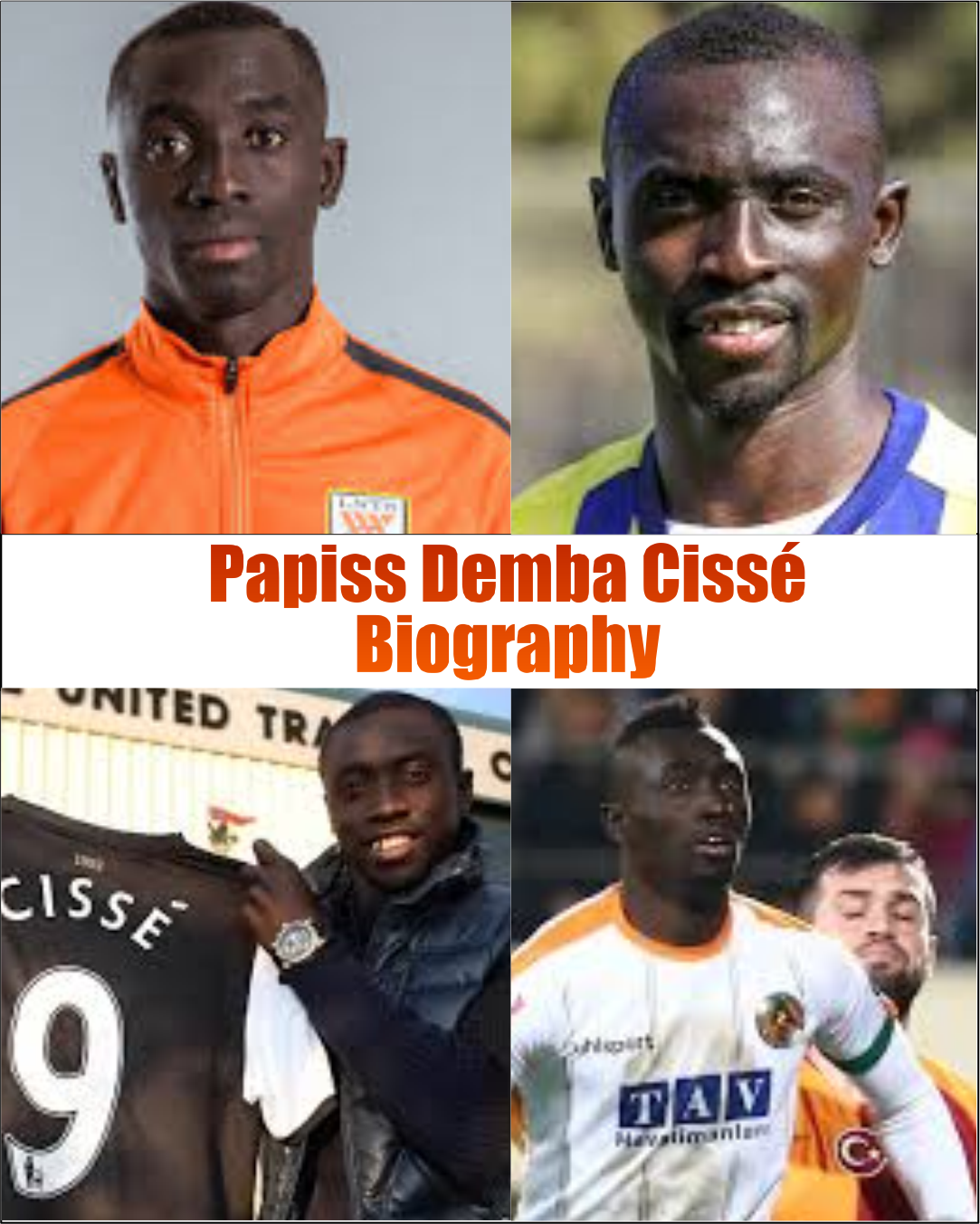
Papiss Demba Cissé Biography
The Papiss Demba Cissé Biography: He Drove an Ambulance to Survive and He Scored the Most Beautiful Goal in Premier League History
Papiss Demba Cissé grew up in Dakar driving ambulances and working as a fisherman to eat. He set an African Bundesliga record, arrived at Newcastle and scored 13 goals in 14 games wearing Alan Shearer’s sacred number nine shirt, produced the most outrageous goal in Premier League history, refused to wear a sponsor’s logo for religious reasons, and quietly built a foundation funding solar wells, schools, and orphanages in Senegal. At 40 he is still scoring goals — this time in a veterans league in Manchester.
He Drove an Ambulance to Survive. Then He Scored the Most Beautiful Goal the Premier League Has Ever Seen: The Story of Papiss Demba Cissé
Nobody who was watching on May 2, 2012 has ever found a satisfying explanation for what Papiss Demba Cissé did to the ball.
He was thirty-seven yards from goal. He was on the right touchline — arguably the most difficult angle from which to score on a goalkeeper of Petr Čech’s quality. The ball arrived at his feet on the half volley. Physics, geometry, and every reasonable assessment of what was possible in that moment suggested that the correct option was to control, lay off, or at worst fire a speculative effort that any competent goalkeeper would gather comfortably.
Instead, Cissé swept his right foot through the ball with the outside of his boot and produced a strike that bent, dipped, curved, and somehow arrived in the top left corner of the net past a diving Čech who had done everything correctly and still ended up picking the ball out of the net.
The Premier League has been played since 1992. Thousands of goals have been scored. Compilation after compilation of the greatest strikes ever produced in English football lists that goal — that specific, unreasonable, physics-defying moment in the dying minutes at Stamford Bridge — somewhere very near the top.
He was a fisherman’s son from Dakar who had driven ambulances as a teenager to buy food. He was wearing Alan Shearer’s shirt. He was four months into his time in England. And he had just done something that nobody in thirty years of the Premier League had done quite like that.
Papiss Demba Cissé Biography
| Information | Details |
|---|---|
| Full Name | Papiss Demba Cissé |
| Date of Birth | June 3, 1985 |
| Age | 41 years (as of 2026) |
| Place of Birth | Dakar, Senegal |
| Nationality | Senegalese |
| Occupation | Professional Footballer (Striker) |
| Known For | Prolific goal-scoring and iconic goals in the English Premier League |
| Famous Club | Newcastle United F.C. |
| International Career | Played for Senegal national team |
Dakar — Poverty, Fish, and the Long Road to Europe
Papiss Demba Cissé was born on June 3, 1985, in Dakar, Senegal, the second of five children in a family rooted in traditional Senegalese values.
The Dakar he grew up in was not the Dakar of tourist brochures — the vibrant capital, the cultural hub, the city of music and cuisine that draws admiring visitors. It was the Dakar of Pikine and Guédiawaye — the sprawling, densely populated suburbs where families packed into small houses, where the informal economy was the only economy available, and where the gap between childhood aspiration and adult opportunity was wide enough to swallow most dreams whole.
He worked as a fisherman. He drove ambulances. Not as career choices — as survival strategies. Football was what he did when he was not doing those things, in the streets and the local pitches where Dakar’s talent has always been plentiful and resources scarce.
The academy that changed his life was Génération Foot — the Senegalese football factory that has produced an extraordinary number of professional players for its size, operating on the principle that Dakar’s streets contain far more talent than European scouts have ever bothered to find. Génération Foot found Cissé. He moved through Douanes Dakar. He caught the attention of French club Metz. He was twenty years old when he left Senegal.
See also: Vishal Nikam Biography: The Farmer’s Son Who Studied Physics, Trained Bodies, and Won Hearts
Freiburg — The Record Nobody Expected an African to Set
SC Freiburg in the German Bundesliga is not the kind of club that produces headline stars. It is a modest, well-run club from a small southwestern German city — the kind of place where a striker can develop quietly, score goals without the amplification of a major market, and build a record that goes largely unnoticed outside the country.
Cissé scored 37 goals in 72 Bundesliga appearances for Freiburg between 2006 and 2012. That is an exceptional return — a goal roughly every two games in one of Europe’s most defensively sophisticated leagues.
But the number that entered the record books was 22. In the 2010-11 Bundesliga season, Papiss Demba Cissé scored 22 goals — the most ever scored by an African player in a single Bundesliga campaign. He also won the EFFIFU award that season for being the most efficient striker in the entire league.
Did you know?
The number nine shirt at Newcastle United carries an almost mythological weight — worn by Jackie Milburn, Malcolm Macdonald, Andy Cole, and Alan Shearer across decades of the club’s history. When manager Alan Pardew handed it to Cissé in January 2012, he said: “It is one of the iconic numbers in world football.” Cissé said: “I know the huge importance of the number nine shirt. I will treat it with respect.” He then scored 13 goals in his first 14 Premier League appearances. He treated it with rather more than respect.
Newcastle 2012 — 13 Goals in 14 Games and a Strike That Broke the Internet
The arrival at Newcastle was not slow or tentative. It was immediate and volcanic.
He debuted as a substitute against Aston Villa on February 5, 2012 — coming on in the 14th minute and scoring the winning goal with a breathtaking volley. He chested the ball and hit it with his left foot before it hit the ground. He had been on the pitch for less than an hour in English football and had already produced a goal that would have satisfied most strikers for a month.
What followed across the next four months was one of the most extraordinary debut half-seasons any striker has produced in Premier League history. Thirteen goals in fourteen appearances. Not in a team of superstars — in a Newcastle side of solid professionals, playing football that was direct but not breathtaking. He made it breathtaking. He was the element the team had not known it was missing.
His partnership with fellow Senegalese striker Demba Ba — the two Lions of Teranga occupying Newcastle’s attack simultaneously — produced the football that drove the club to a fifth-place Premier League finish and European football the following season. Together they were devastating. Apart they were still dangerous. When Ba eventually left for Chelsea in January 2013, the rhythm changed and Newcastle declined. The departure of one half of the partnership illustrated precisely how essential both halves had been.
Stamford Bridge — The Shot That Defied Explanation
Chelsea 0-2 Newcastle, May 2, 2012. Already one of the surprises of that Premier League season — Newcastle demolishing a Chelsea side that would go on to win the Champions League that same month.
Cissé had already scored the first — a left-foot finish from twelve yards, clean and precise, the kind of goal a clinical striker scores without drama. His second had drama to spare.
Thirty-seven yards. Right touchline. Outside of the right boot. No backlift. No hesitation. The ball left his foot moving in one direction and arrived at the net having changed direction so many times that the trajectory seemed physically impossible.
The BBC voted it Goal of the Season. It was subsequently voted into lists of the Premier League’s greatest ever goals with the kind of regularity that suggests it will be replayed in compilation videos for as long as those compilations are made.
The Wonga Dispute — Faith Over Contract
In 2013, Newcastle United signed a controversial shirt sponsorship deal with Wonga — a high-interest payday loan company. For Papiss Demba Cissé, a practising Muslim for whom Islam’s prohibition of usury is not a theoretical position but an operational one, the Wonga logo on his shirt was not something he was willing to wear.
He refused. Publicly. While still under contract. While still dependent on Newcastle for his livelihood. The refusal was a statement about the limits of what his employment required of him — and about where his faith sat in relation to those requirements.
The club’s response was complicated. A photograph of Cissé at a casino emerged — a detail that muddied the religious argument, since Islamic scholars are divided on gambling. Eventually a compromise was reached and he wore the shirt. The episode was not a clean victory. But the willingness to refuse — to publicly state that there were things his contract did not entitle his employer to require of him — was a statement of principle that a player in a more powerful institutional position might have found easier to make.
The Decline, China, and the Comeback That Never Quite Arrived
After Ba’s departure, Cissé’s Newcastle career became inconsistent. Injuries disrupted his rhythm. The team around him declined. By 2016, Newcastle were relegated — and Cissé went with them, then departed.
He joined Shandong Luneng in the Chinese Super League, earning approximately £150,000 a week — the financial reality of a striker in his early thirties whose Premier League peak was behind him but whose name still commanded significant commercial value in developing football markets. China was lucrative. It was not Stamford Bridge.
The Foundation — What the Ambulance Driver Built With His Football Money
In 2023 — after eleven years of working in the social sector alongside his wife Awa — Papiss Demba Cissé formalised what he had been doing quietly into the Cissé Foundation.
The foundation’s four priority areas are education, healthcare, community development, and sport. In Sédhiou, a rural region in southern Senegal, the foundation is rehabilitating classrooms and constructing new facilities — benefiting over 740 students who previously had access to overcrowded, under-resourced schools. It is supporting the Rufisque Orphanage in Dakar. It is installing solar water wells in communities where clean water requires a journey rather than a tap. It has launched the Papiss Cissé 9 Academy — a sports academy designed to give talented African players the pathway that Génération Foot once gave him.
In April 2024, the foundation partnered with Human Appeal — a British development charity — in a three-year collaboration. The Football Legends Gala Dinner in Manchester raised funds for solar wells, school refurbishments, and the football academy. Premier League footballers attended. Cissé himself was there, raising money for the communities in Senegal that the ambulance driver from Dakar had never forgotten.
“Giving back has always been in my nature, and now I am able, through the foundation, to create long and lasting projects that will change the lives of communities in Senegal.”
At 40 — Still Scoring, Still Giving
In October 2025, Papiss Demba Cissé appeared in the headlines again. He was playing for Wythenshawe FC Veterans in the Cheshire Veterans Football League. In a match against Collegiate Old Boys, the forty-year-old scored all six goals in a 6-2 victory.
The instinct has not gone. The hunger for the goal, the relationship with the back of the net that the Bundesliga statisticians called the most efficient in Germany — it persists, in a veterans league in Manchester, in a man who still does what he has always done: find a way to score.
The trajectory — from ambulance driver in Dakar to the most replayed goal in Premier League history to solar wells in Sédhiou — is one that no career path predicted and no academy system produced. It came from the specific combination of talent, determination, faith, and the quiet refusal to forget where he came from.
Frequently Asked Questions
1. Who is Papiss Demba Cissé?
Papiss Demba Cissé is a Senegalese professional footballer known for his role as a striker and his impressive goal-scoring record, particularly during his time in European leagues.
2. Which club made Papiss Cissé famous?
He became globally recognized during his time at Newcastle United F.C., where he scored spectacular goals and formed a notable partnership with Demba Ba.
3. What is Papiss Cissé’s most famous goal?
One of his most iconic goals was a stunning long-range strike against Chelsea F.C. in 2012, widely regarded as one of the best goals in Premier League history.
4. Has Papiss Cissé played for his national team?
Yes — he represented the Senegal national team, participating in international competitions and contributing important goals.
5. What type of striker is Papiss Cissé?
He is known for his clinical finishing, off-the-ball movement, and ability to score from difficult angles, making him a constant threat in the attacking third.