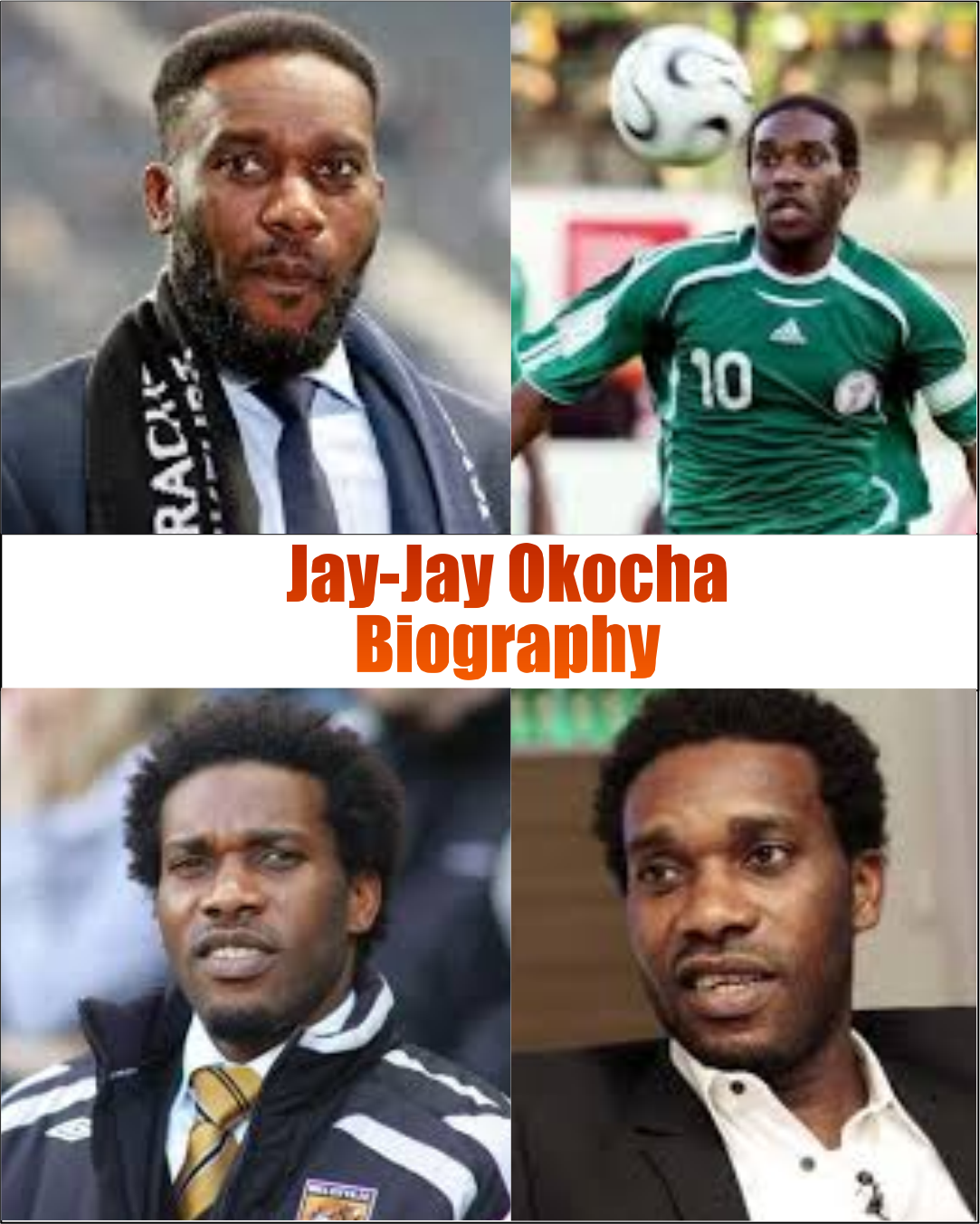
Jay-Jay Okocha Biography
The Jay-Jay Okocha Biography: He Went on Holiday to Germany and Accidentally Became a Legend
Jay-Jay Okocha humiliated Oliver Kahn with a goal so outrageous that German football magazines made it Goal of the Season — and he was playing for a mid-table club. He became the most expensive African player in the world. He mentored Ronaldinho. He won Olympic gold. He captained Nigeria. He scored the 1000th goal in AFCON history. He was so good they named him twice — and at 51 he is still the name every Nigerian street footballer whispers when they try something impossible.
He Went on Holiday to Germany and Accidentally Became a Legend: The Story of Jay-Jay Okocha
In the summer of 1990, a seventeen-year-old from Enugu decided to visit a friend in West Germany.
It was supposed to be a holiday. West Germany had just won the World Cup. The Bundesliga was the most competitive league in the world. His friend Binebi Numa was playing in the third division for Borussia Neunkirchen and invited him along to training one morning.
They asked him to join in. He said yes. He showed them what he could do. The coach invited him back the next day. By the end of the week, Borussia Neunkirchen had offered him a contract.
Augustine Azuka Okocha — the boy who had been playing football on the streets of Enugu with bundled socks when he could not find a proper ball, who had been practising tricks on dusty pitches when the rest of his neighbourhood was asleep — had accidentally started one of the most extraordinary football careers Africa has ever produced.
He went on holiday. He never fully came home. The world was better for it.
Jay-Jay Okocha Biography
| Information | Details |
|---|---|
| Full Name | Augustine Azuka Okocha |
| Popular Name | Jay-Jay Okocha |
| Date of Birth | August 14, 1973 |
| Age | 52 years (as of 2026) |
| Place of Birth | Enugu, Nigeria |
| Nationality | Nigerian |
| Occupation | Former Professional Footballer |
| Playing Position | Attacking Midfielder |
| Known For | Exceptional dribbling skills and flair at Bolton Wanderers F.C. |
Enugu — The Streets, the Socks, and the Name That Was Never His
Jay-Jay Okocha was born on August 14, 1973, in Enugu, Enugu State — though his family roots run to Ogwashi-Uku in Delta State, where the Anioma community he belongs to has its cultural home.
He grew up in a household shaped by football. His older brother James — nicknamed Jay-Jay — played the game first. The name passed down to Augustine the way certain things pass through families, carrying with them both the love that gave them and the specific pressure of an expectation to live up to.
“As far as I can remember, we used to play with anything, with any round thing we could find, and whenever we managed to get hold of a ball, that was a bonus.”
Street football in Enugu in the late 1970s and 1980s was not a casual recreation. It was a complete football education — closer to the Brazilian street game that produced Pelé and Ronaldo than to the structured academy systems that manufactured European players. It rewarded creativity, punished predictability, and demanded that a player develop the full vocabulary of close-control tricks before they had a coach to teach them.
Okocha was learning things on those streets that no academy had put on its syllabus. The stepovers, the feints, the specific combination of deception and acceleration that would later make professional defenders look like they had been fitted with the wrong legs — all of it was practised in Enugu before Europe knew his name.
He joined Enugu Rangers in 1990. He played well enough to make people notice. Then he went on that holiday to Germany and his life changed direction completely, never to return to its original path.
Frankfurt — The Goal Against Oliver Kahn That Changed Everything
From Neunkirchen he moved to FC Saarbrücken briefly, then in December 1991 to Eintracht Frankfurt — a Bundesliga club, the real stage, the place where his talent would either prove itself or be found wanting.
It proved itself. Spectacularly.
In 1993, playing for Frankfurt against Karlsruher SC, Okocha received the ball in the opposition half, ran at the goalkeeper — a young Oliver Kahn, who would go on to be considered the greatest goalkeeper of his generation — and executed a move so outrageous that the description of it still sounds like fiction. He nutmegged Kahn. He went around him. He scored. In one continuous motion, combining close control with the psychological audacity of a player who had decided that convention was for other people.
In 1993, Jay Jay scored a goal against Karlsruher SC that was voted Goal of the Season by several football magazines and Goal of the Year by Sportschau viewers.
Fenerbahçe — The Free-Kick Master and the Turkish Citizenship Nobody Expected
He joined Fenerbahçe in Turkey for almost £1 million. What happened next surprised even those who had been following his career closely.
Okocha was with the team for two seasons and was able to score 30 goals in 62 matches. Many of his goals came from direct free kicks and that became his trademark while at the club. He acquired Turkish citizenship as Muhammet Yaviz during his time with Fenerbahçe.
Turkish citizenship. A Nigerian footballer so loved in Istanbul that the country offered him citizenship under a Turkish name — Muhammet Yaviz — while he was still in his mid-twenties. The free kicks he perfected at Fenerbahçe — struck with either foot, dipping over walls with a trajectory that seemed to be computing variables that other players could not see — became the tool that made him the most expensive African player in the world.
See also: Wangari Maathai Biography: She Planted 51 Million Trees, and They Beat Her Unconscious for It.
Did you know?
Okocha joined Paris Saint-Germain in 1998 for a then-African record transfer fee of $17 million. Seventeen million dollars for a Nigerian midfielder in 1998. In a European football market that still systematically undervalued African talent, this was a statement of financial recognition that the continent’s football had been waiting for. The price tag said: this is not a curiosity. This is a player whose value competes with anyone’s.
PSG — Ronaldinho, the Record, and the Mentor Nobody Credited
At Paris Saint-Germain, Okocha found himself in a city and a club that suited him — where technical brilliance was valued, where entertainment was part of the brief, where a player who turned the pitch into a theatre of skill would be celebrated rather than managed back toward the conventional.
He won the 2001 UEFA Intertoto Cup with PSG. He scored five goals in the competition. He became the creative heart of a team that the French capital claimed as its own.
And then there was the other thing. The mentorship that football history has largely forgotten.
During his time in Paris, he also helped a young Brazilian player named Ronaldinho. Ronaldinho later became a famous football star and won the Ballon d’Or award.
Ronaldinho — who would win the 2005 Ballon d’Or, who is considered one of the two or three most skilful players in football history, who made Barcelona play football that seemed to operate on a different aesthetic plane from every other team — was mentored by Jay-Jay Okocha at PSG.
Bolton Wanderers — The Relegation Battle, the Captain’s Armband, and the Chant That Said Everything
In the summer of 2002, after the World Cup, Okocha joined Bolton Wanderers on a free transfer after leaving PSG.
The logic of the move baffled some observers. The most expensive African player in the world, the man who had mentored Ronaldinho, was joining a Premier League club whose primary objective was avoiding relegation. It was, on paper, a step backward from the Parisian stages he had occupied.
What actually happened was one of the most celebrated individual tenures in the history of the Premier League’s smaller clubs.
His debut season, despite being hampered by injuries, made him a favourite with the Bolton fans, with the team printing shirts with the inscription “Jay-Jay – so good they named him twice”. He steered the team away from relegation with seven goals, including one later voted the team’s Goal of the Season in the vital league win against West Ham United.
So good they named him twice. The terrace chant became one of the most famous in Premier League history — a line that captured not just the nickname but the specific quality of what he was bringing to a club that had never previously possessed anything like it.
The next season saw Okocha receive more responsibility as he was given the captain’s armband following Guðni Bergsson’s retirement. As captain he led Bolton to the 2004 Football League Cup final, their first cup final in nine years.
In 2017, Okocha was voted the best player to have ever played for Bolton Wanderers at the Reebok/Macron Stadium. Not the best recent player. The best player. In the club’s entire history.
Nigeria — Olympic Gold, AFCON Glory, and the 1000th Goal
The club career was extraordinary. The international career was defining.
He was a key member of the Super Eagles team that won the 1994 Africa Cup of Nations and the gold medal at the 1996 Summer Olympics in Atlanta.
The 1996 Olympic gold medal — won in Atlanta, in a tournament that also produced Ronaldo and Roberto Carlos for Brazil, Rivaldo for Argentina — was the greatest moment in Nigerian football history. A team that included Okocha, Kanu, and Amokachi defeated Argentina 3-2 in the semi-final, then beat Argentina again in spirit by beating Brazil in the final through Kanu’s last-minute winner.
Okocha was at the centre of it. Not as a scorer — as the architect. The man who made things happen, who found space where none existed, who produced the pass or the dribble that created the opportunity.
He led the team to the African Cup of Nations in 2004 in Tunisia with some breathtaking displays, scoring four goals including a notable free kick against Cameroon and the 1000th goal in Nations Cup history against South Africa.
The Rivals Who Recognised Him
The measurement of a great player is often found not in trophies but in what the best players of their generation say about them.
Zinedine Zidane — widely considered the finest technical player of his era — named Okocha among the most skilful players he had ever seen. Ronaldinho cited him directly as an influence. Mesut Özil — the German playmaker whose vision and creativity defined Arsenal’s midfield for a decade — named Okocha as a primary inspiration.
Okocha inspired many other African footballers and even influenced players like Mesut Özil and Ronaldinho. Because of his skill, he was sometimes called the “African Maradona.”
The African Maradona. The comparison is not casual — it is specific. Like Maradona, Okocha combined extraordinary close control with the psychological dimension of a player who understood that humiliating a defender was as tactically effective as it was aesthetically satisfying. Like Maradona, he made the crowd feel that watching him was a privilege, not a right.
Unlike Maradona, he never won the Ballon d’Or. The omission is one of football’s most discussed injustices. Jay-Jay Okocha is often cited as one of the most skillful footballers to have never won the FIFA Ballon d’Or.
The award went to European players from clubs that competed for Champions League titles. Okocha played in the Bundesliga, Ligue 1, and then for Bolton Wanderers — the wrong clubs, in the wrong markets, at the wrong time for an African player to receive the recognition his ability deserved from European institutions.
The injustice does not diminish what he was. It clarifies it.
The Legacy, the Foundation, and the Nephew Who Carries the Name
After retirement in 2008, Okocha did not disappear. He returned to Nigerian football life with the specific energy of someone who understood what the game had given him and what remained to be repaid.
He has worked as a football pundit for SuperSport since 2019, providing analysis for AFCON and the European Championships with the same combination of intelligence and warmth that characterised his playing style. He serves as a mentor and ambassador for Nigerian football. He has been elected Chair of the Delta State Football Association. He has expressed interest in the NFF presidency — a statement that the institutional reform that Nigerian football requires is something he is willing to participate in personally.
Through the Jay-Jay Okocha Foundation, he supports underprivileged children by providing education and sports opportunities. The boy who played with bundled socks in Enugu is funding opportunities for children who are playing with bundled socks in Nigeria today.
And then there is the nephew. Jay-Jay also has a nephew, Alex Iwobi, who plays for Fulham and the Nigerian national team.
Alex Iwobi — the Fulham and Super Eagles midfielder, a player whose technical quality and creative intelligence reflect the family’s relationship with the game — carries Okocha’s football DNA into the next generation.
Philosophy — Joy as a Political Statement
“My strength was the desire to survive.”
He said it in a Premier League No Room For Racism feature — four words that cut through everything. The boy who had played with bundled socks. The teenager who went on holiday and asked to join a training session. The player who was disputed over, undervalued, and never given the Ballon d’Or his talent deserved. He survived. Not grimly, not resentfully, but with the specific joy of someone who had decided early that the game was worth playing for its own sake and that the rest of the world’s assessment of his value was its own problem.
The way he played — the audacious tricks, the nutmegs, the free kicks that found the top corner from angles nobody else attempted — was not showboating. It was survival philosophy made athletic. I will play the game the way I learned it on the streets of Enugu, and if you can stop it, stop it. Nobody stopped it for seventeen professional years.
What He Changed About African Football
Before Jay-Jay Okocha, European football’s understanding of African technical quality was theoretical and partial — aware that talent existed on the continent but uncertain whether it could compete with South American flair at the highest level. The stereotype of the African player in European football was physical — fast, strong, direct — rather than technical.
Okocha demolished the stereotype. Not by arguing against it but by doing things with a football in the Bundesliga, in Ligue 1, in the Premier League, that no South American player was simultaneously doing. He was the proof that the technical vocabulary developed on African streets was as sophisticated and as effective as the vocabulary developed on Brazilian ones.
He played a pivotal role in changing perceptions of African footballers in Europe, demonstrating that they could be as technically gifted and tactically astute as their counterparts from other parts of the world.
Every African technical player who succeeded in European football after him — Eto’o, Toure, Drogba, Salah, Mané — competes in a market that Okocha helped reshape. The $17 million transfer fee was not just a number.
Frequently Asked Questions
1. Who is Jay-Jay Okocha?
Jay-Jay Okocha is a Nigerian football legend widely regarded as one of the most skillful players in football history, known for his creativity, flair, and entertaining style of play.
2. Why is Jay-Jay Okocha famous?
He became famous for his incredible dribbling ability, free-kicks, and showmanship, earning admiration from fans worldwide and respect from fellow players.
3. Which clubs did Jay-Jay Okocha play for?
He played for top clubs including Paris Saint-Germain F.C., Bolton Wanderers F.C., and Fenerbahçe, among others.
4. Did Jay-Jay Okocha play for Nigeria?
Yes — he was a key player for the Nigeria national team (Super Eagles), representing the country in multiple World Cups and winning the 1994 Africa Cup of Nations.
5. What is Jay-Jay Okocha known for after football?
After retiring, he has remained active in football as an ambassador, pundit, and mentor, contributing to the development of the sport in Nigeria and Africa.