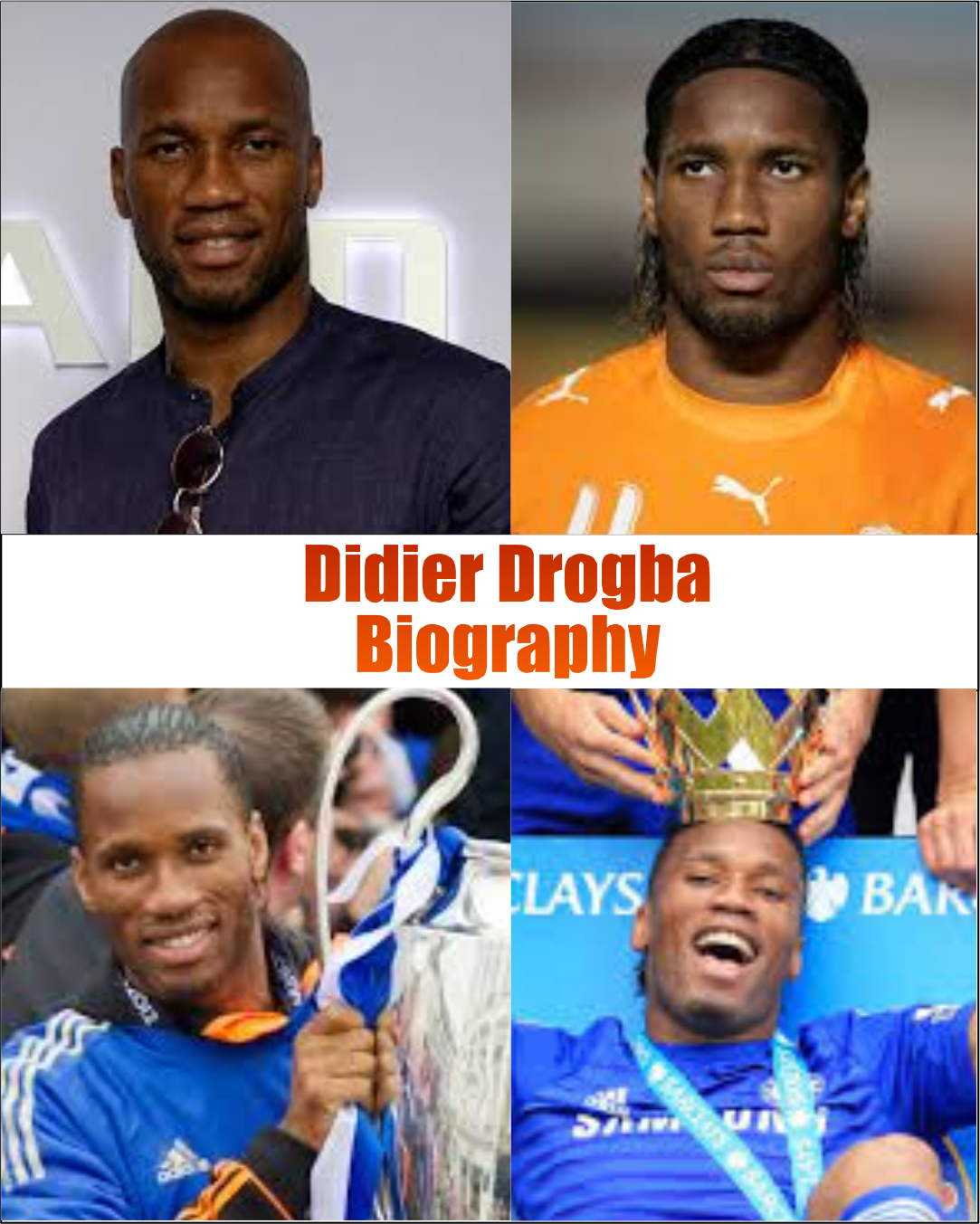
Didier Drogba Biography
The Didier Drogba Biography: He Scored in Every Final and Stopped a War in 59 Seconds
Didier Drogba scored 10 goals in 10 finals, equalised in the last minute of the Champions League final against Bayern Munich, scored the winning penalty, and is Chelsea’s greatest foreign goalscorer. But his greatest moment happened in a dressing room in Sudan in 2005 — when he dropped to his knees on live television and begged his countrymen to stop killing each other. They listened. Sport has never produced anything quite like it.
He Scored in Every Final. His Greatest Moment Was in a Dressing Room — When He Dropped to His Knees and Begged His Country to Stop Dying: The Story of Didier Drogba
There is a stat that belongs to Didier Drogba that no other footballer in history can claim.
Ten finals. Ten goals.
FA Cup finals. Champions League finals. League Cup finals. The specific, high-pressure, season-defining occasions when the biggest clubs in England and Europe needed their most expensive striker to perform — and when most strikers, even great ones, find reasons to be less than they usually are. Drogba was always more. The bigger the occasion, the larger he became.
The equaliser against Bayern Munich in the Champions League final in 2012 — headed in the 88th minute, when Chelsea were one minute from elimination, scored by a man who had been heading the ball all his career and chose the most important moment of his club’s history to head it into the top corner. The winning penalty in the same shootout. The goal against Liverpool in the 2010 FA Cup final at Wembley. The goal against Manchester United in the first FA Cup final at the new Wembley in 2007 — becoming the only player in history to score in both English domestic cup finals in the same season and win both.
Ten finals. Ten goals. Ultimate big-game player.
And then there is the other moment. The one that happened not in a stadium but in a dressing room in Sudan. The one that lasted fifty-nine seconds. The one that dropped a civil war.
That one is not in any football statistic. It belongs to a different category entirely — the category of things that sport occasionally produces that no other human institution could have produced in the same way, with the same authority, at the same moment.
Abidjan — A Boy Who Left at Five and Carried His Country Forever
Didier Yves Drogba Tébily was born on March 11, 1978, in Abidjan, Ivory Coast.
He was the eldest of five children. His father was an accountant, his mother a bank clerk — a middle-class household in a country whose economic foundations, built on cocoa and coffee exports, were more stable than most of West Africa’s but whose political foundations were already developing the cracks that would eventually produce a civil war.
When Didier was five, his parents sent him to live with his uncle Michel Goba in France. Michel was a professional footballer — he played for Dunkerque and later for clubs in Paris — and the decision to send a five-year-old from Abidjan to France to be raised by a footballer uncle was, in the specific logic of a Ivorian family that wanted more for its eldest son, a calculated bet on opportunity.
Didier Drogba Biography
| Information | Details |
|---|---|
| Full Name | Didier Yves Drogba Tébily |
| Date of Birth | March 11, 1978 |
| Age | 48 years (as of 2026) |
| Place of Birth | Abidjan, Ivory Coast |
| Nationality | Ivorian |
| Occupation | Former Professional Footballer |
| Playing Position | Striker |
| Known For | Legendary performances with Chelsea F.C. |
| International Career | Captain of Ivory Coast national team |
Le Mans, Guingamp, Marseille — The Late Bloomer Who Arrived All at Once
Drogba did not begin his professional career with the trajectory that his subsequent fame might suggest. He was twenty-one years old when he made his professional debut for Le Mans in the French second division — an age when many of his future Premier League contemporaries had already accumulated years of top-flight experience.
Le Mans. A small club in the French second tier. Not a glamorous start. Not a start that announced a future two-time African Footballer of the Year and Chelsea’s greatest foreign goalscorer.
He was patient. He developed. He scored 17 goals in 34 appearances for Guingamp in Ligue 1 — a record that made Marseille notice him. At Marseille, he scored 19 goals, helped the club reach the UEFA Cup final, and produced the performances that made José Mourinho pick up the phone.
In July 2004, Drogba moved to Premier League club Chelsea for £24 million — the most expensive Ivorian player of all time. Mourinho had just arrived at Chelsea. Roman Abramovich’s money was reshaping the club. And a twenty-six-year-old striker from Abidjan via Le Mans and Marseille was about to become one of the most feared forwards in European football.
See also: Dick Van Dyke Biography: The Extraordinary Life of One Hundred Years of Joy
The Record, the Rivalries, and What Big Games Brought Out of Him
The statistic that defines Drogba most precisely is the one about finals. Ten goals in ten finals is not luck. It is not coincidence. It is the measurable evidence of a psychological profile that is genuinely rare — a player whose competitive instincts intensified rather than contracted under maximum pressure.
His rivalry with Nemanja Vidic of Manchester United — the best centre-back in England during Drogba’s peak years — was the central contest of Premier League football from 2005 to 2012. Physical, combative, technically superior, each one testing the other’s absolute limits in every encounter. Vidic described Drogba as the most difficult opponent he ever faced. Drogba described the contests with United as the ones that brought out his best.
His rivalry with Arsenal — or more specifically with the idea of Arsenal, the passing, technical football that Arsène Wenger had built as the Premier League’s purest aesthetic project — was different and equally defining. He destroyed Arsenal in finals. He destroyed them in key league matches. The 2007 League Cup Final, the 2010 FA Cup Final, the occasions when Arsenal’s elegance met Drogba’s specificity and found itself overwhelmed.
Did you know?
He also became the first player to score in four FA Cup finals. Four separate FA Cup finals, spanning different Chelsea teams, different opponents, different eras of the competition. The consistency of his performance in the sport’s oldest knockout competition across nearly a decade is a record that may stand indefinitely — because the combination of longevity, peak performance, and repeated access to finals of that magnitude is almost impossible to replicate.
May 19, 2012 — The Minute That Belongs to Him Forever
The 2012 UEFA Champions League final in Munich is the most dramatic single match in Chelsea’s history — and one of the most dramatic in the history of the competition.
Chelsea had no business being there. They had finished sixth in the Premier League. Their manager had been sacked mid-season. They were playing in Bayern Munich’s home stadium, against the host club’s full-strength team, in front of a crowd that was predominantly Bavarian, on a night when every neutral predicted one outcome.
Thomas Müller scored for Bayern in the 83rd minute.
One minute remained. Chelsea were losing. Elimination was seven minutes of injury time away. And then — in the 88th minute — a corner was whipped in and Drogba met it at the far post and headed it, perfectly placed, into the net.
Ten finals. Ten goals. The record was complete.
October 8, 2005 — The Dressing Room in Sudan and the 59 Seconds That Mattered More
Three years before Munich, in a dressing room at the Al-Merrikh Stadium in Omdurman, Sudan, Didier Drogba did the most important thing of his life.
The context requires understanding. Under the presidency of Laurent Gbagbo, the rebels grew unrest of Gbagbo’s government, and his ethnic policies, and the economic crisis that was present in the country. Soon followed the rise of the Military Coup in Ivory Coast, which was led by the Patriotic Movement of Ivory Coast. The war that had been dividing the country since 2002 — with rebels controlling the north and the government controlling the south — had killed thousands and displaced hundreds of thousands more.
Drogba was playing for Chelsea. He was also the most famous person in Ivory Coast. Every television in the country showed his matches. Beer bottles were renamed after him. His face was the face that Ivory Coast’s divided citizens agreed on when they agreed on nothing else.
On the night of October 8, 2005, Ivory Coast needed Cameroon to fail to beat Egypt to qualify for the World Cup for the first time in their history. Ivory Coast beat Sudan 3-1. Then they waited. The Egypt-Cameroon game was level at 1-1 with minutes remaining. Cameroon were awarded a penalty.
Pierre Wome stepped forward. He hit the post. Ivory Coast had qualified for the World Cup.
The dressing room became something between a church and a carnival. Players sang and danced. The captain Cyril Domoraud invited a television camera inside. Drogba was handed a microphone.
Amidst this outpouring of euphoria, Didi was handed a microphone. “Men and women of the Ivory Coast…” he began earnestly, momentarily quelling the celebrations of his teammates.
What followed lasted fifty-nine seconds. The players raised their hands to their heads, their palms turned towards the camera, echoing Drogba’s plea: “Pardonnez!” – “Forgive! Forgive one another!” Over the outbreak of desperate cries, from Kolo Touré, Emmanuel Eboué to Arouna Koné, from Muslim and Christian, to Baolé and Bété, Drogba begged his fellow Ivorians: “Forgive! Forgive! Forgive! The one country in Africa with so many riches must not descend into war. Please lay down your weapons. Hold elections. All will be better.”
Rising to their feet, smiles once again spreading across their faces, the group resumed their jubilatory song to the same tune, however this time with revised lyrics: “We want to have fun, so stop firing your guns.”
The video clip would broadcast on every television in Ivory Coast. Weeks after the video surfaced, the rebels and Gbagbo’s government would negotiate, and eventually agree on a ceasefire.
Fifty-nine seconds. A ceasefire. Sport had never produced anything quite like it.
Bouaké — Taking the Nation Into the Enemy’s City
The speech was the beginning. What Drogba did the following year was, in its way, even more audacious.
The following year, while on a tour of the Ivory Coast’s rebel-controlled north, he declared that the national team’s match against Madagascar on June 3, 2007, would be staged in the rebel stronghold of Bouaké.
Bouaké was the symbolic centre of the rebellion — the second largest city in Ivory Coast, controlled by the forces that had been fighting the government for five years. A football match played in Bouaké — between the national team that represented the south and the Ivorian fans of the north — was an act of deliberate, choreographed reconciliation that no diplomat had managed to achieve.
It was a huge success at the time, with a 5-0 victory highlighted by Drogba’s last goal, which sparked nationwide celebrations.
He scored. Of course he scored. In Bouaké, in the rebel stronghold, surrounded by military personnel and by tens of thousands of people who had been on opposite sides of a war, Drogba scored the fifth goal and the stadium erupted in something that sounded, if you closed your eyes, like peace.
“I have won many trophies in my time, but nothing will ever top helping win the battle for peace in my country. I am so proud because today, in the Ivory Coast, we do not need a piece of silverware to celebrate. There are no words to express how I feel right now. This is love.”
The Foundation, the Hospital, and the Education He Never Stopped Believing In
Away from the pitch and the civil war, Drogba built quietly and consistently.
The Didier Drogba Foundation — established in 2007 — has funded hospitals, schools, and community development projects across Ivory Coast and Guinea. A hospital in Abidjan. Schools whose names the international press never printed. Community projects in communities that the football world did not follow closely enough to document.
“The money came after my education, after I became a man. It is education that can benefit the nation.”
He said it from the position of someone who had left his parents at five and learned the value of the thing he had been sent away to access. The school fees that his family had sacrificed to provide. The uncle who had housed him. The French education that had given him the language and the formation that made the Chelsea career possible. Every hospital bed and every classroom in his foundation carried the direct knowledge of what the absence of those things costs a child.
His net worth is estimated at approximately $90 million — accumulated through nine years at Chelsea, his subsequent clubs, endorsements, a media company, and investment in Phoenix Rising FC in the United Soccer League, where he became player and co-owner before retiring in 2018 at the age of forty. The foundation has spent a significant portion of those resources on the communities that produced him.
What He Changed About Sport
Before Didier Drogba, the template for a footballer’s social influence was largely commercial and charitable — foundation work, hospital visits, scholarship funds. Valuable, genuinely impactful, but operating within the understood boundaries of what a sportsperson’s influence was expected to do.
After Didier Drogba, there is a documented case of a footballer using the specific authority that elite sport generates — the authority of being the person that an entire nation watches, trusts, and recognises as their own across political and ethnic lines — to intervene directly in a political conflict and produce a measurable outcome.
The ceasefire was real. The Bouaké match was real. The civilians who did not die in the weeks after October 8, 2005 are real — unnamed, uncounted, but the specific consequence of a moment when a footballer understood that his platform was not simply a commercial asset but a civic responsibility.
Sport has always claimed to be more than a game. Drogba proved it in fifty-nine seconds in a dressing room in Sudan, on his knees, begging his countrymen to stop killing each other.
They listened.
That is the most important goal he ever scored. It is the one that was not on a pitch.
Frequently Asked Questions
1. Who is Didier Drogba?
Didier Drogba is a retired Ivorian footballer widely regarded as one of Africa’s greatest players, known for his strength, leadership, and clutch performances in big matches.
2. Which club made Didier Drogba famous?
He became a global star at Chelsea F.C., where he won multiple trophies and became one of the club’s all-time legends.
3. What is Didier Drogba’s most iconic moment?
His most iconic moment came in the 2012 UEFA Champions League final, where he scored a late equalizer and the winning penalty to secure Chelsea’s first-ever title.
4. Did Didier Drogba play for his country?
Yes — he captained the Ivory Coast national team and is the country’s all-time top scorer.
5. What is Didier Drogba known for off the pitch?
Beyond football, he is recognized for his peace-building efforts in Ivory Coast, where he played a role in helping to ease civil conflict, as well as his extensive charitable work.